- Free Consultation 24/7: (813) 727-7159 Tap Here To Call Us


From First DUI to Death Penalty



Can an Off-Duty Police Officer Arrest You in Florida? (2026)


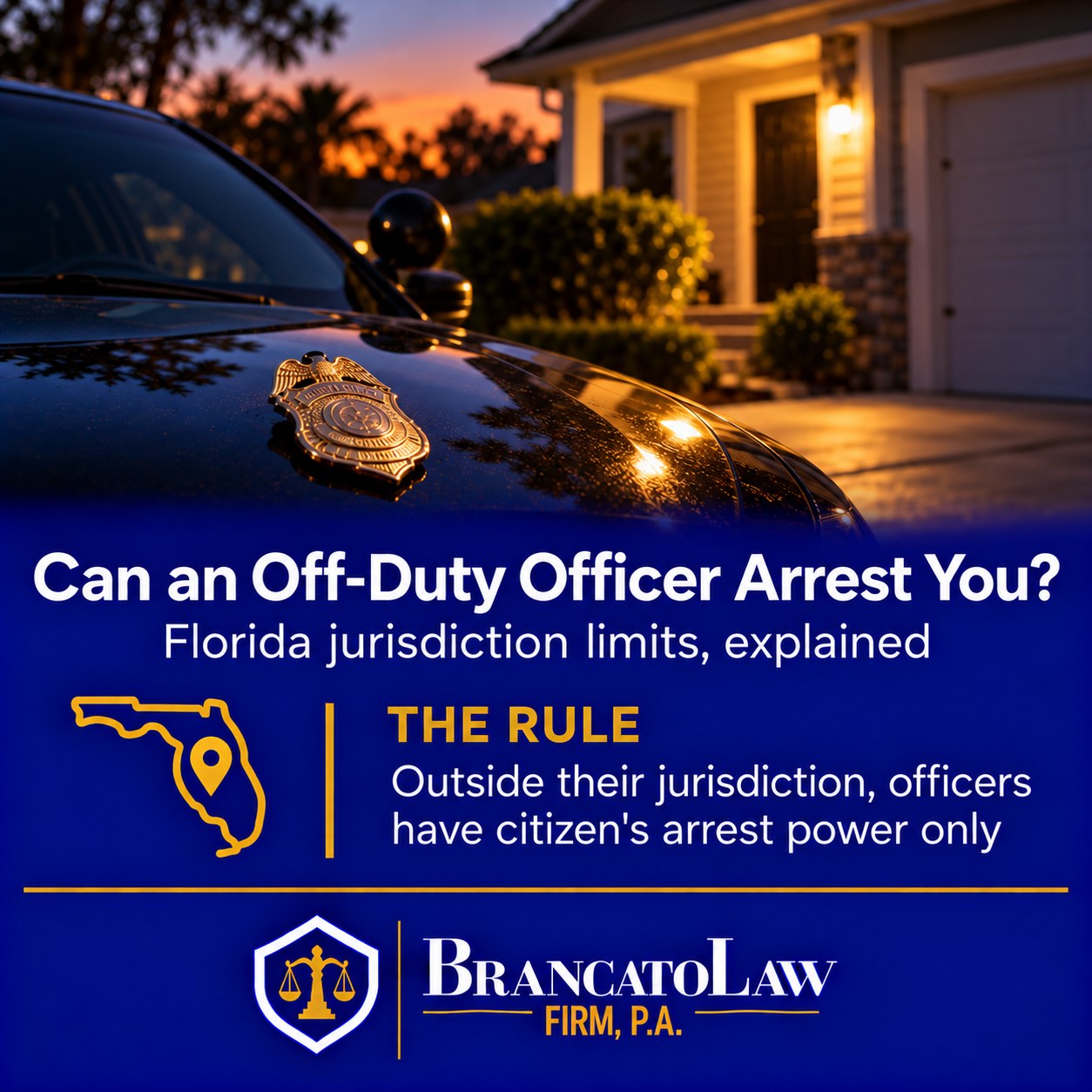
| Yes, inside their own jurisdiction. An off-duty Florida officer keeps full arrest power within the agency’s territory, including while working a paid security detail. Outside it, past the city limit for a police officer or the county line for a sheriff’s deputy, the officer can arrest only through fresh pursuit, a written mutual aid agreement, or a citizen’s arrest for a felony or breach of the peace committed in the officer’s presence. When none of those applies, the arrest is unlawful, and in July 2026 a Florida appeals court suppressed the evidence from an off-duty officer’s arrest and vacated the conviction. |
Before I founded The Brancato Law Firm, P.A., a Tampa criminal defense firm, I taught criminal arrest procedure to recruits as a police academy instructor, and jurisdiction was one of the first limits every class learned. I am Rocky Brancato, and across more than 25 years of Hillsborough County practice and over 150 jury trials, I have seen cases turn on one plain question: where was the officer standing when the arrest happened? Our attorneys ask that question about every arrest made by an off-duty or out-of-town officer, and when the answer falls on the wrong side of a city or county line, we move to suppress what the officer found.
Does an off-duty officer still have arrest powers in Florida?
Yes. Inside the officer’s own jurisdiction, being off duty does not shrink a Florida officer’s arrest authority. In Sinquefield v. State, 1 So. 3d 370 (Fla. 2d DCA 2009), a City of Palmetto officer tried to stop a man in another part of Manatee County. The Second District Court of Appeal, which hears appeals from Hillsborough, Pinellas, and Pasco counties, said the officer’s off-duty status did not change his arrest authority. The problem was location: he was sworn only inside Palmetto, so outside the city he acted as a private citizen.
Officers who work paid private details are also still police. In State v. Williams, 297 So. 2d 52 (Fla. 2d DCA 1974), a uniformed Tampa police sergeant hired by a dance hall to work during his off-duty hours seized a handgun from a patron’s handbag and arrested her. The court agreed with the trial judge that the sergeant “acted as an officer of the City of Tampa,” so the constitutional rules for police searches applied to him. The court still reversed the suppression order, because it found the patron had consented to the search.
That rule matters in Tampa because extra-duty work is an organized program here. The Tampa Police Department’s Extra Duty Office contracts with private citizens, businesses, and organizations for uniformed officers at special events, construction-site traffic control, and escorts, and it requires a background check for establishments with an alcohol license. As we have noted in our Ybor City disorderly conduct cases, Tampa Police also maintain a heavy presence along Seventh Avenue at closing time. A uniformed officer working a bar door inside Tampa city limits has full police power, and the same Fourth Amendment limits that govern a stop and frisk in Florida apply to that officer. Our attorneys test an extra-duty officer’s stop, search, and arrest exactly as we would an on-duty officer’s.
Where does a Tampa Bay officer’s arrest authority stop?
A Florida officer’s full arrest power stops at the edge of the agency’s territory. For a city police officer, that edge is the city limit. For a sheriff’s deputy, it is the county line. The Florida Supreme Court explained in State v. Repple, 428 So. 3d 59 (Fla. 2025) that, under Article VIII, section 2(c) of the Florida Constitution, a city’s police power outside its borders exists only where the Legislature has authorized it. Sheriffs work differently. Under section 30.15(5)(a), Florida Statutes, a sheriff’s jurisdiction runs throughout the entire county, including incorporated cities, concurrently with city police.
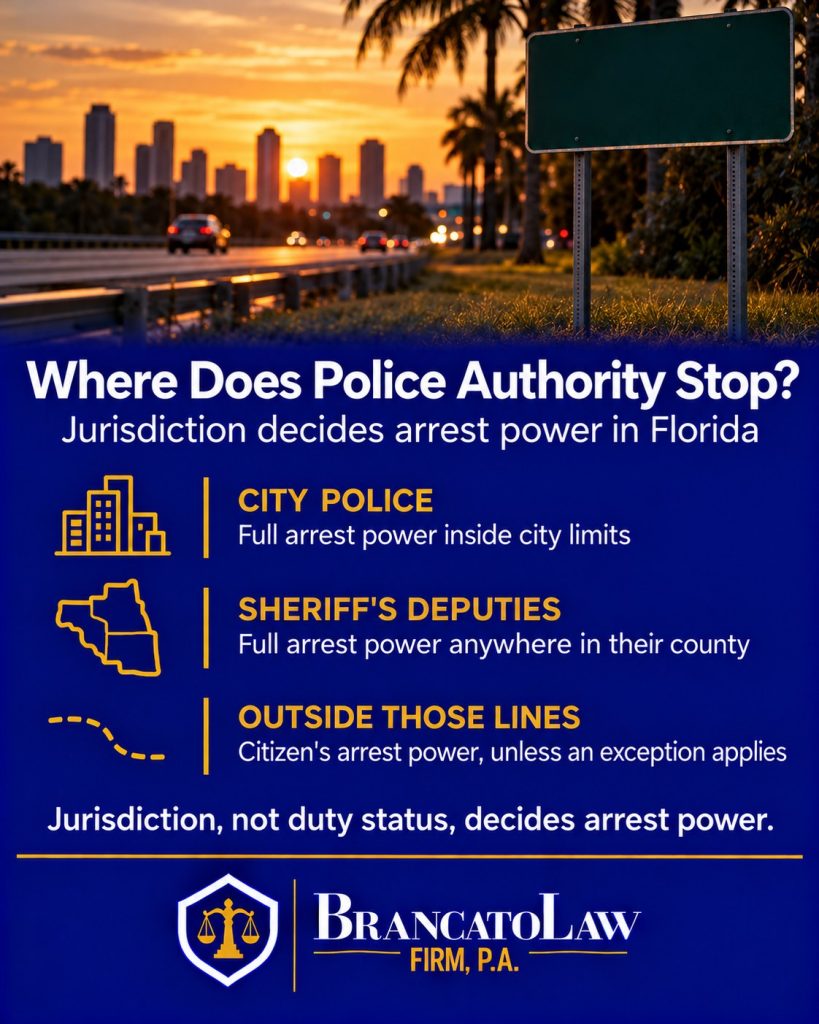
| Officer | Where the officer has full arrest power | Outside that area, the officer generally has |
|---|---|---|
| Tampa Police Department officer | Inside Tampa city limits | Citizen’s arrest power, unless fresh pursuit or a mutual aid agreement applies |
| Temple Terrace or Plant City police officer | Inside that city | Citizen’s arrest power, unless fresh pursuit or a mutual aid agreement applies |
| Hillsborough County Sheriff’s Office deputy | Anywhere in Hillsborough County, including Tampa, Temple Terrace, and Plant City | Outside Hillsborough County, citizen’s arrest power unless an exception applies |
| Pinellas or Pasco sheriff’s deputy | Anywhere in that deputy’s own county | Inside Hillsborough County, citizen’s arrest power unless an exception applies |
| St. Petersburg or Clearwater police officer | Inside that city | Citizen’s arrest power, unless fresh pursuit or a mutual aid agreement applies |
| School district police officer | The area set by the agency’s jurisdiction and its written agreements | Citizen’s arrest power, as in Jeffries below |
The patchwork is large. In 2025, Florida police departments employed 20,647 full-time officers, sheriffs’ offices employed 23,776 full-time law enforcement officers, and school and port agencies employed another 1,987, according to FDLE’s Criminal Justice Agency Profile report. Every one of those officers carries a badge with a boundary. A Tampa officer driving home through Brandon, which is unincorporated Hillsborough County, has left Tampa’s jurisdiction. A Hillsborough deputy standing in the same spot has not. A Pasco deputy who stops a driver on Dale Mabry Highway in Tampa is outside Pasco County, and the question becomes which exception, if any, gave that deputy authority. When a Hillsborough County case involves an out-of-town officer, our Hillsborough County criminal defense team starts by mapping exactly where each step of the stop, detention, and arrest took place.
What can an officer legally do outside their jurisdiction?
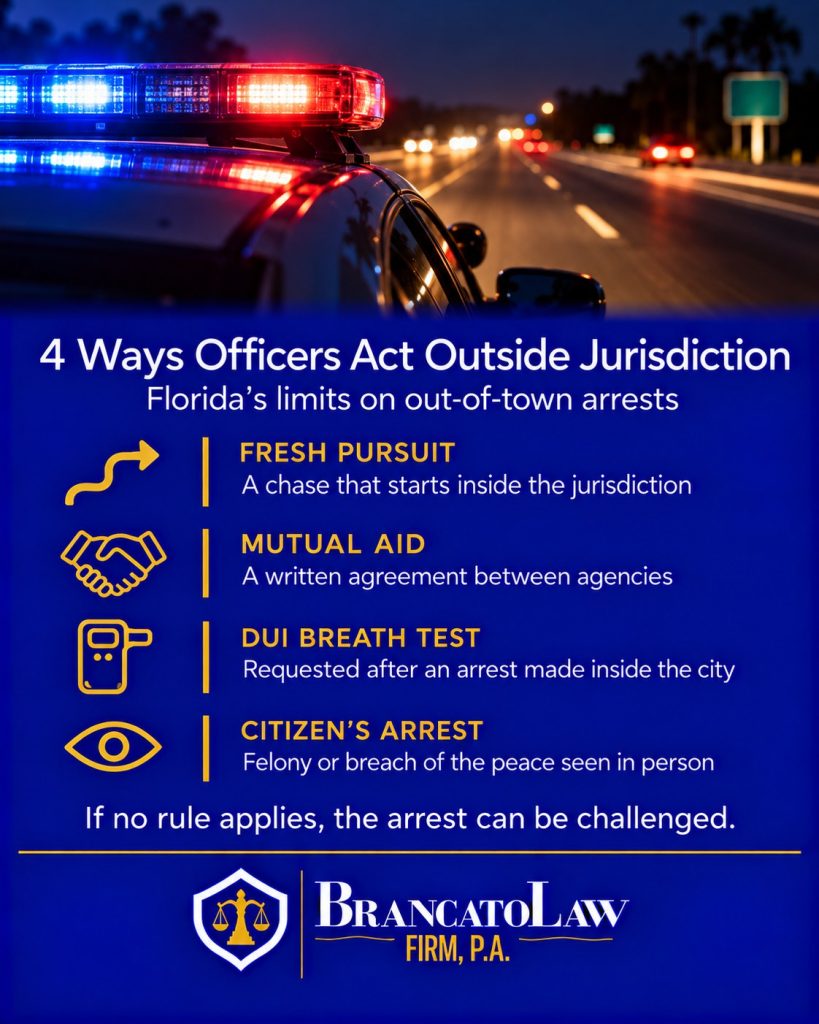
An officer outside their jurisdiction can arrest only through fresh pursuit, a mutual aid agreement, or a citizen’s arrest. A fourth, narrower rule covers DUI breath tests after an in-city arrest. If no rule applies, the officer acted without authority, and the defense can ask the court to suppress what followed.
| Rule | What it allows | Where it comes from |
|---|---|---|
| Fresh pursuit | Arrest outside the jurisdiction after a pursuit that began inside it, for a felony, misdemeanor, ordinance violation, or traffic offense | Section 901.25, Florida Statutes |
| Mutual aid agreement | The same powers the officer has at home, while rendering aid under a written agreement between agencies | Sections 23.1225 and 23.127, Florida Statutes |
| DUI breath test after an in-city arrest | Requesting a breath test at a facility outside the city, when the DUI arrest itself happened inside the city | State v. Repple (Fla. 2025) |
| Citizen’s arrest | Arrest for a felony or a breach of the peace committed in the officer’s presence | Florida common law, applied in Phoenix v. State (Fla. 1984) |
Fresh pursuit. The pursuit has to start inside the officer’s territory. When a fresh pursuit arrest happens outside the officer’s county, the officer must immediately notify the officer in charge of that jurisdiction, and both must bring the arrested person before a trial court judge of the county where the arrest was made without unnecessary delay.
Mutual aid agreements. Florida’s Mutual Aid Act allows written voluntary cooperation agreements for routine work across jurisdictional lines and written requested operational assistance agreements for emergencies. Each agreement must spell out the assistance, the agency in command, and a time limit, and a copy must be filed with the Florida Department of Law Enforcement within 14 days after it is signed. The writing requirement can be waived for up to 90 days only after a Governor-declared state of emergency. Because the agreement is a document, our attorneys demand it in discovery and read its terms against what the officer actually did.
The DUI breath test rule. Repple involved a Maitland officer who arrested a driver for DUI inside Maitland and then requested a breath test at a sheriff-run facility outside the city. The Florida Supreme Court held that Florida’s implied consent law authorized that request, quashed the Sixth District decision that had upheld suppression, and approved the result in State v. Torres, 350 So. 3d 421 (Fla. 5th DCA 2022), a Winter Park case with the same pattern. The Court expressly declined to adopt a broader “continuing investigation” exception. That matters locally: as we have explained in our post on refusing a breathalyzer in Florida, breath testing in the 13th Judicial Circuit runs through the sheriff’s central breath testing facility. Under Repple, a city officer’s request there is authorized when the DUI arrest itself happened inside the officer’s city. An arrest made outside the city needs its own lawful basis first.
What counts as a lawful citizen’s arrest in Florida?
A private person in Florida may arrest someone who commits a felony or a breach of the peace in that person’s presence, and an officer outside their jurisdiction has that same power and no more. In Phoenix v. State, 455 So. 2d 1024 (Fla. 1984), the Martin County Sheriff and a deputy stopped a truck in St. Lucie County after an air and ground surveillance operation and arrested the occupants. The Florida Supreme Court upheld the arrests as citizen’s arrests, reasoning that officers outside their jurisdiction should not be any less capable of making a felony arrest than a private citizen, nor have any greater power.
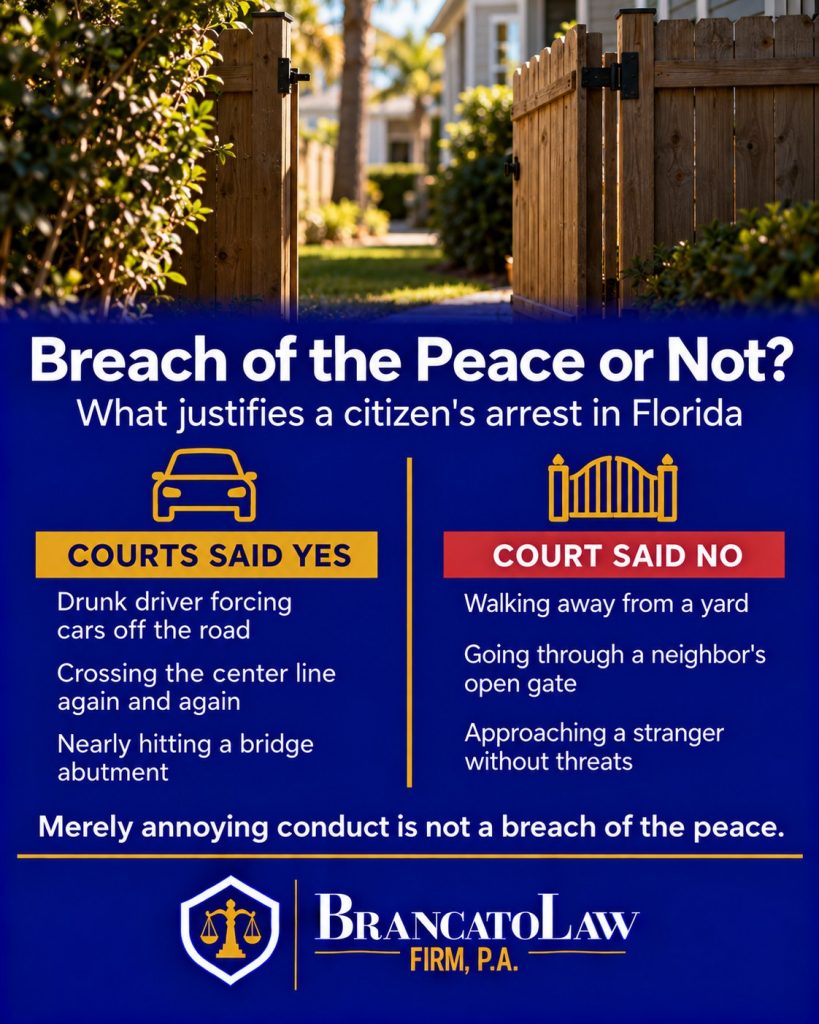
Drunk driving is the classic out-of-jurisdiction breach of the peace, which is why so many of these cases are DUI cases. In Edwards v. State, 462 So. 2d 581 (Fla. 4th DCA 1985), an off-duty Okeechobee officer, not in uniform and showing no badge, followed a pickup truck outside the city limits for about five miles. The driver crossed the center line three to seven times, forced oncoming cars onto the shoulder, and nearly hit a bridge abutment. The court held that this driving was a breach of the peace and upheld the citizen’s arrest. If you were stopped for DUI by an officer from another city or county, our Tampa DUI lawyer page explains how our attorneys build that challenge.
Two more limits narrow the doctrine. First, for a misdemeanor, there must be an actual arrest, meaning the person is deprived of the freedom to leave. In Steiner v. State, 690 So. 2d 706 (Fla. 4th DCA 1997), the State tried to support a DUI arrest with a security guard’s account of a driver whose car later caught fire. The guard never detained the driver, so there was no citizen’s arrest, and the officer could not rely on the guard’s account for a misdemeanor the officer did not see. The Fourth District restored the county court’s order suppressing the evidence. Second, “breach of the peace” is read narrowly. The definition comes from section 877.03, Florida Statutes, the same statute that defines disorderly conduct, and conduct that creates no more than annoyance does not qualify.
Legal scholars have criticized how vague the doctrine is. In Vilifying the Vigilante: A Narrowed Scope of Citizen’s Arrest, 25 Cornell J.L. & Pub. Pol’y 557 (2016), Professor Ira P. Robbins argues that citizen’s arrest rules are unclear on the level of suspicion required, how long a person may be held, and how much force is allowed. He recommends limiting the power to a few groups, including out-of-jurisdiction police. Our attorneys use those narrow edges to test every off-duty arrest.
What happened in Jeffries v. State?
In Jeffries v. State, No. 5D2024-1721 (Fla. 5th DCA July 31, 2026), the Fifth District threw out evidence from an off-duty officer’s citizen’s arrest because the man he arrested had not committed a felony or a breach of the peace in his presence. The officer worked for the Clay County School District police but lived in Putnam County, outside his jurisdiction. His daughter told him someone had been trying to break into his patrol car. He went outside, saw Christien Jeffries already leaving his property, identified himself as law enforcement, and ordered him to stop. Jeffries kept walking and went through an open gate into a neighbor’s backyard, and the officer did not follow him in.
The officer then drove his personal truck to a nearby apartment complex, found Jeffries, again identified himself as law enforcement, and ordered him to stop. He testified that he did not identify himself as a private citizen because most people would not stop for one. Jeffries stopped, turned, and tossed an object that turned out to be a pill bottle. The officer restrained him, and responding officers found a stun gun on him. Jeffries was later convicted of possession of an electric weapon or device by a convicted felon.
The State conceded that the officer never saw a felony, so the case came down to breach of the peace. The court rejected each piece of the State’s argument. The officer never saw anyone touch his patrol car, his daughter’s report was not his own observation, and the smudges he photographed were found only after the arrest. Leaving a yard when confronted, walking through a neighbor’s open gate, and appearing intoxicated without endangering anyone were not breaches of the peace. Approaching an elderly woman at the complex in the middle of the day, without threatening her or even raising his voice, was not one either. The court distinguished drunk-driving cases like Edwards because they involved conduct that “clearly and significantly endangers the public.” It reversed the denial of the motion to suppress and vacated the conviction for possession of an electric weapon by a convicted felon.
The court also held that the tossed pill bottle could not justify the search that turned up the stun gun, because Jeffries had already stopped in compliance with the order when he threw it. We cover that abandonment issue in our post on whether police can use drugs you threw down in Florida.
Jeffries is a Fifth District decision, but it reaches Tampa Bay courtrooms. Under Pardo v. State, 596 So. 2d 665 (Fla. 1992), a district court decision binds every Florida trial court when no other district has ruled differently, so Hillsborough, Pinellas, and Pasco judges must follow it unless the Second District decides otherwise. Our post on disorderly conduct in Florida covers how the same narrow breach-of-the-peace definition plays out in Ybor City arrests.
What is the “color of office” rule?
The color of office rule bars an officer outside their jurisdiction from using police authority to see unlawful activity or gain evidence that a private citizen could not get. Phoenix set the line. Using a police car and announcing “police” at the moment of arrest does not, by itself, ruin a citizen’s arrest, as long as the evidence for the arrest was gathered before the officer asserted any official authority.
The rule bites when an officer uses the badge to get something. In State v. Sills, 852 So. 2d 390 (Fla. 4th DCA 2003), Coconut Creek officers arrested a man for traffic offenses inside their city, then drove him in handcuffs to his apartment in a neighboring city. There they had him sign a Coconut Creek police waiver of a search warrant and talked about him becoming an informant. The Fourth District affirmed suppression of the pills they found, because the officers obtained his consent through the power of their office, including the prospect of leniency that no private citizen could offer.
In Jeffries, the officer repeatedly announced himself as law enforcement, but the court decided the case on breach of the peace and did not reach a color of office theory. Our attorneys raise both arguments when the facts support them, because they attack different parts of the State’s case.
Is evidence thrown out if an off-duty arrest was unlawful?
Often, yes. When an out-of-jurisdiction arrest has no lawful basis, the usual remedy is a motion to suppress, which asks the judge to exclude the evidence the arrest produced. Our post on the motion to suppress evidence in Tampa explains that process. Suppression is not automatic, though, as the table shows.
| Case | What the officer did | Result |
|---|---|---|
| Jeffries (Fla. 5th DCA 2026) | Off-duty school district officer arrested a man for conduct that was not a breach of the peace | Evidence suppressed; conviction vacated |
| Sills (Fla. 4th DCA 2003) | City officers used a police waiver and leniency talk outside their city to get consent to search | Evidence suppressed |
| Steiner (Fla. 4th DCA 1997) | No one actually arrested the driver before police relied on a citizen’s arrest theory | Suppression restored |
| Edwards (Fla. 4th DCA 1985) | Off-duty officer detained a driver whose dangerous driving he watched for miles | Arrest upheld |
| Phoenix (Fla. 1984) | Sheriff and deputy arrested truck occupants in a neighboring county after surveillance | Arrests upheld as citizen’s arrests |
| Repple (Fla. 2025) | City officer requested a breath test outside the city after an in-city DUI arrest | Breath test upheld |
One warning sign for the future: in Repple, Justice Grosshans wrote separately that suppression should not be the remedy when an officer oversteps territorial limits, because those limits protect neighboring governments rather than the accused. No other justice joined that view, and the majority did not adopt it. Prosecutors will cite it anyway, which is one more reason our attorneys pair the jurisdiction argument with Fourth Amendment and citizen’s arrest arguments.
Is it resisting arrest to walk away from an off-duty officer outside their jurisdiction?
Not under the resisting without violence statute, if the officer had no authority there. Section 843.02, Florida Statutes requires proof that the officer was engaged in the lawful execution of a legal duty. In Sinquefield, the Second District held that a Palmetto officer acting outside his city was only a private citizen, refused to read the statute as creating a crime of resisting a citizen’s arrest, and reversed the conviction. Our post on resisting an officer without violence in Florida covers the other elements of that charge.
That defense belongs in a courtroom. At the scene, you cannot tell whether an officer is in fresh pursuit, working under a mutual aid agreement, or standing one block inside the city line, and using force can bring new charges that do not depend on jurisdiction. Comply, stay quiet, and let our attorneys contest the officer’s authority later with the records in hand.
What should you do after an arrest by an off-duty or out-of-town officer?
Act within days, because the strongest evidence of where and how the arrest happened disappears fastest.
- Write down the details while they are fresh. Note the exact location, whether the officer was in uniform or plain clothes, what agency the officer named, what vehicle the officer drove, and the exact words used to make you stop.
- Identify every camera. Bars, apartment complexes, gas stations, and doorbell cameras can record over old footage within days. Our attorneys send preservation requests right away.
- Request the DUI license hearing on time. After a DUI arrest, section 322.2615, Florida Statutes gives you 10 days from the notice of suspension to request a formal or informal review hearing.
- Use the window before charges are filed. The State Attorney’s Office decides what to file after the arrest. Our representation before charges are filed can put the jurisdiction problem in front of the prosecutor before a charging decision is made.
- File the motion to suppress before trial. Florida’s rules generally require a motion to suppress to be filed before trial, and the hearing depends on dispatch records, body-worn camera video, the agency’s jurisdiction, and any mutual aid agreement on file with FDLE.
Frequently asked questions
Can an off-duty officer working security at a Tampa bar arrest me?
Yes, if the bar is inside the officer’s jurisdiction, because an off-duty officer working a private detail still acts as a police officer, as the court held about a Tampa sergeant in State v. Williams. The Brancato Law Firm reviews extra-duty arrests the same way it reviews on-duty arrests, starting with whether the officer had a lawful reason to stop you. The same review applies when a detail officer outside a bar makes a DUI stop.
Can a Hillsborough County deputy arrest me inside Tampa city limits?
Yes. Under section 30.15(5)(a), Florida Statutes, a sheriff’s jurisdiction runs throughout the entire county, including cities like Tampa, alongside city police. Our attorneys at The Brancato Law Firm focus those cases on whether the deputy had a lawful basis for the stop, since jurisdiction will not be in dispute.
Can a Pinellas or Pasco officer arrest me for DUI in Hillsborough County?
Only through fresh pursuit that began in the officer’s own county, a written mutual aid agreement that covers the activity, or a valid citizen’s arrest for a felony or breach of the peace the officer personally saw. The Brancato Law Firm demands the pursuit records and any mutual aid agreement in these cases and holds the State to proving one of those grounds. If an out-of-county officer arrested you, our DUI defense team can review whether any of them applies.
What counts as a breach of the peace for a citizen’s arrest in Florida?
Conduct that clearly disturbs or endangers others, such as fighting or dangerous drunk driving, can qualify, while conduct that is merely annoying does not. Our attorneys at The Brancato Law Firm compare the officer’s own report against the narrow definition courts apply under Jeffries and section 877.03, Florida Statutes.
Can charges be dropped if the arresting officer was outside their jurisdiction?
Yes, charges can be dropped or reduced when the arrest was unlawful and the key evidence is suppressed, although the outcome depends on whether the State can prove fresh pursuit, a mutual aid agreement, or a valid citizen’s arrest. The Brancato Law Firm raises the jurisdiction problem early, often before the prosecutor makes a filing decision, through our pre-file advocacy.
Talk to a Tampa defense lawyer about an off-duty arrest
Ten days is all you have to challenge a DUI license suspension, and the video that shows where an off-duty or out-of-town officer stopped you can be recorded over even sooner. The Brancato Law Firm, P.A., founded by Tampa Criminal Defense Attorney Rocky Brancato, will start by pinning down the officer’s agency, jurisdiction, and legal basis for the arrest, then preserve the footage and records that prove it. Call (813) 727-7159 today to discuss your case. For more about our defense strategies, visit our Tampa DUI defense page.
The Brancato Law Firm, P.A.
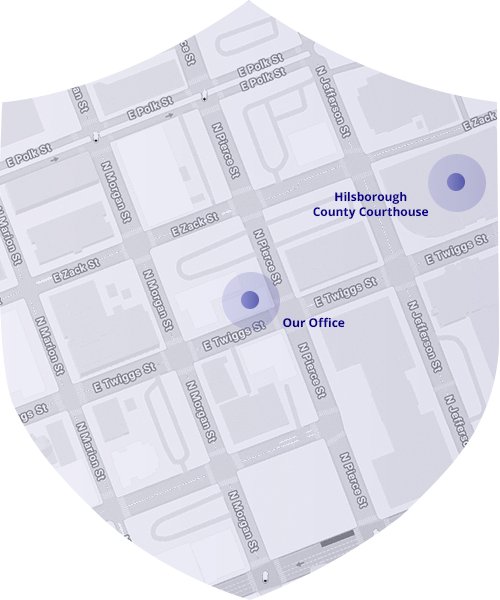
620 E. Twiggs Street, Suite 205, Tampa, FL 33602
(813) 727-7159
Serving Hillsborough, Pinellas, and Pasco Counties
The Brancato Law Firm, P.A. is a Tampa-based criminal defense practice. We are not affiliated with any other Brancato-named law firms.
Visit Us
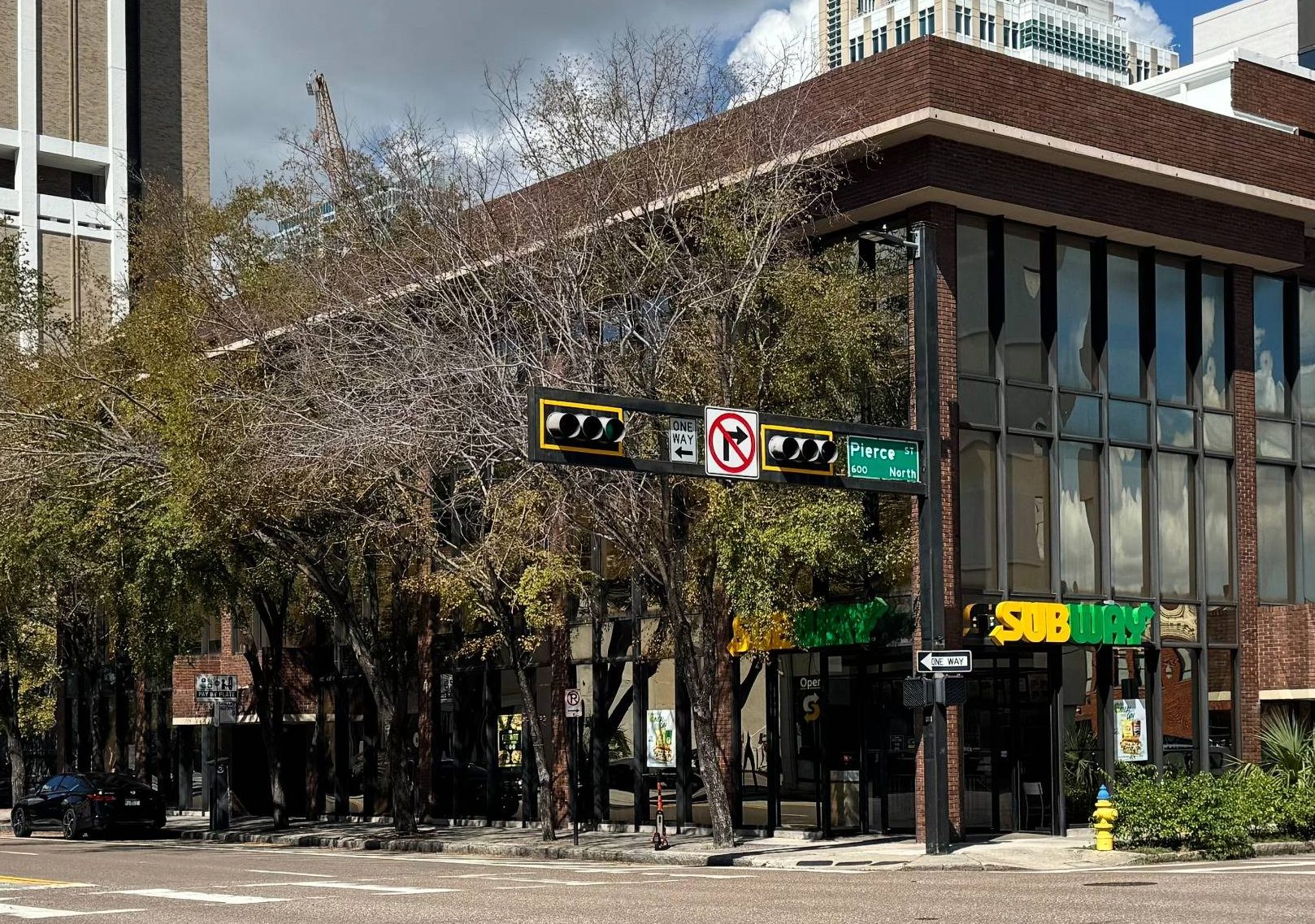
Tampa, FL 33602
Contact Us Now
Free Legal Consultation (813) 727-7159