

From First DUI to Death Penalty



Can You Get a DUI in a Tesla on Autopilot in Florida? (2026)


You can be charged. Whether you can be convicted is a jury question. Florida’s DUI law requires proof that you were “driving or in actual physical control of a vehicle,” and when a Tesla was steering, braking, and navigating on its own, that element is open to challenge. Florida’s self-driving car statute says an engaged automated driving system “shall be deemed to be the operator,” and no Florida appellate court has decided how that rule applies to a DUI charge. Tesla’s own data can show the jury who, or what, was actually driving.
If you were arrested for DUI while your Tesla was driving itself, the officer made a legal assumption: that the person in the driver’s seat was in control. Florida law requires the State to prove that assumption to a jury beyond a reasonable doubt. I’m Rocky Brancato, founder of The Brancato Law Firm, P.A., a Tampa criminal defense firm. I’m a former police academy instructor who taught criminal procedure and courtroom testimony, a member of the National College for DUI Defense, and I have more than 25 years in Hillsborough County courtrooms. When a Tesla is involved, our attorneys lock down the car’s data and build every available argument on control, from the facts at the scene to the text of Florida’s autonomous vehicle law.
Can you get a DUI if your Tesla is on Autopilot or FSD in Florida?
You can be arrested and charged, but the State still has to prove control, and a jury decides that question. Under section 316.193(1), Florida Statutes, DUI requires proof that the person was “driving or in actual physical control of a vehicle within this state” while impaired or at a breath or blood alcohol level of 0.08 or higher. When the car’s software was performing the driving, “driving” is contested and the case turns on actual physical control.
The standard jury instruction says the defendant “must be physically in or on the vehicle and have the capability to operate the vehicle, regardless of whether [he][she] is actually operating the vehicle at the time.” In State v. Fitzgerald, 63 So. 3d 75 (Fla. 2d DCA 2011), a woman was found in the driver’s seat of a car stopped in a Largo intersection with the engine off, the lights on, and the keys in her hand. The Second District, which hears appeals from Hillsborough, Pinellas, and Pasco Counties, read “capability” to mean “practical ability.” It held only that the State had shown enough to survive a motion to dismiss, and sent the case back for trial. It did not decide she was guilty. That is the point: whether a person had control is decided on the facts, at trial, by the jury.
The State will lean on Griffin v. State, 457 So. 2d 1070 (Fla. 2d DCA 1984), which said the actual physical control rule exists “to enable the drunken driver to be apprehended before he strikes.” Griffin was decided in 1984 about a car with a key, a brake pedal, and a human doing all the driving. It did not address a vehicle that the Legislature has since said can have a software “operator.” Our Tampa DUI lawyer page explains how our attorneys challenge each element the State must prove.
Does Florida’s self-driving car law help a Tesla driver?
It gives the defense a real statutory argument that Florida’s appellate courts have not yet resolved. Under section 316.85(3)(a), Florida Statutes, “the automated driving system, when engaged, shall be deemed to be the operator of an autonomous vehicle, regardless of whether a person is physically present in the vehicle.” That rule applies “for purposes of this chapter,” and the DUI statute, section 316.193, is in the same chapter.
The defense reads the definitions closely. Under section 316.003(3), Florida Statutes:
- An “automated driving system” is hardware and software “collectively capable of performing the entire dynamic driving task of an autonomous vehicle on a sustained basis, regardless of whether it is limited to a specific operational design domain.”
- An “autonomous vehicle” is “any vehicle equipped with an automated driving system.”
- A “fully autonomous vehicle” is one “designed to function without a human operator.”
The deemed-operator rule in section 316.85(3)(a) covers an “autonomous vehicle,” not only a “fully autonomous vehicle.” The words “without a human operator” appear only in the definition of a fully autonomous vehicle, and a system can qualify as an automated driving system even if it is limited to certain roads or conditions. When a Tesla is steering, braking, changing lanes, and navigating mile after mile with no input from the person in the seat, the defense can argue that the system was performing the entire driving task on a sustained basis and was, by statute, the operator.
Florida’s rule of lenity backs this up. Under section 775.021(1), Florida Statutes, criminal statutes “shall be strictly construed; when the language is susceptible of differing constructions, it shall be construed most favorably to the accused.” If the interaction between section 316.85 and the DUI statute is unclear, that doubt belongs to the defendant.
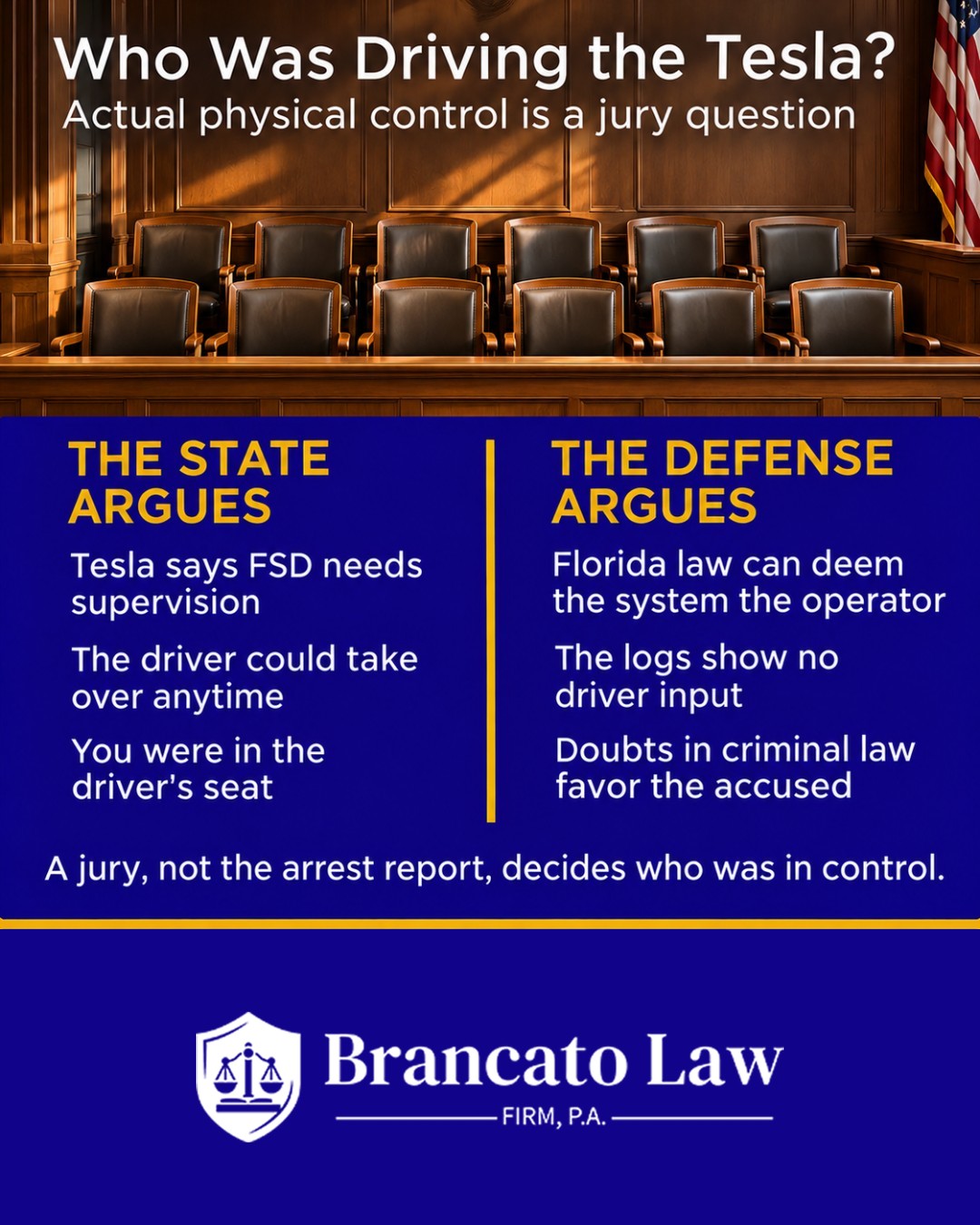
The State has its answers, and our attorneys prepare for them. Prosecutors will point to Tesla’s Full Self-Driving (Supervised) support page, which says the features “require active driver supervision and do not make the vehicle autonomous,” and to the Model Y owner’s manual, which calls for “a fully attentive driver who is ready to take immediate action at all times.” They will argue that section 316.85 applies only “unless the context otherwise requires,” and that the DUI statute asks about “actual physical control,” not who the “operator” was. Commentators have taken the State’s side. A note in the Alabama Law Review argued that “Semiautonomous vehicles are, by definition, not fully autonomous and thus rely on human supervision and backup.” Katelyn Carson, My Car Is My Designated Driver: Examining Autonomous Vehicle Technology & Alabama’s DUI Laws, 73 Ala. L. Rev. 437 (2021). That note analyzed Alabama’s statute, not Florida’s, and Florida’s text is different. A manufacturer’s marketing disclaimer is not a statute. What a jury hears about the system’s actual capability, and what the car’s logs show it did, are the facts that decide this question.
We have not found a published Florida appellate decision applying section 316.85 to a DUI charge. That means every one of these arguments is open, and every one is worth making.
| Scenario | The State’s argument | The defense argument |
|---|---|---|
| Autopilot (Traffic-Aware Cruise Control, Autosteer) engaged | Driver assistance only; the person was supervising and had capability | The system was steering and controlling speed; the data shows no driver input; the State must prove control beyond a reasonable doubt |
| Full Self-Driving (Supervised) engaged | Tesla says it “requires active driver supervision” | The system performed the full driving task on a sustained basis; section 316.85(3)(a) deems it the operator; lenity resolves doubt for the accused |
| Car moved by Summon or parked with no one in the driver’s seat | The person directed the car from a phone | No one was “physically in or on the vehicle” in the driver’s position; the jury instruction requires physical presence |
| True driverless vehicle with no human operator (section 316.003(3)(c)) | Rarely charged | Section 316.85 expressly deems the system the operator |
What will the jury look at to decide actual physical control in a Tesla?
The jury weighs the facts at the scene and what the car recorded, and each fact cuts both ways. A Tesla has no traditional ignition key. It unlocks and becomes drivable with a phone key or key card, so the usual “keys in the ignition” evidence becomes a question about where the phone or card was.
- Seat position. The driver’s seat helps the State. A passenger or rear seat helps the defense, and the car’s logs may show where the occupant was.
- Key access. Was the phone key in hand, in a pocket, or somewhere the person could not reach?
- Vehicle state. Was the car in drive or park, in a travel lane or a parking space, and how did it get there?
- System status. Was Autopilot or FSD engaged, for how long, and did the car log any steering, braking, or accelerator input from the person?
- Statements. Officers often record “the car was driving” as an admission. Our attorneys present it to the jury as the truth about who was performing the driving.
Parked-car cases follow the same logic. Our post on whether you can get a DUI for sleeping in your car in Florida shows how juries weigh seat position, keys, and location.
Can Tesla’s data help or hurt a DUI case?
It can do both, which is why our attorneys secure it early and review it before anything is disclosed. A Tesla records far more than a typical car, but the records live in different places and some disappear quickly.
| Data source | What it can show | How our attorneys get it |
|---|---|---|
| Event Data Recorder (EDR) in the restraint control module | Pre-crash speed, accelerator and brake use, seat belt status, governed by 49 C.F.R. Part 563 | Download with Tesla’s published EDR retrieval tool, often through an independent reconstruction expert |
| Dashcam and Sentry Mode clips on the car’s USB drive | Video of the stop, the driving pattern, and the officer’s approach | Immediate preservation demand; the drive itself if the car is impounded |
| Autopilot and vehicle logs sent to Tesla | Whether Autopilot or FSD was engaged, driver inputs, alerts | Preservation letter and subpoena to Tesla |
| Phone app and account records | Location history and which phone key was active | Subpoena or the client’s own account, with consent |
Federal regulators have warned that Tesla’s remote data is incomplete. In closing its Autopilot investigation in April 2024, the National Highway Traffic Safety Administration found that “Tesla is not aware of every crash involving Autopilot even for severe crashes because of gaps in telematic reporting,” and that Tesla largely receives crash data only when airbags or other pyrotechnics deploy. NHTSA noted that only 18 percent of police-reported crashes include airbag deployments. For most DUI stops and minor crashes, the data that matters may sit only in the car itself.
Data can also exist when a company says it does not. In Benavides v. Tesla, Inc., No. 1:21-cv-21940 (S.D. Fla. Feb. 19, 2026), a wrongful death case over a 2019 Autopilot crash in Key Largo, a Miami federal jury found Tesla 33 percent responsible. The court entered a $242.57 million judgment and later denied Tesla’s motion for a new trial. Before trial, plaintiffs’ forensic expert recovered crash data that Tesla had said it did not have. The lesson for a DUI defense: ask for everything, in writing, right away.
How do our attorneys use Tesla data to defend a DUI charge?
We use it to attack the stop, the officer’s driving observations, and the control element. Our process:
- Send preservation letters within days to Tesla, the towing company, and the arresting agency, covering the EDR, the USB drive, and the vehicle logs.
- Pull the dashcam footage before the car is driven again or the clips are overwritten.
- Compare the data to the arrest report. If the officer reports weaving but the logs show Autosteer was holding the lane, the stop and the officer’s credibility are both in play. Our post on failure to maintain a single lane in Florida DUI stops explains why weaving alone often does not justify a stop under Second District case law.
- Build the control case for the jury. Logs showing miles of system driving with no human input are evidence that the software, not the person, was performing the driving task.
- Bring in experts on reconstruction and on how the driver-assistance system works, so the jury understands what the car was doing on its own.
Data is not always helpful. A log showing ignored hands-on-wheel alerts can support the State’s impairment theory. That is why our attorneys review everything first and decide what to use, with the defense controlling its disclosures through discovery under the Florida criminal case process.
What do the numbers say about driver-assist systems and impaired driving?
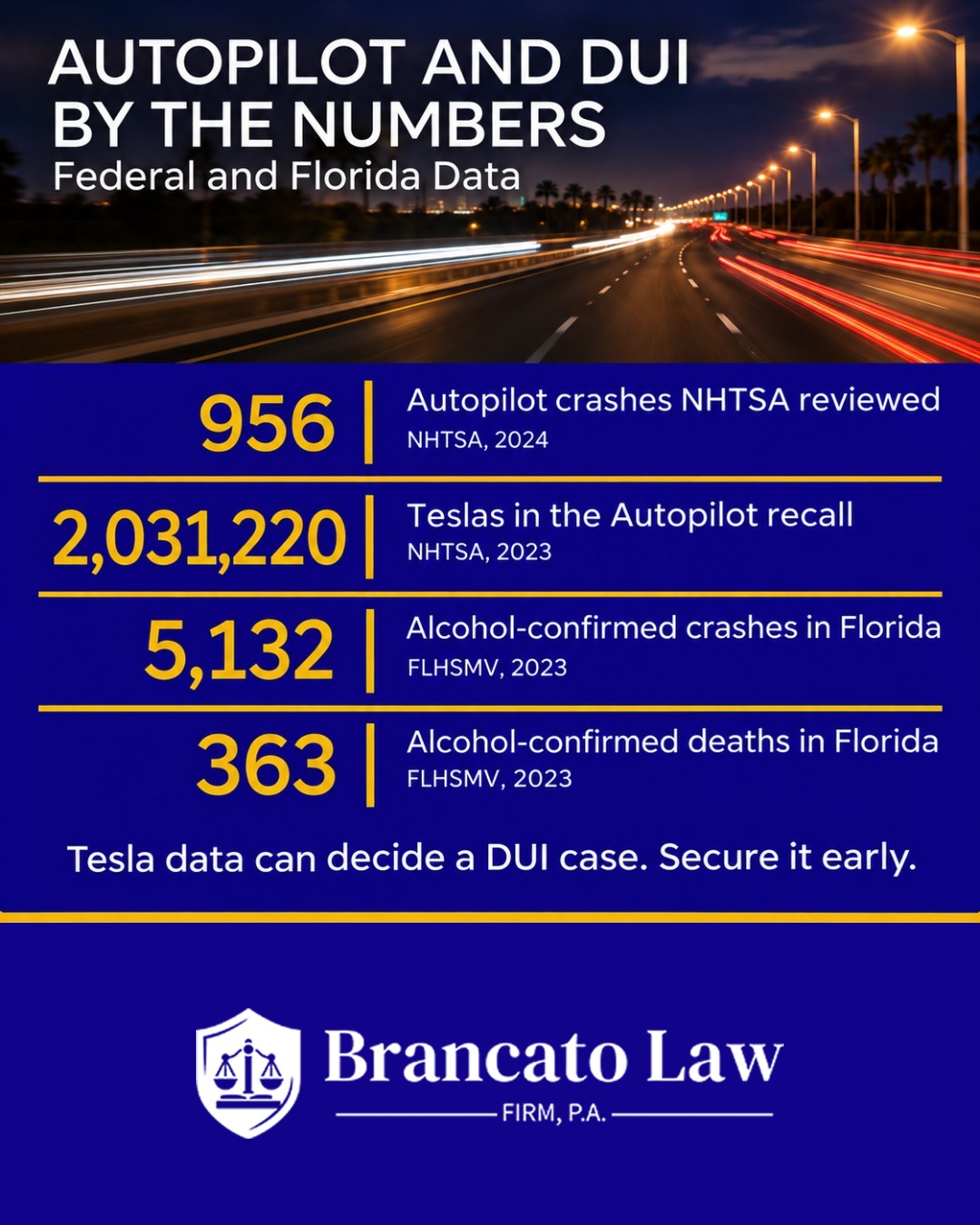
The numbers show that driver-assist systems are widely used and frequently misused, and that impaired driving remains a leading cause of Florida crashes. In April 2024, NHTSA closed an investigation that reviewed 956 crashes where Autopilot was alleged to be in use and identified at least 13 fatal crashes in which “foreseeable driver misuse of the system played an apparent role.” That investigation led to Tesla’s Recall 23V-838 covering 2,031,220 vehicles, more than 2 million Teslas on the road with Autosteer.
In March 2024, the Insurance Institute for Highway Safety rated 14 partial automation systems on their safeguards against misuse. Only one earned an acceptable rating, and Tesla’s Autopilot and FSD were rated poor.
Florida’s own data shows why police are watching. The Florida Department of Highway Safety and Motor Vehicles recorded 5,132 alcohol-confirmed crashes and 363 alcohol-confirmed deaths statewide in 2023. Locally, the Hillsborough County Sheriff’s Office reported 39 DUI arrests during its four-day “Operation Turkey Day” over Thanksgiving 2024.
What happens after a Tesla DUI arrest in Hillsborough County?
The process is the same as any DUI arrest, and the clock starts right away. Sheriff’s Office and Tampa Police arrestees are taken to Central Breath Testing, the Sheriff’s Office breath-testing site, where the breath test is requested. You then have 10 days to challenge the administrative license suspension or apply for a hardship license. Our post on how to protect your driver’s license after a DUI arrest in Florida covers both choices.
Many first-time DUI cases in Hillsborough County can qualify for the RIDR diversion program, and in our experience a breath-test refusal alone does not disqualify someone. A strong control defense changes the negotiation: a prosecutor facing an untested statutory question and a jury question on control has real reason to offer a better resolution.
What if the Tesla crashed and someone was hurt?
A crash with serious injury or death turns a misdemeanor DUI into a felony case, and the vehicle data becomes central to both control and causation. Prosecutors often file DUI serious bodily injury or DUI manslaughter charges weeks or months after the crash, while investigators wait for toxicology and reconstruction. That window is when representation before charges are filed matters most: our attorneys can secure the car’s data and retain an independent reconstructionist before the State’s version hardens. Our post on how DUI manslaughter cases are defended in Florida explains why causation decides many of these cases, and our Tampa homicide attorney page covers fatal crash defense.
Frequently Asked Questions
Is “my Tesla was driving itself” a defense in Florida?
It can be, because the State must prove actual physical control and a jury decides that question. The Brancato Law Firm builds that defense from the car’s own logs and from section 316.85, which deems an engaged automated driving system the operator.
Has any Florida court decided whether Autopilot or FSD counts as the operator in a DUI case?
We have not found a published Florida appellate decision on it, so the question is open. The Brancato Law Firm raises the statutory argument and the rule of lenity in every case where the facts support it, through motions and at trial on a DUI charge.
Can police get my Tesla’s data without a warrant?
Police generally need a warrant or your consent to search the car’s stored data. Our attorneys at The Brancato Law Firm review how any vehicle data was obtained and challenge it through a motion to suppress when the search was unlawful.
Can I get a DUI if my Tesla was parked and I was in it?
You can be charged, but the State must prove you had the practical ability to operate the car, and the jury weighs seat position, the phone key, and where the car was. The Brancato Law Firm takes parked-car cases apart one fact at a time, as our sleeping-in-your-car post explains.
How fast can Tesla dashcam footage disappear?
Recent clips can be overwritten as the car keeps recording, so footage can be lost within days of an arrest. The Brancato Law Firm sends preservation demands right away and works to secure the USB drive before the car is driven again.
Can Tesla data be used against me?
Yes. Speed, braking, and ignored attention alerts can all support the State’s case. Our attorneys at The Brancato Law Firm review the data first and decide what helps before anything is disclosed.
For more about our defense strategies, visit our Tampa DUI lawyer page.
The data in your Tesla and the 10-day window to protect your license both start running at arrest. Call The Brancato Law Firm, P.A., founded by Tampa Criminal Defense Attorney Rocky Brancato, at (813) 727-7159, and our attorneys will start securing the vehicle data on day one. You can call us at any hour, and our office is two blocks from the courthouse. Our firm has Spanish-speaking staff, and attorney Jean-Luc Adrien speaks Spanish, Haitian Creole, and French.
The Brancato Law Firm, P.A.
620 E. Twiggs Street, Suite 205, Tampa, FL 33602
(813) 727-7159
Serving Hillsborough, Pinellas, and Pasco Counties
The Brancato Law Firm, P.A. is a Tampa-based criminal defense practice. We are not affiliated with any other Brancato-named law firms.
Visit Us

Tampa, FL 33602

Contact Us Now
Free Legal Consultation (813) 727-7159
