- Free Consultation 24/7: (813) 727-7159 Tap Here To Call Us


From First DUI to Death Penalty



Can You Get a DUI for Sleeping in Your Car in Florida? (2026)


Yes. Florida’s DUI law applies to anyone who is driving or “in actual physical control” of a vehicle while impaired, so a person asleep in the driver’s seat with the keys within reach can be arrested for DUI even if the car never moved. Whether the charge holds up depends on specific facts: where the person was sitting, where the keys were, whether the engine was running, where the car was stopped, and whether it could be driven at all. Florida appellate courts have said that pulling over to “sleep it off” is conduct the law should encourage, and that a car that cannot be operated is a defense.
A Florida prosecutor does not have to prove you drove to win a DUI case. The State has to prove you were impaired and that you had the practical ability to operate the car, and that is the standard a jury hears read to it. I taught criminal law and courtroom testimony at the police academy, I am a member of the National College for DUI Defense, and as founder of The Brancato Law Firm, P.A., a Tampa criminal defense firm, I have spent more than 25 years in Hillsborough County courtrooms. Our attorneys take parked-car DUI cases apart one fact at a time: the seat, the keys, the engine, the location, and whether the car could move.
What does “actual physical control” mean under Florida DUI law?
Actual physical control means the person was physically in or on the vehicle and had the capability to operate it, whether or not the person was operating it at that moment. That definition comes from Florida’s standard DUI jury instruction, and the Second District Court of Appeal, which hears appeals from Hillsborough, Pinellas, and Pasco Counties, read “capability” to mean “practical ability” in State v. Fitzgerald, 63 So. 3d 75 (Fla. 2d DCA 2011).
The words come straight from the statute. Under section 316.193(1), Florida Statutes, a person commits DUI if the person “is driving or in actual physical control of a vehicle within this state” and is impaired or has a blood or breath alcohol level of 0.08 or higher. The legislature added the actual physical control language so police could stop an impaired person before the car moved. Our broader guide, What Is DUI in Florida?, walks through every element of the charge. When the arrest involves a parked or stopped car, our Tampa DUI lawyer team starts with the actual physical control element, because it is often the weakest part of the State’s case.
What happened in the Ybor City sleeping-driver arrest?
FOX 13 reported on November 17, 2026 that a Tampa Police officer patrolling 7th Avenue in Ybor City shortly before 12:30 a.m. on a Sunday saw a car stopped in traffic with the driver apparently asleep. According to police, when the officer asked the driver to turn the car off, the driver accelerated and hit another vehicle. Police said his breath alcohol level was 0.116, and he was charged with DUI and leaving the scene of a crash with property damage, according to FOX 13’s report and the released body camera video. Those are allegations, and the driver is presumed innocent.
The case shows how quickly a sleeping-driver case can change shape. Before the car moved, the State’s theory was actual physical control: a sleeping man behind the wheel of a car stopped in a traffic lane. Once the car moved forward and struck another vehicle, the State will argue he was driving. That matters because the crash-related DUI charge in section 316.193(3) requires proof that the person “operates a vehicle” and, by that operation, caused damage or injury. Actual physical control alone does not satisfy that element, so a defense that would work for a parked car is a different defense once the wheels turn.
What do Florida courts look at when someone is found asleep in a car?
Florida courts look at the whole picture, and no single fact decides the case. The facts that come up again and again are listed below, with the cases that show how each one has played out.
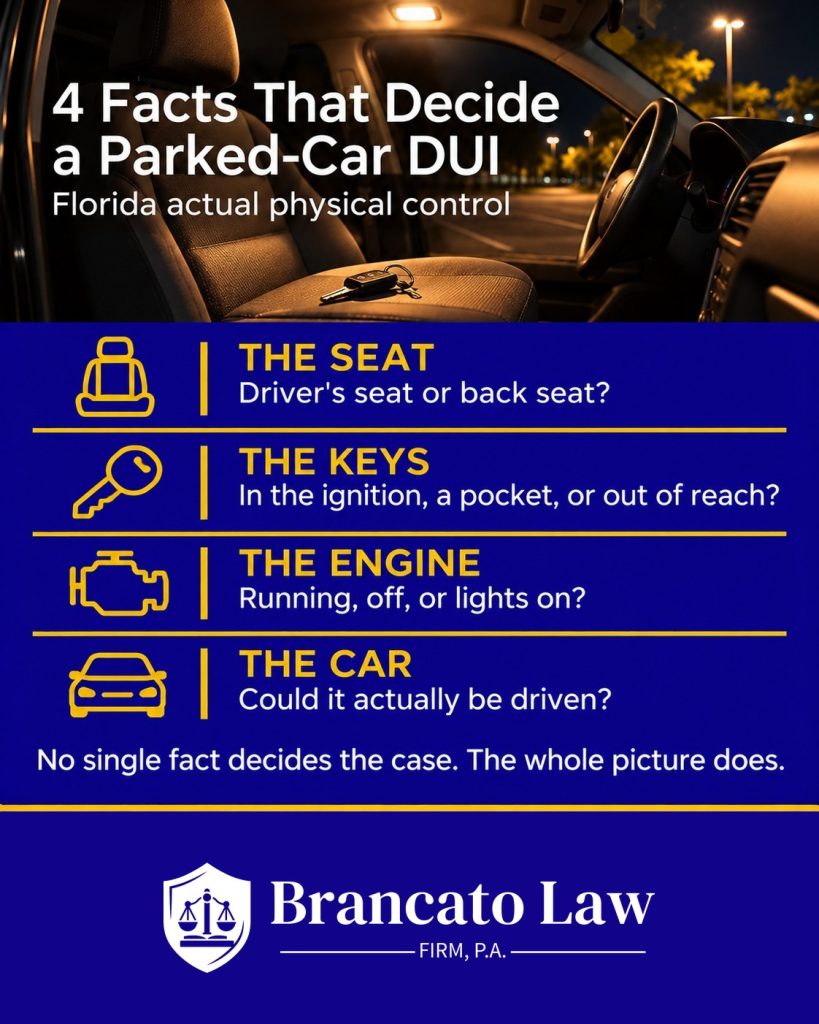
| Fact | Why it matters | Florida case example |
|---|---|---|
| Which seat you were in | The jury instruction requires that you be physically in or on the vehicle with the capability to operate it. The driver’s seat puts you within reach of every control. | Fitzgerald (2d DCA 2011): driver’s seat, keys in hand, car stopped in an intersection with lights on. Dismissal reversed. |
| Where the keys were | Keys in the ignition or in your hand show capability. Keys in the trunk, with a friend, or in another room weaken it. | Fitzgerald: she “readily produced” the keys, so capability was shown. |
| Engine, lights, and brake lights | A running engine or a lit brake light is evidence you were exercising control. | Griffin (2d DCA 1984): engine off, but key in the ignition, lights on, and brake light lit by his foot. Conviction upheld. |
| Where the car was stopped | A car in a traffic lane supports an inference you drove there and could drive away. A legally parked car does not. | Griffin: car stopped in a traffic lane, facing the wrong way. |
| Whether the car could move | Inoperability is a defense the defense can raise, even though the State need not prove operability up front. | Jones (1st DCA 1987): car disabled, could only be moved by an outside agency. Conviction reversed. |
In Griffin v. State, 457 So. 2d 1070 (Fla. 2d DCA 1984), an officer found a man asleep at about 2:30 a.m. in the driver’s seat of a car stopped in a traffic lane, with the key in the ignition, the lights on, and his foot apparently on the brake. The Second District upheld his conviction. The court also responded to his argument that the ruling would discourage impaired drivers from pulling over, and it agreed that pulling over to “sleep it off” is conduct that “should be encouraged.” What sank Griffin was where the car was: in the middle of the road.
In Jones v. State, 510 So. 2d 1147 (Fla. 1st DCA 1987), troopers found a woman slumped over the wheel of a car that her sister-in-law had been driving until it broke down. The car had electrical problems and had to be pushed to a repair shop. The First District held that the State does not have to prove a car was operable in every case, but that inoperability “may be a defense,” and it reversed her conviction because the car could not be moved except by an outside agency.
Can you get a DUI in Florida if the engine was running for the air conditioning?
Yes, a running engine is some of the strongest evidence of actual physical control, and in a Florida summer many people leave the engine on so they can run the air conditioning while they sleep. A running engine is not the end of the analysis, though. In Department of Highway Safety & Motor Vehicles v. Sarmiento, 989 So. 2d 692 (Fla. 4th DCA 2008), a driver was found in the driver’s seat with the engine running and the keys in the ignition, but two tires were blown out. A circuit court set aside his license suspension because the car was inoperable, and the Fourth District left that ruling in place. The lesson for anyone arrested in a parked car: our attorneys look at the car itself, including tow records and mechanic testimony, not only at the driver.
Is it safer to sleep in the back seat after drinking?
Sleeping in the back seat, with the engine off and the keys out of reach, removes most of the facts that prove actual physical control, but Florida has no statute that guarantees a person in the back seat will not be arrested. The jury instruction asks whether you were in the vehicle and had the capability to operate it. A person curled up in the back seat with the keys locked in the trunk has a far stronger defense than a person in the driver’s seat with the keys in the ignition. A ride home, a rideshare, or a sober friend is always the safer choice.
There is also a medical reason sleeping it off in a car is riskier than it sounds. The National Institute on Alcohol Abuse and Alcoholism warns that “BAC can continue to rise even when a person stops drinking or is unconscious,” according to its guide Understanding the Dangers of Alcohol Overdose. A person who parks and falls asleep may test higher an hour later than when the drinking stopped, which is why the timing of the breath test is part of every case our firm reviews.
How many DUI arrests happen in Hillsborough County?
In 2024, law enforcement wrote 4,593 DUI citations in Hillsborough County, according to the Florida Department of Highway Safety and Motor Vehicles’ Annual Uniform Traffic Citation Report. The Hillsborough County Sheriff’s Office wrote 2,202 of them, municipal police departments such as Tampa Police wrote 1,927, and the Florida Highway Patrol wrote 343.
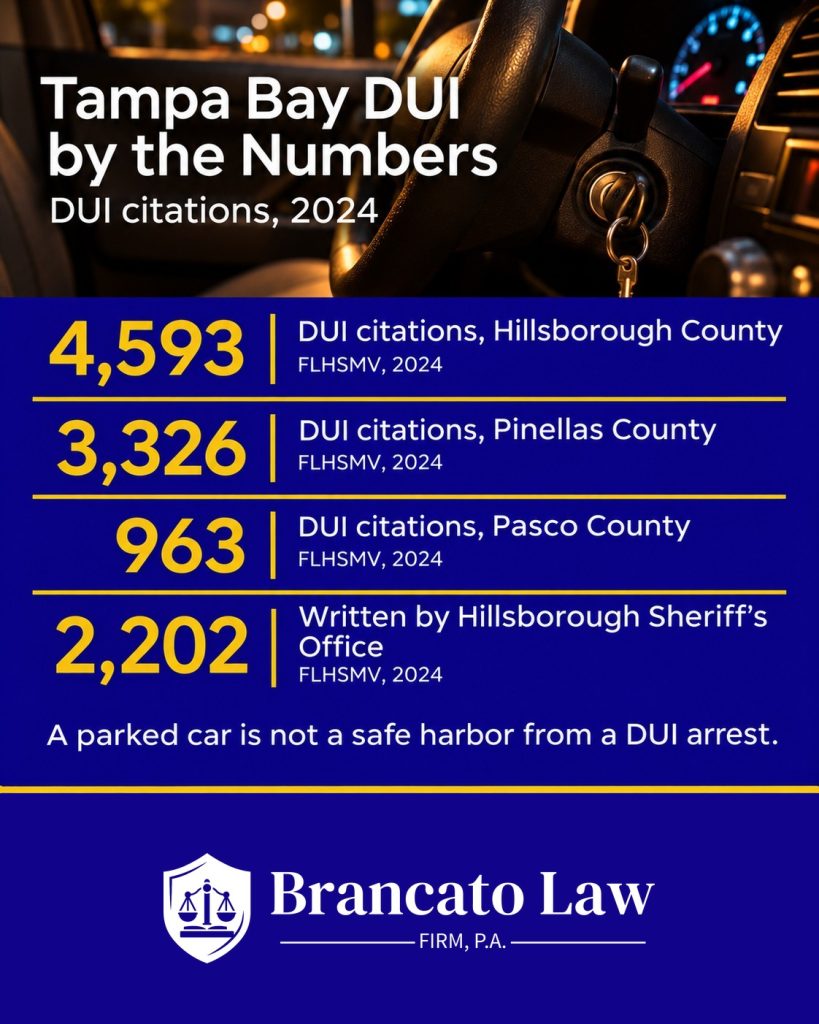
| County | DUI citations written in 2024 |
|---|---|
| Hillsborough | 4,593 |
| Pinellas | 3,326 |
| Pasco | 963 |
Numbers like these explain why parked-car arrests are common in Tampa Bay. Officers patrol nightlife districts like Ybor City late at night, as the FOX 13 case shows, and a car stopped with its lights on draws attention. In Hillsborough County, people arrested for DUI by the Sheriff’s Office or Tampa Police are taken to Central Breath Testing, the Sheriff’s Office breath-testing site, where the breath test is requested. If you were arrested in Hillsborough, our Hillsborough County criminal defense attorneys know that process from the inside.
Does a parked-car DUI arrest still suspend your driver’s license?
Yes. Florida’s implied consent law and the administrative license suspension apply to a person arrested while driving or while in actual physical control, so an arrest in a parked car triggers the same 10-day deadline as an arrest after a traffic stop. The Sarmiento case shows the flip side: when the car could not be operated, the suspension was set aside. Our guide on how to protect your driver’s license after a DUI arrest explains the review hearing and the hardship license options.
How do our attorneys fight a DUI when the car was parked?
Our attorneys build a parked-car defense around the specific facts that the State must prove. The work usually follows these steps:
- Attack the “capability” element. We pin down exactly where the keys were, whether the car had a push-button start and where the fob was, and whether the car could be driven. Tow records, repair invoices, and photographs can prove a car was disabled.
- Separate driving from sitting. If the State claims you drove to the spot while impaired, it has to prove when you arrived and when you drank. Receipts, phone records, and witnesses can show you parked first and drank later, or that you were waiting for a ride.
- Review the body camera video. Video often shows a calm, legally parked car, the engine off, and a person who was asleep rather than driving. It can also contradict a report about slurred speech or poor balance. Our guide on challenging field sobriety tests in Tampa explains what we look for.
- Challenge the encounter. A welfare check is not a license to search. We examine whether the officer had a lawful basis to order you out of the car and to begin a DUI investigation, and we file a motion to suppress when the officer did not.
- Test the breath result. The timing of the test matters in a case where alcohol was still absorbing while you slept. The retrograde extrapolation problem works in your favor when the State cannot say what your level was when you were last in control.
- Negotiate from strength. Weak actual physical control evidence gives the defense bargaining power. Many parked-car cases resolve with a reduction to reckless driving or through Hillsborough’s RIDR program, and our post on whether a DUI can be reduced to reckless driving explains when that is possible.
What should you do after a DUI arrest for sleeping in your car?
Act within the first 10 days, because the license deadline runs from the arrest, not from your first court date. While the details are fresh, write down where you parked, where the keys were, whether the engine was running, and why you stopped. Save receipts, rideshare app screenshots, and texts that show your plan to get home. Do not discuss the case with anyone except your lawyer. Then talk to a DUI lawyer about what happens next in the Florida criminal case process, from first appearance through trial.
Frequently asked questions about DUI for sleeping in your car in Florida
Can you get a DUI in Florida if the keys were in your pocket, not the ignition?
Yes, keys in a pocket can still support a DUI arrest, because the question is whether you had the practical ability to start the car, and in Fitzgerald the keys were in the driver’s hand. The Brancato Law Firm focuses on where the keys were and how quickly you could have used them, because keys in a jacket in the back seat or with a friend tell a different story than keys in the ignition.
Is it illegal to sleep in your car in a parking lot after drinking in Florida?
Sleeping in your car is not a DUI by itself, but being impaired while in actual physical control of the car is, so the risk depends on the seat, the keys, and the engine. Our attorneys at The Brancato Law Firm have seen legally parked, engine-off cases end well, because those facts make the State’s capability argument hard to prove.
Can a DUI for sleeping in your car be reduced to reckless driving in Florida?
Often, yes, if the breath or blood result is under 0.15 and the evidence of actual physical control is weak, a prosecutor may agree to reduce the charge to reckless driving. The Brancato Law Firm uses the weaknesses in a parked-car case to push for a better offer, and our guide to DUI reductions to reckless driving explains the limits.
Are the penalties lower for a parked-car DUI in Florida?
No, a DUI based on actual physical control carries the same penalties as a DUI based on driving: for a first conviction, a fine of $500 to $1,000 and up to six months in jail under section 316.193(2). Because the penalties are identical, our DUI defense attorneys at The Brancato Law Firm treat the actual physical control element as a full trial issue rather than a technicality.
Can DUI charges be dropped in Florida if I was asleep in a parked car?
Yes, DUI charges can be dropped or dismissed when the State cannot prove actual physical control, for example when the car was inoperable or the keys were out of reach, as in Jones v. State. The Brancato Law Firm gathers that proof early and presents it to the State Attorney’s Office before the case hardens.
Does a parked-car DUI arrest affect my license if I refused the breath test?
Yes, a refusal triggers an administrative suspension even when you were found in a parked car, because implied consent applies to a person in actual physical control. Our attorneys at The Brancato Law Firm review whether the officer had a lawful basis to treat you as being in control before the refusal was requested, which can matter at the license review hearing.
Arrested in a Parked Car? Start With the Keys and the Clock
The first questions our attorneys ask are where your keys were and how many of your 10 days are left. The Brancato Law Firm, P.A., founded by Tampa Criminal Defense Attorney Rocky Brancato, can request the license review, get the body camera video, and start building the actual physical control defense this week. Call (813) 727-7159 at any hour. Our firm has Spanish-speaking staff, and attorney Jean-Luc Adrien speaks Spanish, Haitian Creole, and French. For more about our defense strategies, visit our Tampa DUI defense page.
The Brancato Law Firm, P.A.
620 E. Twiggs Street, Suite 205, Tampa, FL 33602
(813) 727-7159
Serving Hillsborough, Pinellas, and Pasco Counties
The Brancato Law Firm, P.A. is a Tampa-based criminal defense practice. We are not affiliated with any other Brancato-named law firms.
Visit Us

Tampa, FL 33602

Contact Us Now
Free Legal Consultation (813) 727-7159
