- Free Consultation 24/7: (813) 727-7159 Tap Here To Call Us


From First DUI to Death Penalty



What Happens If You Miss a Probation Curfew Check in Florida? (2026)


Updated November 17, 2026
Short answer: A missed curfew check can lead to a violation of probation charge in Florida, but an unanswered knock does not by itself prove you were gone. The State must prove a willful and substantial violation, and in September 2026 Florida’s Second District Court of Appeal reversed a revocation where officers knocked, called, and got no answer at 10:25 p.m. but could not show the probationer would have heard them. Proof that you were home, a good reason for being late, and the State’s reliance on paperwork alone are the main defenses.
If a probation officer knocked on your door after curfew and nobody answered, you may now be facing an affidavit of violation and a warrant. What happens in the first few days, before the hearing, often decides whether you keep your probation. I’m Rocky Brancato, founder of The Brancato Law Firm, P.A., a Tampa criminal defense firm, and I have spent more than 25 years in Hillsborough County courtrooms, including as former Chief Operations Officer of the Hillsborough County Public Defender’s Office, where I oversaw a staff of over 100 attorneys. Our attorneys defend curfew violations by building the proof that you were home, or that any lapse was not willful, before the judge ever hears the officer’s version.
What does a probation curfew condition require in Florida?
A curfew condition requires you to be inside your approved residence during set hours, usually overnight, unless your probation officer gives permission. Where the curfew comes from matters, because it decides the hours and how strictly the condition is enforced.
| Type of supervision | Curfew rule | Source |
|---|---|---|
| Sex offender probation or community control for listed offenses | Mandatory curfew from 10 p.m. to 6 a.m.; the court may set another 8-hour period if work requires it and the Department of Corrections recommends it | Section 948.30(1)(a), Florida Statutes |
| Community control (house arrest) | Confinement to an agreed residence during hours away from work and public service | Section 948.101(1)(b), Florida Statutes |
| Regular felony or misdemeanor probation | Only if the judge ordered a curfew as a special condition; hours are set in the order | Your probation order |
Read your probation order first. If the judge did not order a curfew, an officer cannot create one on the spot, and our attorneys check the order against the affidavit in every curfew case. For the special rules that apply on sex offender supervision, see our post on Florida sex offender probation rules.
How do probation officers check curfew in Hillsborough County?
In Hillsborough County, Department of Corrections probation officers run unannounced curfew checks late at night. They knock, ring, call your cell phone, and call out your name. In our experience, when nobody answers, the officer often writes it up as a violation even when the client was inside asleep.
That write-up becomes an affidavit of violation. Under section 948.06(1), Florida Statutes, the judge can issue a warrant on the affidavit or, for people with no qualifying offense, a notice to appear instead. The same statute lists “a violation of curfew” as a low-risk violation that may qualify for the alternative sanctioning program, which lets the officer handle an eligible technical violation without filing an affidavit with the court. Our firm’s pillar guide on how to fight a probation violation in Florida explains how Hillsborough routes these cases after the arrest.
Does an unanswered knock prove you were not home at curfew?
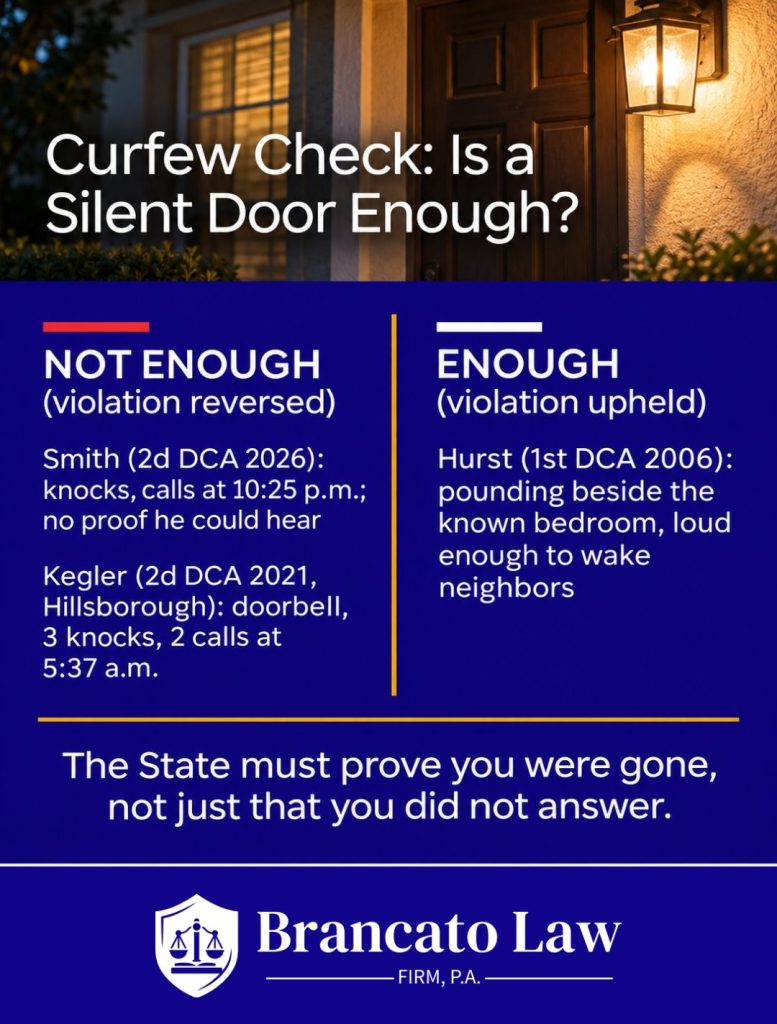
No. In the Second District, which covers Hillsborough, Pinellas, and Pasco Counties, an unanswered knock proves a curfew violation only when the evidence shows you would have heard the officer. The most recent example is Smith v. State, No. 2D2025-1715 (Fla. 2d DCA Sept. 18, 2026), where the court reversed a revocation and ordered probation reinstated.
In Smith, a Sarasota County probationer had a 10 p.m. to 6 a.m. curfew. Two officers arrived at his rooming house at about 10:25 p.m. One knocked on the front door and a window next to it, called his name, and called his cell phone several times. Nobody answered, even though a car sat in the carport and a scooter was in the yard. Smith testified that he was asleep in a back bedroom with an air-conditioning unit running and his phone off. Neither officer said how long or how loudly they knocked, and neither knew where his room was.
The majority held that “there is no basis to infer that Smith even would have heard the officers,” let alone that he was gone. The court also noted that the affidavit listed the visit at about 11:24 p.m. while the officer testified it happened at about 10:25 p.m. Details like that are why our attorneys compare the affidavit, the officer’s notes, and the testimony line by line.
Kegler v. State, 313 So. 3d 824 (Fla. 2d DCA 2021) is the Hillsborough County version of the same rule. An officer rang the doorbell and knocked at least three times at 5:37 a.m., and his partner called twice. The court found that was not competent, substantial evidence that Kegler was away and ordered his community control reinstated. Courts have upheld violations when the knocking was hard to miss. In Hurst v. State, 941 So. 2d 1252 (Fla. 1st DCA 2006), the officer pounded on the side of the trailer where she knew the bedroom was, loudly enough to wake the neighbors, and the trial judge did not believe the probationer’s account.
| Case | What the officer did | Result |
|---|---|---|
| Smith v. State, No. 2D2025-1715 (Fla. 2d DCA Sept. 18, 2026) | Knocks on door and window, called name, several cell phone calls at about 10:25 p.m.; no proof of how long or loud, or where the bedroom was | Revocation reversed; probation reinstated |
| Kegler v. State, 313 So. 3d 824 (Fla. 2d DCA 2021) | Doorbell, at least three knocks, two phone calls at 5:37 a.m. (Hillsborough County) | Revocation reversed; community control reinstated |
| Hurst v. State, 941 So. 2d 1252 (Fla. 1st DCA 2006) | Repeated knocking and pounding beside the known bedroom, loud enough to wake neighbors, at 11:48 p.m. | Violation affirmed |
Could the “loud enough, long enough” rule change?
Possibly. In his Smith dissent, Chief Judge Lucas called the Second District’s approach a “Loud Enough/Long Enough” standard, said it set an unclear bar for officers, and urged the court to stop applying it. A dissent is not the law, but it signals that the State may ask the full court, or a later panel, to revisit the rule.
For now, Smith and Kegler control in Hillsborough, Pinellas, and Pasco courtrooms. Our attorneys build every curfew defense so it holds up even if the rule tightens: we do not rely on the officer’s silence about volume alone, and we gather independent proof that the client was home.
Is a curfew violation willful if you had a reason for being late?
Not necessarily. Probation can be revoked only for a willful and substantial violation, and Florida courts hold that negligence or ineptitude is not enough. A violation is willful only when you failed to make reasonable efforts to comply.
In Kafus v. State, No. 6D2025-1445 (Fla. 6th DCA Sept. 18, 2026), the Department of Corrections alleged that a Lee County probationer missed his curfew five separate times. The trial court revoked his probation. The Sixth District reversed and ordered probation reinstated, holding there was “no competent, substantial evidence” that any of the five curfew violations was willful. Rides that fell through, a shift that ran late, or a medical problem can all matter, but only if the defense proves them with records and witnesses. The Brancato Law Firm collects that proof before the hearing, not after.
Can the State prove a curfew violation with only the officer’s report?
No. Hearsay is allowed at a Florida violation hearing, but a revocation cannot rest on hearsay alone. In Marshall v. State, No. 5D2025-3795 (Fla. 5th DCA Oct. 5, 2026), the Fifth District reversed a revocation because the only proof of the alleged violation was an arrest affidavit and a violation report built from it, and the probation officer had no personal knowledge.
In a curfew case, that means the State usually needs the officer who went to the door to testify. If the State plans to proceed on another officer’s notes or a computer entry, our attorneys object and hold the State to live, first-hand testimony.
How often do probation violations send people to prison in Florida?
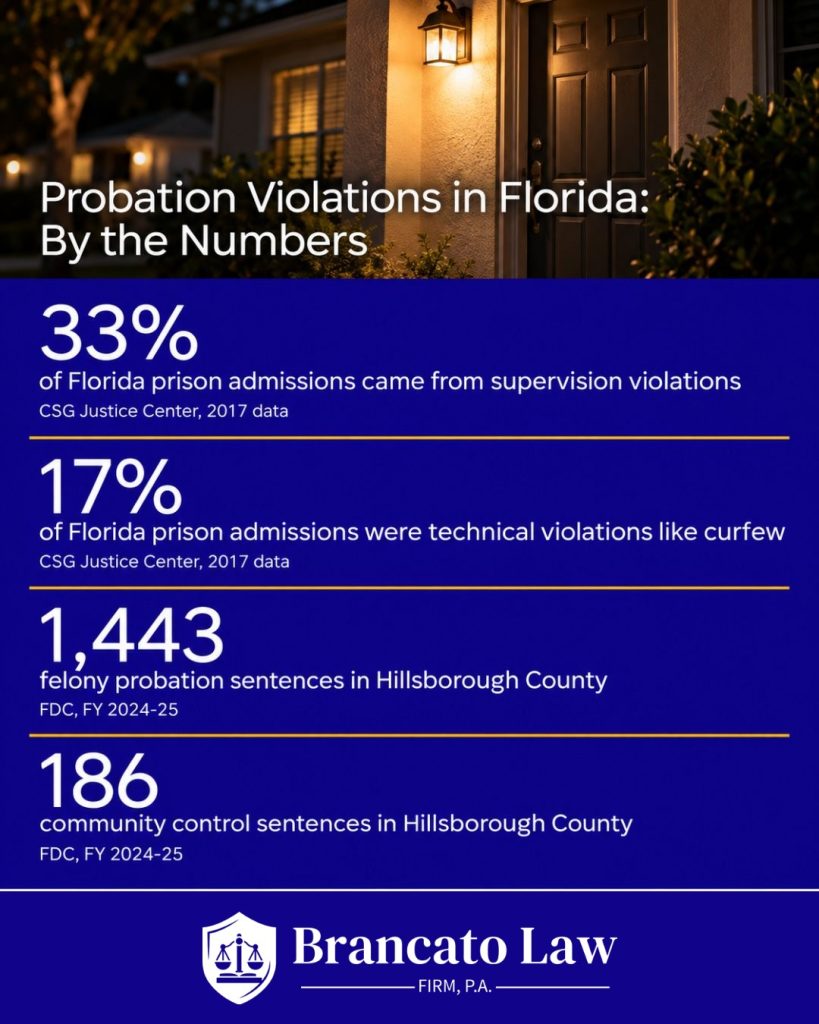
Often. A Council of State Governments Justice Center study, “Confined and Costly”, found that in 2017 supervision violations accounted for 33% of Florida prison admissions, and technical violations, such as curfew and reporting violations, accounted for 17%. The same study estimated that on any given day 16,558 people in Florida were incarcerated because of a supervision violation, at a yearly cost to the state of $330 million.
Could the “loud enough, long enough” rule change?
Possibly. In his Smith dissent, Chief Judge Lucas called the Second District’s approach a “Loud Enough/Long Enough” standard, said it set an unclear bar for officers, and urged the court to stop applying it. A dissent is not the law, but it signals that the State may ask the full court, or a later panel, to revisit the rule.
For now, Smith and Kegler control in Hillsborough, Pinellas, and Pasco courtrooms. Our attorneys build every curfew defense so it holds up even if the rule tightens: we do not rely on the officer’s silence about volume alone, and we gather independent proof that the client was home.
Is a curfew violation willful if you had a reason for being late?
Not necessarily. Probation can be revoked only for a willful and substantial violation, and Florida courts hold that negligence or ineptitude is not enough. A violation is willful only when you failed to make reasonable efforts to comply.
In Kafus v. State, No. 6D2025-1445 (Fla. 6th DCA Sept. 18, 2026), the Department of Corrections alleged that a Lee County probationer missed his curfew five separate times. The trial court revoked his probation. The Sixth District reversed and ordered probation reinstated, holding there was “no competent, substantial evidence” that any of the five curfew violations was willful. Rides that fell through, a shift that ran late, or a medical problem can all matter, but only if the defense proves them with records and witnesses. The Brancato Law Firm collects that proof before the hearing, not after.
Can the State prove a curfew violation with only the officer’s report?
No. Hearsay is allowed at a Florida violation hearing, but a revocation cannot rest on hearsay alone. In Marshall v. State, No. 5D2025-3795 (Fla. 5th DCA Oct. 5, 2026), the Fifth District reversed a revocation because the only proof of the alleged violation was an arrest affidavit and a violation report built from it, and the probation officer had no personal knowledge.
In a curfew case, that means the State usually needs the officer who went to the door to testify. If the State plans to proceed on another officer’s notes or a computer entry, our attorneys object and hold the State to live, first-hand testimony.
How often do probation violations send people to prison in Florida?
Often. A Council of State Governments Justice Center study, “Confined and Costly”, found that in 2017 supervision violations accounted for 33% of Florida prison admissions, and technical violations, such as curfew and reporting violations, accounted for 17%. The same study estimated that on any given day 16,558 people in Florida were incarcerated because of a supervision violation, at a yearly cost to the state of $330 million.
The number of people at risk in Tampa is large. According to the Florida Department of Corrections’ October 2025 Criminal Punishment Code report, felony scoresheets from Hillsborough County for fiscal year 2024-2025 show 1,443 sentences to probation and 186 to community control, out of 5,336 scoresheets the department received for the county. Each of those sentences carries conditions that a missed check can put at risk.
The stakes at the hearing are high. Under section 948.06(2)(b), Florida Statutes, if probation is revoked, the judge can impose any sentence that could have been imposed originally, up to the statutory maximum for the underlying charge. In our experience, judges in the 13th Judicial Circuit often reinstate or modify probation on a first technical curfew violation when the defense shows a reason for it and an otherwise clean record. That outcome is not automatic, and it depends on the preparation our attorneys put in before the hearing.
What proof helps when you were home during a curfew check?
The best curfew defense is independent proof that you were inside, or that any lapse was not willful. These are the records our attorneys gather first:
- Phone records. Call logs and data use can show the phone was at home or turned off, as Smith testified his was.
- Location data. GPS on a phone, a car’s telematics, or an ankle monitor if you wear one.
- Witnesses in the home. Roommates, a partner, or family members who saw you there.
- Layout of the residence. Photos and measurements showing how far the bedroom is from the door, and noise from fans or an air conditioner.
- Work and travel records. Time cards, rideshare receipts, or hospital records that explain a late return.
- Your compliance history. Prior curfew checks you passed, which supports a finding that one missed check was not willful.
Why act fast after a curfew violation warrant?
Proof disappears quickly. Phone and app location data is not kept forever, witnesses forget dates, and a client held without bond on a violation warrant has fewer ways to gather records. Under section 948.06(2)(c), the judge may hold you, or release you with or without bail, until the hearing. Our post on bond hearings in Tampa covers how to ask for release. Probation violations are a sentencing-stage issue in the Florida criminal case process.
For more about our defense strategies, visit our violation of probation defense guide and our Hillsborough County criminal defense page.
Frequently asked questions about probation curfew violations
Can my probation officer violate me for not answering the phone after curfew?
A missed call alone rarely proves you were away, because a phone can be off, silenced, or in another room. The Brancato Law Firm uses your phone records to show what the officer’s call log cannot, as in Smith v. State, No. 2D2025-1715 (Fla. 2d DCA Sept. 18, 2026).
Will I go to jail for a first curfew violation in Hillsborough County?
Not always; a judge can reinstate, modify, or revoke, and many first technical violations end with reinstatement or added conditions. Our attorneys at The Brancato Law Firm present your work, treatment, and compliance record so the judge has a reason to keep you on supervision.
Is a curfew violation a new crime in Florida?
No. Florida law treats a curfew violation as a technical violation, meaning it is not a new felony, misdemeanor, or criminal traffic offense, under section 948.06(1)(c). The Brancato Law Firm still treats it seriously, because revocation can bring the original maximum sentence.
What if my curfew check happened while I was at work?
If your curfew hours conflict with your job, the officer or the court can adjust them, and sex offender curfews can be moved to another 8-hour period when the Department of Corrections recommends it. Our team at The Brancato Law Firm gathers time cards and employer letters to show the lapse was not willful and to ask for a schedule that fits your work.
Do I have to testify at my curfew violation hearing?
No, you are not required to testify, and whether you should depends on the other proof available. Our attorneys at The Brancato Law Firm decide that with you after reviewing the officer’s report, because in Hurst v. State, 941 So. 2d 1252 (Fla. 1st DCA 2006) the judge’s disbelief of the probationer decided the case.
Call The Brancato Law Firm, P.A. at (813) 727-7159 as soon as you learn about a curfew violation affidavit, while phone and location records still exist. The firm was founded by Tampa Criminal Defense Attorney Rocky Brancato, and our attorneys will start by getting the officer’s notes and your records side by side. Our firm has Spanish-speaking staff, and attorney Jean-Luc Adrien speaks Spanish, Haitian Creole, and French. You can call us at any hour; our office is two blocks from the courthouse.
The Brancato Law Firm, P.A.
620 E. Twiggs Street, Suite 205, Tampa, FL 33602
(813) 727-7159
Serving Hillsborough, Pinellas, and Pasco Counties
The Brancato Law Firm, P.A. is a Tampa-based criminal defense practice. We are not affiliated with any other Brancato-named law firms.
Visit Us

Tampa, FL 33602

Contact Us Now
Free Legal Consultation (813) 727-7159
