

From First DUI to Death Penalty



How to Fight a Failure to Register as a Sex Offender Charge in Florida? (2026)


To fight a failure to register as a sex offender charge in Florida, the defense tests whether the State can prove the specific reporting duty it charged, that the person knew of that duty, and that a reportable event, such as a new residence, vehicle, job, or online account, actually happened and went unreported within the deadline. Failure to comply with registration requirements under section 943.0435(9), Florida Statutes, is a third-degree felony punishable by up to 5 years in prison, and for violations on or after July 1, 2018, a judge who does not impose prison must order at least 6 months of community control with electronic monitoring for a first offense. Common defenses include no proof of a new residence, a sheriff’s office that misinformed the person or prevented compliance, database errors, and duplicate counts for a single reporting event.
If a deputy has come to your door about an address check, or a detective has called about a missed reregistration, the next 48 hours matter more than anything that happens in court. As founder of The Brancato Law Firm, P.A., a Tampa criminal defense firm, I have spent more than 25 years in Hillsborough County courtrooms, including as former Chief Operations Officer of the Hillsborough County Public Defender’s Office, where I oversaw a staff of over 100 attorneys, and I have tried more than 150 jury trials to verdict. Our attorneys defend registration cases by pulling the registration file, the sheriff’s address verification records, and the person’s own paperwork, because these cases are usually won or lost on documents.
What is failure to register as a sex offender in Florida?
Failure to register is any knowing failure by a person designated as a sexual offender to complete a reporting duty required by section 943.0435, Florida Statutes. The statute lists many duties, and each one is a separate way to commit the crime. Sexual predators have parallel duties under section 775.21, and many of the same defenses apply. Our guide to sex offender registration in Florida explains who must register and what the registry contains.
| Duty | Deadline | Where to report |
|---|---|---|
| Initial registration after establishing a residence, release from custody, or conviction | Within 48 hours | In person at the sheriff’s office |
| Change of permanent, temporary, or transient residence, or legal name | Within 48 hours | In person at a driver license office (or the sheriff’s office if a license cannot be updated) |
| Vacating a residence without establishing a new one | Within 48 hours | In person at the sheriff’s office |
| Transient residence | Within 48 hours, then every 30 days | In person at the sheriff’s office |
| Email addresses and Internet identifiers | Within 48 hours after use | FDLE online system or the sheriff’s office |
| Vehicle changes | Within 48 hours | FDLE online system or the sheriff’s office |
| Phone numbers, employment, and higher education status | Within 48 hours | FDLE online system or in person at specified offices |
| Reregistration | Twice a year (birth month and six months later), or quarterly for certain offenses | In person at the sheriff’s office |
| Address verification correspondence | Respond within 3 weeks | As the letter directs |
The quarterly schedule in section 943.0435(14)(b) applies to registrants whose qualifying conviction is one of the listed offenses, such as sexual battery or certain lewd or lascivious molestation offenses. A missed reregistration month is one of the most common charges our attorneys see.
What are the penalties for failure to register in Florida?
Failure to register is a third-degree felony punishable by up to 5 years in prison and a $5,000 fine under section 943.0435(9)(a). Each missed report is a separate offense. For violations committed on or after July 1, 2018, section 943.0435(9)(b) requires mandatory community control with electronic monitoring whenever the judge does not impose prison.
| Offense | If the court does not impose prison |
|---|---|
| First failure-to-register felony | Mandatory minimum 6 months of community control with electronic monitoring |
| Second | Mandatory minimum 1 year of community control with electronic monitoring |
| Third or subsequent | Mandatory minimum 2 years of community control with electronic monitoring |
Community control is often called house arrest. It means confinement to the home except for approved work, treatment, and other activities, under close supervision. The State can also prosecute the case in several counties: where the failure happened, the county of the last registered address, the county of the original conviction, the county of release, or the county the person listed as an intended address before release, under section 943.0435(9)(c).
Does the State have to prove you knew about the duty to register?
Yes. The Florida Supreme Court has construed the registration statute to require knowledge of the duty to register, and Florida’s standard jury instruction requires the State to prove the person “knowingly failed” to make the charged report. As the Fifth District explained in Smith v. State, 968 So. 2d 1054 (Fla. 5th DCA 2007), a case in which a man claimed he went to the licensing office but was turned away, this is a general intent element: the State must prove knowledge of the duty, not a desire to break the law, and simply forgetting is not a defense.
Knowledge matters most in cases involving newer or less obvious duties, such as reporting a new Internet identifier, a vehicle owned by a family member the person lives with, or a change in employment. The standard jury instruction also includes a specific defense: under the instruction approved in In re Standard Jury Instructions in Criminal Cases, Report No. 2015-05, 195 So. 3d 1088 (Fla. 2016), it is a defense that the person “attempted to comply but was misinformed or otherwise prevented from complying by the office of the sheriff.” Our attorneys look for that evidence in every case: emails, receipts, appointment confirmations, and witnesses who went to the sheriff’s office with the client.
How do our attorneys fight a failure to register charge in Florida?
Our attorneys fight a failure to register charge by holding the State to the exact theory it charged and proving what actually happened with documents. These are the steps The Brancato Law Firm takes most often in Hillsborough, Pinellas, and Pasco County cases.
- Pin down the charged duty. The information must name a specific duty, and the State must prove that duty. In Demus v. State, 281 So. 3d 505 (Fla. 4th DCA 2019), a man released from prison was charged with failing to register after establishing a residence in Broward County. The State proved only that he had not registered there, offered no evidence he ever lived there, and his release form listed Miami. The Fourth District ordered a judgment of acquittal on both counts.
- Prove where the client actually lived. A charge built on a missed address check often assumes a move that never happened. Leases, utility bills, mail, and witnesses can show the registered address was still the residence.
- Audit the registration file. We obtain the FDLE and sheriff’s office records, including every form the client signed, to find data entry errors, lost paperwork, and reports the system never recorded.
- Look for misinformation by the sheriff’s office. If staff told the client a report was not required, turned the client away, or gave a wrong deadline, the standard jury instruction recognizes a defense.
- Challenge knowledge of the duty. Registration paperwork changes over time. We check whether the client was ever told about the specific duty charged.
- Collapse duplicate counts. In Hill v. State, 351 So. 3d 1222 (Fla. 2d DCA 2022), a Polk County man was convicted of four counts for failing to register four of his parents’ vehicles at a single reregistration. The Second District, the appeals court that covers Hillsborough, Pinellas, and Pasco, held the statute ambiguous on the unit of prosecution, applied the rule of lenity, and reversed three of the four counts.
- Confirm the duty exists at all. We verify that the underlying conviction actually requires registration under the current statute, and whether the client may qualify for removal.
Our Tampa sex crimes lawyer page explains how registration defense fits into the firm’s broader sex crimes practice.
How many people are on Florida’s sex offender registry?
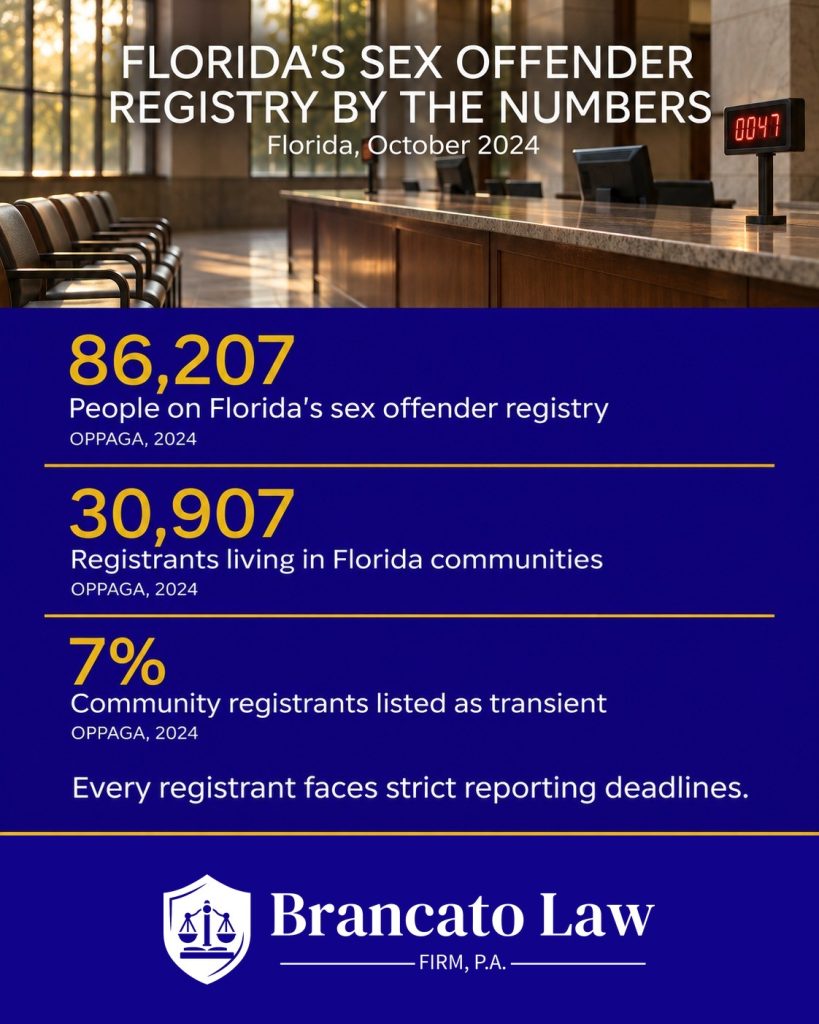
Florida’s registry is one of the largest in the country. The Florida Department of Law Enforcement’s registry lists more than 86,000 offenders and predators, of whom over 30,000 live in Florida communities, according to the Florida Legislature’s OPPAGA Report 24-11, Sex Offender Registration and Monitoring Triennial Review (December 2024). As of October 2024, the exact count was 86,207 people on the registry, and 30,907 of them lived in Florida communities. The same report found that about 7% of registered sexual offenders living in Florida communities are homeless or transient, with rates ranging from 0% to 34% by county. Transient registrants must report in person every 30 days, which makes them far more exposed to failure to register charges.
Are registration violations a sign of dangerousness?
Research suggests most registration violations are compliance failures rather than signs of new offending. In a study of 2,970 registered sex offenders, “Failure to Register as a Sex Offender: Is it Associated with Recidivism?” (Levenson, Letourneau, Armstrong, and Zgoba, Justice Quarterly, 2010), researchers found no significant difference in sexual recidivism between people who failed to register and compliant registrants, 11 percent versus 9 percent.
Our attorneys use that research at sentencing and in negotiations. A missed deadline caused by homelessness, a work schedule, a hospital stay, or confusion about a new rule is a different case from a person hiding from law enforcement, and prosecutors and judges should treat it that way.
What happens after a failure to register arrest in Hillsborough County?
A failure to register arrest in Hillsborough County leads to first appearance within 24 hours, where a judge reviews probable cause and sets bond by video from the jail. Our post on Hillsborough first appearance explains that hearing. In our experience, Hillsborough County does not offer pretrial services supervision as a release option, though some neighboring counties do. A registrant who is also on probation or community control may face a violation of probation warrant with no bond at first appearance.
The most useful step after release is to complete any missing report immediately and keep proof. Coming into compliance does not erase the charge, but it shows the court and the State Attorney’s Office for the 13th Judicial Circuit that the failure was not an attempt to hide. Our page on representation before charges are filed explains how our attorneys present that record to prosecutors, our Hillsborough County criminal defense page covers the local courts, and our guide to the Florida criminal case process maps each stage from arrest to sentencing.
What should you do if you are accused of failing to register?
Get into compliance and gather your records. These steps protect the defense.
- Complete any missing report right away, in person if the duty requires it, and keep the receipt.
- Gather leases, utility bills, pay stubs, vehicle titles, and anything that shows where you lived and when.
- Keep every registration form, letter, and text from the sheriff’s office or FDLE.
- Write down any visit or call where staff told you something about your duties, with the date and the name if you have it.
- Do not explain the situation to a detective without a lawyer.
- Call a defense attorney before the State’s filing decision.
Frequently asked questions about failure to register in Florida
Can failure to register as a sex offender charges be dropped in Florida?
Yes. The State Attorney’s Office can decline to file or dismiss the charge when the records show no reportable change, a sheriff’s office error, or a report that was actually made. The Brancato Law Firm assembles that paper trail before the filing decision, and our page on pre-file advocacy explains how that work is presented.
Is a missed reregistration appointment a felony in Florida?
Yes. Failing to reregister as required is a third-degree felony under section 943.0435(9)(a). Our attorneys at The Brancato Law Firm look closely at the reason for the missed month, such as hospitalization or incarceration, and at whether the sheriff’s office scheduling records are accurate.
Do I have to register a car I do not own but drive every day?
Often yes. The statute requires reporting vehicles owned, and under the definition in section 775.21 that the Second District applied in Hill, that can include vehicles registered to a person the registrant lives with for at least five consecutive days. The Brancato Law Firm reviews titles and household facts in every vehicle case, and if several vehicles were missed at one reporting event, Hill v. State limits the State to a single count.
Can I go to jail for failure to register for the first time?
Yes, up to 5 years in prison, but for violations on or after July 1, 2018, a judge who does not impose prison must order at least 6 months of community control with electronic monitoring. The Brancato Law Firm builds a mitigation record focused on compliance and stability to keep clients out of prison, and our sex crimes defense attorneys handle these sentencing arguments regularly.
What if the sheriff’s office told me I did not need to report something?
That can be a complete defense. Florida’s standard jury instruction recognizes that a person who attempted to comply but was misinformed or prevented from complying by the sheriff’s office is not guilty. Our attorneys at The Brancato Law Firm track down the visit logs, emails, and witnesses that prove what the client was told.
Can I be charged in a county where I no longer live?
Yes. Section 943.0435(9)(c) lets the State prosecute in the county of the failure, the last registered address, the original conviction, the release, or the intended address listed before release. The Brancato Law Firm handles registration cases in Hillsborough, Pinellas, and Pasco Counties and checks whether the chosen county is a proper venue.
Talk to a Tampa failure to register defense attorney
A failure to register charge moves fast, and the records that win these cases can disappear. Our attorneys will start by pulling the registration file and proving where you actually lived. Call The Brancato Law Firm, P.A., founded by Tampa Criminal Defense Attorney Rocky Brancato, at (813) 727-7159. You can call us at any hour, and our office is two blocks from the courthouse. Our firm has Spanish-speaking staff, and attorney Jean-Luc Adrien speaks Spanish, Haitian Creole, and French. For more about our defense strategies, visit our Sex Crimes Defense page.
The Brancato Law Firm, P.A.
620 E. Twiggs Street, Suite 205, Tampa, FL 33602
(813) 727-7159
Serving Hillsborough, Pinellas, and Pasco Counties
The Brancato Law Firm, P.A. is a Tampa-based criminal defense practice. We are not affiliated with any other Brancato-named law firms.
Visit Us

Tampa, FL 33602

Contact Us Now
Free Legal Consultation (813) 727-7159
