

From First DUI to Death Penalty



Can Police See Your BitTorrent Files in Florida? (2026)


In brief: Yes. Florida police can see files you share on BitTorrent and other peer-to-peer networks, and courts have held there is no reasonable expectation of privacy in files you make public there. Officers use law-enforcement-only software to find shared files that match known child sexual abuse material, then subpoena the internet provider for the subscriber behind the IP address and seek a search warrant for the home. The defense fights these cases on how the software worked, whether police got a complete file from one computer, who actually used the internet connection, and whether the person knew the files were being shared.
A BitTorrent case usually turns on a log file the accused person never knew existed: the police software’s record of which IP address offered which file, and when. As a former police academy instructor, I taught officers the search and seizure rules that decide whether that record can support a warrant. I’m Rocky Brancato, founder of The Brancato Law Firm, P.A., a Tampa criminal defense firm, and I have tried more than 150 jury trials to verdict in more than 25 years in Hillsborough County courtrooms. In file-sharing cases, our attorneys start by demanding that log and the software’s version and by arranging for our forensic expert to examine the seized devices at the agency that holds them, because those steps show whether the State’s story holds together.
This guide is part of our series on police surveillance in Florida. It focuses on peer-to-peer investigations. Reports that tech companies send to the National Center for Missing and Exploited Children, called CyberTips, follow a different path, explained in our guide to what happens after a CyberTip report in Florida, and our guide to fighting a child pornography charge in Florida covers the full defense of a charged case.
How Do Police Find Shared Files on BitTorrent?
Police find shared files by running software that searches peer-to-peer networks for files whose digital fingerprints, called hash values, match files already identified as child sexual abuse material (CSAM). When a computer offers a matching file, the software records its IP address, the time, and the file’s hash, and it may try to download the file directly from that one computer. The most common program in these cases is Torrential Downpour, part of the Child Protection System software suite that is available only to law enforcement.
BitTorrent works by breaking a file into pieces and letting users download those pieces from many other users at once. Anyone running a BitTorrent program can see which IP addresses are offering a given file. The police version does the same thing at scale, limited to files police already know are illegal and, usually, to IP addresses within the investigating agency’s jurisdiction.
In Tampa, the Tampa Police Department’s Cyber Crimes squad is part of the Central Florida Task Force of the federal Internet Crimes Against Children (ICAC) program, according to the department’s ICAC page. Two of the leading Florida appellate decisions on peer-to-peer investigations came out of Polk County Sheriff’s Office cases, and both were decided by the Second District Court of Appeal, whose decisions bind trial judges in Hillsborough, Pinellas, and Pasco Counties.
Do You Have a Reasonable Expectation of Privacy in Shared Files?
No. Florida and federal courts have held that a person who makes files available on a peer-to-peer network has no reasonable expectation of privacy in those files, so the police software’s access to them is not a Fourth Amendment search. That means police do not need a warrant to find and download publicly shared files.
The Second District’s decision in Youngman v. State, 342 So. 3d 770 (Fla. 2d DCA 2022) is the controlling Tampa Bay case. The Polk County Sheriff’s Office used Torrential Downpour to identify two hash values for known CSAM shared from Lawrence Youngman’s IP address. The court held that he lacked a reasonable expectation of privacy in the files and hash values he shared over BitTorrent, because the software “only searched for information that Mr. Youngman’s computer made publicly available over the network.” It rejected his argument that the software was like the thermal imager in Kyllo, noting that Torrential Downpour cannot reach a user’s hard drive or unshared files.
The Eleventh Circuit, which covers federal courts in Florida, reached the same result in United States v. Ewing, 140 F.4th 1339 (11th Cir. 2025), an appeal from the Northern District of Florida. Ewing argued that he agreed to share bits of files, not whole files, and that Torrential Downpour exceeded that consent by forcing a download from his computer alone. The court disagreed: once he enabled sharing, “he consented to users downloading content from his computer,” and he had no control over whether they got it from one user or many.
These rulings settle the warrant question for files a person really did share publicly. The privacy holding still depends on proof that the software touched only public files, and our attorneys make the State prove that at the suppression hearing.
How Does an IP Address Become a Search Warrant?
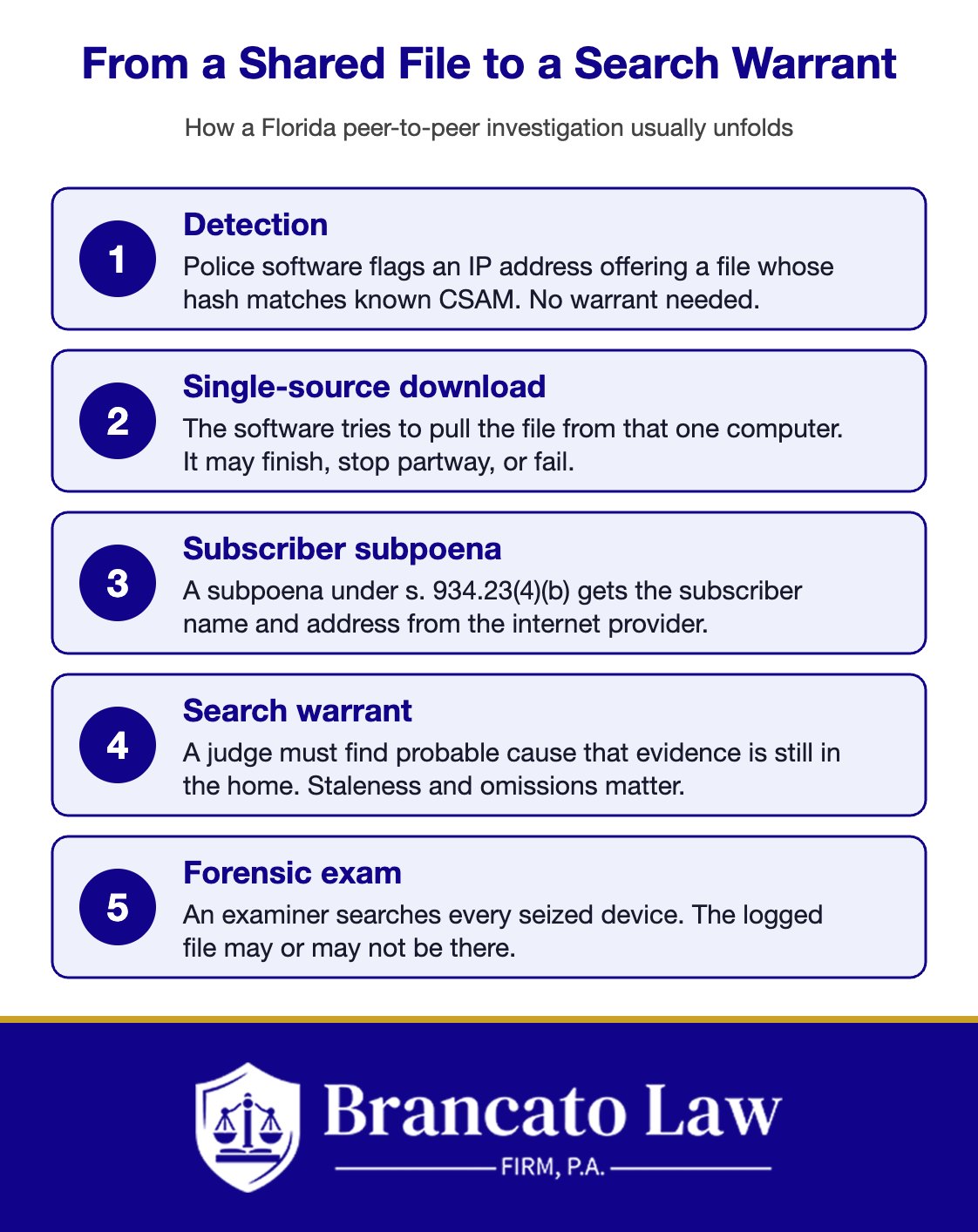
An IP address becomes a search warrant in three steps: police log the address, subpoena the internet provider for the subscriber’s name and service address, and then present both to a judge in a search warrant affidavit. No warrant is needed for the subscriber records.
Florida law lets officers get those records with a subpoena. Under section 934.23(4)(b), Florida Statutes, a provider must disclose a subscriber’s name, address, records of session times, and “any temporarily assigned network address” when the government uses a subpoena, and subsection (4)(c) says the officer does not have to notify the subscriber. Federal agents use the matching provision, 18 U.S.C. section 2703(c)(2). A person often learns of the investigation for the first time when officers arrive with the warrant.
| Step | What police do | Legal process needed | What our attorneys examine |
|---|---|---|---|
| 1. Detection | Software flags an IP address offering a file with a known hash | None, under Youngman and Ewing | Software version, logs, and whether it reached only shared files |
| 2. Download | Software tries to pull the file from that one computer | None | Whether the download was complete, partial, or failed |
| 3. Subscriber records | Subpoena to the internet provider | Subpoena under s. 934.23(4)(b) | Whether the IP address and time match the subscriber records exactly |
| 4. Search warrant | Affidavit ties the IP address to a home | Warrant based on probable cause | Staleness, accuracy, and what the affidavit left out |
| 5. Forensic exam | Examiner images and searches every device | The warrant’s scope | Which device, which user, and whether the logged file is there at all |
The time between steps 1 and 4 matters. Months can pass between a logged download and a warrant, and the affidavit has to show a fair probability that evidence is still in the home when the judge signs it. Our post on a Florida reversal for a stale child pornography search warrant shows how timing can sink a case.
Can the Defense Test the Police Software?
Sometimes. Courts have ordered disclosure when the defense makes a specific showing that the software may have misreported what it downloaded, and have refused when the request rests on speculation. The government usually resists turning over the program itself, calling it proprietary and sensitive, so the defense has to build the request carefully.
The leading case for the defense is United States v. Budziak, 697 F.3d 1105 (9th Cir. 2012), where the FBI used an enhanced peer-to-peer program to download files from the defendant’s shared folder. His expert offered evidence that agents may have downloaded only fragments from his “incomplete” folder, or overridden his sharing settings. The Ninth Circuit held that denying him access to the program was an abuse of discretion.
The other side of the line is United States v. Owens, 18 F.4th 928 (7th Cir. 2021). Torrential Downpour twice logged a download of a video from an IP address tied to Thomas Owens, but agents never found that video on his computer. He asked for the program and its source code to prove a false positive. The Seventh Circuit affirmed the denial because other forensic evidence, including the torrent opened in his file-sharing program and the file’s name in his recently used folder, tied him to the video anyway. Courts in the First, Second, Sixth, and Eighth Circuits have also denied access on records where the defense could not point to a concrete flaw, according to the Owens opinion’s survey.
A bare request for source code usually fails. A request backed by a forensic examiner’s findings, such as a logged file that is missing from every seized device or file dates that come after the police download, has a real chance. Our attorneys work with independent digital examiners through our Tampa criminal forensic science attorney practice to find those concrete gaps first, then ask for the logs, the software’s configuration, and a demonstration.
Why Does a Partial or Single-Source Download Matter?
A partial download matters because the State’s case often rests on what police say they received from one specific computer. Normal BitTorrent downloads gather pieces from many users at once, so a file assembled that way does not prove any single computer held the whole thing. Police software is built to force a single-source download from one IP address, which is stronger evidence, but those downloads sometimes fail or finish only in part.
Ewing describes the mechanics: BitTorrent’s “choking” algorithm normally spreads a download across many users, and Torrential Downpour overrides it to pull a file from one source. In Youngman, the sheriff’s office “was unable to complete the download of the media” at all and got a warrant based on the hash values alone, which the Second District accepted because hash matching identifies known files with near certainty. So a failed or partial download does not, by itself, defeat a warrant in Tampa Bay.
It can still matter at trial. A warrant needs only a fair probability; a conviction needs proof beyond a reasonable doubt that this person knowingly possessed the material. When the logged file is missing from the seized devices, as in Owens, or the download was only a fragment, as the expert suggested in Budziak, the gap between what police logged and what the forensic exam found becomes a central defense question.
Who Gets Charged When Several People Share the Wi-Fi?
An IP address identifies an internet connection, not a person, so the subscriber is not automatically the user. In a home with roommates, family members, guests, or an open network, the State has to connect a specific person to the files through evidence such as user accounts, device ownership, timing, and statements.
McClelland v. State, 255 So. 3d 929 (Fla. 2d DCA 2018) shows how wrong the first assumption can be. Polk County detectives searched a house tied to an IP address sharing CSAM and found that none of its devices had been used to download or share the files. The homeowner’s Wi-Fi was not password-protected. Detectives then monitored the network, traced the device’s MAC address with a directional antenna to a motorhome parked nearby, and found the files on the neighbor’s computer. The Second District held that the neighbor had no privacy interest in signals he used to access someone else’s network without permission. The homeowner, the subscriber of record, was not the person charged.
Hypothetically, say four roommates in a Brandon rental share one router and one internet account in a single name. Police log a download from that account. The search warrant will cover the whole house, but the State still has to prove which roommate’s laptop held the files, who logged into it, and whether that person knew what was there. Our attorneys build a timeline of who was home and which device was online at each logged time, using router records, work schedules, phone location data, and the forensic exam itself.
What Does the State Have to Prove About Sharing?
For possession, the State must prove the person knowingly possessed, controlled, or intentionally viewed material he or she knew contained CSAM, under section 827.071(5), Florida Statutes. For transmission, Florida asks a different and lower question: whether the person “knew or reasonably should have known” he or she was transmitting the material, under section 847.0137, Florida Statutes. These are sexual offense charges, and our Tampa sex crimes lawyer page explains the penalties and sex offender registration consequences that come with them.
| Charge | Statute | Degree | Point that matters in a file-sharing case |
|---|---|---|---|
| Possession, control, or intentional viewing of CSAM | s. 827.071(5) | Second-degree felony, each image and each child a separate count | Each file in a shared folder can be charged separately |
| Possession with intent to promote | s. 827.071(4) | Second-degree felony | Three or more copies of the same item is prima facie evidence of intent to promote |
| Transmission of CSAM | s. 847.0137(2) | Second-degree felony, 5-year mandatory minimum for adults unless the court makes the subsection (7) findings | “Transmit” includes providing access for others to receive the file |
Federal law is stricter on the government. In United States v. Carroll, 886 F.3d 1347 (11th Cir. 2018), the Eleventh Circuit reversed a federal distribution conviction because the government offered no evidence that the defendant knew his Ares program automatically shared his downloads. The court refused to treat file-sharing users as strictly liable, while noting that a program that prompts users to choose sharing would make ignorance hard to claim. The Florida transmission statute’s “reasonably should have known” wording gives prosecutors more room, so our attorneys look closely at how the specific program was installed, what settings it showed, and what the user actually did.
BitTorrent programs often leave the same video in a download folder and a completed folder, and forensic tools may count thumbnails and fragments too. Our attorneys and our examiners count unique files, not tool hits, before any discussion of intent to promote.
How Large Is the Police Effort Behind These Cases?
In 2025, ICAC task forces conducted nearly 347,000 investigations that led to the arrest of more than 17,000 offenders, according to the U.S. Office of Juvenile Justice and Delinquency Prevention, which funds the program’s 61 task forces.
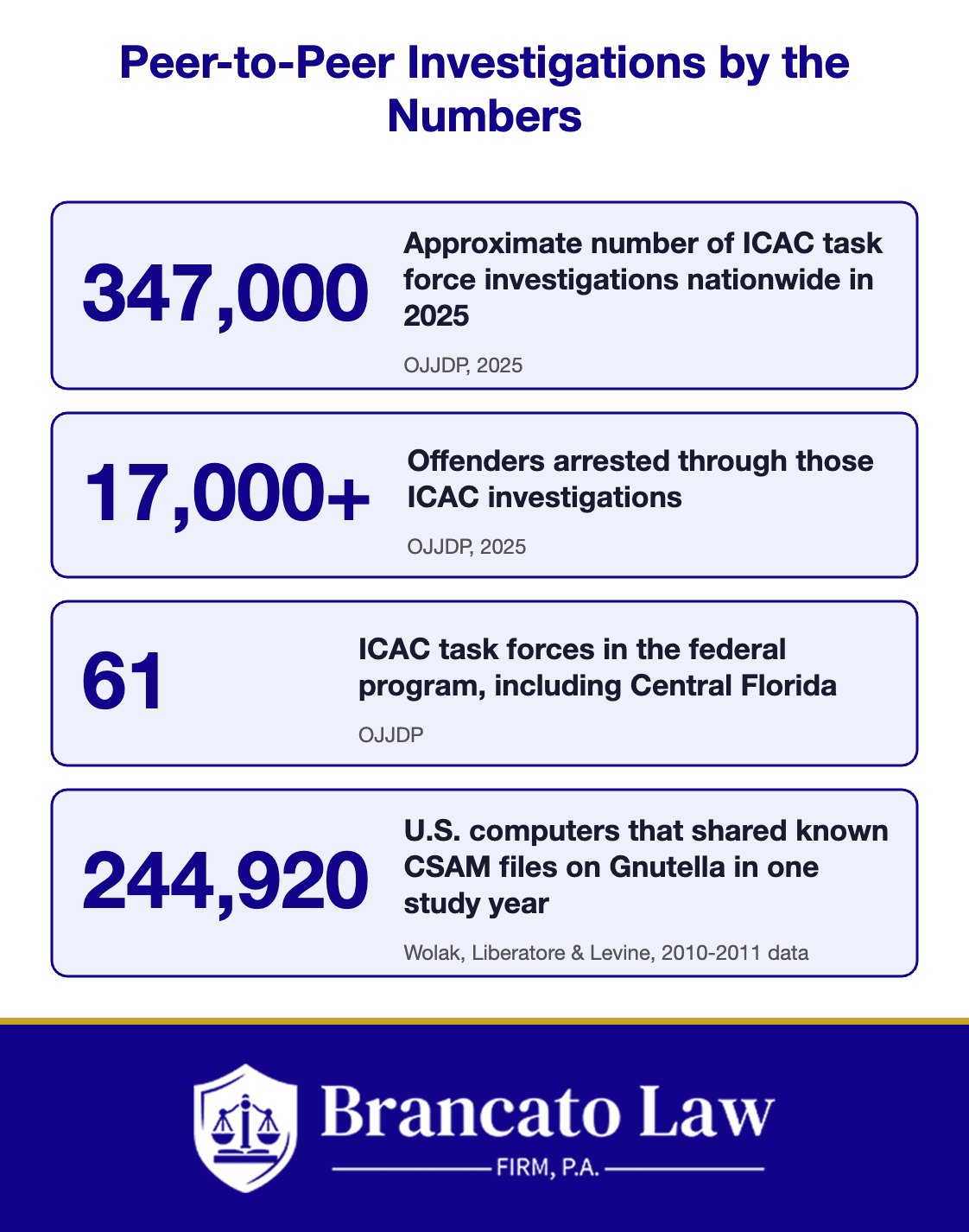
The most cited measurement of peer-to-peer trafficking is older but still telling. A study by Janis Wolak, Marc Liberatore, and Brian Neil Levine, published in Child Abuse & Neglect in 2013, used law enforcement data from October 2010 to September 2011 and found that 244,920 U.S. computers shared known CSAM files on the Gnutella network during that year, according to the authors’ published paper. Less than 1% of those computers, 915 in all, contributed most of the files. The authors called their counts lower-bound estimates. The study shows how the software works at scale, and it also shows why an individual case needs individual proof: most flagged computers offered very few files.
What Should You Do If Police Come With a Warrant?
Stay calm, do not answer questions, and ask for a lawyer. Officers serving a peer-to-peer warrant often bring a forensic examiner and ask friendly questions while the search happens, because a statement like “that’s my laptop” or “I use BitTorrent for movies” can supply the knowledge and identity proof the logs cannot.
Say this, not that, when officers serve a search warrant
- Say: “I’m not going to answer questions. I want a lawyer.”
- Say: “I don’t consent to any search beyond the warrant.”
- Don’t say who uses which device, whether you use BitTorrent, or what you have downloaded.
- Don’t give passwords or unlock a phone or computer without talking to a lawyer.
- Don’t delete files, reset devices, or uninstall programs; that can lead to a tampering charge.
Write down who came, what they took, and what they said, and keep the warrant and inventory. If you suspect an investigation before anyone knocks, our representation before charges are filed lets our attorneys deal with investigators early. Our guide to how a Florida criminal case moves from investigation to trial explains what comes next.
How Do Our Attorneys Defend Peer-to-Peer Cases?
Our attorneys defend these cases by comparing what police logged against what the devices actually show. A defense built on that comparison can lead to suppression, dropped counts, or a dismissal. The checklist below is where we start, and our Tampa internet crimes attorney page explains how we handle these charges from investigation through trial.
- Get the software’s records: the download log, hash list, software version, and any video or report of the session.
- Match every logged IP address and time to the provider’s subscriber records, down to the time zone.
- Find out whether each logged download was complete, partial, or failed, and from how many sources.
- Test the warrant affidavit for staleness and for facts it left out, such as an open Wi-Fi network or other residents.
- Have an independent examiner, working at the agency where the devices are held, determine which device, which user account, and which program touched each file.
- Count unique files, separate thumbnails and fragments, and challenge any inflated count before scoring.
The defense does not get its own copy of the seized computer or phone in these cases. The State treats the files as contraband and will not release a forensic image, so our attorneys review the evidence at the agency, send our forensic expert there to examine it, or both. That review has to be scheduled early, because every hour of examination happens on the agency’s premises and on its calendar.
Frequently Asked Questions About BitTorrent Investigations in Florida
Can police get my name from my IP address without a warrant in Florida?
Yes. Section 934.23(4)(b) requires an internet provider to give police a subscriber’s name, address, and assigned network address in response to a subpoena, with no notice to the subscriber. The Brancato Law Firm checks that the subpoenaed records match the logged time exactly, because a wrong time or time zone can point to the wrong household.
Does an incomplete BitTorrent download count against me in Florida?
It can support a search warrant, as Youngman shows, even when police never finished downloading the file. At trial, our attorneys at The Brancato Law Firm use the gap between a failed or partial download and the forensic results to challenge whether the State can prove knowing possession.
Can I be charged for files that BitTorrent shared automatically?
You can be charged with transmission under section 847.0137 if the State says you knew or reasonably should have known the files were being shared. Because federal courts require proof of actual knowledge, as the Eleventh Circuit held in Carroll, The Brancato Law Firm’s attorneys examine the program’s settings and prompts to show what a user would really have understood.
Can my lawyer get the police software tested?
Sometimes, if the defense first shows a concrete reason to doubt it, such as a logged file missing from every seized device. When the forensic exam reveals that kind of gap, our attorneys at The Brancato Law Firm ask for the logs, configuration, and a demonstration through our digital forensic defense team.
Can peer-to-peer child pornography charges be dropped in Florida?
Yes. Charges can be dropped or reduced when the warrant is suppressed, the identity evidence points to someone else on the network, or the file counts fall apart under forensic review. Building that record early, often before an arrest, is the focus of The Brancato Law Firm’s pre-file advocacy.
How long after a BitTorrent download do police serve a search warrant?
It varies, and it is often weeks or months, because the subpoena and affidavit take time. At The Brancato Law Firm, we measure that gap against the warrant’s facts, since an affidavit that does not show the files were likely still there can be stale.
Who is charged when the internet account belongs to a parent or landlord?
Whoever the evidence shows knowingly possessed the files, which is not necessarily the account holder. In McClelland, the person charged was a neighbor using an open network, and The Brancato Law Firm builds the same kind of device-and-timeline proof when a household shares one connection.
Sources
- Youngman v. State, 342 So. 3d 770 (Fla. 2d DCA 2022)
- United States v. Ewing, 140 F.4th 1339 (11th Cir. 2025)
- United States v. Budziak, 697 F.3d 1105 (9th Cir. 2012)
- United States v. Owens, 18 F.4th 928 (7th Cir. 2021)
- McClelland v. State, 255 So. 3d 929 (Fla. 2d DCA 2018)
- United States v. Carroll, 886 F.3d 1347 (11th Cir. 2018)
- Section 934.23, Florida Statutes; section 827.071; section 847.0137
- 18 U.S.C. section 2703
- OJJDP, Internet Crimes Against Children Task Force Program
- Wolak, Liberatore & Levine, Measuring a Year of Child Pornography Trafficking by U.S. Computers on a Peer-to-Peer Network, Child Abuse & Neglect (2013)
Talk to a Tampa Defense Attorney About a File-Sharing Investigation
The software log and the subscriber records are fixed early, the seized devices can be examined only at the agency, and the defense needs that review finished before deadlines for motions pass. Call The Brancato Law Firm, P.A., founded by Tampa Criminal Defense Attorney Rocky Brancato, at (813) 727-7159; you can call us at any hour, and our office is two blocks from the courthouse. Our firm has Spanish-speaking staff, and attorney Jean-Luc Adrien speaks Spanish, Haitian Creole, and French.
For more about our defense strategies, visit our Internet Crimes and Sex Crimes pages.
The Brancato Law Firm, P.A.
620 E. Twiggs Street, Suite 205, Tampa, FL 33602
(813) 727-7159
Serving Hillsborough, Pinellas, and Pasco Counties
The Brancato Law Firm, P.A. is a Tampa-based criminal defense practice. We are not affiliated with any other Brancato-named law firms.
Visit Us

Tampa, FL 33602

Contact Us Now
Free Legal Consultation (813) 727-7159
