

From First DUI to Death Penalty



What Happens After a CyberTip Report in Florida? (2026)


Quick answer: After a tech company flags a file as suspected child sexual abuse material, it sends a CyberTip to the National Center for Missing and Exploited Children (NCMEC), which reviews it and forwards it to police where the account appears to be located. Florida officers then subpoena the subscriber records, often visit the home for a “knock and talk,” and seek search warrants for the account and devices, sometimes months after the upload. The key defense questions are whether police opened files no one at the company had viewed, whether the warrant affidavit described the files well enough, and whether anything the person said at the door filled the gaps.
A Florida judge reviewing a CyberTip case usually decides the suppression motion on two questions: did the police look at anything the company had not already looked at, and did the warrant affidavit give the judge enough to decide for herself what the files showed. I have argued those questions in more than 25 years in Hillsborough County courtrooms, and I first saw how these investigations are built as an attorney in the Major Crimes Unit handling sex crime and child abuse cases. I’m Rocky Brancato, founder of The Brancato Law Firm, P.A., a Tampa criminal defense firm. When a client calls about a CyberTip, our attorneys start by getting the report itself, because its file-by-file details decide which motions are possible.
This guide is part of our series on police surveillance in Florida. It follows a CyberTip from the company’s scan to the search warrant. For the full defense of a charged case, including knowledge, file counts, and Florida’s July 2026 penalty changes, see our guide to fighting a child pornography charge in Florida.
What Is a CyberTip?
A CyberTip is a report to NCMEC’s CyberTipline, the national clearinghouse for suspected online child sexual exploitation. Under 18 U.S.C. section 2258A, an electronic service provider must report apparent child sexual abuse material (CSAM) “as soon as reasonably possible after obtaining actual knowledge” of it. The report may include the user’s email address, IP address, upload times, location information, and the files themselves.
The same statute says nothing in it requires a provider to “monitor any user” or to “affirmatively search, screen, or scan” for this material. Most large platforms scan anyway, which is why nearly every CyberTip that reaches a Florida detective starts with a company such as Google, Meta, Snapchat, or Microsoft rather than a member of the public. The usual tool is hash matching: the company computes a digital fingerprint of each uploaded file and compares it with a list of fingerprints of images its staff, or another organization, already identified as CSAM.
How much a person at the company actually saw varies by company and by file. In United States v. Brillhart, 181 F.4th 1181 (11th Cir. 2026), a Fort Myers Police Department case, Google confirmed three files in the defendant’s email accounts by human review and a fourth only by hash match to a file a Google employee had reviewed in another user’s account. That difference became the center of the appeal.
How Many CyberTips Are There?
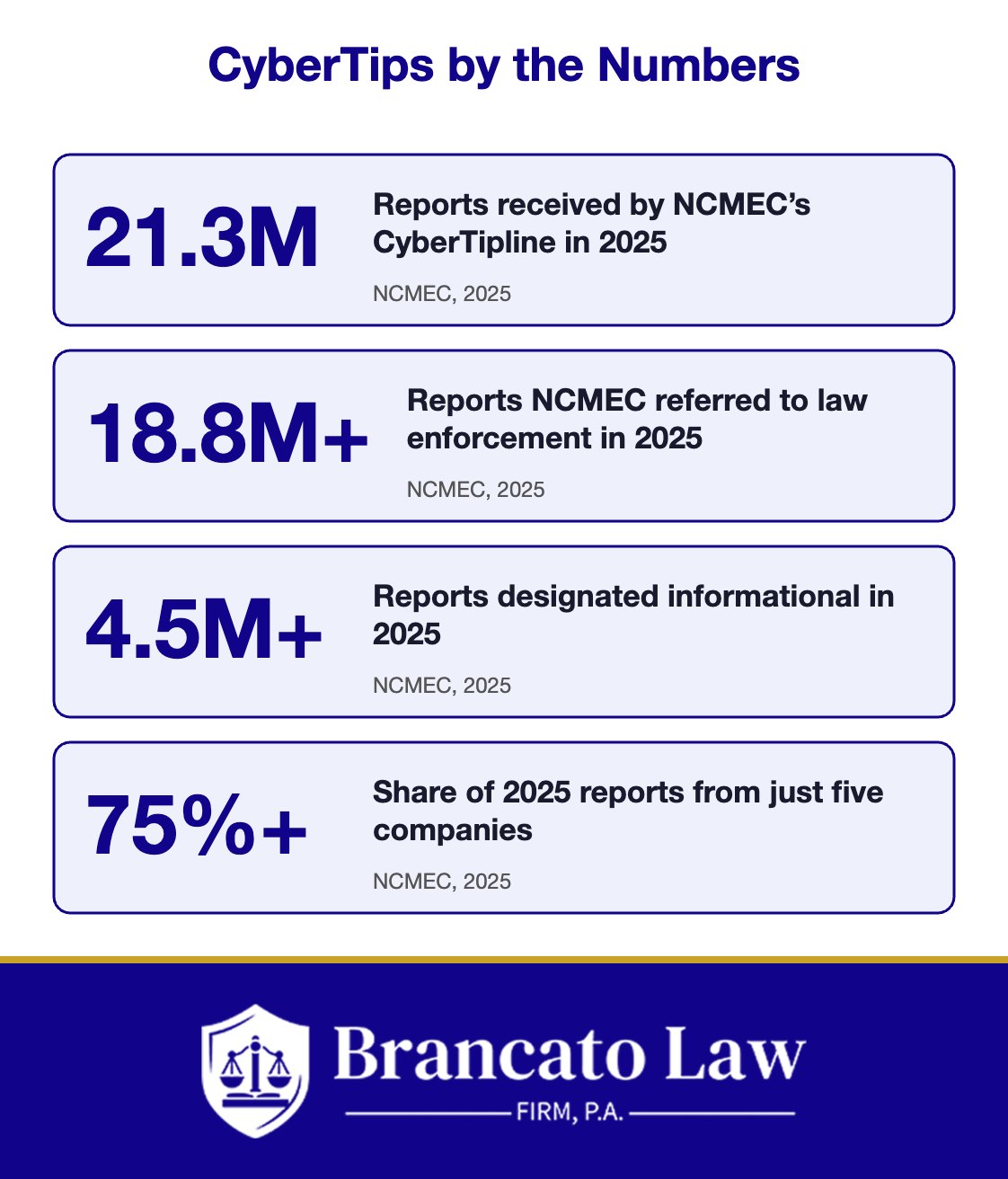
There are millions every year. In 2025, NCMEC’s CyberTipline received 21.3 million reports, referred more than 18.8 million of them to law enforcement, and designated more than 4.5 million as informational when making them available to police, according to NCMEC’s 2025 CyberTipline data. Just over 300 companies submitted reports that year, and five companies accounted for more than 75% of them.
A 2024 Stanford Internet Observatory report on the CyberTipline, based on interviews with 66 people across industry, law enforcement, and civil society, found that officers are “overwhelmed by the high volume” of reports and that “many reports are low quality.” It also found that platforms often do not say whether anyone viewed a reported file, which leaves police deciding whether they need a warrant just to look. Those are the same gaps our attorneys look for in a client’s report.
What Happens After a CyberTip Is Sent?
After a provider submits a CyberTip, NCMEC reviews it, tries to locate the user, and makes it available to the law enforcement agency where the account appears to be. Under section 2258A(c), NCMEC makes reports available to federal, state, or local agencies that investigate child sexual exploitation; the Tampa Police Department’s Cyber Crimes squad, for example, is part of the Central Florida ICAC Task Force, according to the department. From there, cases tend to follow the same path.
| Stage | What happens | What our attorneys look at |
|---|---|---|
| 1. Detection | A platform’s scan or a user report flags a file | Whether a person at the company viewed each file or only a hash matched |
| 2. Report | The provider sends the CyberTip to NCMEC | The report’s “reviewed” answers, labels, upload times, and IP addresses |
| 3. NCMEC review | NCMEC reviews the report and routes it to police | Whether NCMEC opened files the company had not viewed |
| 4. Police review | A detective reads the tip and may open the files | Whether the detective went beyond what the company saw, without a warrant |
| 5. Subpoena | Subscriber records tie the IP address to a home | Whether the account holder is really the user |
| 6. Knock and talk | Detectives visit, ask questions, and ask for consent | Every statement and consent, which can supply missing proof |
| 7. Warrants | Warrants for the account, the home, and devices | Probable cause, staleness, and scope |
The gap between steps 1 and 7 can be long. In United States v. Gibbs, No. 24-12448 (11th Cir. Sept. 17, 2026), a Tallahassee case, the tip reported an upload on or about June 15, 2022, and the detective reviewed it on October 26, 2022. Federal law now treats a completed CyberTip as a request that the company preserve the report’s contents for one year, under section 2258A(h). The Stanford report, written earlier in 2024, described a 90-day period that often ran out before police followed up.
Is NCMEC Part of the Government?
At least one federal appeals court says yes, which matters because the Fourth Amendment limits only government searches. In United States v. Ackerman, 831 F.3d 1292 (10th Cir. 2016), AOL’s filter matched one of four images attached to an email, and an NCMEC analyst opened the email and all four attachments. Writing for the court, then-Judge Neil Gorsuch held that NCMEC is a governmental entity, and in that case a government agent, because “the dispositive question isn’t one of form but function.” Opening the email and the three attachments AOL never examined exceeded AOL’s private search.
The Eleventh Circuit, which covers Florida, has not decided NCMEC’s status. In United States v. Williamson, No. 24-12038 (11th Cir. June 30, 2026), an unpublished decision from a North Port investigation, the court found it unnecessary to decide because NCMEC reviewed only files Yahoo had already viewed. That leaves the question open for a Florida case where NCMEC opened something the company did not.
Did Police Need a Warrant to Open the Flagged Files?
It depends on what the company’s search covered. Under the private search doctrine, police may repeat a search a private party already did without a warrant, but they need a warrant to go further. Courts ask whether there was a “virtual certainty” that the officer would learn nothing beyond what the private search revealed, the test the Eleventh Circuit applied in Brillhart.
Federal appeals courts are split on whether a hash match alone counts as that private search. The table below shows where things stand as of November 2026.
| Court | Case | Answer |
|---|---|---|
| Fifth Circuit | United States v. Reddick, 900 F.3d 636 (5th Cir. 2018) | Yes; hash matching is a private search |
| Sixth Circuit | United States v. Miller, 982 F.3d 412 (6th Cir. 2020) | Yes |
| Ninth Circuit | United States v. Wilson, 13 F.4th 961 (9th Cir. 2021) | No; a hash match cannot stand in for human viewing |
| Second Circuit | United States v. Maher, 120 F.4th 297 (2d Cir. 2024) | No |
| Fourth Circuit | United States v. Lowers, 170 F.4th 134 (4th Cir. 2026) | No |
| Eleventh Circuit (federal courts in Florida) | Brillhart (2026) | Yes, where a person at Google had reviewed the matching file; fully automated flags left undecided |
| Florida First District | Morales v. State, 274 So. 3d 1213 (Fla. 1st DCA 2019) | Yes, as an alternative holding |
| Florida Second District (Tampa Bay) | No decision on point found | Open |
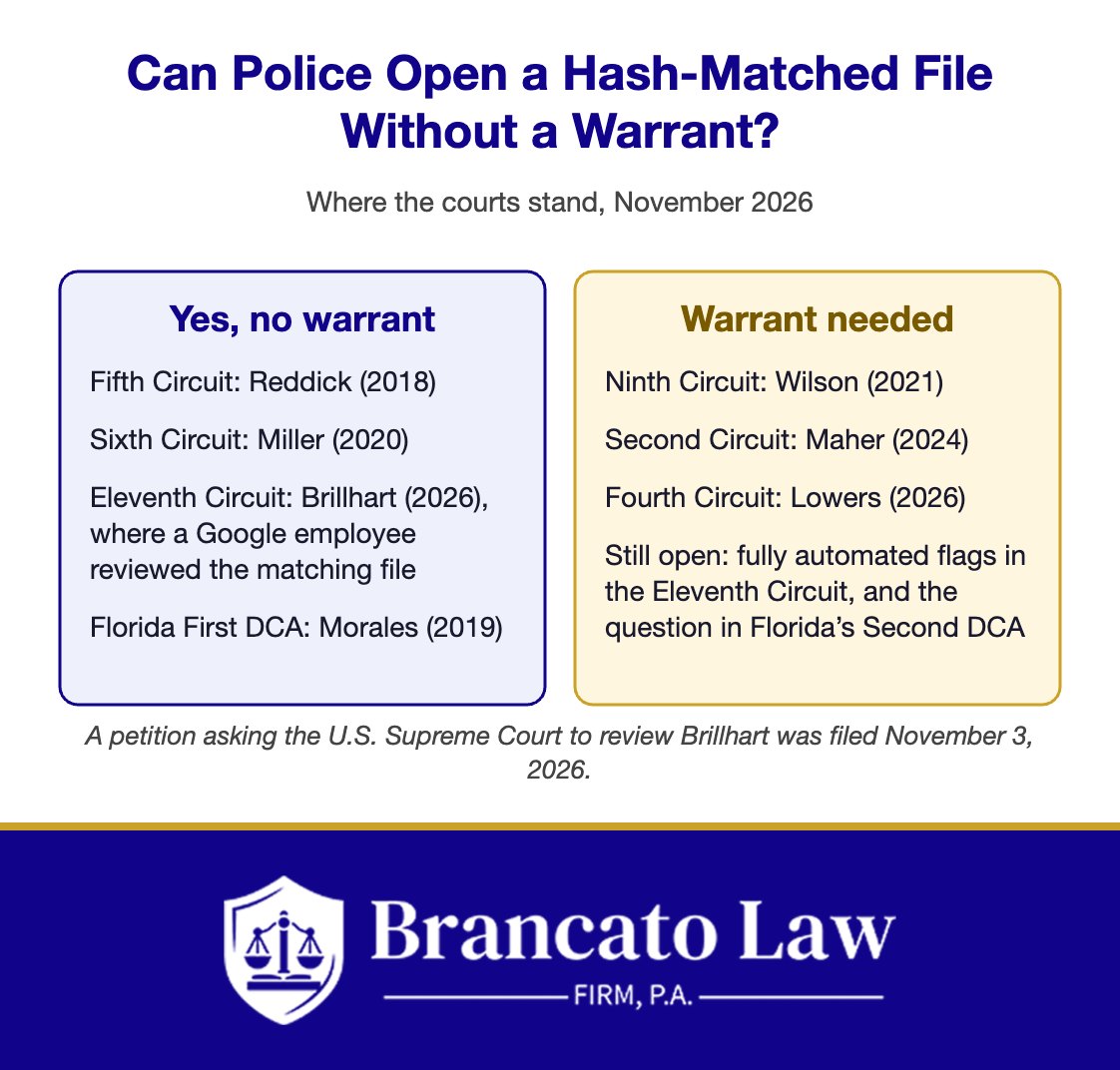
Brillhart is now the most important case for Florida federal prosecutions. The court sided with the Fifth and Sixth Circuits, reasoning that Google’s hash matching “simply used a computer to save one flesh-and-blood individual the trouble” of confirming what another person had already concluded. But it stressed that a Google employee reviewed the matching file first, and it said it “needn’t decide whether the Fourth Amendment requires that a qualifying private search entail human involvement.” A CyberTip built on a fully automated classifier, with no human ever reviewing a matching image, is still an open question in the Eleventh Circuit.
Richard Brillhart filed a petition asking the U.S. Supreme Court to review the decision on November 3, 2026, and the government’s response is due December 10, 2026, according to the Supreme Court’s docket in No. 26-6129. With five federal circuits divided, our attorneys preserve the hash-match issue in every case where it applies, so a client can benefit if the Court takes it up.
Florida’s state courts are not bound by Brillhart. In Morales, a Santa Rosa County case, no one at the chat service, Microsoft’s PhotoDNA, or NCMEC had opened the image before an FDLE agent did, and the First District upheld the agent’s look both because the defendant showed no privacy interest in an image he uploaded to an anonymous chatroom and, alternatively, under the private search doctrine. The Second District, whose decisions bind Hillsborough, Pinellas, and Pasco trial judges, has not decided the hash-match question in any decision we have found, so the argument is fully available in Tampa Bay. Our guide to fighting a child pornography charge in Florida explains how our attorneys build the motion from the report’s per-file review answers.
Is a CyberTip Enough for a Search Warrant?
Usually, if the affidavit describes what the company reported. The Second District treats a provider’s report as reliable and asks whether the judge could decide independently that the images are CSAM. In State v. McNeela, No. 2D2022-1418 (Fla. 2d DCA June 21, 2023), a Manatee County case, Microsoft reported four images uploaded through OneDrive, and the affidavit described each one in detail. The court reversed a suppression order, holding that Microsoft’s report was a presumptively reliable tip and the descriptions let the judge make the call.
The same opinion distinguished an earlier Second District case where the affidavit offered only a detective’s “conclusory assertion” that a photo was child pornography and nothing about the detective’s training. Our attorneys read every CyberTip affidavit for that flaw: a warrant that rests on a label instead of a description is vulnerable.
Federal courts may still admit the evidence under the good-faith exception. In Gibbs, the Eleventh Circuit assumed the affidavit did not establish probable cause, since it never described the files, but reversed suppression because the detective reasonably relied on a warrant based on a provider’s report, his experience with hundreds of CyberTips, and a police legal advisor’s approval. State and federal cases can come out differently on the same facts, which is one reason the forum matters.
Why Does the Knock and Talk Matter So Much?
The knock and talk matters because it is where people often supply the proof a CyberTip lacks. A CyberTip identifies an account and an IP address, not a person. When detectives come to the door, explain the report, and ask who uses the computer, the answers can connect a specific person to the files.
McNeela shows how this works. After the subpoena tied the IP address to the home, detectives told the man and his spouse about the report, and he said he was the primary user of the computer and agreed to let them look at it. The Second District said that the report, the image descriptions, and his own statements that he lived there and was the computer’s main user “alone established probable cause to search the computer.” Without his words, the State would have had an account and a house.
| Myth | Fact |
|---|---|
| If I explain, the detectives will drop it. | Statements at the door are often the evidence that ties a person to the account, as in McNeela. |
| A CyberTip proves someone at the company looked at the image. | Reports may rest on hash matches alone; the 2024 Stanford report found platforms often do not say whether a file was viewed. |
| If the company reported it, the evidence is automatically admissible. | Whether police could open unviewed files without a warrant is split nationally and open in the Second District. |
| Deleting the account ends the problem. | Current federal law treats a completed CyberTip as a request to preserve its contents for a year, and deleting files after learning of an investigation can bring a tampering charge. |
What If the CyberTip Involves a Teen?
Many CyberTips involve teenagers who shared or received images of each other, and the same reporting system applies. A platform that detects the image reports it the same way, and the case can land in juvenile court or, for a young adult, adult court. Chapter 4 of our free guide for families, Images: Sexting, Sextortion, and Deepfakes, explains in plain language what teens and parents should do when an image is shared, reported, or used for sextortion.
Florida’s transmission statute, section 847.0137, Florida Statutes, carries a five-year mandatory minimum for adults, but subsection (7) lets a judge skip it on written findings that the child was 14 or older, the image was made with permission, the offender was no more than four years older, and the image was not sent to anyone else. Those facts need to be developed early, before charging decisions.
Can a CyberTip Be Wrong?
Yes. A CyberTip is a report, and its labels and its claims about human review can be wrong, including on whether the person pictured is a minor. Our guide to fighting a child pornography charge in Florida describes a St. Johns County case in which charges were dropped after a report about adult images, and how our attorneys check each file’s label and review status with an independent examiner.
What Should You Do If You Learn About a CyberTip?
Do not talk to detectives, consent to a search, or delete anything, and call a defense attorney. Many people first hear about a CyberTip when detectives knock, and the visit is designed to get statements and consent before a warrant. If you are contacted before charges, our representation before charges are filed lets our attorneys speak with investigators for you and protect the motions described above.
- Say you will not answer questions without a lawyer, and do not explain who uses which device.
- Do not unlock phones or computers or give passwords.
- Keep any paperwork, business cards, or warrants officers leave.
- Write down what officers said about the report, including the platform and dates.
Our guide to how a Florida criminal case moves from investigation to trial explains what comes after an arrest, and our Tampa internet crimes attorney page describes how our firm defends these charges. Because these files are charged as sexual offenses, our Tampa sex crimes lawyer page covers the penalties and registration consequences that follow. Investigations that start on peer-to-peer networks follow a different path, covered in our guide to whether police can see your BitTorrent files in Florida.
Frequently Asked Questions About CyberTips in Florida
How long after a CyberTip do Florida police show up?
It varies from days to many months. In Gibbs, more than four months passed between the reported upload and the detective’s review. The Brancato Law Firm measures that delay against the warrant affidavit, because an old tip with nothing newer can make a warrant stale.
Can police open my Google or Snapchat files without a warrant if the company flagged them?
Sometimes. In federal court in Florida, Brillhart allows it when a company employee had reviewed the matching file, while other circuits require a warrant for files no person viewed. Our attorneys at The Brancato Law Firm compare the report’s per-file answers with every file the detective opened.
Does a CyberTip mean I will be arrested?
No, not automatically. A CyberTip starts an investigation, and NCMEC designated more than 4.5 million 2025 reports as informational rather than referrals. When a client hears about a tip before any arrest, The Brancato Law Firm’s pre-file advocacy focuses on keeping statements and consent out of the State’s file.
Does the Eleventh Circuit’s Brillhart decision apply in Florida state court?
No. Florida state courts follow the U.S. Supreme Court and Florida’s own appellate courts, not the Eleventh Circuit, so Brillhart binds federal judges in Florida but not a Hillsborough circuit judge. The Brancato Law Firm argues the hash-match question in state court on its own terms, citing the circuits that require a warrant.
Can a CyberTip warrant be thrown out in Hillsborough County?
Yes, if the affidavit relies on a conclusory label instead of describing the files, the information is stale, or police opened files beyond the company’s search. Because the Second District has not decided the hash-match question, The Brancato Law Firm raises it in Tampa internet crimes defense cases where the report shows unviewed files.
Can CyberTip charges be dropped in Florida?
Yes. Charges can be dropped or reduced when files are suppressed, the user cannot be identified beyond the account holder, or an examiner shows the images do not depict minors. The Brancato Law Firm builds those defenses from the report, the subpoena returns, and an expert examination of the seized devices, done at the agency because the State will not release copies of contraband files.
Sources
- 18 U.S.C. section 2258A; section 847.0137, Florida Statutes
- United States v. Brillhart, 181 F.4th 1181 (11th Cir. 2026)
- United States v. Gibbs, No. 24-12448 (11th Cir. Sept. 17, 2026)
- United States v. Williamson, No. 24-12038 (11th Cir. June 30, 2026) (unpublished)
- United States v. Ackerman, 831 F.3d 1292 (10th Cir. 2016)
- State v. McNeela, No. 2D2022-1418 (Fla. 2d DCA June 21, 2023)
- Morales v. State, 274 So. 3d 1213 (Fla. 1st DCA 2019)
- NCMEC, CyberTipline Data (2025)
- Stanford Internet Observatory, How to Fix the Online Child Exploitation Reporting System (2024)
Talk to a Tampa Defense Attorney About a CyberTip
If detectives have mentioned a CyberTip, or left a card at your door, the next conversation matters more than any other. Our attorneys can contact investigators, request the report, and protect your right to challenge the search. The Brancato Law Firm, P.A. was founded by Tampa Criminal Defense Attorney Rocky Brancato; call (813) 727-7159 at any hour. Our firm has Spanish-speaking staff, and attorney Jean-Luc Adrien speaks Spanish, Haitian Creole, and French.
For more about our defense strategies, visit our Internet Crimes page.
The Brancato Law Firm, P.A.
620 E. Twiggs Street, Suite 205, Tampa, FL 33602
(813) 727-7159
Serving Hillsborough, Pinellas, and Pasco Counties
The Brancato Law Firm, P.A. is a Tampa-based criminal defense practice. We are not affiliated with any other Brancato-named law firms.
Visit Us

Tampa, FL 33602

Contact Us Now
Free Legal Consultation (813) 727-7159
