

From First DUI to Death Penalty



Do You Get Out-of-State Jail Credit in Florida? (2026)



Fully rewritten and updated November 14, 2026. Previously updated November 8, 2026. Originally published January 16, 2026.
| Short answer: Florida does not guarantee credit for time spent in jail in another state. Section 921.161 requires credit only for time in a Florida county jail, and the Florida Supreme Court held in Kronz v. State that credit for out-of-state time is up to the sentencing judge, who should consider it when the person was held there solely because of the Florida charge. The request belongs at sentencing. After sentencing, the Second District Court of Appeal requires a timely Rule 3.850 motion, usually alleging ineffective assistance of counsel, filed within two years after the judgment becomes final. |
If you were picked up in another state on a Florida warrant and sat in that state’s jail waiting to be brought back, every one of those days should be raised before the judge pronounces sentence. I spent more than 25 years in Hillsborough County courtrooms before and after founding The Brancato Law Firm, P.A., a Tampa criminal defense firm, including as former Chief Operations Officer of the Hillsborough County Public Defender’s Office, where I oversaw a staff of over 100 attorneys. Our attorneys gather the out-of-state booking records and argue for that credit at sentencing, and when it was missed, we evaluate whether a postconviction motion can still recover it.
Do you get credit for time served in another state in Florida?
Sometimes, but it is not automatic. Section 921.161(1), Florida Statutes, requires a judge to give credit “for all of the time she or he spent in the county jail before sentence,” and the Florida Supreme Court read “county jail” to mean a Florida county jail. Time in another state’s jail falls under the judge’s discretion instead.
That rule comes from Kronz v. State, 462 So. 2d 450 (Fla. 1985). Kronz escaped from a Florida jail, was arrested in South Carolina on a fugitive warrant, fought extradition, and later pleaded guilty to escape. The Court held the statute mandates credit “only for time served in Florida county jails,” but that the trial judge has inherent authority to award credit for time served elsewhere while awaiting transfer, and “should consider the appropriateness” of credit when the defendant was jailed in the other state “solely because of the Florida offense.” The case went back to the trial judge to exercise that discretion.
| Where the time was served | Credit in Florida | Source |
|---|---|---|
| Florida county jail before sentence, on the same case | Required | s. 921.161(1) |
| Another state’s jail, held only on the Florida warrant or detainer | Up to the judge; should be considered | Kronz (Fla. 1985) |
| Another state’s jail on that state’s own charges | Up to the judge; a weaker request | Kronz (Fla. 1985) |
The Second District followed Kronz in McRae v. State, 820 So. 2d 1048 (Fla. 2d DCA 2002) (en banc), treating out-of-state credit as discretionary rather than an entitlement as a matter of law.
When should you ask for out-of-state jail credit?
Ask at sentencing, with proof. Because the credit is discretionary, the strongest moment is when the judge is deciding the sentence and can award it on the spot. Our attorneys bring certified booking and release records from the other state’s jail, the Florida warrant or detainer showing why the person was held, and any extradition paperwork showing whether the person waived or fought extradition. Kronz tells the judge to look hardest at whether the out-of-state custody was solely because of the Florida offense, so the records need to show that.
If the judge denies the request, the denial can be preserved and raised on direct appeal. Garnett v. State, 957 So. 2d 32 (Fla. 2d DCA 2007) (en banc) noted that a defendant “is certainly entitled to preserve and argue” on direct appeal that the court did not properly exercise its discretion.
What if out-of-state credit was missed at sentencing?
After sentencing, the usual route is a timely motion under Florida Rule of Criminal Procedure 3.850 alleging ineffective assistance of trial counsel. In Garnett, the defendant asked for credit for time held out of state on a fugitive warrant through a Rule 3.800(a) motion, which can be filed at any time. The Second District, sitting en banc, affirmed the denial because discretionary out-of-state credit is not “an entitlement” that Rule 3.800(a) can enforce. The court said the proper method “would normally require a timely allegation of ineffective assistance of trial counsel under rule 3.850,” such as a claim that counsel failed to request the credit or preserve the issue.
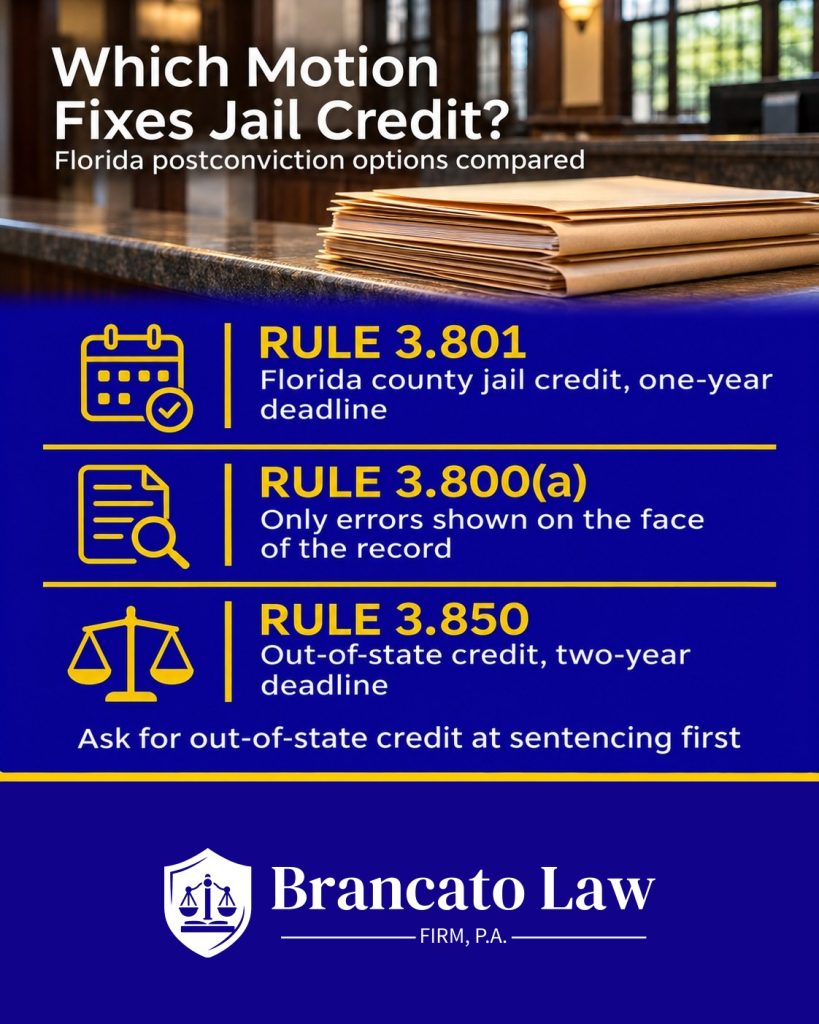
| Motion | What it fixes | Deadline | Out-of-state credit? |
|---|---|---|---|
| Rule 3.801 | Florida county jail credit the statute requires | One year after the sentence becomes final | Generally no |
| Rule 3.800(a) | Illegal sentences and credit errors shown on the face of the record | Any time | No, unless the record itself shows an entitlement |
| Rule 3.850 | Postconviction claims, including ineffective assistance of counsel | Two years after the judgment and sentence become final | Yes, the normal route |
What did Ghoneim v. State decide in 2026?
The Second District held that a court must treat an out-of-state credit claim filed under the wrong rule as if it had been filed under the right one. In Ghoneim v. State, 427 So. 3d 195 (Fla. 2d DCA 2026), Ehab Moustafa Ghoneim filed a Rule 3.801 motion in Pinellas County seeking credit for time he spent in jail in Cook County, Illinois. The circuit court summarily denied it because out-of-state credit generally has to be raised under Rule 3.850. The Second District agreed that Rule 3.850 is the proper vehicle, but reversed on January 16, 2026.
Relying on Gill v. State, 829 So. 2d 299 (Fla. 2d DCA 2002), which requires courts to treat a properly pleaded claim as if it were in a properly styled motion, the court held the claim should have been treated as a Rule 3.850 claim. Because Ghoneim filed within Rule 3.850(b)’s two-year limit, he was entitled to a chance to amend a facially insufficient claim under Rule 3.850(f)(2) and Spera v. State, 971 So. 2d 754 (Fla. 2007), where the Florida Supreme Court held that a timely postconviction movant should get at least one opportunity to amend. The court ordered that Ghoneim be allowed to file a facially sufficient Rule 3.850 motion within 60 days after the opinion became final.
The practical lessons: the label on a motion does not defeat a timely claim, but the two-year clock is what saved Ghoneim’s right to amend, and the claim still has to be pleaded correctly to win.
How many people does this affect in Hillsborough County?
Jail credit decides real time for a large number of people. The Florida Department of Corrections’ October 2025 Criminal Punishment Code report counted 27,171 prison admissions statewide from July 1, 2024 through June 30, 2025, and 1,351 of them were sentenced from Hillsborough County, the fourth-highest county in Florida (FDC report, page 46). Every one of those sentences carries a jail credit figure set by the sentencing judge.
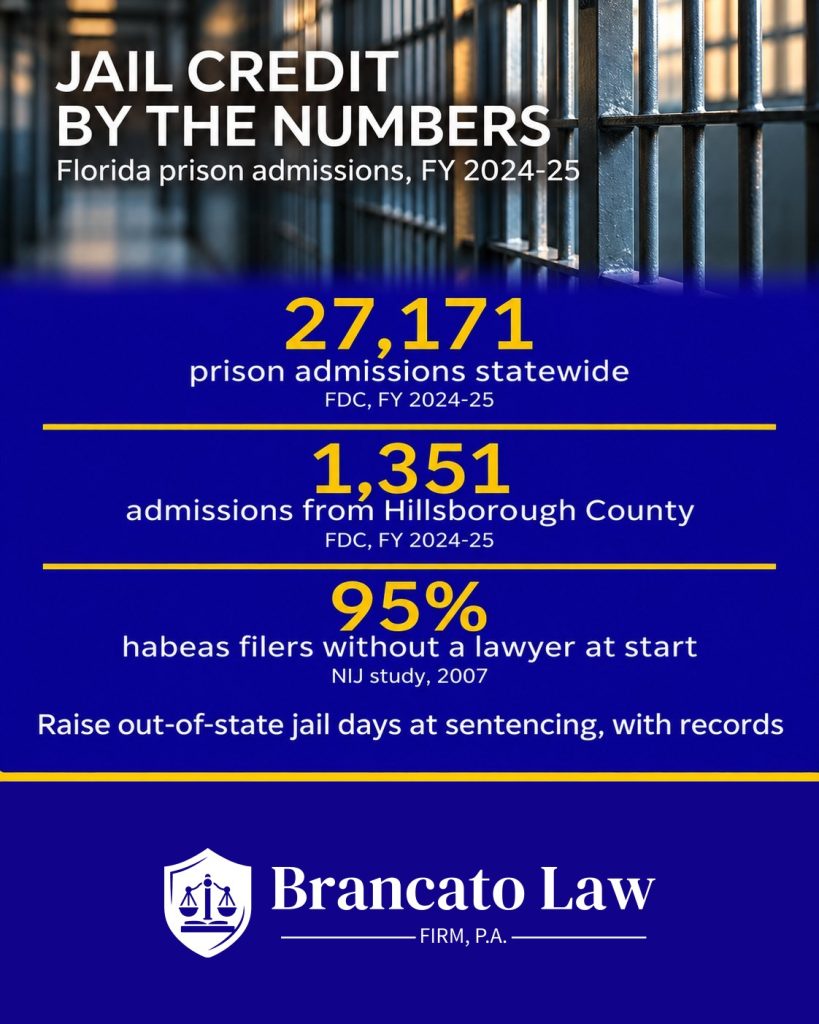
Most people who try to fix a sentence after the fact do it without a lawyer. A National Institute of Justice-funded study by Nancy J. King, Fred L. Cheesman II, and Brian J. Ostrom, Habeas Litigation in U.S. District Courts (2007), found that 95% of the state prisoners in its non-capital sample were pro se at the start of their federal habeas cases. Ghoneim filed his own motion too, under the wrong rule.
Hillsborough County is in the 13th Judicial Circuit, and its appeals go to the Second District Court of Appeal, along with Pinellas and Pasco cases, under section 35.03, Florida Statutes. That makes Ghoneim, Garnett, McRae, and Gill binding on the circuit judges our Hillsborough County criminal defense attorney team appears before. If you or a family member is in the Orient Road or Falkenburg Road Jail waiting on a Florida case after being held in another state, our guide to finding an inmate in the Hillsborough County jail explains how to confirm custody dates.
What records prove out-of-state jail time?
The best proof is a certified record from the out-of-state jail showing the booking date, release date, and the hold that kept the person there. Our attorneys usually gather:
- Certified booking and release records from the other state’s jail or sheriff.
- The Florida warrant, capias, or detainer, and the date it was lodged.
- Extradition paperwork, including any waiver of extradition or governor’s warrant.
- Proof of whether the other state had its own pending charges or sentence during the same days.
- The Florida judgment and sentence showing the credit actually awarded.
Days served only on the Florida hold make the strongest request under Kronz. Days that overlap with the other state’s own charges are harder to win. If you have an older Florida sentence that may have been miscalculated, our post on when the lowest permissible sentence exceeds the maximum covers another common sentencing error.
Frequently asked questions
Is a Florida judge required to give credit for jail time in another state?
No. Under Kronz v. State, credit for out-of-state jail time is discretionary, though the judge should consider it when the person was held solely on the Florida charge. The Brancato Law Firm presents certified out-of-state jail records at sentencing so the judge has a documented basis to award every eligible day.
Can I use a Rule 3.801 motion to get out-of-state jail credit?
Generally no; Rule 3.801 corrects credit the statute requires for Florida county jail time, and the Second District sends out-of-state credit to Rule 3.850. Under Ghoneim v. State, a timely claim filed under the wrong rule should be treated as a Rule 3.850 claim, and The Brancato Law Firm files under the correct rule from the start to avoid that detour.
What is the deadline to fix missed out-of-state jail credit in Florida?
A Rule 3.850 motion must be filed within two years after the judgment and sentence become final, with limited exceptions. Our attorneys at The Brancato Law Firm calculate that date first, because a timely motion also preserves the right to amend that saved the claim in Ghoneim.
Why do I have to claim ineffective assistance of counsel to get out-of-state credit?
Because out-of-state credit is discretionary, it is not an entitlement a court must correct at any time, so the postconviction claim is usually that trial counsel failed to request it or preserve it, as Garnett explains. The Brancato Law Firm reviews the sentencing transcript to see whether the credit was ever raised before drafting that claim.
Does time in another state’s jail on that state’s own charges count toward my Florida sentence?
Usually not as of right; Kronz focuses on time held solely because of the Florida offense, so overlapping out-of-state charges weaken the request. The Brancato Law Firm separates the days held only on the Florida warrant from the days held on the other state’s case, and our Hillsborough County defense attorneys argue for the days that qualify.
Can a family member gather out-of-state jail records before sentencing?
Yes, a family member can usually request booking and release records from the other jail or sheriff’s office, though each agency sets its own rules for certified copies. The Brancato Law Firm tells families exactly which records to request so they arrive before the sentencing hearing.
Get out-of-state jail time in front of the judge
Credit for out-of-state time is won or lost at the sentencing hearing, and after that the two-year Rule 3.850 clock starts once the judgment is final. Call The Brancato Law Firm, P.A., founded by Tampa Criminal Defense Attorney Rocky Brancato, at (813) 727-7159. Our attorneys will gather the other state’s jail records, raise every eligible day at sentencing, and review older sentences for a timely postconviction claim. Our firm has Spanish-speaking staff, and attorney Jean-Luc Adrien speaks Spanish, Haitian Creole, and French. Call us at any hour; our office is two blocks from the courthouse.
For more about our defense strategies, visit our Hillsborough County criminal defense page.
The Brancato Law Firm, P.A.
620 E. Twiggs Street, Suite 205, Tampa, FL 33602
(813) 727-7159
Serving Hillsborough, Pinellas, and Pasco Counties
The Brancato Law Firm, P.A. is a Tampa-based criminal defense practice. We are not affiliated with any other Brancato-named law firms.
Visit Us

Tampa, FL 33602

Contact Us Now
Free Legal Consultation (813) 727-7159
