

From First DUI to Death Penalty



Will a Law School Honor Code Violation Affect My Florida Bar Admission? (2026)


Short answer: Yes, it can. The Florida Board of Bar Examiners asks every applicant about honor code and student conduct accusations, and the law school dean separately certifies the student’s disciplinary record to the Board “regardless of final disposition.” An accusation that was dismissed still has to be reported. In Florida Board of Bar Examiners re John Doe, 770 So. 2d 670 (Fla. 2000), the Florida Supreme Court approved denying admission to an applicant who left a law school honor code accusation off his application, even though his school had cleared him, along with other false answers. An omission is treated as a separate candor problem, so the safest record is a full disclosure backed by the school’s outcome letter.
Several of the Florida Supreme Court’s bar admission decisions turn on an applicant’s incomplete answer about an old accusation, sometimes one the applicant won. I’m Rocky Brancato, founder of The Brancato Law Firm, P.A., a Tampa criminal defense firm, and a former Chief Operations Officer of the Hillsborough County Public Defender’s Office, where I oversaw a staff of over 100 attorneys. As the office’s training director I trained hundreds of Tampa Bay attorneys, and I have spent more than 25 years in Hillsborough County courtrooms. Our attorneys help Stetson and Cooley law students get through honor code, conduct, Title IX, and criminal matters in a way they can disclose accurately when the Bar asks.
Does a law school honor code accusation have to be disclosed to the Florida Bar?
Yes. The Florida Board of Bar Examiners asks about school discipline broadly, and an accusation must be reported whether or not the school found a violation. The Board’s Fall 2025 Florida Bar Admissions Process presentation describes the academic misconduct questions as “very broad,” reaching everything from “housing violations to plagiarism investigations, whether or not there was a finding of guilt,” and tells applicants to err on the side of disclosure.
The law school reports too. The Board’s Certificate of Dean of Law School (Form 3) asks the dean whether the applicant “has ever been accused of a violation of the honor code or student conduct code, warned, placed on scholastic or disciplinary probation, suspended” or otherwise disciplined, and instructs the dean to answer “regardless of final disposition and regardless of formal or informal expunction.” The dean also rates the applicant on honesty, meeting obligations, meeting deadlines, and civility. If the applicant’s answers and the dean’s answers do not match, the Board will ask why.
Registered students also have a continuing duty to update their file. The same presentation says applicants must file amendments “within 30 days of any change that would result in a different answer to a question on the application,” and it lists being accused of violating a student conduct code as one of the changes that triggers an amendment.
| Document | What it asks | Who answers | When |
|---|---|---|---|
| Florida Bar application (student registration or full application) | Accusations of honor code or student conduct code violations, warnings, probation, suspension, and other school discipline, whatever the outcome | The student | At registration, usually the first year of law school, and again when converting to a full application |
| Application amendment | Any new event that changes an earlier answer, including a new conduct accusation | The student | Within 30 days of the change |
| Certificate of Dean of Law School | Honor code and conduct accusations, discipline, arrests, legal proceedings, and the dean’s view of the applicant’s honesty | The dean, from school records | After the J.D. is conferred |
| Law school admission application | Pre-law-school arrests and discipline; schools may require an amendment if something was left out | The student | Before enrollment, with amendments during law school |
How many Tampa Bay law students face this process?
More than 1,400 people were enrolled in J.D. programs at the two Tampa Bay law schools in fall 2025, and every one who wants to practice in Florida will answer the Board’s school-discipline questions. Stetson University College of Law reported 1,009 J.D. students as of October 5, 2025, in its 2025 ABA Standard 509 report, across its Gulfport campus and Tampa Law Center. Cooley Law School reported 476 J.D. students as of the same date in its 2025 Standard 509 report, a school-wide figure that includes its Tampa campus. In July 2026, 3,252 applicants sat for the Florida bar exam, according to the Florida Board of Bar Examiners statistics letter of September 18, 2026.
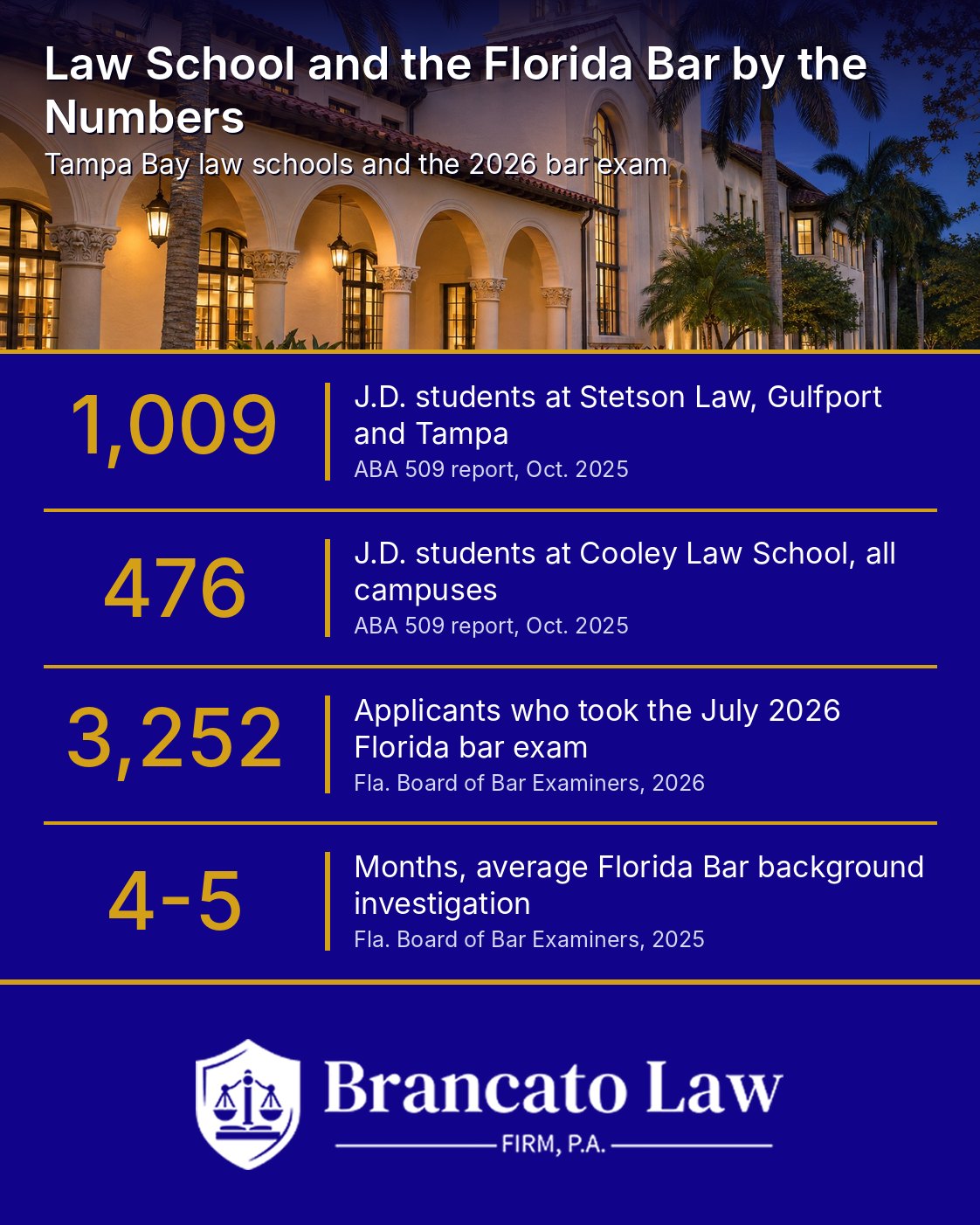
For most registrants the investigation moves quickly. The Board’s Fall 2025 presentation says the background investigation “takes 4-5 months on average,” and that for 75% to 85% of registrants it is finished within four months. A file with a conduct matter or an arrest to explain can take longer, which is one reason to handle the school case and the bar disclosure together.
What happened to the applicant who left out an honor code charge he had beaten?
He was denied admission. In Florida Board of Bar Examiners re John Doe, 770 So. 2d 670 (Fla. 2000), a female law student accused the applicant of violating his law school’s honor code in 1993, and the school’s judicial committee later found he had not violated any rule. He did not report the accusation to the Board. He also failed to disclose a pending battery charge and gave false accounts of being academically excluded from law school, telling the Board he had withdrawn for health reasons.
The Florida Supreme Court approved the Board’s recommendation to deny admission and said he could reapply in two years, with proof of rehabilitation that it called “firm and fixed.” The Court repeated its rule that “no qualification for membership in the Florida Bar is more important than truthfulness and candor” and that “[a] lack of candor on the part of an applicant is intolerable and disqualifying for membership in the Bar.” The honor code charge itself had been resolved in his favor. The nondisclosure was what counted against him.
The same rule reaches omissions made while still a student. In Florida Board of Bar Examiners re J.H.K., 581 So. 2d 37 (Fla. 1991), a student registrant answered “N/A” to questions about juvenile accusations and only listed eight of them when he converted his student application into a full application. The Court accepted the Board’s recommendation against admission and said it was not the eight juvenile accusations that disqualified him; it was leaving them off and then giving conflicting explanations. The Court cited J.H.K. again in Florida Board of Bar Examiners re J.R.B., 151 So. 3d 1218 (Fla. 2014) for the line that “no moral character qualification for Bar membership is more important than truthfulness and candor,” and in that case it denied a former university employee with a theft conviction admission permanently after a long pattern of dishonest statements.
Research on character screening points the same way. Leslie C. Levin, Christine Zozula, and Peter Siegelman studied the disclosures of 1,343 Connecticut bar applicants and their later discipline records in “The Questionable Character of the Bar’s Character and Fitness Inquiry,” 40 Law & Social Inquiry 51 (2015). They found some application data associated with a higher risk of later discipline, but with “extremely low” predictive power. Florida’s cases show the other side of the screen: how an applicant reports a past problem can decide the outcome by itself.
How do Stetson and Cooley handle honor code and conduct cases?
Stetson University College of Law uses two codes: an Academic Honor Code for academic dishonesty and a Code of Student Professionalism and Conduct for other misconduct, and the Conduct Code applies to all students admitted to the College of Law, at the Gulfport campus and the Tampa Law Center. The posted Conduct Code (an administrative regulation dated January 5, 2005; students should confirm the current version in Stetson’s PolicyTech system) assigns an investigator, usually from the Office of Student Life, who gives written notice, meets with the student, and decides whether it is “more likely than not” that a violation occurred. Under that code, the investigator’s decision is final, subject to the dean’s review.
Three parts of the Stetson code matter most for the Bar. It says “it is not appropriate for counsel to attend or participate” in conduct proceedings, it says the student “does not have a right to examine the witnesses,” and it allows the dean to report “any finding of an Conduct Code violation” to any board of bar examiners. Stetson’s catalog also lists an “Amendment to Admission Application” policy, which lets students correct omissions from their law school application.
Cooley Law School publishes the substance of its Honor Code online. It defines a violation as “any act” of lying, cheating, stealing, or plagiarism, or toleration of such conduct, and its definition of lying includes “knowingly failing to disclose a material fact.” The public page refers to an Honor Council and an Office of Law School Advocate but does not post the hearing procedures, so a Cooley student facing a charge should get the full procedural sections from the student handbook before the first meeting.
| Issue | Stetson (Gulfport and Tampa Law Center) | Cooley Law School (Tampa campus) | Title IX formal complaint (either school) |
|---|---|---|---|
| Rules | Academic Honor Code; Code of Student Professionalism and Conduct | Honor Code (substantive sections posted online) | 34 C.F.R. 106.45 grievance process |
| Who decides | Investigator, usually from the Office of Student Life; dean may review | Honor Council process (procedures in the student handbook) | Decision-maker after a live hearing |
| Lawyer’s role | Posted code says counsel should not attend or participate | Check the handbook | Advisor of choice, who may be a lawyer, conducts cross-examination |
| Standard | More likely than not | Check the handbook | Set by the school’s Title IX policy |
| Report to the Bar | Dean may report any finding; dean’s certificate covers accusations | Dean’s certificate covers accusations | Dean’s certificate covers accusations |
Can a lawyer help a law student with an honor code case?
Yes, even where the school limits what a lawyer may do in the room. I have seen both kinds of hearing. At a Hillsborough County Public Schools expulsion hearing, I cross-examined witnesses and argued for the student, as our guide to the Hillsborough County School expulsion hearing explains. At a USF conduct hearing, I could not cross-examine or argue; I appeared as the student’s advisor, and my main job was preparing the student. Our guide to what happens at a USF student conduct hearing walks through that process.
For a law student, the preparation is the case. Our attorneys help the student write a response that is accurate and complete, decide what to say about any related police matter, gather documents that support the student’s account, and keep a copy of every notice and outcome letter. The written record from the school will be compared, years later, with what the student tells the Board, so the two have to match.
How is a Title IX case at a law school different?
A Title IX formal complaint of sexual harassment follows federal rules that give the accused student more procedural rights than a typical honor code case. Under 34 C.F.R. § 106.45(b)(6)(i), a postsecondary school “must provide for a live hearing,” and each party’s advisor of choice conducts cross-examination “directly, orally, and in real time.” If a student has no advisor, the school must provide one at no charge, and that advisor “may be, but is not required to be, an attorney.” The U.S. Department of Education returned the 2020 Title IX regulations to the Code of Federal Regulations in a final rule published September 29, 2026.
That means a lawyer can do far more in a Title IX hearing at Stetson or Cooley than in an ordinary conduct meeting. A sexual misconduct accusation is also among the most serious matters a law student can carry into character and fitness, so the response and the bar disclosure should be planned together. Our student conduct and Title IX defense guide covers how these hearings work at each Tampa Bay school.
What if a law student is arrested?
An arrest during law school has to be reported to the Board even if the charge is dropped, sealed, or expunged. Florida law normally lets a person with a sealed or expunged record deny the arrest, but section 943.0585(6)(b), Florida Statutes and section 943.059(6)(b) both make an exception for anyone who “is a candidate for admission to The Florida Bar.” A law student who seals a record and then answers “no” on the bar application has created a new problem.
The criminal case still matters most, because a dismissal or a no-file decision reads very differently from a conviction. If police are still investigating, our representation before charges are filed can sometimes keep a case from being filed at all. If there has already been an arrest and first appearance, the timing of the plea, any diversion program, and the bar amendment all need to line up. Parents of a younger student facing the same problem can read what parents should do when a college student is arrested in Tampa.
When does the character and fitness investigation happen?
Earlier than most students expect. The Board encourages first-year students to register, offers a discounted registrant fee to those who file by January 15, and runs the background investigation while the student is still in school. That means a conduct case in the second or third year usually arrives after the student has already answered the Board’s questions, so it has to be reported as an amendment within 30 days.
| Stage | What happens | What to watch |
|---|---|---|
| Before 1L | Law school application asks about arrests and school discipline | Answers must match the later bar application |
| 1L year | Student registration with the Board (discount deadline January 15) | Every prior accusation goes on the registration |
| During law school | Background investigation, about 4 to 5 months on average | New conduct accusations or arrests: amend within 30 days |
| Conversion (3L) | Student registration converted to a full bar application | Update every answer; confirm nothing was missed |
| After graduation | Dean files the Certificate of Dean with the final transcript | The dean reports accusations regardless of outcome |
Discrepancies between a law school application and a bar application are a common source of trouble. Roy M. Sobelson, a former associate dean at Georgia State University College of Law, described in an article in The Bar Examiner (Spring 2021) how bar offices find those gaps by comparing the two applications, and how schools began asking students to confirm or amend their law school answers before graduation. A student who left something off a law school application should correct it through the school’s amendment process before the dean’s certificate is filed.
What should a law student do first after an honor code or conduct notice?
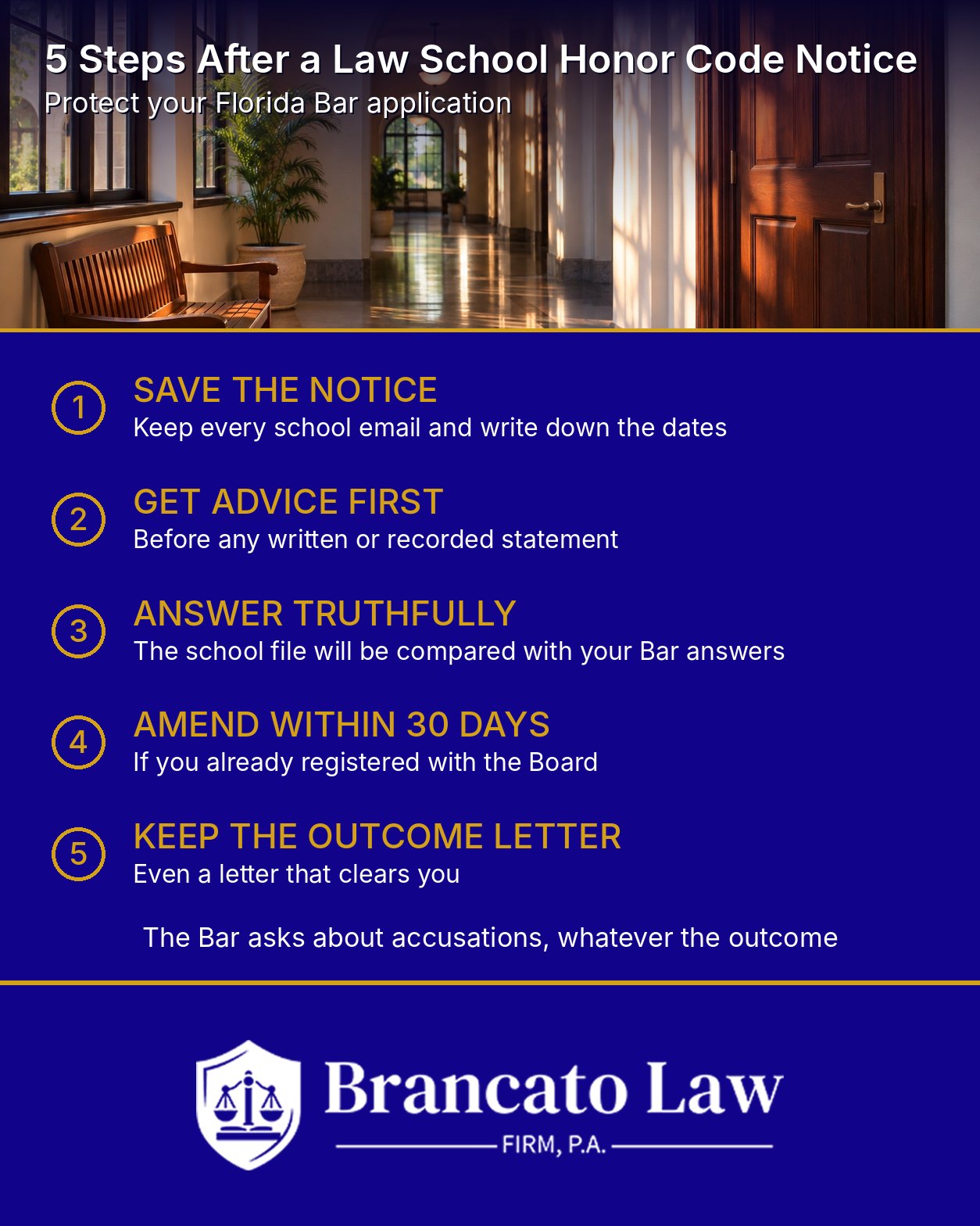
Take these five steps before the first meeting with the school:
- Save the notice and every email from the school, and write down dates while they are fresh.
- Get legal advice before giving a written or recorded statement, especially if police are involved.
- Answer truthfully and consistently; the school’s file will be compared with the bar application.
- If you are already registered with the Board, file an amendment within 30 days of the accusation.
- Keep the final outcome letter, including a letter clearing you, for the bar application and the dean’s certificate.
Our attorneys at The Brancato Law Firm work through each of these steps with the student, and we draft the bar disclosure language at the same time as the response to the school so the two match.
Frequently asked questions
Do I have to report an honor code accusation if I was found not responsible?
Yes. The Board’s questions and the dean’s certificate both cover accusations “regardless of final disposition,” and the applicant in the John Doe case was denied admission partly for omitting an accusation his school had dismissed. The Brancato Law Firm helps students describe a cleared accusation in a short, factual statement backed by the outcome letter.
Can I be denied admission to the Florida Bar for plagiarism in law school?
It can, because plagiarism is an honesty finding, but the Florida Supreme Court has admitted applicants with serious past misconduct who prove rehabilitation by clear and convincing evidence. Our attorneys at The Brancato Law Firm help law students gather proof of the steps they took after a finding, and our student conduct defense team handles the school case itself.
Does an expunged arrest from college have to go on my Florida Bar application?
Yes. Florida’s sealing and expunction statutes let most people deny a sealed or expunged arrest, but they make an exception for candidates for admission to The Florida Bar. The Brancato Law Firm helps law students locate the arrest records they need so their answers are complete.
Should I talk to the Dean of Students before I talk to a lawyer?
It is safer to get advice first, because anything you say becomes part of the school record the dean later certifies. When police are also involved, The Brancato Law Firm coordinates the school response with our pre-file advocacy on the criminal side.
Will a Title IX finding at Stetson or Cooley follow me to the Bar?
Yes, a Title IX accusation is a student conduct accusation that the Board and the dean’s certificate both ask about. Our attorneys at The Brancato Law Firm can serve as the advisor of choice at a Title IX live hearing, where federal rules let the advisor cross-examine witnesses.
What if I forgot to report something on my bar registration?
File an amendment as soon as you find the omission, with a short explanation. The Florida Supreme Court has treated an applicant’s later conflicting explanations harshly, as in J.H.K., so The Brancato Law Firm helps applicants prepare a single, documented account before the amendment goes in.
Call before you answer the school
The first written response to a law school is the document the Bar will read later, so the time to call is before it is due. The Brancato Law Firm, P.A., founded by Tampa Criminal Defense Attorney Rocky Brancato, advises Stetson and Cooley law students on honor code, conduct, Title IX, and criminal matters and on how to report them to the Florida Board of Bar Examiners. Call (813) 727-7159; you can call us at any hour. Our firm has Spanish-speaking staff, and attorney Jean-Luc Adrien speaks Spanish, Haitian Creole, and French.
For more about how our attorneys handle school discipline, visit our Student Conduct and Title IX Defense page.
The Brancato Law Firm, P.A.
620 E. Twiggs Street, Suite 205, Tampa, FL 33602
(813) 727-7159
Serving Hillsborough, Pinellas, and Pasco Counties
The Brancato Law Firm, P.A. is a Tampa-based criminal defense practice. We are not affiliated with any other Brancato-named law firms.
Visit Us

Tampa, FL 33602

Contact Us Now
Free Legal Consultation (813) 727-7159
