

From First DUI to Death Penalty



How to Fight a Retail Theft Charge in Florida? (2026)


To fight a retail theft charge in Florida, the defense tests intent, value, and the store’s evidence. Under section 812.015, retail theft is taking merchandise, switching tags or containers, or removing a cart with intent to deprive the merchant of it. Most cases are misdemeanors graded by the price tag: under $100 is punishable by up to 60 days in jail, and $100 to under $750 by up to 1 year. Two prior theft convictions, $750 or more, or an organized pattern within 120 days makes it a felony.
Most shoplifting cases are decided by the store’s video and the loss prevention report, long before anyone walks into a courtroom. I’m Rocky Brancato, founder of The Brancato Law Firm, P.A., a Tampa criminal defense firm, and I have watched that pattern repeat over more than 25 years in Hillsborough County courtrooms, including as a former Chief Operations Officer of the Hillsborough County Public Defender’s Office, where I oversaw a staff of over 100 attorneys, and through more than 150 jury trials to verdict. Our attorneys request the full video, the receipts, and the price records before we let a store employee’s summary define the case.
Retail theft looks simple, but the statute has its own definition, its own rule for value, and its own felony triggers. Our Tampa theft and property crimes attorney page covers the full range of theft charges; this guide focuses on shoplifting: what the State must prove, how penalties climb, what a store may do to detain you, and the defenses that work.
What is retail theft in Florida?
Retail theft is shoplifting, defined in section 812.015(1)(i), Florida Statutes as “the taking possession of or carrying away of merchandise, property, money, or negotiable documents; altering or removing a label, universal product code, or price tag; transferring merchandise from one container to another; or removing a shopping cart, with intent to deprive the merchant of possession, use, benefit, or full retail value.” Leaving the store is not an element. Concealing an item, swapping a price tag, or moving goods into another box can be enough if the State proves intent.
Intent is the element our attorneys at The Brancato Law Firm test first. A distracted parent at self-checkout, a shopper who walked into the garden center with an unpaid item, and a person who meant to pay at another register all lack the intent to deprive that the statute requires. The State usually proves intent with video, so the full video, not the clip in the report, decides most of these cases.
What are the penalties for retail theft in Florida?
Most retail thefts are punished under the general theft statute, section 812.014, which grades the offense by value and prior record, unless one of the organized-theft patterns in section 812.015 applies. Jail limits come from section 775.082 and fines from section 775.083. A court must also order restitution for the value of merchandise stolen or damaged under section 812.015(12).
| Situation | Statute | Degree | Maximum jail and fine |
|---|---|---|---|
| Merchandise under $100, no prior theft conviction | § 812.014(3)(a) | Second-degree misdemeanor | 60 days; $500 |
| Merchandise $100 to under $750 | § 812.014(2)(f) | First-degree misdemeanor | 1 year; $1,000 |
| Petit theft with one prior theft conviction | § 812.014(3)(b) | First-degree misdemeanor | 1 year; $1,000 |
| Petit theft with two or more prior theft convictions | § 812.014(3)(c) | Third-degree felony | 5 years; $5,000 |
| Second or later petit theft from a merchant | § 812.015(2) | Penalty under 812.014(3) plus a mandatory fine | Fine of $50 to $1,000, or public service in its place |
| Merchandise $750 or more | § 812.014(2)(c) | Third-degree felony (grand theft) | 5 years; $5,000 |
| Organized or multi-store pattern within 120 days | § 812.015(8) | Third-degree felony | 5 years; $5,000 |
| Larger or repeat organized pattern | § 812.015(9) | Second-degree felony | 15 years; $10,000 |
| Organized pattern with two prior convictions, or with a firearm | § 812.015(11) | First-degree felony | 30 years; $10,000 |
| Resisting a merchant’s effort to recover property | § 812.015(6) | First-degree misdemeanor | 1 year; $1,000 |
| Possessing or using a device to defeat anti-theft tags in a store | § 812.015(7) | Third-degree felony | 5 years; $5,000 |
How does the State prove the value of shoplifted merchandise?
In a retail theft case, value is the sale price on the tag, not what the item is worth on the open market. In F.T. v. State, 146 So. 3d 1270 (Fla. 3d DCA 2014), a juvenile was accused of taking several items from a J.C. Penney store worth $100 or more but less than $300. The defense argued the State had no admissible proof of value. The Third District affirmed, holding that the State proves value in a retail case “by simply introducing evidence of the sale price as stated on the price tag,” and that a loss prevention officer may testify to what the tag said without a business-records foundation.
That rule cuts both ways, and our attorneys use it. Because the tag price controls, we check whether each item was on sale, whether the report used the regular price, whether the count of items matches the video, and whether recovered merchandise was added twice. A few dollars can move a case from a first-degree to a second-degree misdemeanor, or from a felony to a misdemeanor. Our guide on how the State proves value in a Florida grand theft case explains the different, stricter rule for non-retail property.
Can you be charged with retail theft if you never left the store?
Yes, because the statute covers “taking possession” of merchandise, not just carrying it out the door. But a person who changes his or her mind and leaves the goods behind may have a defense. In McClover v. State, 125 So. 3d 926 (Fla. 4th DCA 2013), two women at a Port St. Lucie Wal-Mart put expensive electronics in a cart near a back exit; one walked out the front with nothing, and the other then left the cart and walked out too. The Fourth District reversed the conviction and ordered a new trial because the jury was not instructed on voluntary abandonment. The court reasoned that placing items in a store cart, without concealing them or changing tags, may not be a “taking possession,” and that leaving the goods in the store could be an abandonment.
The lesson from McClover is that conduct inside the store is often ambiguous. Our attorneys at The Brancato Law Firm ask what the employee actually saw, whether the person passed the last register, whether anything was concealed, and whether the merchandise ever left the building, because each answer changes what the State can prove.
Can a store hold you until police arrive in Florida?
Yes, within limits. Under section 812.015(3)(a), a merchant or employee who has probable cause to believe a retail theft occurred may detain the person “in a reasonable manner for a reasonable length of time” and must call law enforcement to the scene immediately after taking the person into custody. Under section 812.015(3)(b), an anti-theft alarm going off as a person leaves is reasonable cause for a brief detention if the store has posted notice that it uses such devices.
A store that follows those rules is protected from false arrest claims, and a person who resists a merchant’s reasonable effort to recover property can be charged with a separate first-degree misdemeanor under section 812.015(6), unless he or she did not know, and had no reason to know, that the person was a merchant or employee. Our attorneys review how long the detention lasted, what was said in the back office, and whether a written statement was signed, because loss prevention reports often become the State’s main evidence.
When does shoplifting become a felony in Florida?
Shoplifting becomes a felony in four main ways: the merchandise is worth $750 or more, the person has two or more prior theft convictions, the theft involves a device to defeat anti-theft tags, or the case fits one of the organized-theft patterns in section 812.015(8). Those patterns include thefts from more than one location within 120 days that add up to $750 or more, and three or more retail thefts within 120 days, at least two at different stores, that take 10 or more items in total regardless of value.
Organized retail theft cases are often built over weeks of investigation, with video from several stores before anyone is arrested. When a store or detective calls about past visits, that is the time for representation before charges are filed. Section 812.015(10) also lets the Office of the Statewide Prosecutor bring cases that cross judicial circuits, which is one more reason to speak with counsel before answering questions.
How common are theft arrests in Hillsborough County?
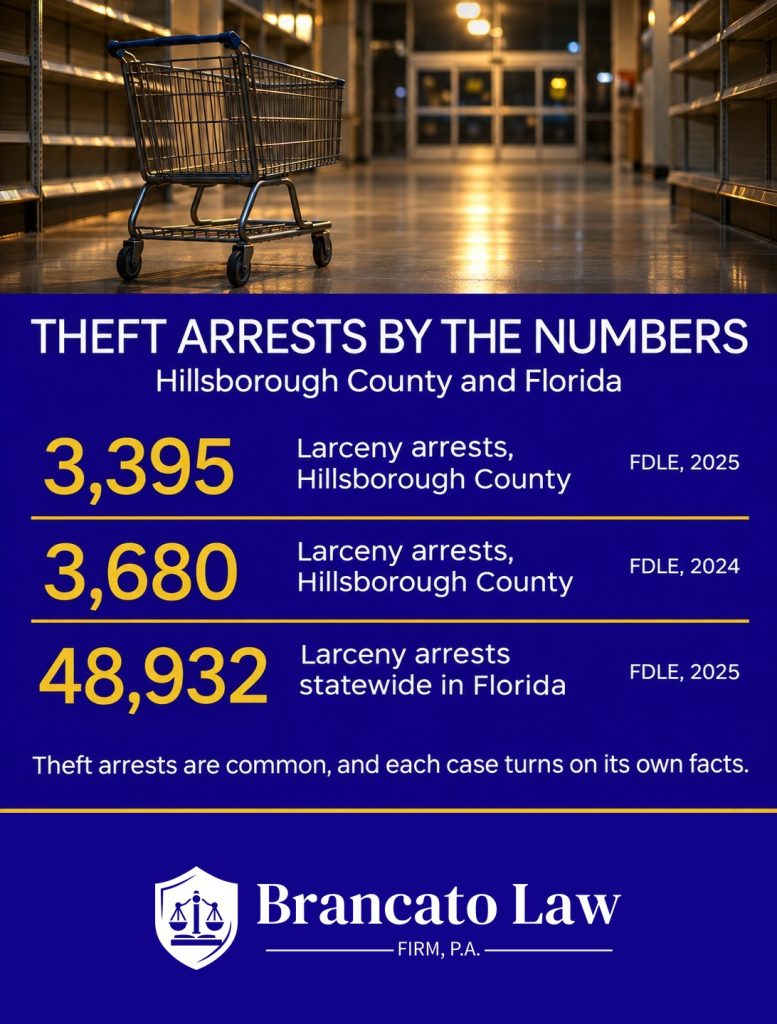
Theft arrests in Hillsborough County have fallen over the past decade. According to Florida Department of Law Enforcement arrest data published on Florida Health CHARTS, Hillsborough County recorded 3,395 larceny arrest events in 2025, down from 3,680 in 2024, and Florida recorded 48,932 statewide in 2025. Larceny includes all thefts, not only shoplifting, and the counts include only fingerprinted arrests, so many shoplifting cases handled by a notice to appear do not appear in them.
National data on shoplifting itself are less clear than headlines suggest. In its November 2024 report Between the Aisles: A Closer Look at Shoplifting Trends, the Council on Criminal Justice found that two FBI data systems disagree: the Summary Reporting System showed reported shoplifting in 2023 at the same level as 2019, while the National Incident-Based Reporting System showed it 93% higher. The Brancato Law Firm points to that kind of uncertainty when a prosecutor argues that a first-time shoplifting case calls for a harsh sentence to deter a crime wave.
What happens to a retail theft case in Hillsborough County?
In Hillsborough County, a misdemeanor retail theft is heard in county court in the 13th Judicial Circuit, and a felony goes to circuit court. In our experience, police often issue a notice to appear instead of booking someone for a small shoplifting case, so many people never see the jail. The case then moves through the stages on our Florida criminal case process page: arraignment, discovery, and then a plea, a diversion agreement, or trial.
First-time defendants are often good candidates for diversion. Hillsborough’s Misdemeanor Intervention Program (MIP), run by the Hillsborough County Sheriff’s Office with the State Attorney’s Office, monitors a participant for three to five months, and the State then drops the charge with a nolle prosequi. For a third-degree felony such as grand theft, the pretrial intervention program can lead to a dismissal for a person with no more than one prior nonviolent misdemeanor, with the consent of the State Attorney, the victim, and the judge. Our attorneys push for the right program before the arraignment, and our Hillsborough County criminal defense page explains more about local procedure.
A store may also send a civil demand letter asking for money. That letter is separate from the criminal case, and paying it does not dismiss the charge. Our guide on whether to pay a civil theft demand letter explains the choice.
Is skip scanning at self-checkout retail theft in Florida?
Yes. Skipping an item, switching a barcode or produce code, or leaving unscanned items in the cart at a self-checkout is charged as retail theft under section 812.015, graded by the value of the unpaid items. The State still has to prove you meant to skip the item, and our attorneys at The Brancato Law Firm test that by matching the store video against the station’s transaction log. Our full guide explains whether skip scanning is a crime in Florida and how to fight it.
How do our attorneys fight a retail theft charge?
Our attorneys fight retail theft charges by testing every fact the store report assumes. These are the defenses we look at first:
- No intent to deprive. Self-checkout errors, items left in a cart or under a stroller, and a plan to pay at another register all go to intent. The full video often shows a shopper who was not hiding anything.
- No taking. Under McClover, placing items in a cart and leaving them behind may not be a taking, and abandonment is a defense the jury must hear when the evidence supports it.
- Value. Under F.T., the tag price controls. We check sale prices, item counts, and duplicate entries, which can lower the degree of the charge.
- Identity. Stores misidentify people from grainy video, especially in multi-store cases built from separate incidents. We compare every clip and timestamp.
- Prior convictions. A felony petit theft charge depends on two prior theft convictions. We pull the certified records and check that each prior is a theft conviction the statute counts.
- Detention and statements. We review how the store detained the person and what was written in its office, and we challenge statements that were not voluntary.
- Aggregation. Felony patterns require specific dates, locations, and totals within 120 days. A missing receipt or a theft outside the window can drop the case to a misdemeanor.
Can retail theft charges be dropped in Florida?
Yes. Retail theft charges are often dropped when the video does not show intent, when the value or item count is wrong, through a diversion program such as MIP or pretrial intervention, or when the store’s witness does not cooperate. The State Attorney’s Office makes that decision, not the store, so the defense has to give the prosecutor a reason. Our general guide on how to fight a theft charge in Florida covers other theft charges that often come with retail cases.
What should you do after a shoplifting arrest or notice to appear?
Keep the paperwork, stay away from the store, and speak with a lawyer before speaking with anyone else about the case. These steps protect the defense:
- Keep the notice to appear, the trespass warning, any receipts, and the civil demand letter if one arrives. Note the court date; missing it can lead to a warrant.
- Do not return to the store. A trespass warning issued during the stop can make a later visit a separate crime.
- Write down what happened while it is fresh: what you bought, where you were in the store, and what employees said.
- Do not call the store, the loss prevention office, or the detective to explain. Anything you say can be used to prove intent.
Frequently asked questions about retail theft charges in Florida
Is switching a price tag retail theft in Florida?
Yes. Section 812.015(1)(i) defines retail theft to include “altering or removing a label, universal product code, or price tag” with intent to deprive the merchant of full retail value. The Brancato Law Firm looks at who changed the tag and when, because a mispriced item a shopper did not alter is not a crime.
Will a second shoplifting charge be a felony in Florida?
Not usually. A second petit theft is a first-degree misdemeanor under section 812.014(3)(b), and it becomes a third-degree felony only with two or more prior theft convictions. Our attorneys at The Brancato Law Firm check the prior records closely, and our theft defense lawyers hold the State to certified proof of each prior.
Can a teenager lose a driver license for shoplifting in Florida?
Yes, but only as an alternative sentence. Under section 812.0155, a court may revoke, suspend, or withhold the license of a person under 18 with no prior record for 6 months to 1 year instead of other sentences. The Brancato Law Firm works to resolve juvenile shoplifting cases through diversion, so the license question never comes up.
Does a civil demand letter mean I am being prosecuted?
No. A civil demand letter is a separate civil claim by the store, and the State Attorney’s Office decides on its own whether to prosecute. Our attorneys at The Brancato Law Firm review the letter and the criminal case together, so a payment or a written response does not hurt the defense.
What happens if I am accused of stealing from more than one store?
Thefts from more than one location within 120 days can be added together, and if they total $750 or more, the charge is a third-degree felony under section 812.015(8)(c). The Brancato Law Firm tests each incident separately, because the State must prove every theft, every date, and every location before it can add them up.
Can a store detain me for a long time or search my bag in Florida?
A store may detain a person only in a reasonable manner, for a reasonable time, and must call police immediately after taking the person into custody under section 812.015(3)(a). When a detention went beyond those limits, our attorneys at The Brancato Law Firm use it to challenge the store’s account and any statement taken in the back office.
Talk to our Tampa defense attorneys about a retail theft charge
For more about our defense strategies, visit our Theft and Property Crimes page. Your first court date is printed on the notice to appear, and the weeks before it are when diversion and dismissal are won, so call The Brancato Law Firm, P.A., founded by Tampa Criminal Defense Attorney Rocky Brancato, at (813) 727-7159 now. You can call us at any hour. Our firm has Spanish-speaking staff, and attorney Jean-Luc Adrien speaks Spanish, Haitian Creole, and French. Our office is two blocks from the courthouse, and we defend shoplifting and theft charges in Hillsborough, Pinellas, and Pasco counties.
The Brancato Law Firm, P.A.
620 E. Twiggs Street, Suite 205, Tampa, FL 33602
(813) 727-7159
Serving Hillsborough, Pinellas, and Pasco Counties
The Brancato Law Firm, P.A. is a Tampa-based criminal defense practice. We are not affiliated with any other Brancato-named law firms.
Visit Us

Tampa, FL 33602

Contact Us Now
Free Legal Consultation (813) 727-7159
