

From First DUI to Death Penalty



How to Fight Public Assistance Fraud in Florida? (2026)


To fight a public assistance fraud charge in Florida, the defense focuses on knowledge and value: under section 414.39, the State must prove you knowingly hid a material fact or failed to report a change in circumstances to get SNAP, Medicaid, cash assistance, or other benefits you were not entitled to. The charge is a misdemeanor under $200 and a felony at $200 or more in any 12 consecutive months, rising to a first-degree felony at $100,000. Reemployment assistance (unemployment) fraud is charged separately under section 443.071 as a third-degree felony for each false statement, and in both cases paying the money back does not end the criminal case.
If a letter from the Department of Children and Families says you were overpaid, or a state investigator wants to talk about your food assistance or unemployment claim, the case may already be on its way to a prosecutor. I’m Rocky Brancato, founder of The Brancato Law Firm, P.A., a Tampa criminal defense firm, and a former Chief Operations Officer of the Hillsborough County Public Defender’s Office, where I oversaw a staff of over 100 attorneys. In more than 25 years in Hillsborough County courtrooms, I have seen benefits cases won or lost on one question: what did the person actually know about the reporting rules? Our attorneys build the defense around that question from the first contact.
What is public assistance fraud in Florida?
Public assistance fraud in Florida is knowingly hiding a material fact, or knowingly failing to report a change in circumstances, to get or keep public benefits you are not entitled to. Section 414.39, Florida Statutes, covers any state or federally funded assistance program, including SNAP food assistance, Temporary Cash Assistance, and Medicaid. Our firm defends these cases alongside the other fraud offenses described on our Tampa theft and property crimes attorney page.
The statute reaches four kinds of conduct:
- Hiding a material fact on an application through a false statement, misrepresentation, or impersonation, such as leaving a working spouse off the household list.
- Failing to report a change in circumstances, such as a new job, a raise, or a household member moving in, to keep benefits or get a larger amount.
- Misusing an EBT card, food assistance authorization, or Medicaid card, including trafficking benefits for cash.
- Helping someone else do any of these things.
The most common case we see is the second one: a person starts a job, the household’s income goes up, and benefits keep arriving because the change was never reported. The State then calculates an overpayment and charges fraud.
What does the State have to prove?
The State has to prove that you acted knowingly, that the fact you hid or failed to report was material to eligibility, and that the benefits you wrongfully received reached the value charged. Florida’s standard jury instruction defines “knowingly” as done voluntarily and intentionally, and not because of mistake, accident, or another innocent reason.
| Element | What the State must show | Where the defense looks |
|---|---|---|
| Knowledge | You knew the fact had to be reported and chose not to report it | Whether you were told the rule, in a language you read, and whether you tried to report |
| Material fact | The hidden fact affected eligibility or the benefit amount | Whether the income or household change actually changed what you could receive |
| Value | The benefits wrongfully received reached the charged amount | The State’s overpayment math, the months counted, and benefits you were still entitled to |
| Your conduct | You, not someone else, made or controlled the statements | Who filled out the online application or renewal, and who used the EBT card |
Value is measured over any 12 consecutive months. In State v. Lauriston, 295 So. 3d 281 (Fla. 4th DCA 2020), a Broward County woman was charged with failing to report a job while receiving food assistance over a period of about 10 months and 26 days. The trial court dismissed the case because, it reasoned, the statute required 12 months of fraud. The Fourth District reversed, holding that the 12-month language sets the window in which the benefits must add up to the charged value, not a minimum length of fraud. The practical lesson is that the defense fight is over the dollar figure inside the window, which is where the State’s overpayment calculation is often weakest.
What are the penalties for public assistance fraud in Florida?
The degree depends on the total value of benefits wrongfully received in any 12 consecutive months under section 414.39(5). Maximum sentences come from section 775.082.
| Charge | Degree | Maximum jail or prison |
|---|---|---|
| Public assistance fraud, under $200 in 12 months | First-degree misdemeanor | 1 year in jail |
| Public assistance fraud, $200 to under $20,000 | Third-degree felony | 5 years |
| Public assistance fraud, $20,000 to under $100,000 | Second-degree felony | 15 years |
| Public assistance fraud, $100,000 or more | First-degree felony | 30 years |
| Selling an EBT card while holding 2 or more cards issued to others, first offense | First-degree misdemeanor, plus at least 20 hours of community service | 1 year in jail |
| Reemployment assistance fraud, s. 443.071(1), each false statement | Third-degree felony | 5 years per count |
Most cases we see fall in the third-degree felony range, because a few months of unreported income usually produces an overpayment of a few thousand dollars. That still means a felony record unless the case is resolved through diversion or a withhold of adjudication.
Is unemployment fraud charged differently in Florida?
Yes. Reemployment assistance fraud is charged under section 443.071(1), which makes it a third-degree felony to make a false statement, knowing it is false, or to knowingly hide a material fact to get or increase unemployment benefits. Unlike section 414.39, there is no dollar threshold, and the statute says each false statement or failure to disclose is a separate offense.
That separate-offense rule is why unemployment cases can arrive with many counts. A person who certified “no earnings” for 10 weekly claims while working part-time can face 10 felony counts. Our attorneys look at how the weekly certification questions were worded, whether the earnings were reported to the employer side of the system, and whether the claimant understood that gross pay, not take-home pay, had to be reported.
How do public assistance fraud investigations start?
Most cases start with a data match or a tip, then an overpayment notice, then a referral for prosecution. The Department of Financial Services runs a Bureau of Public Assistance Fraud, and in July 2026 the Department reported that the bureau had referred 322 public assistance fraud cases totaling $8 million for criminal prosecution over the prior year.
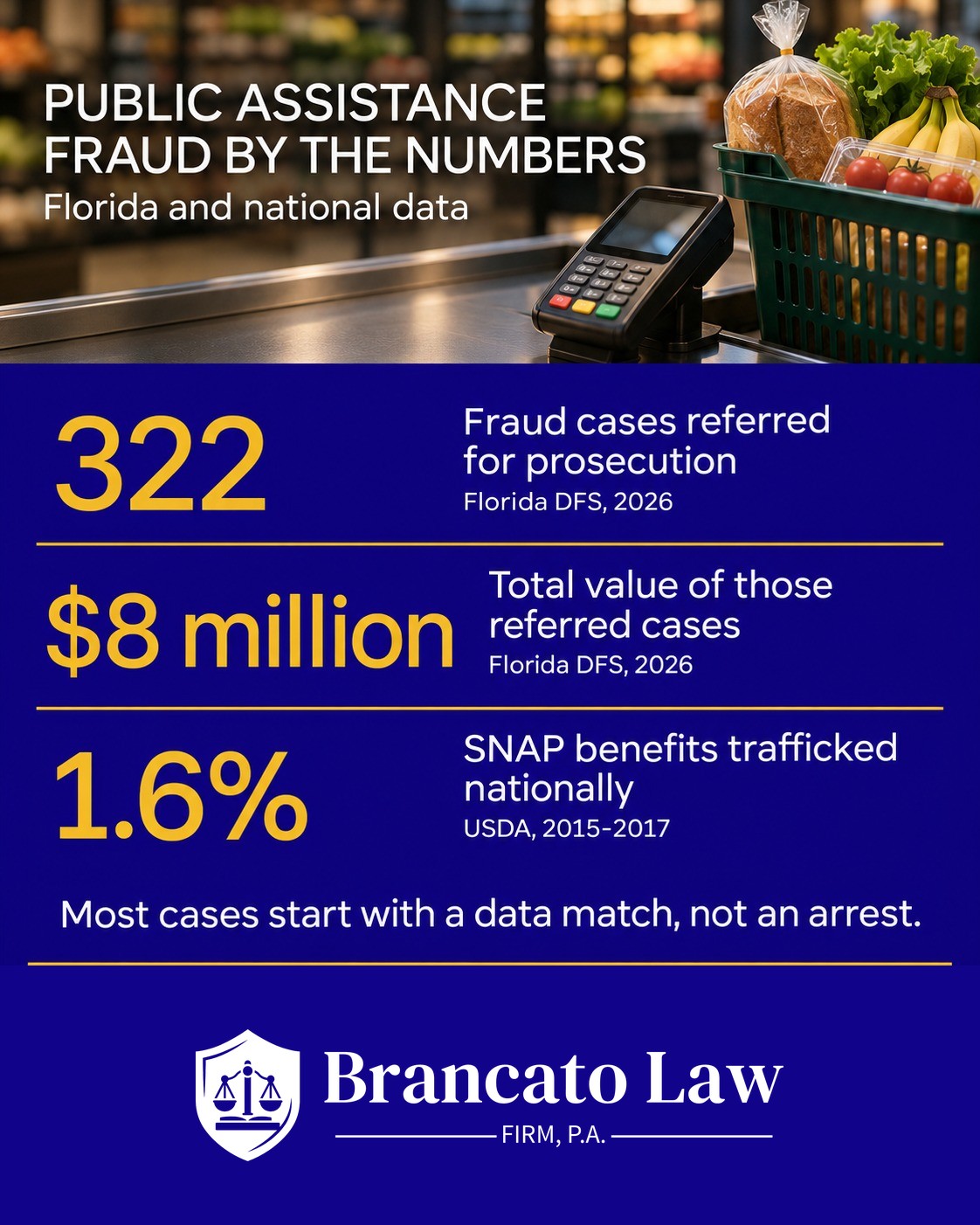
Trafficking cases follow a different track. Federal researchers estimated that about 1.6 percent of SNAP benefits were trafficked nationally from 2015 to 2017, roughly $1.27 billion a year, according to the U.S. Department of Agriculture’s study The Extent of Trafficking in SNAP: 2015-2017. That small share means most benefit recipients are never involved in trafficking, and a trafficking accusation against an individual usually rests on store transaction records that need careful review.
In our experience in Hillsborough County, the first contact is often a letter or a call asking you to come in and “explain” an overpayment. That interview is evidence-gathering. Our representation before charges are filed means we handle that contact, review the overpayment worksheet, and present the reporting history to the investigator or the State Attorney’s Office for the 13th Judicial Circuit before a filing decision. When a case is filed, it often begins with a warrant or a notice to appear rather than an arrest at the scene. Our guide to the Florida criminal case process walks through what happens at each step after that.
How do our attorneys defend public assistance fraud charges?
Our attorneys defend these charges by attacking knowledge, recalculating the value, and pursuing diversion where it fits. The strategies that matter most are:
- You tried to report. Call logs, online account histories, office visit records, and copies of submitted documents can show the change was reported and the agency failed to act.
- You did not know the rule. Renewal notices and reporting rules are long and technical. A person who did not read English well, or who was never told a specific change had to be reported, did not act knowingly.
- The overpayment math is wrong. The State often counts months when you were still eligible for some benefits, or uses gross figures that do not match program rules. Reducing the value can move a case from a felony to a misdemeanor.
- Someone else controlled the account. A former partner or relative may have filed the application, kept the EBT card, or certified the weekly unemployment claims.
- Identity theft. During the pandemic, many unemployment claims were filed with stolen identities. Our guide to identity theft in Florida explains how those cases are proven.
Repayment matters even though it is not a legal defense. Section 414.39(7) says repaying benefits is not a defense or a ground for dismissal, but in practice a repayment plan is often the key term in diversion or a reduced charge. Our attorneys negotiate the amount and the schedule so you repay only what the evidence supports.
Can a public assistance fraud charge be resolved without a conviction?
Yes. In Hillsborough County, the State Attorney’s Office offers pretrial intervention for certain first-time felony offenders, supervised by the Florida Department of Corrections, and repayment is usually a condition. Completing it leads to dismissal. Our guide to the Hillsborough County PTI program explains eligibility. When PTI is not available, a withhold of adjudication on a plea can avoid a formal felony conviction for many first offenders.
Bond is another early issue. In our experience, pretrial services supervision is not available in Hillsborough County, though nearby counties offer it, so release after a warrant arrest usually depends on the bond amount and on whether we can arrange a voluntary surrender before the arrest happens.
Frequently asked questions about Florida public assistance fraud
Is not reporting a new job to DCF a crime in Florida?
It can be. Knowingly failing to report a change in circumstances, such as new income, to keep receiving benefits you are no longer entitled to is a crime under section 414.39(1)(b). Our attorneys at The Brancato Law Firm look first at what reporting notice you received and whether you tried to report the job.
Can food stamp fraud charges be dropped in Florida?
Yes. Charges can be dropped or reduced when the State cannot prove you knew the rule, when the overpayment is recalculated below the charged amount, or when a first offender completes pretrial intervention. The Brancato Law Firm presents that evidence to the prosecutor, and our Tampa fraud defense lawyers often start that process before charges are filed.
Does paying back an overpayment stop a fraud charge in Florida?
No. Section 414.39(7) says repayment is not a defense or a ground for dismissal. Even so, The Brancato Law Firm treats repayment as a negotiation tool, because prosecutors weigh it heavily when deciding on diversion or a reduced charge.
How many counts can unemployment fraud carry in Florida?
One count for each false statement or failure to disclose. Under section 443.071(1), each weekly certification with a false answer can be a separate third-degree felony; our attorneys at The Brancato Law Firm push to consolidate counts that come from a single misunderstanding.
What happens if a DFS investigator asks to interview me about benefits?
Decline the interview until you have spoken with a defense attorney. Anything you say about what you knew can become the State’s proof of knowledge, and The Brancato Law Firm handles that contact through our pre-file advocacy practice.
Is selling an EBT card a felony in Florida?
It depends. Selling or trying to sell a card while holding two or more EBT cards issued to other people is a first-degree misdemeanor for a first offense and a third-degree felony for a second offense, while trafficking benefits for cash is charged by value under section 414.39(5). The Brancato Law Firm reviews the store transaction records that these cases usually rest on.
Benefits fraud cases often overlap with other charges, including a scheme to defraud charge for repeated false claims and an insurance fraud charge when private insurance is involved.
For more about our defense strategies, visit our Theft and Property Crimes page.
An overpayment letter or an investigator’s call is the time to get advice, before the interview and before a warrant issues. Our attorneys will review your reporting history and the State’s math. Call The Brancato Law Firm, P.A., founded by Tampa Criminal Defense Attorney Rocky Brancato, at (813) 727-7159, available 24/7, from our office two blocks from the courthouse. Our firm has Spanish-speaking staff, and attorney Jean-Luc Adrien speaks Spanish, Haitian Creole, and French. Language matters in benefits cases, because many reporting notices and recorded interviews happen only in English.
The Brancato Law Firm, P.A.
620 E. Twiggs Street, Suite 205, Tampa, FL 33602
(813) 727-7159
Serving Hillsborough, Pinellas, and Pasco Counties
The Brancato Law Firm, P.A. is a Tampa-based criminal defense practice. We are not affiliated with any other Brancato-named law firms.
Visit Us

Tampa, FL 33602

Contact Us Now
Free Legal Consultation (813) 727-7159
