

From First DUI to Death Penalty



How to Fight a False Report of a Crime Charge in Florida? (2026)


Making a false report of a crime in Florida is a first-degree misdemeanor under section 817.49, punishable by up to 1 year in jail and a $1,000 fine. It becomes a third-degree felony if the police or emergency response to the false report results in great bodily harm, permanent disfigurement, or permanent disability, and a second-degree felony if the response results in a death. The State must prove the person knew the report was false and that no such crime actually happened, so a mistaken report, an exaggerated one about a real event, or a later recantation is not enough by itself to convict.
A prosecutor deciding whether to file a false report charge looks for one thing above all: proof that the reported crime never happened and that the person knew it. In more than 25 years in Hillsborough County courtrooms, including my years as former Chief Operations Officer of the Hillsborough County Public Defender’s Office, where I oversaw a staff of over 100 attorneys, I have seen how often that proof is missing. I founded The Brancato Law Firm, P.A., a Tampa criminal defense firm, and our attorneys defend false report charges by separating what the State can prove about the event from what it assumes about the reporter’s state of mind.
What Is a False Report of a Crime Under Florida Law?
A false report of a crime is telling police or another public safety agency that a crime happened when you know it did not. Section 817.49, Florida Statutes, makes it a crime to willfully impart or convey, or cause to be imparted or conveyed, false information or reports about the alleged commission of any crime to a law enforcement officer or an employee of a public safety agency, knowing the report is false, when no such crime has actually been committed. A public safety agency includes police and sheriff’s offices, fire departments, emergency medical services, and ambulance services.
The “cause to be conveyed” language means a person can be charged for a report made through someone else, such as a friend who calls 911 on the person’s behalf. Section 817.49 sits in the fraud chapter of the Florida Statutes, and a common fact pattern is a false theft or burglary report made to support an insurance claim, which can bring fraud charges handled by a Tampa white collar crime attorney.
What Are the Penalties for Filing a False Police Report in Florida?
A false report of a crime is a first-degree misdemeanor in most cases, punishable by up to 1 year in jail under section 775.082 and a $1,000 fine under section 775.083. The penalty rises sharply when the public safety response to the false report injures or kills someone as a proximate result of lawful conduct during the response.
| Offense | Statute | Degree | Maximum jail or prison | Maximum fine |
|---|---|---|---|---|
| False report of a crime that did not occur | 817.49(1) | First-degree misdemeanor | 1 year in county jail | $1,000 |
| False report where the response results in great bodily harm, permanent disfigurement, or permanent disability | 817.49(2)(b)1. | Third-degree felony | 5 years in prison | $5,000 |
| False report where the response results in death | 817.49(2)(b)2. | Second-degree felony | 15 years in prison | $10,000 |
| Knowingly giving false information to an officer about the alleged commission of any crime | 837.05(1)(a) | First-degree misdemeanor | 1 year in county jail | $1,000 |
| Second false information conviction, when the statement was in writing or corroborated by a recording, the person’s own statement, or a witness | 837.05(1)(b) | Third-degree felony | 5 years in prison | $5,000 |
| False information about the alleged commission of a capital felony | 837.05(2) | Third-degree felony | 5 years in prison | $5,000 |
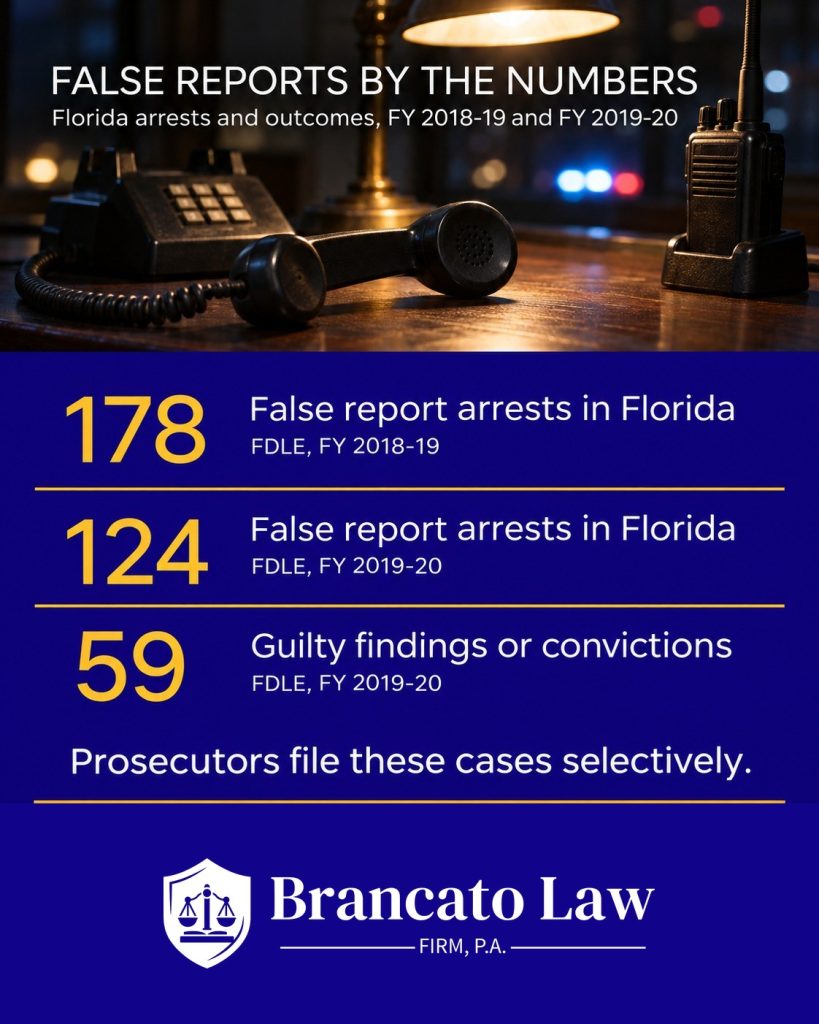
False report arrests are relatively rare in Florida. Statewide, FDLE recorded 124 arrests for making false reports of the commission of crimes in fiscal year 2019-20, with 59 charges ending in a guilty finding or conviction and 12 with adjudication withheld, according to the Legislature’s Criminal Justice Impact Conference analysis of HB 371 (2021). The same analysis reported 178 arrests in fiscal year 2018-19. Those numbers show that prosecutors bring these cases selectively, usually when they believe they can prove the reported event never happened.
What Is the Difference Between Section 817.49 and Section 837.05?
Sections 817.49 and 837.05 overlap heavily, and prosecutors can choose either one. Section 837.05, Florida Statutes, makes it a first-degree misdemeanor to knowingly give false information to a law enforcement officer concerning the alleged commission of any crime, and a third-degree felony when the false information concerns a capital felony or the person has a prior conviction under the statute and the new statement was written or corroborated.
The Second District compared the two laws in Boland v. State, 893 So. 2d 683 (Fla. 2d DCA 2005). A woman called a Lee County deputy and falsely reported that a local doctor was molesting his young children, a capital felony allegation, and was charged under section 837.05(2). The court described the misdemeanor offenses in sections 817.49 and 837.05(1) as virtually identical and held that both are necessarily lesser-included offenses of the capital felony version. Because the trial judge refused to instruct the jury on the misdemeanor, the court reversed the felony conviction and ordered a new trial.
There is one important difference. Section 817.49 requires proof that no such crime was actually committed, while section 837.05 focuses on whether the information given was false. In State v. Wesley, No. 6D2024-1651 (Fla. 6th DCA June 12, 2026), an Orange County homeowner and his companion were granted Stand Your Ground immunity for a fatal shooting but were also charged with giving false statements to law enforcement about what happened. The Sixth District held the immunity ruling ended an accessory-after-the-fact charge, because no crime had been committed, but reinstated the section 837.05(2) false report charge, because that statute targets the false statements to police rather than whether the underlying crime occurred.
| Question | Section 817.49 | Section 837.05 |
|---|---|---|
| Who receives the report | A law enforcement officer or public safety agency employee | A law enforcement officer |
| Must the State prove no crime occurred? | Yes | No, under Wesley |
| Indirect reports through another person | Covered (“causes to be imparted”) | May require giving the information directly, as Boland noted |
| When it becomes a felony | The response causes serious injury or death | Capital felony allegation, or a repeat offense with corroboration |
Is Recanting an Accusation the Same as Filing a False Report?
No, recanting an accusation does not by itself prove the original report was false. People take back true reports for many reasons, including pressure from family, fear, financial dependence, or reconciliation, and a recantation can be the false statement as easily as the original report. To convict under section 817.49, the State must prove beyond a reasonable doubt that the reported crime never happened and that the person knew it.
This issue comes up most often in domestic violence cases, where an alleged victim asks to drop charges, as covered in our post on whether a victim can drop domestic violence charges in Florida. False reports are less common than many people assume: a peer-reviewed study of ten years of sexual assault reports at a U.S. university, Lisak and colleagues, Violence Against Women (2010), classified 5.9% of cases as false reports. That is one reason prosecutors need evidence beyond a recantation before charging the reporter.
How Do Our Attorneys Fight a False Report of a Crime Charge?
Our attorneys fight false report charges by holding the State to the two hardest elements: that the crime did not happen and that our client knew the report was false. These are the defenses we raise most often:
- The crime may have happened. Under section 817.49, the State must prove no crime was committed. Missing property, an injury, or a third-party witness can keep that element in doubt.
- Honest mistake. A person who reports a stolen phone that was actually misplaced, or who misidentifies an attacker in good faith, did not knowingly make a false report.
- Exaggeration about a real event. Overstating details of something that did happen does not fit section 817.49’s requirement that no such crime occurred, though the State may try section 837.05 instead.
- Who actually made the report. When someone else called police, the State must prove our client caused the report and knew it was false.
- Lesser-included offense instructions. In a felony case, we insist on the misdemeanor instruction that Boland requires.
- Suppression of statements. A confession that the report was false, obtained without Miranda warnings during custodial questioning, can be challenged.
- Resolution without a conviction. For first-time misdemeanor charges, we press for dismissal, pretrial diversion, or a withhold of adjudication.
What Happens After a False Report Arrest in Hillsborough County?
A misdemeanor false report charge in Hillsborough County is heard in county court,. A person who is booked into the county jail sees a judge at first appearance within 24 hours. In our experience, Hillsborough County does not offer pretrial services supervision as a release option, though some neighboring counties do, so release turns on the bond and conditions the judge sets at that hearing. Our post on Hillsborough first appearance explains that hearing.
Felony false report charges go to circuit court in the 13th Judicial Circuit. Our guide to the Florida criminal case process walks through each stage after arrest, and our Hillsborough County criminal defense attorney page covers local programs and procedure.
What Should You Do If Police Say Your Report Was False?
If detectives call you back to discuss a report you made, do not try to explain or correct the story before speaking with a lawyer, because a changed account can become the evidence the State needs. A follow-up interview about a report is often the start of an investigation into the reporter. Our attorneys provide representation before charges are filed, which lets us communicate with investigators and present the facts that show the report was made in good faith.
Frequently Asked Questions About False Report Charges in Florida
Can a false report of a crime charge be dropped in Florida?
Yes, false report charges are dropped when the State cannot prove that the reported crime never happened or that the person knew the report was false. The Brancato Law Firm gathers the evidence that supports the original report, such as messages, photos, and witnesses, and presents it to prosecutors to seek a dismissal.
Is it a crime to call 911 and report something that turns out to be wrong?
No, a report made in good faith is not a crime under section 817.49, even if it turns out to be mistaken, because the statute requires knowledge that the report was false. Our attorneys at The Brancato Law Firm focus on what the caller actually knew at the time of the call.
Can I be charged for falsely reporting my car or phone stolen in Florida?
Yes, a knowingly false theft report is a misdemeanor under section 817.49, and if it was used to support an insurance claim, the State may add insurance fraud charges. The Brancato Law Firm defends both, and our fraud and white collar defense page explains those charges.
Can a domestic violence victim be charged for recanting in Florida?
A recantation alone is not proof of a false report, but if a person admits that the original report was a knowing lie, the State can charge it under section 817.49 or section 837.05. Our attorneys at The Brancato Law Firm advise anyone considering a recantation to talk to a lawyer first, and our post on dropping domestic violence charges explains the process.
What if my false report caused police to injure someone?
If the police or emergency response to a knowingly false report results in great bodily harm, permanent disfigurement, or permanent disability, the charge becomes a third-degree felony under section 817.49, and a second-degree felony if someone dies. The Brancato Law Firm examines whether the injury was a proximate result of lawful conduct during the response, which the State must prove; our post on how to fight a bomb or shooting threat charge in Florida covers a related offense.
Is lying to police about my own identity the same crime?
No, lying about who you are after a lawful stop or arrest is a separate offense under section 901.36, and lying during a felony investigation can be charged under section 837.055. The Brancato Law Firm explains those laws in our guide on how to fight a false name to police charge in Florida.
Talk to a Tampa Defense Lawyer About a False Report Charge
The moment a detective suggests your report was false is the moment to stop talking and call a lawyer. Our attorneys will review the original report, gather the evidence that supports it, and press the State on the elements it cannot prove. Contact The Brancato Law Firm, P.A., founded by Tampa Criminal Defense Attorney Rocky Brancato, at (813) 727-7159; call us at any hour, and our office is two blocks from the courthouse. Our firm has Spanish-speaking staff, and attorney Jean-Luc Adrien speaks Spanish, Haitian Creole, and French. Learn more about our Spanish and Haitian Creole criminal defense services.
For more about our defense strategies, visit our Tampa White Collar Crime Defense page.
The Brancato Law Firm, P.A.
620 E. Twiggs Street, Suite 205, Tampa, FL 33602
(813) 727-7159
Serving Hillsborough, Pinellas, and Pasco Counties
The Brancato Law Firm, P.A. is a Tampa-based criminal defense practice. We are not affiliated with any other Brancato-named law firms.
Visit Us

Tampa, FL 33602

Contact Us Now
Free Legal Consultation (813) 727-7159
