

From First DUI to Death Penalty



How to Fight a Fake Drug Sale Charge in Florida (2026)


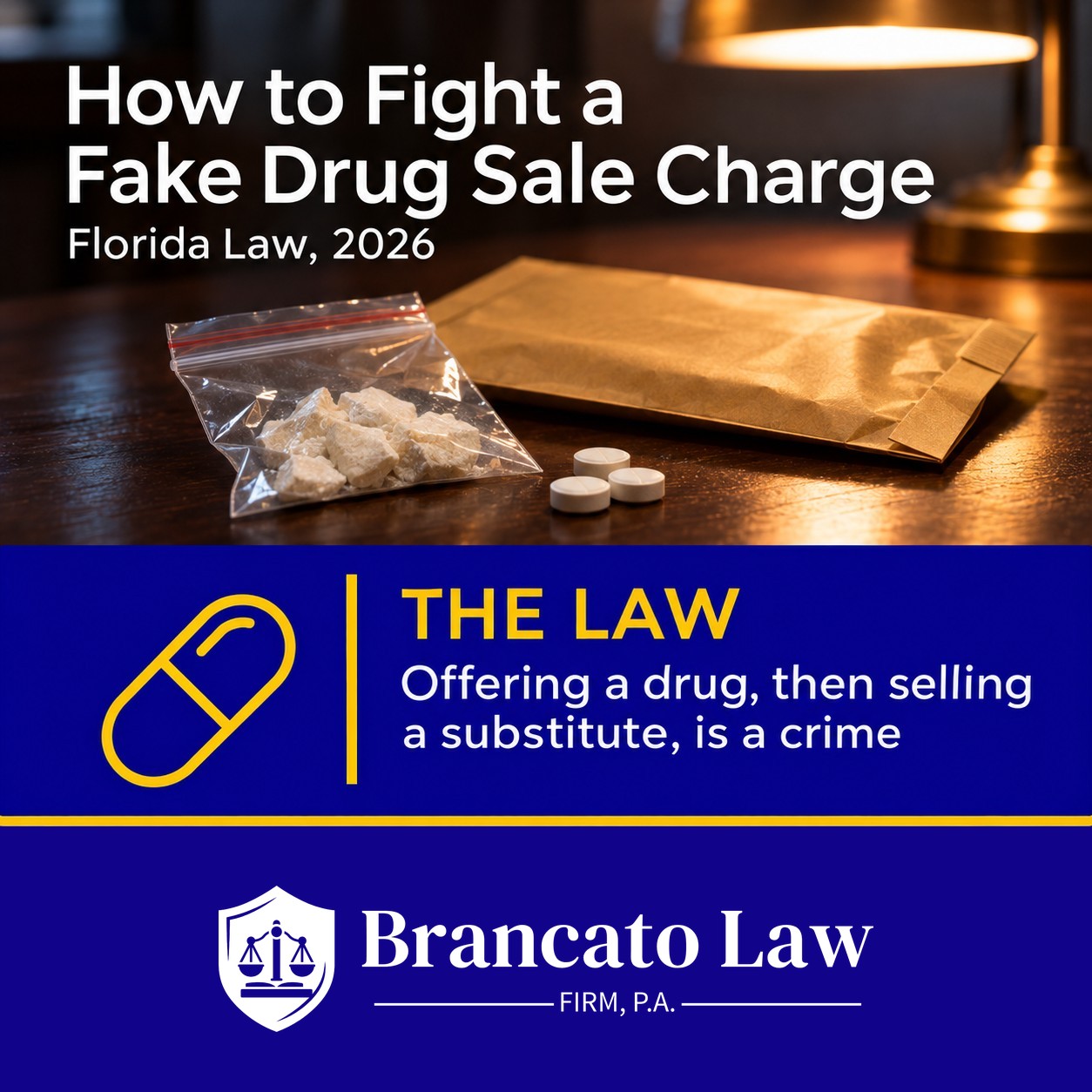
Selling fake drugs in Florida is a crime under section 817.563, which makes it illegal to agree or offer to sell a controlled substance and then sell the buyer some other substance instead. When the drug offered is in Schedules I through IV, such as cocaine, heroin, fentanyl, or cannabis, the charge is a third-degree felony punishable by up to 5 years in prison and a $5,000 fine. To fight the charge, the defense tests both elements the State must prove: that the accused actually offered a controlled substance, and that a sale of the substitute was completed. Missing payment, a weak identification, unclear recorded words, and entrapment are the most common defenses.
A fake drug sale case usually comes down to two moments a detective has to prove: what the seller said before the handoff, and whether money actually changed hands. I have tried more than 150 jury trials to verdict over more than 25 years in Hillsborough County courtrooms, and as founder of The Brancato Law Firm, P.A., a Tampa criminal defense firm, and former Chief Operations Officer of the Hillsborough County Public Defender’s Office, where I oversaw a staff of over 100 attorneys, I have watched these cases weaken on exactly those two points. Our attorneys get involved before charges are filed whenever we can, because the State Attorney’s Office decides what to file from the reports detectives send over.
What is the crime of selling fake drugs in Florida?
Florida makes it a crime to offer someone a controlled substance and then sell them something else in its place. The statute, section 817.563, Florida Statutes, says it is unlawful to “agree, consent, or in any manner offer to unlawfully sell” a controlled substance listed in section 893.03 “and then sell to such person any other substance in lieu of such controlled substance.” Courts and police often call this a “bogus drug” or “fake dope” case. Florida Standard Jury Instruction (Criminal) 25.1, titled Sale of a Substance in Place of a Controlled Substance, is the instruction a jury hears at trial.
The Florida Supreme Court explained the offense in State v. Bussey, 463 So. 2d 1141 (Fla. 1985). Bussey was accused of offering to sell heroin and then selling a mix of caffeine and methapyrilene. The trial court threw out the charge as unconstitutional, but the Supreme Court reversed and upheld the statute. It held that the crime has two factual requirements: an agreement, consent, or offer to sell a controlled substance, and then providing another substance in its place. The court called section 817.563 a drug abuse law rather than a fraud law, so the State does not have to prove an intent to cheat the buyer out of money.
| Element | What the State must prove | Where the defense looks |
|---|---|---|
| 1. The offer | The accused agreed, consented, or offered to sell a specific controlled substance, knowing it was a controlled substance being offered | Recorded calls, texts, the officer’s report, and whether the words used actually named a drug |
| 2. The substitute sale | The accused then sold the buyer a different substance in place of that drug | Whether payment was made, who handed over the item, and the lab or field test result |
Our firm’s Tampa drug crimes attorney page covers the full range of drug charges our attorneys defend in Hillsborough, Pinellas, and Pasco Counties. A fake drug sale charge is one of the few drug crimes where no drug exists at all, which changes how the case is investigated and how it is defended.
What are the penalties for selling fake drugs in Florida?
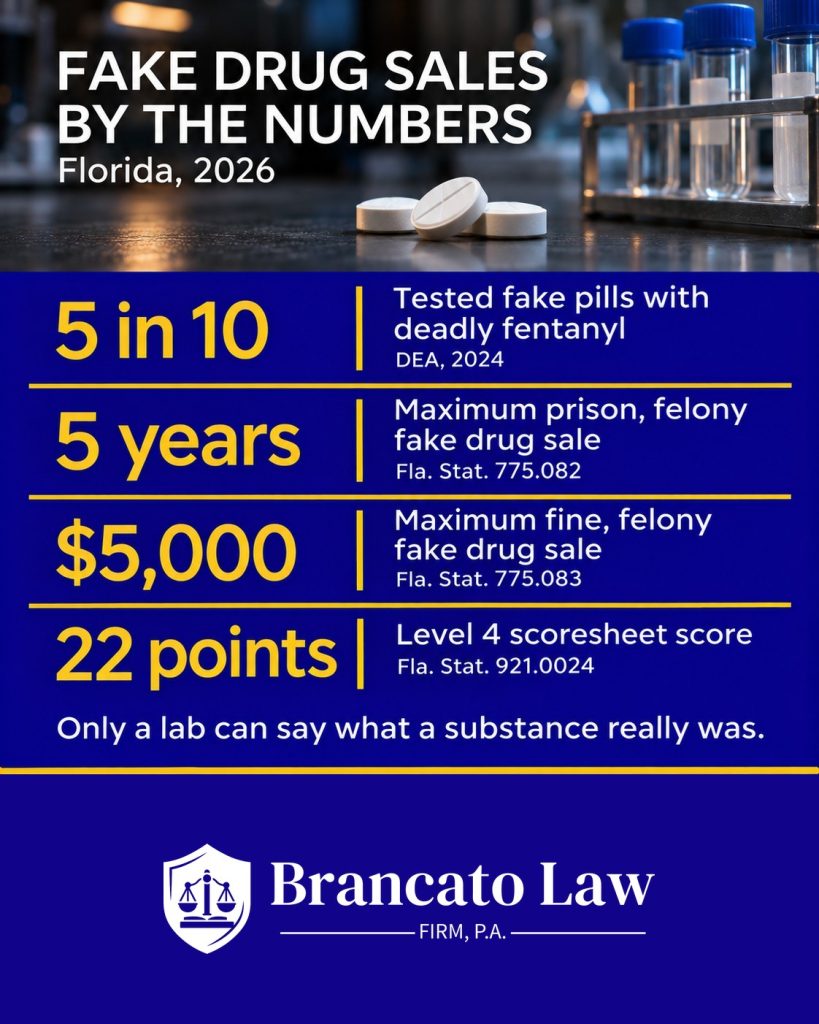
Selling a fake version of a Schedule I through IV drug is a third-degree felony, and selling a fake Schedule V drug is a second-degree misdemeanor. A third-degree felony carries up to 5 years in prison under section 775.082 and a fine of up to $5,000 under section 775.083. A second-degree misdemeanor carries up to 60 days in jail and a $500 fine. The Florida Criminal Punishment Code ranks the felony version at Level 4 in the offense severity chart in section 921.0022, and a Level 4 primary offense scores 22 points on the scoresheet under section 921.0024.
| Drug the seller offered | Charge level | Maximum jail or prison | Maximum fine |
|---|---|---|---|
| Schedule I, II, III, or IV drug (cocaine, heroin, fentanyl, cannabis, oxycodone, alprazolam) | Third-degree felony, Level 4 | 5 years in prison | $5,000 |
| Schedule V drug | Second-degree misdemeanor | 60 days in jail | $500 |
The charge level depends on the drug that was offered, not on what was handed over. In Houser v. State, 477 So. 2d 548 (Fla. 1985), the defendant pleaded no contest to two counts after agreeing to sell methamphetamine and methaqualone and providing other substances instead. The Florida Supreme Court rejected his argument that grading the crime by the drug offered made no sense, and held that the Legislature could treat an offer of some drugs as more serious than others “when in neither case are any controlled substances actually provided.” So a bag of baking soda sold as cocaine is a felony, even though baking soda is legal.
The Second District enforces the 5-year cap. In Thomas v. State, 909 So. 2d 601 (Fla. 2d DCA 2005), the trial court imposed 72 months for a section 817.563(1) conviction and a companion drug count. The Second District reversed because both were third-degree felonies with a 5-year maximum, and sent the case back for resentencing. A sentence above 60 months for this charge is illegal unless a separate enhancement applies.
Enhancements do apply in some cases. In Raines v. State, 14 So. 3d 244 (Fla. 2d DCA 2009), a Hillsborough County case from the Thirteenth Judicial Circuit, the defendant sold counterfeit crack cocaine to an undercover officer in 1989 and was charged under section 817.563(1). He received community control and probation, then a 10-year habitual offender sentence after a violation. The Second District said that sentence was illegal if he had not been sentenced as a habitual offender at the start, but it denied relief because the sentence had long since expired. The lesson for anyone with prior felonies: a “fake dope” charge can still carry habitual offender exposure, and sentencing paperwork has to be checked from day one.
How is selling fake drugs different from selling real or “imitation” drugs?
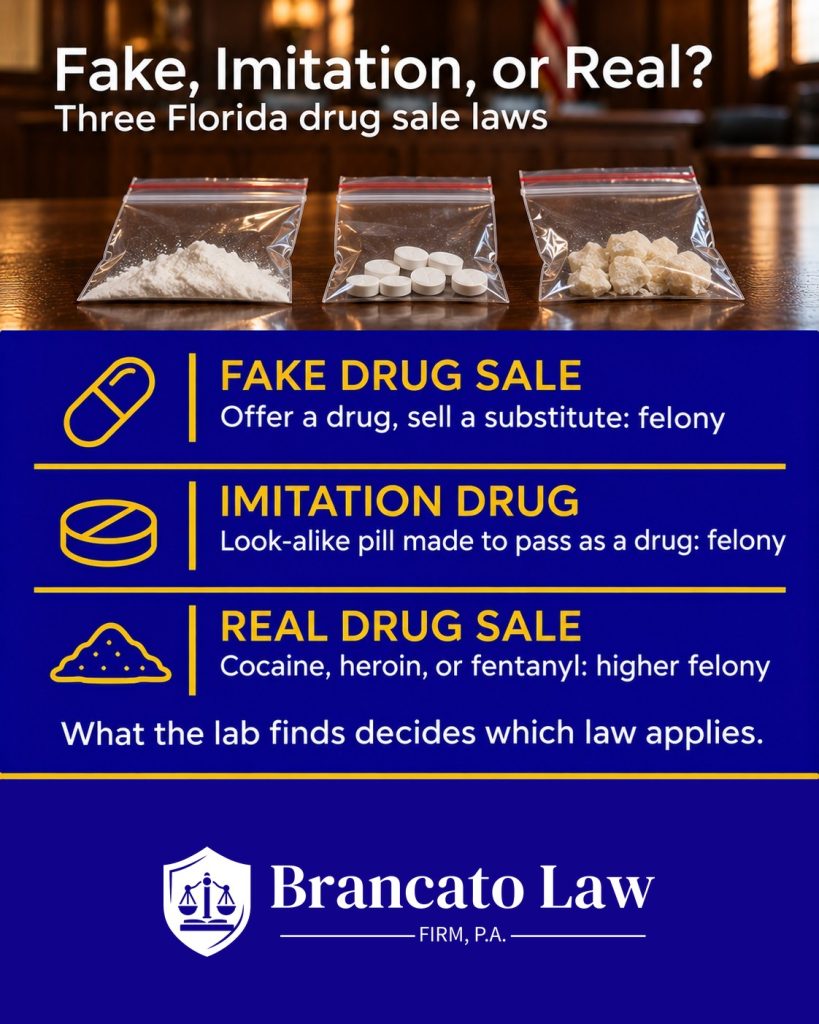
Florida has three separate laws that can apply when a drug deal involves something other than what it appears to be, and each carries a different penalty. Section 817.563 covers an offer of a real controlled substance followed by a sale of something else. Section 817.564 covers “imitation controlled substances,” meaning pills or powders that are not controlled but are made or presented to look like controlled drugs and are “subject to abuse.” Selling a real controlled substance falls under section 893.13, where selling cocaine or heroin is a second-degree felony.
| Fake drug sale (s. 817.563) | Imitation controlled substance (s. 817.564) | Real drug sale (s. 893.13(1)(a)) | |
|---|---|---|---|
| What was sold | Any other substance in place of the drug offered | A non-controlled pill or substance made or presented to pass as a controlled drug | An actual controlled substance |
| Key proof | An offer of a controlled drug, then a completed sale of the substitute | Look-alike appearance or representations, and that the item is subject to abuse | Lab confirmation of the drug and a sale or delivery |
| Typical level | Third-degree felony (Schedules I to IV) | Third-degree felony | Second-degree felony for cocaine, heroin, and fentanyl-class drugs |
Mixing up the two statutes can matter at trial. In Jones v. State, 620 So. 2d 236 (Fla. 1st DCA 1993), the lawyers and the court used the two offense names interchangeably. The First District affirmed the section 817.563 conviction because the charge, the evidence, and the jury instructions all tracked that statute, and it noted that the imitation offense requires proof that the substance was “subject to abuse,” which the State never pleaded or proved. Our attorneys read the charging document closely for this kind of mismatch, because the State has to prove the crime it actually charged.
Why are prosecutors focused on fake pills right now?
Prosecutors and police treat fake pills seriously because counterfeit pills sold on the street often contain fentanyl. DEA laboratory testing announced in fall 2024 found that 5 out of 10 pills tested contained a potentially deadly dose of fentanyl, down from 7 out of 10 in 2023, according to the Drug Enforcement Administration. When a pill sold as oxycodone or Xanax turns out to be fentanyl, the case is no longer a fake drug case. It becomes a real drug sale or a fentanyl trafficking charge with far higher penalties.
Buyers and sellers are often wrong about what is in a bag or a pill. A 2023 peer-reviewed study in the Harm Reduction Journal by Swartz and colleagues tested drug samples from 118 opioid users recruited at two Chicago syringe service programs between 2021 and 2022, and found that users were especially inaccurate at identifying the cutting agents and other drugs in their own samples (Swartz et al., Harm Reduction Journal, 2023). For the defense, that research supports a simple point: only a proper lab analysis can say what a substance was, and a field test or an officer’s description is not a substitute.
That cuts both ways in a section 817.563 case. If the lab finds no controlled substance, the State’s theory depends on proving the offer. If the lab finds a real controlled substance, prosecutors may try to upgrade the charge, so our attorneys look at the lab report, the chain of custody, and the testing method before advising a client on any plea.
How do our attorneys fight a fake drug sale charge?
Our attorneys fight a fake drug sale charge by attacking whichever element the State’s evidence supports least. These are the defenses we test first:
- No completed sale. The statute requires a sale of the substitute, not just an offer. In Mitchell v. State, 488 So. 2d 632 (Fla. 4th DCA 1986), the defendant offered a plainclothes officer a rock of cocaine and handed over a bag with a pebble in it, but was arrested before any money changed hands. The Fourth District reversed his conviction, holding that “a subsequent sale of a ‘bogus drug’ is required” and that the motion to dismiss should have been granted.
- No offer of a controlled substance. The State must prove the accused offered a specific controlled drug. Street slang, a buyer’s assumption, or an officer’s paraphrase in a report may not prove what was actually said. We get the recordings, texts, and body camera video and compare them word for word with the arrest affidavit.
- Knowledge. Under Bussey, the State must prove knowledge as to the controlled substance agreed or offered to be sold, while only general intent is required for handing over the substitute. A person who did not make the offer, such as a friend standing nearby, is in a different position from the person who did.
- Identification. Many of these cases rest on a quick hand-to-hand buy and a later identification from video. In State v. Thomas, 826 So. 2d 1048 (Fla. 2d DCA 2002), two Lee County undercover agents bought $40 worth of “crack” that turned out to be candle wax, and an agent identified the seller from a car-mounted video that was later misplaced. The trial court dismissed the case, but the Second District reinstated the charges because the defense never showed bad faith or filed a formal motion. For the defense, that means demanding and preserving recordings early and making a proper record if the State loses them.
- Entrapment. Under section 777.201, a person must be acquitted if he or she proves by a preponderance of the evidence that an officer or informant induced the crime with methods that created a substantial risk it would be committed by someone not ready to commit it. Our guide to the entrapment defense in Florida explains how informant pressure and repeated requests are proven.
- Charging overlap. When no fake drug was handed over but money was taken, prosecutors sometimes charge theft instead, as in State v. Gordon, 920 So. 2d 42 (Fla. 1st DCA 2005), where the First District allowed a grand theft charge against a man who took an undercover officer’s $330 and drove off without delivering cannabis. In State v. Thompson, 607 So. 2d 422 (Fla. 1992), the Florida Supreme Court approved a ruling that a defendant could not be sentenced for both the sale of a counterfeit controlled substance and felony petit theft based on the same fraudulent sale. We check every count for that kind of duplication.
- Scoresheet and sentencing. A Level 4 primary offense scores 22 points, and when total points are 44 or less the lowest permissible sentence is any nonstate prison sanction, unless the court decides prison is appropriate. With little or no prior record, that leaves room to argue for probation, diversion, or a withhold of adjudication.
Each of these defenses depends on the paperwork and recordings, which is why our attorneys request them at the start of the case. The Florida criminal case process page explains where discovery, motions, and plea talks fit between arrest and trial.
Can a fake drug sale charge be dropped in Florida?
Yes. A fake drug sale charge can be dropped, reduced, or never filed when the evidence of the offer or the sale is weak. Many of these cases begin as undercover or informant buys that are investigated for weeks before an arrest, and that window is when representation before charges are filed matters most. Nearly every month, our firm sees cases that never get filed because of front-end advocacy with the State Attorney’s Office before a filing decision is made.
Our attorneys decide case by case what, if anything, to provide to detectives. Sometimes the right move is to say nothing; other times a document, a witness, or a recording changes the filing decision. After an arrest, the same review drives motions to dismiss, plea negotiations, and diversion requests. Our post on fighting a drug charge before it is filed covers that stage in more detail.
What should you do if you are under investigation for selling fake drugs?
If a detective calls or a buyer starts asking questions about an old deal, the steps you take in the first few days can shape the whole case:
- Do not discuss the deal with the buyer, the detective, or anyone by text or social media. Messages are the State’s best evidence of the offer.
- Do not try to explain that the substance was fake. Admitting the sale of a fake drug proves the second element of section 817.563.
- Write down the dates, places, and people involved while your memory is fresh, and share it only with your lawyer.
- Keep your phone and accounts intact. Deleting messages can lead to a separate tampering charge.
- Call a criminal defense attorney before any interview so the lawyer can decide what, if anything, goes to the detective.
If the case involves a real drug sale or a larger quantity, our posts on fighting an intent to sell charge, Florida drug trafficking laws, and prescription fraud charges explain the related charges prosecutors may add.
Frequently asked questions about fake drug sale charges
Is it a crime to sell fake drugs in Florida if no one gets hurt?
Yes. Section 817.563 does not require harm to anyone, and the Florida Supreme Court in Bussey treated it as a drug abuse law that protects public health and welfare. The Brancato Law Firm focuses its defense on whether the State can prove the offer and the completed sale, since harm is not part of the case.
Can I be charged if the buyer was an undercover officer?
Yes. Many section 817.563 cases, including Raines in Hillsborough County and Thomas in Lee County, began with sales to undercover officers. Our attorneys at The Brancato Law Firm review how the operation was set up and whether an informant’s pressure supports an entrapment defense.
What if I never took the money for the fake drugs?
Without a completed sale, the State may be unable to prove the second element. In Mitchell, the Fourth District reversed a conviction where the defendant was arrested before any payment. The Brancato Law Firm uses the timing of the arrest and the buy money records to raise this defense in a motion to dismiss when the facts support it.
Is selling fake Xanax or fake weed a felony in Florida?
Usually, yes. Alprazolam (Xanax) and cannabis are controlled substances in Schedules I through IV, so offering either and then selling something else is a third-degree felony; only a fake Schedule V drug is a misdemeanor. When the offered drug is unclear from the recordings, our attorneys at The Brancato Law Firm challenge the State’s proof of exactly what was offered, which controls the charge level. Learn more on our drug crimes defense page.
Can the State charge me with both a fake drug sale and theft?
The State may file both, but stacked sentences for the same sale can be challenged. In Thompson, the Florida Supreme Court approved a ruling barring separate sentences for selling a counterfeit controlled substance and felony petit theft arising from one fraudulent sale. The Brancato Law Firm reviews every count in the information for this kind of double punishment before any plea.
Can a fake drug sale charge be resolved without a conviction?
Often it can, especially for a first offense. With a Level 4 scoresheet and a limited record, options can include diversion, a withhold of adjudication, or a reduced charge. Our attorneys at The Brancato Law Firm press for those outcomes early, often during pre-file advocacy before formal charges.
For more about our defense strategies, visit our Drug Crimes page.
A detective’s call or a buyer’s sudden questions usually mean a filing decision is weeks away, so the time to act is now. The Brancato Law Firm, P.A., founded by Tampa Criminal Defense Attorney Rocky Brancato, can review the recordings, the lab report, and the timeline with you; call (813) 727-7159 at any hour. Our office is two blocks from the courthouse. Our firm has Spanish-speaking staff, and attorney Jean-Luc Adrien speaks Spanish, Haitian Creole, and French.
The Brancato Law Firm, P.A.
620 E. Twiggs Street, Suite 205, Tampa, FL 33602
(813) 727-7159
Serving Hillsborough, Pinellas, and Pasco Counties
The Brancato Law Firm, P.A. is a Tampa-based criminal defense practice. We are not affiliated with any other Brancato-named law firms.
Visit Us

Tampa, FL 33602

Contact Us Now
Free Legal Consultation (813) 727-7159
