

From First DUI to Death Penalty



How to Fight a Computer Hacking Charge in Florida? (2026)


To fight a computer hacking charge in Florida, the defense starts with authorization: section 815.06 makes it a crime to access a computer, network, or electronic device willfully, knowingly, and without authorization or exceeding authorization. The basic offense is a third-degree felony punishable by up to 5 years in prison. It becomes a second-degree felony, up to 15 years, when the damage is at least $5,000, the access is part of a scheme to defraud, or it disrupts government or public services, and a first-degree felony when it endangers human life. Shared passwords, family devices, workplace access, and proof of who was actually at the keyboard decide most of these cases.
Many of today’s hacking charges have nothing to do with professional hackers: they come from a breakup, a divorce, or a job that ended badly, and someone logged into an account they used to share. I’m Rocky Brancato. As founder of The Brancato Law Firm, P.A., a Tampa criminal defense firm, and a former Chief Operations Officer of the Hillsborough County Public Defender’s Office, where I oversaw a staff of over 100 attorneys, I have watched computer crime cases grow from rare to routine over more than 25 years in Hillsborough County courtrooms. I have tried more than 150 jury trials to verdict, and our attorneys, working with a network of independent digital forensic experts, defend these cases by proving what access the client actually had and what the data actually shows.
What is a computer hacking charge in Florida?
A computer hacking charge in Florida is usually a charge under section 815.06, Florida Statutes, titled “offenses against users of computers, computer systems, computer networks, and electronic devices.” The statute applies when a person acts “willfully, knowingly, and without authorization or exceeding authorization” and does any of the following:
- Accesses a computer, computer system, network, or electronic device knowing the access is unauthorized or the manner of use exceeds authorization.
- Disrupts or denies an authorized user’s ability to send or receive data.
- Destroys, takes, injures, or damages computer equipment or supplies.
- Destroys, injures, or damages a computer, system, network, or device.
- Introduces a computer contaminant, such as malware or a virus.
- Engages in audio or video surveillance of a person by accessing a device’s built-in features, including data stored by a third party, such as a cloud account.
“Electronic device” brings phones, tablets, smart home devices, and vehicle systems within the law, not just desktop computers. A related statute, section 815.04, covers offenses against intellectual property, such as altering or taking data and programs. Because these cases rest on digital evidence and often involve social media accounts, they are part of the work on our Tampa internet crimes attorney page.
What are the penalties for computer hacking in Florida?
Unauthorized access under section 815.06 is a third-degree felony punishable by up to 5 years in prison and a $5,000 fine under section 775.082. Section 815.06 is not listed on the sentencing chart, so under section 921.0023 it ranks at Level 1 as a third-degree felony, Level 4 as a second-degree felony, and Level 7 as a first-degree felony. A first offender charged with the basic offense scores well below a prison sentence, but the enhanced versions can score prison quickly.
| Conduct | Subsection | Degree and level | Maximum penalty |
|---|---|---|---|
| Unauthorized access, disruption, damage, contaminant, or device surveillance | 815.06(2), (3)(a) | Third-degree felony, Level 1 | 5 years prison, $5,000 fine |
| Same, with damage or loss of $5,000 or more, a scheme to defraud, or disruption of government, utility, or transit systems | 815.06(3)(b) | Second-degree felony, Level 4 | 15 years prison, $10,000 fine |
| Same, endangering human life or disrupting medical equipment | 815.06(3)(c) | First-degree felony, Level 7 | 30 years prison, $10,000 fine |
| Modifying computer equipment or supplies without authorization | 815.06(4) | First-degree misdemeanor | 1 year jail, $1,000 fine |
The consequences reach beyond the sentence. Section 815.06(6) makes a defendant’s computers and devices used in the offense, or used to store data obtained through it, subject to forfeiture, and section 815.06(5) lets the owner of the accessed system sue a convicted person for compensatory damages and attorney fees. Our attorneys factor both into every negotiation.
What does exceeding authorization mean in a Florida hacking case?
Exceeding authorization means a person who had some permission used the system beyond it. Section 815.06 now reaches both access “without authorization” and access that “exceeds authorization,” which matters for employees, former partners, and family members who once had passwords. Florida courts have not drawn a precise line for “exceeding authorization” under section 815.06, so the defense often looks to how courts have read similar language in federal law.
In Van Buren v. United States, 593 U.S. 374 (2021), a Georgia police sergeant ran a license plate search in a law enforcement database in exchange for money. The U.S. Supreme Court held that under the federal Computer Fraud and Abuse Act, a person “exceeds authorized access” only when he accesses a computer with authorization and then obtains information in areas, “such as files, folders, or databases,” that are off-limits to him, not when he uses permitted access for an improper purpose. Van Buren interprets the federal statute, not section 815.06, but our attorneys use its reasoning to argue that misusing access you were given is a workplace or civil problem, not a felony.
Is logging into an ex’s social media or email a crime in Florida?
It can be, if you no longer had permission. In Umhoefer v. State, 235 So. 3d 989 (Fla. 2d DCA 2017), a man accessed a woman’s Facebook account and sent her private messages to her mother. He claimed she had given him the password, but she testified she had changed it and had not given him the new one, and a detective testified he used a password-bypass application called Passfinder. The Second District affirmed the conviction, reasoning that if he still had the password, “he would not have needed Passfinder,” and that expert testimony showed he accessed Facebook’s servers, which qualifies as a computer network.
The lesson cuts both ways. Shared passwords, saved logins on a family computer, and a partner’s prior permission are real defenses, and many relationship cases fall apart on them. But proof that the password was changed, that permission was withdrawn, or that a bypass tool was used can make the State’s case. Our attorneys collect the text messages, account settings, and device histories that show what permission existed and when, if ever, it ended.
How do our attorneys fight a computer hacking charge in Florida?
We fight computer charges by testing authorization, knowledge, identity, and value, and by challenging how the State collected its digital evidence. These are the defenses we raise most often.
- Authorization. The client had the password, shared the account, used a family or household device, or had express or implied permission that was never withdrawn.
- Lawful employment. Section 815.06(7) excludes a person acting within the scope of lawful employment and anyone performing authorized security operations for a government or business.
- Knowledge and willfulness. The State must prove the client knew the access was unauthorized. Automatic syncing, saved logins, and shared cloud accounts can explain access the client never intended.
- Identity. An IP address identifies a connection, not a person. Shared Wi-Fi, VPNs, and multiple household users can make it impossible to prove who was at the keyboard.
- Value and purpose. The second-degree enhancement requires $5,000 in damage or loss, a scheme to defraud, or disruption of public services. Inflated restoration costs and unproven fraud claims are common targets.
- Unlawful searches. Phone and computer searches require a valid warrant particular to the evidence sought. Overbroad warrants and searches beyond their scope can be suppressed.
- Independent forensic review. Our forensic experts examine the State’s extraction reports and logs, which often contain timestamp, time-zone, and attribution errors.
How common are computer and internet crimes in Florida?
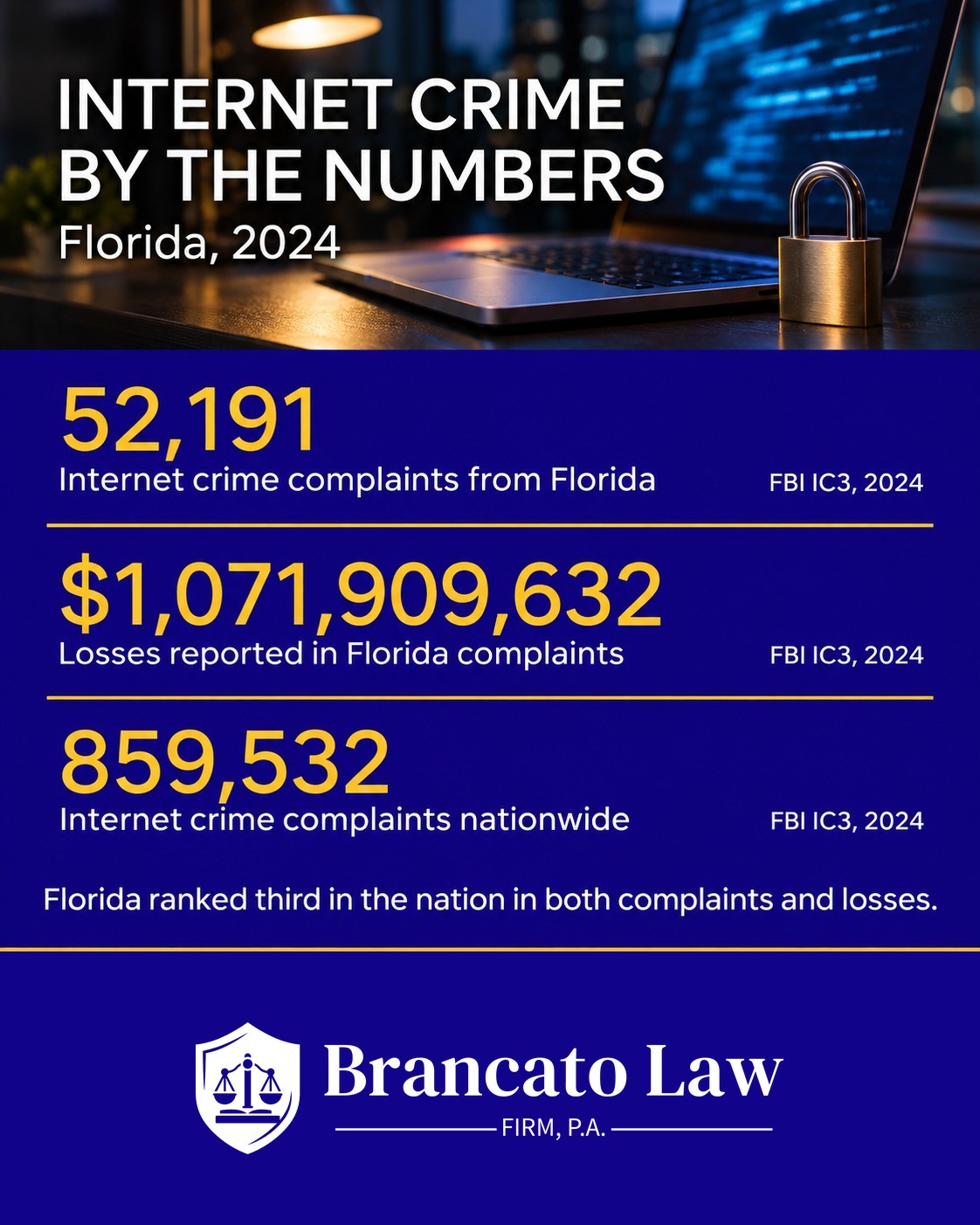
Florida is one of the largest sources of internet crime reports in the country. In 2024, the FBI’s Internet Crime Complaint Center received 52,191 complaints from Florida reporting $1,071,909,632 in losses, ranking Florida third among the states in both, according to the IC3 2024 Internet Crime Report. Nationally, the report counted 859,532 complaints and $16.6 billion in losses. That volume puts pressure on police and prosecutors to bring computer charges, including in cases that are really private disputes.
Legal scholars have long criticized vague authorization rules in computer crime laws. In “Norms of Computer Trespass,” published in the Columbia Law Review, Volume 116, in 2016, law professor Orin S. Kerr argued that authorization to access a computer should depend on trespass norms, and that access is unauthorized when the owner requires authentication, such as a password, to get in. His approach, which the Supreme Court’s reasoning in Van Buren echoes, helps our attorneys separate a true break-in from a broken rule in a workplace policy or terms of service.
How are computer hacking cases handled in Hillsborough County?
In Hillsborough County, computer charges under section 815.06 are prosecuted by the State Attorney’s Office for the 13th Judicial Circuit, usually after an investigation by the Hillsborough County Sheriff’s Office or the Tampa Police Department that can take months while devices are imaged and examined. In our practice, many of these cases begin in a divorce, custody fight, or injunction hearing, when one side discovers the other read private messages or tracked a phone, and the criminal case often overlaps with a stalking or cyberstalking charge. Because the investigation happens before any arrest, our representation before charges are filed can present the authorization evidence to the detective or prosecutor while the case is still being evaluated.
A first-time defendant charged with the basic third-degree felony may be a candidate for the pretrial intervention program in Hillsborough County, which can end in dismissal, especially when no data was damaged and no money was taken. Cases involving financial fraud often bring related charges, explained in our guides to identity theft defense and scheme to defraud charges. Our guide to the Florida criminal case process explains each stage that follows an arrest.
Can computer hacking charges be dropped in Florida?
Yes. Computer hacking charges are dropped or reduced when the evidence shows the client had permission, when the State cannot prove who accessed the account, when the claimed damage does not reach the $5,000 threshold, or when the digital evidence was obtained unlawfully. Our attorneys gather the account records, messages about password sharing, device ownership records, and an independent forensic report, then show the prosecutor where the case fails. For first offenders without financial harm, we also pursue diversion that ends in dismissal.
Frequently asked questions about computer hacking charges in Florida
Is reading my spouse’s text messages on their phone a crime in Florida?
It can be, if you accessed the phone without authorization or beyond the permission you had. Section 815.06 covers electronic devices, and authorization is the central question. The Brancato Law Firm examines how the phone was shared, whether passcodes were known to both spouses, and whether any permission was withdrawn, as our internet crimes defense team does in every relationship case.
Can an employee be charged for accessing company files after quitting?
Yes. Once employment ends, access to the employer’s systems is usually no longer authorized, and the lawful-employment exception no longer applies. Our attorneys at The Brancato Law Firm look at whether the account was disabled, what the departure agreement said, and whether the files were taken or only viewed.
Is installing tracking software or a hidden app on someone’s phone hacking?
It can be. Section 815.06(2)(f) covers audio or video surveillance through a device’s built-in features, and installing spyware can also support a stalking charge. The Brancato Law Firm can speak with investigators before an arrest through our pre-file advocacy when a client learns a partner has reported tracking.
Will police take my computer and phone in a hacking case?
Often, yes. Police usually seize devices under a search warrant, and section 815.06(6) allows forfeiture of devices used in the offense or used to store the data. Our attorneys at The Brancato Law Firm challenge overbroad warrants and seek the return of devices and data not tied to the charge.
Can I be charged with hacking for sharing my own Netflix or streaming password?
Prosecutions for simple password sharing among family members are rare, and violating a company’s terms of service is usually a contract issue rather than a crime. The Brancato Law Firm relies on the authorization reasoning in Van Buren and Kerr’s trespass-norms analysis when a case turns on a terms-of-service violation.
Can a hacking charge also be prosecuted federally?
Yes. The same conduct can violate the federal Computer Fraud and Abuse Act, and federal agents sometimes take cases with large losses or interstate victims. Our attorneys at The Brancato Law Firm focus on the Florida charge and on resolving it before it grows, starting with the State Attorney’s charging decision.
For more about our defense strategies, visit our Internet Crimes page.
Digital evidence is examined long before an arrest, so the time to act is when you first learn of a complaint or a seized device. The Brancato Law Firm, P.A., founded by Tampa Criminal Defense Attorney Rocky Brancato, can begin with a confidential consultation at (813) 727-7159, and you can call us at any hour. Our firm has Spanish-speaking staff, and attorney Jean-Luc Adrien speaks Spanish, Haitian Creole, and French. Our office is two blocks from the courthouse, and we defend computer and internet crime charges in Hillsborough, Pinellas, and Pasco counties.
The Brancato Law Firm, P.A.
620 E. Twiggs Street, Suite 205, Tampa, FL 33602
(813) 727-7159
Serving Hillsborough, Pinellas, and Pasco Counties
The Brancato Law Firm, P.A. is a Tampa-based criminal defense practice. We are not affiliated with any other Brancato-named law firms.
Visit Us

Tampa, FL 33602

Contact Us Now
Free Legal Consultation (813) 727-7159
