

From First DUI to Death Penalty



Accessory After the Fact in Florida: How to Fight It (2026)



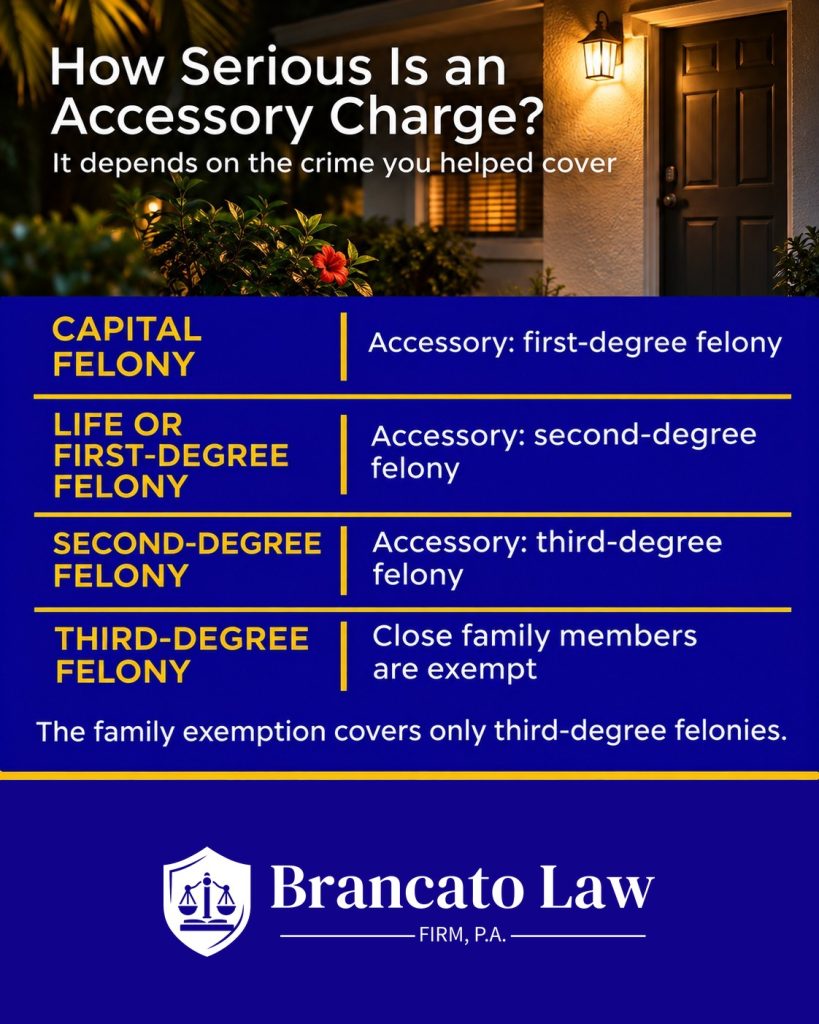
Accessory after the fact in Florida, under section 777.03, Florida Statutes, is helping someone you know committed a crime avoid detection, arrest, trial, or punishment, for example by hiding them, giving them money or a car to flee, or lying to police for them. The charge is usually one level below the underlying crime: helping after a capital felony is a first-degree felony, after a life or first-degree felony a second-degree felony, and after a second-degree felony a third-degree felony. Spouses, parents, grandparents, children, grandchildren, and siblings are exempt only when the underlying crime is a third-degree felony. Refusing to talk to police or denying that you know anything is not enough; the State must prove an overt act of help, done with knowledge and intent.
Most accessory after the fact cases are built from one conversation with a detective, usually a conversation the person thought was about someone else. I’m Rocky Brancato, founder of The Brancato Law Firm, P.A., a Tampa criminal defense firm. As a former police academy instructor, I taught officers criminal procedure and courtroom testimony, and I have spent more than 25 years in Hillsborough County courtrooms. Our attorneys defend these charges by testing the three things the State has to prove: that you knew about the crime, that you gave real help, and that you meant that help to keep the offender from being caught.
What is accessory after the fact in Florida?
Accessory after the fact is knowingly helping a person who committed a crime, after the crime is complete, with the intent that the person avoid or escape detection, arrest, trial, or punishment. Section 777.03, Florida Statutes defines it, and Florida’s standard jury instructions list the elements a jury must find.
In Bowen v. State, 791 So. 2d 44 (Fla. 2d DCA 2001), a Tampa case discussed below, the Second District listed what the State essentially had to prove:
- The other person committed the underlying crime.
- You knew that person had committed it.
- You afterward maintained, assisted, or gave the person some other aid.
- You gave that aid intending that the person avoid or escape arrest.
- You were not related to the person in a way the statute exempts.
The court added that the timing of events and what the defendant knew at specific moments are the critical parts of these prosecutions. Accessory after the fact is a separate crime from the underlying offense. It is often charged alongside, or in place of, charges like tampering with evidence and giving a false name to police.
What counts as helping someone after a crime?
Any overt act that helps the offender avoid being caught can count: hiding the person, letting them stay with you, giving them money, a phone, or a car to leave town, moving or destroying evidence, or telling police a story meant to send them in the wrong direction. The statute’s words are broad: anyone who “maintains or assists” the offender “or gives the offender any other aid.”
The limit is that the help must be an action. In Melahn v. State, 843 So. 2d 929 (Fla. 5th DCA 2003), a man’s roommate stole a Panther Chameleon from a pet shop. When police questioned Melahn, he said he did not know what the officer was talking about and did not know who had been in the car with him. The Fifth District held that accessory after the fact requires some overt action, and that merely refusing to cooperate and disavowing knowledge could not support the conviction. Because the jury may have relied on that theory, the court reversed.
Intent is usually proven from circumstances. Bowen explained that the type of aid is often the best evidence of intent: the greater the help and the more it could assist the offender, the more likely a jury will find it was given to help them escape. A ride to work the morning after a crime is a very different fact from a ride to the bus station with cash and a new phone.
Is lying to police accessory after the fact?
It can be. A false statement that goes beyond denying knowledge, such as giving police a false name for the offender, a false alibi, or a false direction of travel, can support an accessory charge. Melahn drew the line: certain falsehoods told to an officer seeking information, which go further than merely disavowing knowledge or refusing to cooperate, may support a conviction.
You have no legal duty to help police with their investigation, and declining to answer questions is not a crime. Lying is different, and it can also be charged under other statutes. The safest course when detectives want to talk about someone else’s crime is to say you want a lawyer and stop talking, then call one.
Can family members be charged with accessory after the fact?
It depends on the underlying crime. Florida’s family exemption covers a spouse, parent, grandparent, child, grandchild, brother, or sister, by blood or by marriage, but only when the underlying crime is a third-degree felony. For a capital, life, first-degree, or second-degree felony, the statute contains no family exemption, so a mother who hides her son after an armed robbery can be charged. For child abuse, neglect of a child, aggravated child abuse, aggravated manslaughter of a child, or murder of a child, anyone who helps can be charged unless the court finds that the person is a victim of domestic violence.
| Underlying crime | Does the family exemption apply? | Accessory charge |
|---|---|---|
| Capital felony | No | First-degree felony |
| Life or first-degree felony | No | Second-degree felony |
| Second-degree felony | No | Third-degree felony |
| Third-degree felony ranked level 3 to 10 | Yes | Third-degree felony |
| Third-degree felony ranked level 1 or 2 | Yes | First-degree misdemeanor |
| Child abuse, neglect, or killing of a child | No (domestic violence victim exception only) | Depends on the degree of the underlying crime |
Boyfriends, girlfriends, cousins, aunts, uncles, and friends are not on the statute’s list at all. Bowen noted that the defendant and the offender were not legally married, and the exemption in effect at the time therefore did not apply to her. The Legislature has since narrowed the exemption to third-degree felonies.
Legal scholars have documented how unusual these family carve-outs are. Professors Dan Markel, Jennifer Collins, and Ethan Leib examined exemptions for family members who harbor fugitives in Criminal Justice and the Challenge of Family Ties, 2007 U. Ill. L. Rev. 1147, part of a wider study of how criminal law gives benefits or burdens based on family status.
What are the penalties for accessory after the fact in Florida?
The penalty depends on the crime the other person committed. Section 777.03(2) sets the degree, and section 775.082, Florida Statutes and section 775.083, Florida Statutes set the maximums.
| Accessory charge | Maximum prison or jail | Maximum fine |
|---|---|---|
| First-degree felony (after a capital felony) | 30 years | $10,000 |
| Second-degree felony (after a life or first-degree felony) | 15 years | $10,000 |
| Third-degree felony (after a second-degree or higher-level third-degree felony) | 5 years | $5,000 |
| First-degree misdemeanor (after a level 1 or 2 third-degree felony) | 1 year | $1,000 |
For sentencing under Florida’s Criminal Punishment Code, section 777.03(3) ranks accessory after the fact two levels below the underlying felony on the offense severity chart. That lower ranking usually means fewer scoresheet points than the underlying crime would carry, which matters when the score decides whether prison is required.
Can you be charged as both a principal and an accessory after the fact?
The State can charge both, but Florida law does not allow a conviction for both as to the same crime. In Staten v. State, 519 So. 2d 622 (Fla. 1988), the Florida Supreme Court held that being a principal to a crime and being an accessory after the fact to the same crime are mutually exclusive, and it ordered the accessory convictions vacated. Bowen added that accessory liability cannot arise until the underlying crime is complete.
That distinction drives strategy. A person who helped plan or carry out the crime is a principal under Florida’s law of principals and faces the same penalty as the person who committed it. A person whose only involvement came afterward faces a lower-level offense. Our attorneys often use that difference to move a case from a principal charge to an accessory charge, or to show the State cannot prove either.
The State also does not need to convict the other person first. Under section 910.13, Florida Statutes, prosecution of an accessory is not contingent on prosecution or conviction of the principal, and the accessory can be tried in the county where the help was given or in any county where the principal could be tried. The State must still prove at trial that the other person actually committed the crime.
What does the Hank Carr case teach about accessory charges in Tampa?
Bowen came out of one of the worst days in Tampa’s history, and it shows how much accessory cases turn on what the defendant knew at each moment. In 1998, Bernice Bowen’s young son died of a gunshot wound in her Tampa apartment, where she lived with her boyfriend, Hank Carr. Carr later escaped from police custody, killed two Tampa Police detectives and a Florida Highway Patrol trooper, and took his own life after a standoff at a gas station. Bowen was charged as an accessory after the fact to five crimes, mainly because she did not give police Carr’s correct name, which would have revealed an out-of-state warrant, and did not volunteer that he often carried a handcuff key.
The Second District reversed every conviction. It held the State failed to prove that a manslaughter of her son had occurred or that she knew of one when she helped Carr, and failed to prove she knew Carr had killed the trooper when she gave any help, so she was entitled to acquittal on those two counts. On the escape and the detectives’ murders, the State had enough evidence to go to a jury, but trying them together with the manslaughter count had turned the trial into a debate about what Bowen could have done to prevent the killings instead of what she did after them. The court ordered a new trial on those counts.
On retrial, Bowen was convicted on those three counts, and the Second District affirmed in Bowen v. State, 868 So. 2d 541 (Fla. 2d DCA 2003). After detectives told her Carr had shot the detectives and escaped, she kept telling police his name was Joseph Bennett. The court held that this false identification aided his attempted escape, and that her later cooperation did not erase her earlier lies.
The lesson for anyone in Hillsborough, Pinellas, or Pasco County is the timeline: what matters is what you knew at the moment you acted, and what you did with it.
How do our attorneys fight an accessory after the fact charge?
Our firm defends these cases one element at a time, and we look for the weakest link early, often before formal charges. When an accessory charge is tied to a violent crime, it falls within our Tampa violent crime lawyer practice. The work usually includes:
- Making the State prove the underlying crime. If the State cannot prove the other person committed the crime charged, as in the manslaughter count in Bowen, there is nothing to be an accessory to.
- Fixing the timeline of knowledge. Help given before you knew about the crime is not accessory after the fact.
- Separating silence from action. Under Melahn, refusing to talk and denying knowledge are not overt acts.
- Offering the innocent explanation for the help. A ride, a meal, or a place to sleep often has a reason that has nothing to do with avoiding arrest.
- Checking the family exemption and the degree of the underlying crime, including whether it is a level 1 or 2 third-degree felony that drops the charge to a misdemeanor.
- Holding the State to the line between principal and accessory, using Staten.
- Preserving each argument in a specific motion for judgment of acquittal at trial.
What should you do if detectives ask about someone you know?
Ask for a lawyer before you answer questions about a friend’s or relative’s crime, even if detectives say you are only a witness. That interview is where most accessory cases are made: a detective already suspects the other person, asks you where they are or what they told you, and your answer becomes the charge. Investigation is the first stage of the Florida criminal case process, and it is when the State is still deciding whom to charge.
Our representation before charges are filed is a staple of our practice. Nearly every month, cases never get filed because of our firm’s front-end advocacy, and our attorneys decide case by case what, if anything, to give detectives. Our guide to the signs you are being investigated for a crime in Florida covers what to watch for.
Frequently asked questions about accessory after the fact in Florida
Can my mother be charged for letting me stay at her house after an arrest warrant was issued?
It depends on the crime in the warrant. A parent is exempt only if the underlying crime is a third-degree felony; for a second-degree felony or higher, a parent who hides a child to help them avoid arrest can be charged under section 777.03. The Brancato Law Firm often arranges a planned surrender, which protects the family members who were asked to help.
Is it a crime to refuse to tell police where someone is?
Refusing to answer is not accessory after the fact, because Florida courts require an overt act of help and Melahn v. State held that refusing to cooperate and denying knowledge are not enough. Our attorneys at The Brancato Law Firm advise people in that position to ask for a lawyer rather than offer any story, because a false answer can be charged.
Can I be charged as an accessory if the person I helped was never convicted?
Yes. Section 910.13 says an accessory’s prosecution does not depend on the principal being prosecuted or convicted, though the State must still prove the other person committed the crime. The Brancato Law Firm attacks that proof directly, since a failure to prove the underlying crime defeats the accessory charge.
Is a girlfriend or boyfriend exempt from accessory after the fact charges?
No. The family exemption covers only spouses, parents, grandparents, children, grandchildren, and siblings, by blood or marriage, and only when the underlying crime is a third-degree felony. Our attorneys at The Brancato Law Firm focus those defenses on knowledge and intent instead, explained further on our violent crimes defense page.
Can accessory after the fact charges be dropped in Florida?
Yes. Prosecutors drop or reduce accessory charges when they cannot prove what the person knew at the time, when the help was really silence, or when the family exemption applies. The Brancato Law Firm presents that evidence early, often through pre-file advocacy before the State makes its charging decision.
Can I be charged as an accessory after the fact to a misdemeanor?
No. Section 777.03 applies only when the underlying crime is a felony, and helping after a level 1 or 2 third-degree felony is itself only a first-degree misdemeanor. The Brancato Law Firm checks the degree and severity ranking of the underlying charge at the start of every accessory case.
For more about our defense strategies, visit our Violent Crimes page.
If a detective has asked to speak with you about a friend or family member, our attorneys will first find out what the detective is investigating and whether you need to say anything at all. Call The Brancato Law Firm, P.A., founded by Tampa Criminal Defense Attorney Rocky Brancato, at (813) 727-7159 before that interview happens; you can call us at any hour. Our firm has Spanish-speaking staff, and attorney Jean-Luc Adrien speaks Spanish, Haitian Creole, and French.
The Brancato Law Firm, P.A.
620 E. Twiggs Street, Suite 205, Tampa, FL 33602
(813) 727-7159
Serving Hillsborough, Pinellas, and Pasco Counties
The Brancato Law Firm, P.A. is a Tampa-based criminal defense practice. We are not affiliated with any other Brancato-named law firms.
Visit Us

Tampa, FL 33602

Contact Us Now
Free Legal Consultation (813) 727-7159
