

From First DUI to Death Penalty



Can You Be Charged for Someone Else’s Crime in Florida? (2026)


Yes. Under Florida’s law of principals, section 777.011, Florida Statutes, anyone who helps, encourages, counsels, or hires another person to commit a crime can be charged, convicted, and punished exactly as if they had committed it themselves, even if they were not at the scene. The State must prove two things: that you intended the crime to be committed, and that you did or said something that actually helped it happen. Being present, knowing about the crime, or leaving with the people who did it is not enough on its own to make you a principal.
If police say you were “with” the person who robbed, shot, or stole, you can be charged with that crime even though your hands never touched the gun or the property. I’m Rocky Brancato, founder of The Brancato Law Firm, P.A., a Tampa criminal defense firm, and I have tried more than 150 jury trials to verdict, many of them cases where the State’s whole theory was that my client helped someone else. Our attorneys defend these cases by pinning down exactly what you knew and when you knew it, because that timeline decides whether you are a principal or only a bystander.
What does Florida’s law of principals say?
Section 777.011, Florida Statutes makes a person a “principal in the first degree” if they commit a crime or if they “aid, abet, counsel, hire, or otherwise procure” it, as long as the crime is committed or attempted. A principal may be charged, convicted, and punished as such whether or not they were actually or constructively present when it happened.
In plain terms, Florida does not have a separate, smaller crime for helping. The lookout, the driver, the person who handed over the gun, and the person who planned it from across town all face the same charge as the person who did the act. That rule applies to felonies and misdemeanors alike, from a petit theft to first-degree murder.
The statute also covers conduct that older law called being an “accessory before the fact.” Counseling, hiring, or procuring a crime makes you a principal in Florida. Helping someone only after the crime is over is a different offense, accessory after the fact, covered below.
What must the State prove to convict you as a principal?
The State must prove you intended the crime to be committed and did some act to help the other person commit it. The Florida Supreme Court set that rule in Staten v. State, 519 So. 2d 622 (Fla. 1988), the leading case on Florida principal liability, holding that a person who did not physically commit the crime is guilty as a principal only if they intended it and assisted in it.
Florida courts state the same rule more specifically. In Turner v. State, 402 So. 3d 1162 (Fla. 3d DCA 2025), the Third District explained that the State must show “a conscious intent that the criminal act be done” and an act or word that was meant to, and did, “incite, cause, encourage, assist, or advise” the other person. The same opinion repeats the limit that protects bystanders: knowing a crime is happening, being at the scene, and fleeing afterward are not enough to prove participation with criminal intent.
Florida’s standard jury instructions include a principals instruction, Instruction 3.5(a), which judges read when the State relies on this theory. The Florida Bar’s jury instructions builder lists it in Chapter 3 alongside the defenses that most often answer it.
The table below shows where the lines fall.
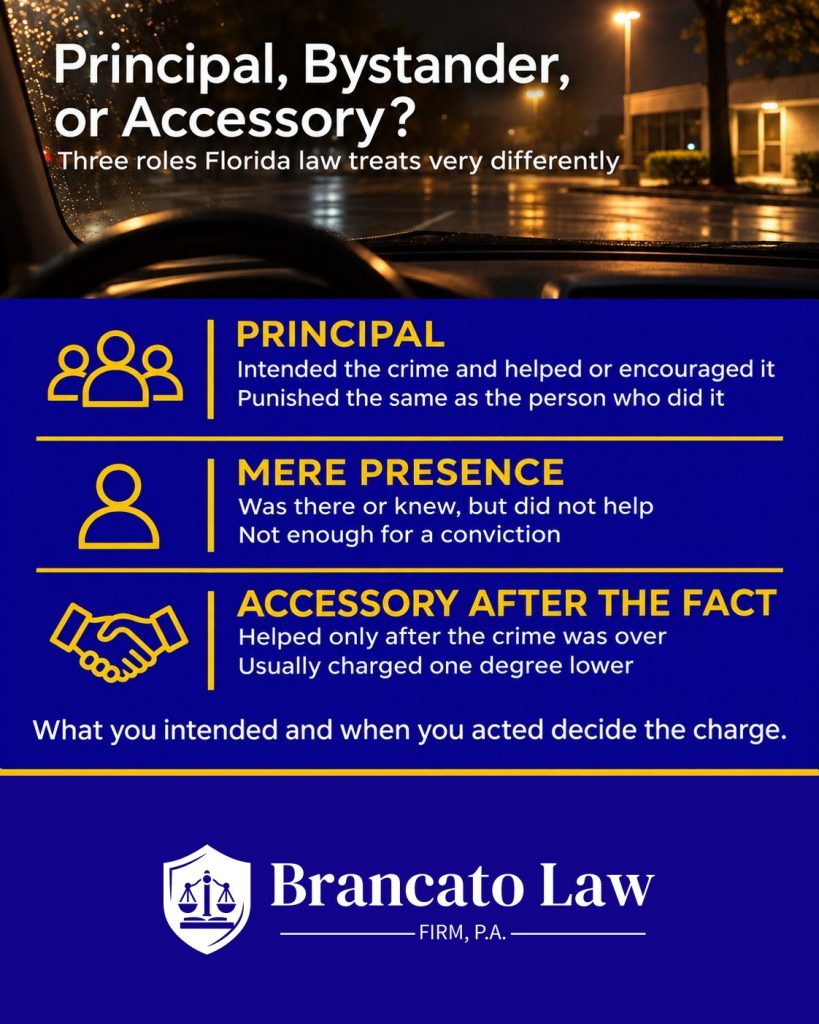
| Your role | What it looks like | Legal result in Florida |
|---|---|---|
| Principal | You agreed to the plan and helped: drove, kept watch, supplied a weapon, lured the victim | Same charge and same maximum penalty as the person who did the act, s. 777.011 |
| Mere presence | You were there, or found out what happened, but did not intend or help the crime | Not guilty of the crime; presence and knowledge alone are not enough |
| Accessory after the fact | You helped the person avoid arrest only after the crime was finished | Separate, lower-level offense under s. 777.03 |
Does being at the scene make you guilty?
No. Presence at the scene, even close presence, does not make you a principal without proof that you intended the crime and helped it. This is the most common defense in principal cases, and it often turns on small facts: who planned what, who said what in the car, and whether you had any reason to know a weapon was there.
The proof problem for the State is intent. Prosecutors usually try to infer it from circumstances: texts before the crime, the route you drove, where you parked, what you did afterward. Our attorneys answer with the same kind of evidence, such as phone records showing you made other plans, location data placing you somewhere else during the planning, or witnesses who saw you surprised when the crime started. Florida’s rules on circumstantial evidence matter in nearly every one of these cases.
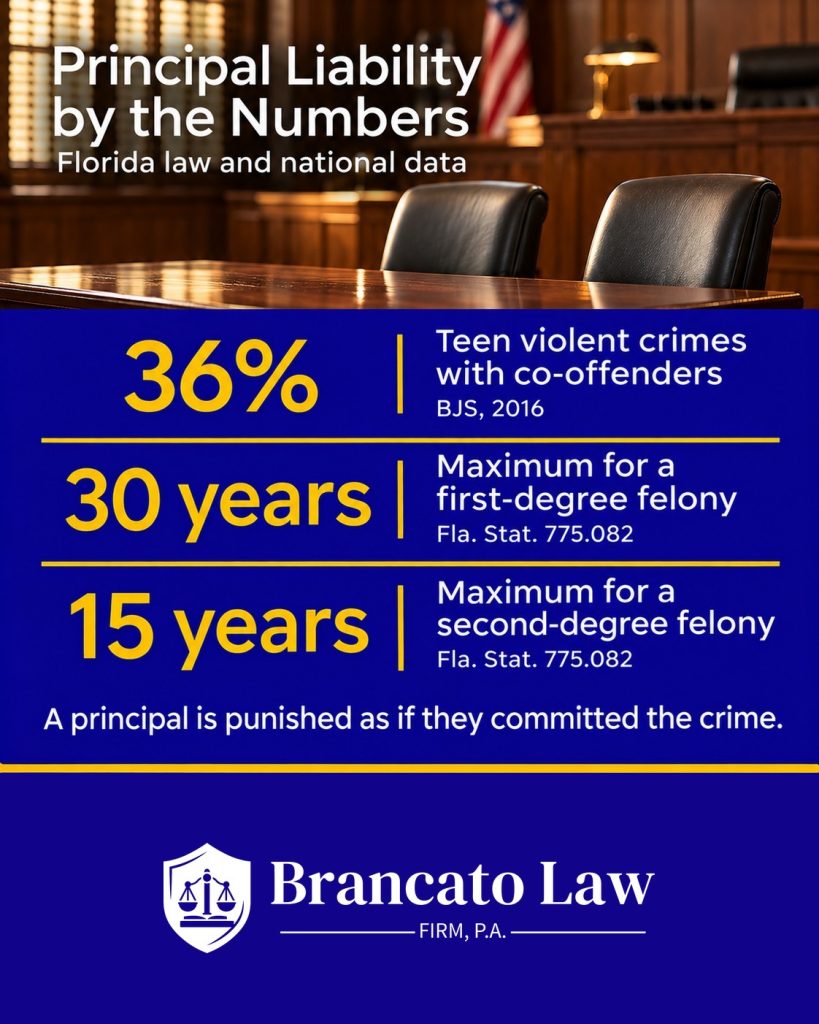
Statistics show why this issue comes up so often. In a Bureau of Justice Statistics study of National Crime Victimization Survey data from 2004 to 2013, 36 percent of violent victimizations committed by adolescents involved co-offenders (BJS, July 2016). When young people commit crimes in groups, everyone in the group is exposed to a principal charge, including the friend who only came along for the ride.
Is the getaway driver guilty of the robbery?
A getaway driver who knew about the plan in advance and was waiting to help is guilty of the robbery as a principal. A driver who did not know a robbery was planned is not. Staten drew that line, and it still controls.
In Staten, the defendant was present on several occasions when the group planned to rob a drug dealer, rode with the group as they discussed the plan on the way, waited across the street while the others robbed and killed the dealer, and then drove everyone away. The Florida Supreme Court held that combination of facts let the jury infer she was a participant, and it upheld her convictions as a principal for second-degree murder, armed robbery, and aggravated battery.
Turner shows how much the details of trial practice matter. Police stopped the car Turner was driving less than two miles from a Miami-Dade laundromat robbery, about five minutes after it happened, with the robbers inside and a gun hidden under his seat. On appeal, Turner argued he was merely present. The Third District held he had not made that specific argument in his motion for judgment of acquittal at trial, so it reviewed only for fundamental error. It affirmed his armed robbery and conspiracy convictions and his 10-year mandatory minimum for actual possession of a firearm. The lesson for any defendant: the mere-presence argument has to be raised, in specific terms, at trial. For more on how the State proves these cases, see our guide on how to defend against an armed robbery charge in Florida.
How did a Hillsborough County case limit the principals instruction?
A judge may give the principals instruction only when evidence shows the defendant intended and helped the other person’s crime. The Second District Court of Appeal, which hears appeals from Hillsborough, Pinellas, and Pasco Counties, enforced that limit in Montgomery v. State, 291 So. 3d 170 (Fla. 2d DCA 2020).
Montgomery and a companion were drinking outside a Hillsborough County convenience store. A store employee told them to leave, and Montgomery swung a box cutter at him, then sliced his side during a scuffle in the road median. In a second fight a short time later, the companion stabbed the employee in the back three times; the employee learned who stabbed him only from the store video. The State charged Montgomery with one count of aggravated battery and argued he was guilty both for the box cutter and as a principal to the stabbing.
The Second District reversed the aggravated battery conviction. Nothing showed Montgomery knew his companion was armed or intended the stabbing, the second fight was a separate episode, and his conduct during or after the stabbing could not make him a principal to it. Because the general verdict did not show which theory the jury used, the error was not harmless.
The lesson for clients in our area: when the State stacks a principal theory on top of your own conduct, our attorneys object to the principals instruction and make the State show intent and help for each act. Doctrine like this survives at more than one stage. The same facts support a motion for judgment of acquittal, an objection to the instruction, and an appeal.
Can you be a principal to a murder you did not plan?
Yes, through felony murder, but there is a limit called the independent act doctrine. If you join in a robbery or other listed felony and someone dies, every participant can face a murder charge, even if no one planned a killing. Our guide on how to fight a felony murder charge in Florida covers that rule in depth.
The independent act doctrine applies when a co-felon commits an act that falls outside of, and is foreign to, the plan the group agreed on. The Florida Supreme Court described it in Ray v. State, 755 So. 2d 604 (Fla. 2000): a defendant whose co-felon goes beyond the original plan is not punished for that independent act. The same opinion set its limit. When the defendant willingly took part in the underlying felony and the death resulted from forces the participants set in motion, no independent act instruction is given. Ray and his cousin planned and carried out a robbery, and the killing happened when an officer confronted them while they were still fleeing, so the Court affirmed Ray’s first-degree murder conviction while reducing his death sentence to life. Florida’s standard jury instructions include the defense as Instruction 3.6(l).
For murder that is not felony murder, the State must prove you shared the required intent. In Farris v. State, 406 So. 3d 951 (Fla. 4th DCA 2025), surveillance video showed a Broward County woman take a gun from her purse, set it near a propane tank cage, and appear to signal a man who picked it up and shot a victim at a bus stop. The Fourth District held the State had to prove she consciously intended him to shoot the victim unjustifiably, though not that she intended the death. The evidence was enough to go to the jury, but the court reversed her second-degree murder conviction because the prosecutor told jurors in rebuttal that she did not need that conscious intent, and that error, combined with an improper reference in opening statement, denied her a fair trial. Our Tampa homicide attorney page explains how our firm handles murder charges built on a principal theory.
What are the penalties if you are convicted as a principal?
A principal faces the same degree of crime and the same maximum sentence as the person who committed the act. Mandatory minimums can apply too, as the 10-year firearm minimum in Turner shows. Florida’s general maximums come from section 775.082, Florida Statutes and section 775.083, Florida Statutes.
| Degree of the underlying crime | Maximum prison or jail | Maximum fine |
|---|---|---|
| First-degree felony | 30 years (life when a statute says so) | $10,000 |
| Second-degree felony | 15 years | $10,000 |
| Third-degree felony | 5 years | $5,000 |
| First-degree misdemeanor | 1 year | $1,000 |
| Second-degree misdemeanor | 60 days | $500 |
Legal scholars have criticized this all-or-nothing rule for decades. Professor Joshua Dressler’s article Reassessing the Theoretical Underpinnings of Accomplice Liability, 37 Hastings L.J. 91 (1985) points out that people who give even minor encouragement or trivial help can be punished to the same degree as the person who committed the crime. Florida follows that rule, which is why the difference between helping and merely being there is often the whole case.
How do our attorneys fight a principal theory?
Our firm attacks the two elements the State must prove, intent and assistance, and the procedure the State uses to put the theory in front of a jury. When we take a Tampa violent crime lawyer case built on a principal theory, the work usually follows these steps:
- Build a timeline of what you knew and when. Intent has to exist before or during the crime; learning about it afterward does not count.
- Collect phone records, texts, and location data that show your actual plans, not the State’s version of them.
- Separate the episodes. As Montgomery shows, a later act by someone else is not automatically part of your conduct.
- Raise mere presence in specific terms in the motion for judgment of acquittal, so the issue is preserved for appeal, the step that was missing in Turner.
- Object to the principals instruction when the evidence does not support it, and request the independent act instruction when a co-defendant went beyond the plan.
- Watch closing arguments for misstatements of principal law, the error that won a new trial in Farris.
- Challenge co-defendant testimony. Codefendants who cooperate often receive plea offers, and our attorneys cross-examine them on what they were promised.
What should you do if police want to talk to you about what someone else did?
Talk to a criminal defense attorney before you give any statement, even if police call you a witness. Many principal cases start with a “witness” interview in which the person admits knowing about a plan, and that admission becomes the State’s proof of intent. Our representation before charges are filed is a staple of our practice: nearly every month, cases never get filed because of our firm’s front-end advocacy, and we decide case by case what, if anything, to provide to detectives.
The investigation stage is the first stage of the Florida criminal case process, and it is when the charging decision is still open. If a friend or family member has been arrested and detectives want to speak with you, call before you answer their questions.
Frequently asked questions about principal liability in Florida
Can I be charged if I didn’t know my friend was going to commit a crime?
You can be charged, but you should not be convicted as a principal if you did not know about and intend the crime. The Brancato Law Firm builds these defenses from phone records, location data, and witness accounts that show what you actually knew at the time, as Staten v. State requires.
Can I be charged as a principal if I wasn’t there when the crime happened?
Yes. Section 777.011 applies whether or not you were present, so someone who planned, paid for, or counseled a crime from somewhere else can be charged as a principal. Our attorneys at The Brancato Law Firm test whether the State can prove your role went beyond conversation into actual help or procurement.
Is a principal punished the same as the person who committed the crime?
Yes. A principal faces the same charge, the same degree, and the same maximum penalty, and mandatory minimums can apply. The Brancato Law Firm often negotiates from the gap between what the State can prove about your role and what it has charged, which you can read more about on our violent crimes defense page.
What is the difference between a principal and an accessory after the fact in Florida?
A principal intends and helps the crime before or while it happens; an accessory after the fact helps the offender escape arrest only after the crime is finished. Our attorneys at The Brancato Law Firm use that difference in negotiations, because accessory after the fact is a lower-level offense under section 777.03, and Florida law does not allow a conviction for both as to the same crime.
Can principal charges be dropped in Florida?
Yes. Prosecutors drop or reduce principal charges when the evidence of intent is weak, when a co-defendant’s account falls apart, or when the defense shows the client learned of the crime only afterward. The Brancato Law Firm presents that evidence to prosecutors early, sometimes before charges are filed, through our pre-file advocacy.
Can a teenager be charged as a principal for a crime a friend committed?
Yes, and group cases involving teenagers are common, since 36 percent of violent victimizations by adolescents involve co-offenders, according to BJS data for 2004 to 2013. The Brancato Law Firm looks first at whether the young person had any real advance knowledge of the plan and whether the case can stay in juvenile court.
For more about our defense strategies, visit our Violent Crimes page.
Before you answer a detective’s questions about what a friend or relative did, call The Brancato Law Firm, P.A., founded by Tampa Criminal Defense Attorney Rocky Brancato, at (813) 727-7159. Our office is two blocks from the courthouse, and you can call us at any hour. Our firm has Spanish-speaking staff, and attorney Jean-Luc Adrien speaks Spanish, Haitian Creole, and French.
The Brancato Law Firm, P.A.
620 E. Twiggs Street, Suite 205, Tampa, FL 33602
(813) 727-7159
Serving Hillsborough, Pinellas, and Pasco Counties
The Brancato Law Firm, P.A. is a Tampa-based criminal defense practice. We are not affiliated with any other Brancato-named law firms.
Visit Us

Tampa, FL 33602

Contact Us Now
Free Legal Consultation (813) 727-7159
