- Free Consultation 24/7: (813) 727-7159 Tap Here To Call Us


From First DUI to Death Penalty


How to Fight a Hate Crime Enhancement in Florida (2026)


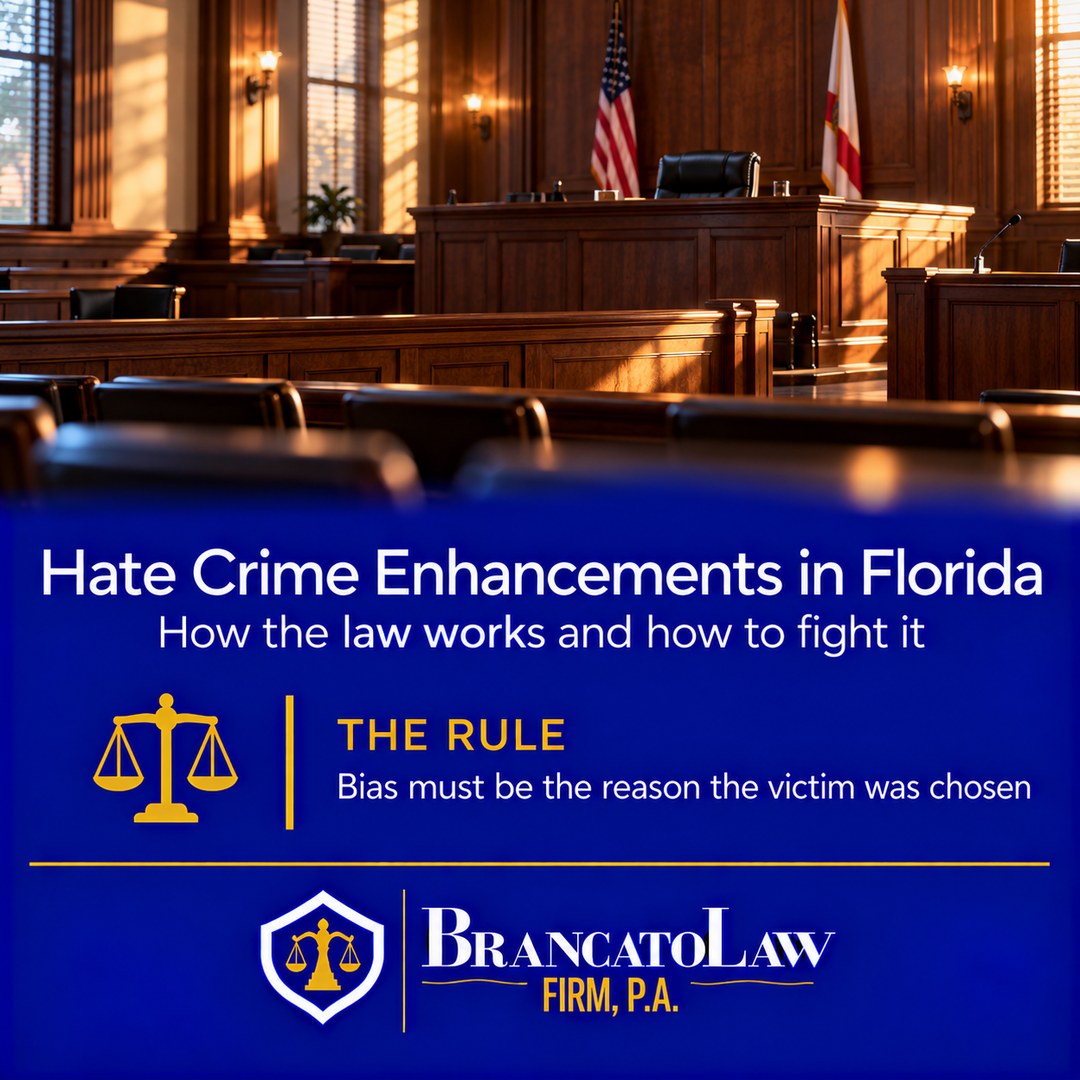
| In Florida, a “hate crime” is a penalty enhancement added to another charge. It is not a separate offense. Under section 775.085, Florida Statutes, any misdemeanor or felony moves up one degree if the State proves the defendant intentionally selected the victim because of race, color, ancestry, ethnicity, religion, sexual orientation, national origin, homeless status, or advanced age. Disability is covered by a separate statute. The law turns on what the defendant perceived, so it can apply even when the defendant was wrong about the victim. A jury must find the bias motive beyond a reasonable doubt, and a slur spoken during a crime committed for another reason is not enough. |
Every Florida hate crime enhancement comes down to one question for the jury: why did the defendant choose this victim? As founder of The Brancato Law Firm, P.A., a Tampa criminal defense firm, I have tried more than 150 cases to jury verdict and served as Chief Operations Officer of the Hillsborough County Public Defender’s Office, overseeing a staff of over 100 attorneys. When our attorneys defend a case charged under section 775.085, we build the defense around motive: the history between the people involved, the order in which words were spoken and blows were thrown, and whether the State can prove that bias caused the crime instead of just showing up during it.
What is a hate crime under Florida law?
Florida has no stand-alone crime called “hate crime.” The State charges an underlying offense, such as battery, criminal mischief, or aggravated assault, and then alleges that the offense “evidences prejudice” under section 775.085. If the jury agrees, the offense is reclassified one degree higher. Florida’s Second District Court of Appeal, which hears appeals from Hillsborough, Pinellas, and Pasco Counties, said so directly in Freudenberger v. State, 940 So. 2d 551 (Fla. 2d DCA 2006), calling the term “hate crime” a misnomer and describing section 775.085 as an enhancement statute.
The enhancement can attach to almost any crime. It is most often charged with battery and assault, the cases our Tampa violent crimes attorney team defends, but it also reaches property crimes. In Freudenberger, the State used it on arson and burglary charges involving a Lutheran church.
Florida and federal law protect different lists of characteristics. The table below compares the two.
| Characteristic | Florida (§ 775.085 / § 775.0863) | Federal (18 U.S.C. § 249) |
|---|---|---|
| Race, color | Yes | Yes |
| Religion | Yes | Yes |
| National origin | Yes | Yes |
| Ancestry, ethnicity | Yes | Not listed separately |
| Sexual orientation | Yes | Yes |
| Homeless status | Yes | No |
| Advanced age (older than 65) | Yes | No |
| Mental or physical disability | Yes, under § 775.0863 (narrow definition) | Yes |
| Gender | No | Yes |
| Gender identity | No | Yes |
| Covers “actual or perceived” status in the text | Not in those words | Yes |
Disability sits in its own statute, section 775.0863, Florida Statutes. Its definition is narrow. It requires incapacitation due to a developmental disability, organic brain damage, or mental illness, plus limits on normal daily activities. Gender and gender identity are not covered by Florida’s statute at all. Lawmakers keep proposing to add new categories. In the 2026 session, Senate Bill 402 would have added “political ideology,” and it died in committee in March 2026.
How much does a hate crime enhancement increase the penalty in Florida?
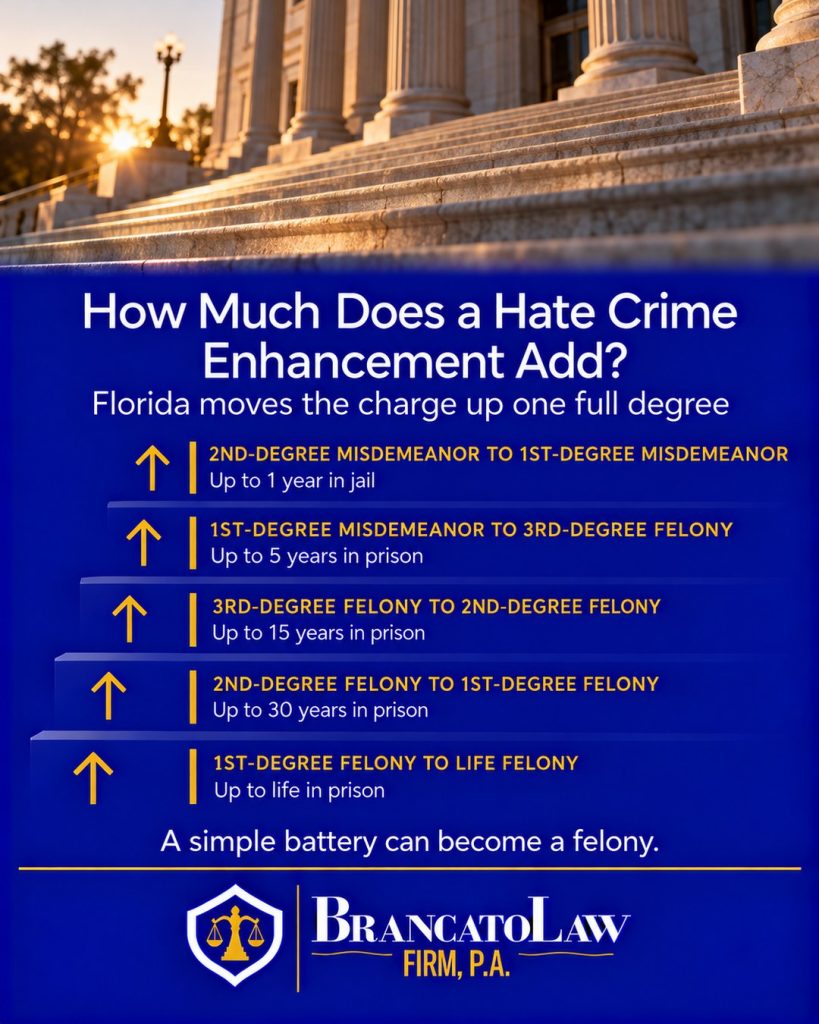
A hate crime enhancement raises the maximum sentence by one full degree, which often turns a misdemeanor into a felony. A simple battery is a first-degree misdemeanor under section 784.03, Florida Statutes, with a maximum of one year in county jail. With the enhancement, the same battery becomes a third-degree felony carrying up to five years in state prison.
| Original charge | Reclassified to | New maximum prison term | New maximum fine |
|---|---|---|---|
| Second-degree misdemeanor | First-degree misdemeanor | 1 year (jail) | $1,000 |
| First-degree misdemeanor | Third-degree felony | 5 years | $5,000 |
| Third-degree felony | Second-degree felony | 15 years | $10,000 |
| Second-degree felony | First-degree felony | 30 years | $10,000 |
| First-degree felony | Life felony | Life | $15,000 |
The prison maximums come from section 775.082, Florida Statutes, and the fines come from section 775.083, Florida Statutes. A felony conviction also carries consequences beyond the sentence, including the loss of the right to possess a firearm. At sentencing, our attorneys also look for legal grounds to go below the scoresheet, which we explain in our guide on how to get a downward departure sentence in Florida.
Section 775.085 also gives a civil remedy. A person or organization that proves by clear and convincing evidence that it was coerced, intimidated, or threatened in violation of the statute can sue for triple damages and attorney’s fees. That means a criminal case can be followed by a civil lawsuit.
Is it a hate crime if the attacker was wrong about the victim?
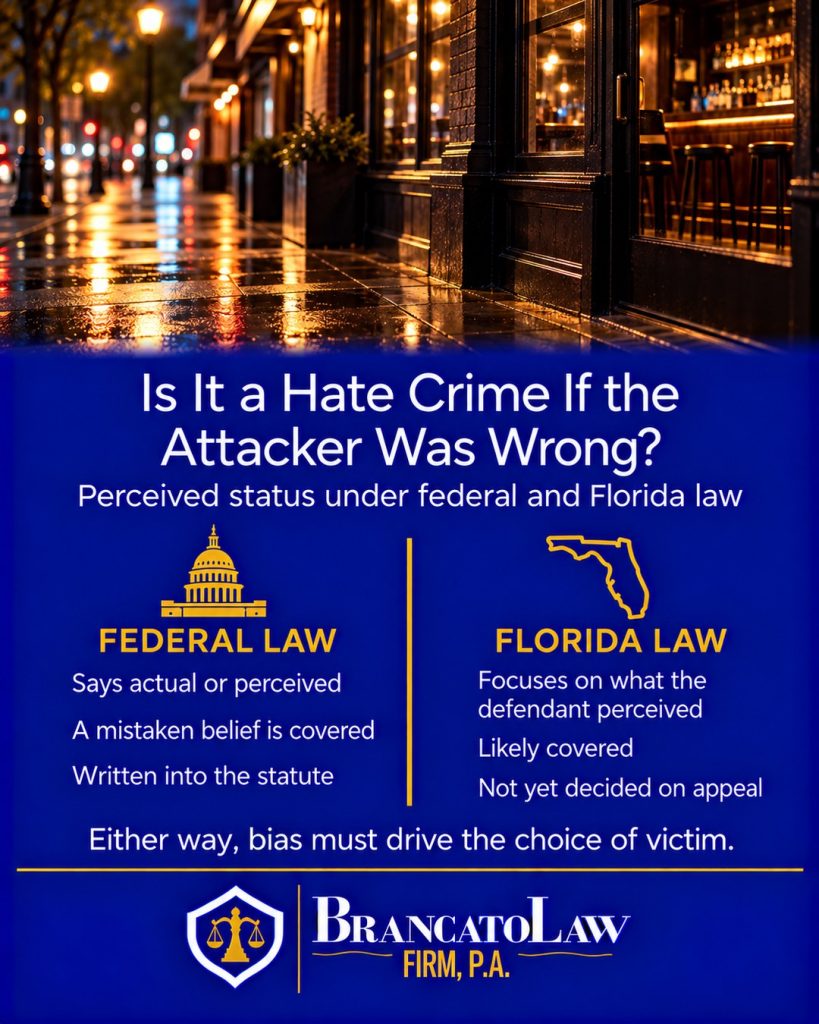
Under federal law, yes, and under Florida law, probably yes, although no Florida appellate court has squarely decided the question. Take a common example. A man leaves a bar, someone assumes he is gay, and he is beaten for it. He is not gay. Does the enhancement apply?
Federal law answers the question in its text. The federal hate crime statute, 18 U.S.C. § 249, covers injury caused “because of the actual or perceived” race, color, religion, national origin, gender, sexual orientation, gender identity, or disability of any person. A mistaken belief about the victim does not help the defendant.
Florida law points the same way, but less directly. Section 775.085(3) makes it “an essential element” that the defendant “perceived, knew, or had reasonable grounds to know or perceive that the victim was within the class.” Florida’s standard jury instruction on this enhancement, Florida Standard Jury Instruction (Criminal) 3.3(f), tells jurors to decide whether the defendant “perceived, knew, or had reasonable ground to perceive or know” the victim’s sexual orientation (or other listed trait) and “intentionally selected” the victim “because of that perception or knowledge.” That wording focuses on what was in the defendant’s mind. It does not ask the jury to decide who the victim really is. A prosecutor will also point out that every person has a sexual orientation, a race, and a national origin, so a straight man attacked because he was thought to be gay was still selected because of his sexual orientation as the attacker perceived it.
The defense argument is real, and it comes from the statute’s own wording. Florida never uses the phrase “actual or perceived,” and the main clause of section 775.085 speaks of prejudice based on the listed trait “of the victim.” Other legislatures have written the mistaken-belief rule out in full. New York’s statute, N.Y. Penal Law § 485.05, applies “regardless of whether the belief or perception is correct.” Florida’s own Legislature knows how to write that kind of clause, too. The statute for assault or battery on a person 65 or older, section 784.08, Florida Statutes, applies “regardless of whether he or she knows or has reason to know the age of the victim.” Section 775.085 has no matching clause about mistaken perceptions. Florida also requires criminal statutes to be “strictly construed” and, when language can be read more than one way, read “most favorably to the accused” under section 775.021(1), Florida Statutes.
| Question | Florida | Federal | New York |
|---|---|---|---|
| Does the statute say “actual or perceived”? | No | Yes | Yes, “regardless of whether the belief or perception is correct” |
| What must the defendant have perceived? | That the victim was within the protected class | The victim’s actual or perceived trait | A belief or perception about the victim’s trait |
| Is a mistaken perception clearly covered? | Likely, through the “perceived” element and jury instruction, but not tested on appeal | Yes | Yes |
| Defense argument available? | Yes: statutory text and the rule of lenity | Limited | Limited |
Our firm’s view is that a Tampa jury is likely to be instructed in a way that lets a mistaken-perception case go forward, so the stronger defense is usually the motive question covered below. The text-and-lenity argument still matters, because it can be raised before trial, preserved for appeal, and used in plea negotiations.
The reverse situation is the clearer one. If the State cannot prove the defendant knew or perceived the victim’s protected trait at all, the enhancement fails, because section 775.085(3) makes that knowledge or perception an essential element. A defendant who did not know the victim’s religion cannot have selected the victim because of it.
What does the State have to prove to make a hate crime enhancement stick?
The State must prove three things beyond a reasonable doubt: the underlying crime, the defendant’s knowledge or perception of the victim’s protected trait, and the intentional selection of the victim because of that trait. Three decisions explain how strict that last element is.
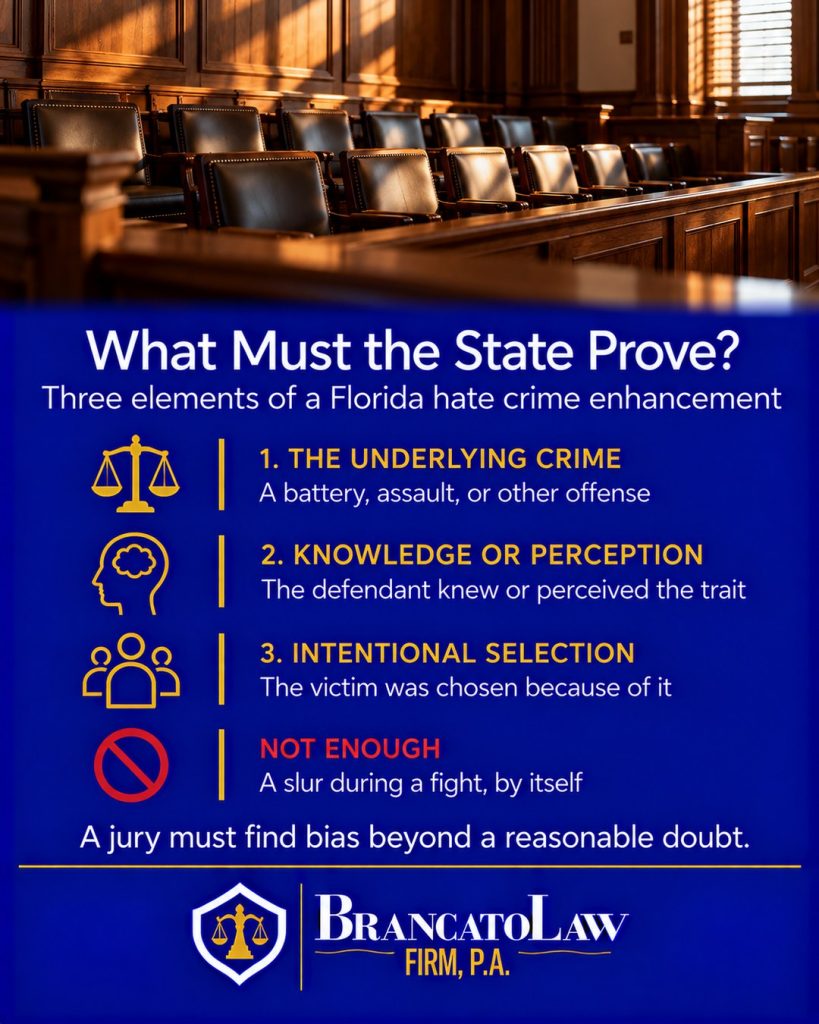
Bias must be the reason the victim was chosen. In State v. Stalder, 630 So. 2d 1072 (Fla. 1994), Richard Stalder was charged with simple battery for pushing a man who came to his home to pick up a friend’s earrings, and the State sought the enhancement because Stalder allegedly yelled antisemitic insults during the encounter. The trial court threw out the enhancement on First Amendment grounds. The Florida Supreme Court reinstated it, but upheld the statute only by reading it narrowly: it applies to “bias-motivated crimes,” meaning crimes where “the perpetrator intentionally selects the victim because of” a protected trait. The court gave an example that defense lawyers still use. If A beats B out of jealousy and calls B a racial slur during the fight, the slur and the crime share “the same temporal framework, nothing more,” and the enhancement does not apply. The lesson for anyone charged: ugly words alone do not make a hate crime under Florida law.
Bias does not have to be the only motive. In State v. Hart, 677 So. 2d 385 (Fla. 4th DCA 1996), a man arrested for DUI made repeated racist threats against the Black officer who arrested him, after directing no personal attacks at the white officer who first stopped him. The trial court dismissed the enhancement, and the appeals court reversed. It held that prejudice need not be the sole motive but must be “a significant factor in bringing about” the crime, and that motive is a fact question for the jury. The lesson: mixed motives are a jury fight, and a pretrial motion to dismiss under Florida Rule of Criminal Procedure 3.190(c)(4) rarely ends the enhancement.
The jury must make a specific finding. The U.S. Supreme Court’s decision in Apprendi v. New Jersey, 530 U.S. 466 (2000), which arose from New Jersey’s hate crime enhancement, held that any fact other than a prior conviction that raises a sentence above the statutory maximum must be found by a jury beyond a reasonable doubt. In Freudenberger, the verdict form let the jury find the defendant guilty of “Arson Evidencing Prejudice” without finding that he chose the church because of its religion. The Second District reversed the enhanced sentences and sent the case back for resentencing without the enhancement. The lesson: the defense should watch the jury instructions and the verdict form as closely as the evidence.
The Supreme Court has also held that enhancing a sentence for choosing a victim based on race does not violate the First Amendment. In Wisconsin v. Mitchell, 508 U.S. 476 (1993), the Court upheld Wisconsin’s penalty-enhancement law because it punishes the conduct of selecting a victim, not the defendant’s beliefs. Florida’s statute survives for the same reason, which is why the defense focuses on the facts of selection instead of attacking the statute itself.
How do our attorneys fight a hate crime enhancement?
Our attorneys fight the enhancement by separating what was said from why the crime happened, and by holding the State to every element. These are the steps we take most often.
- Find the real motive. Most charged incidents start with something other than bias: a parking dispute, a bar fight, road rage, a debt, a romantic conflict, or alcohol. We collect texts, social media messages, prior police calls, and witness accounts that show what the dispute was about before anyone said anything offensive.
- Build the timeline of the words. Under Stalder, a slur that comes after the fight has already started points to an expression of anger instead of a reason for selecting the victim. Body camera footage, 911 audio, and surveillance video often show exactly when words were spoken.
- Attack the perception element. The State must prove the defendant knew or perceived the victim’s protected trait. Where the trait was not visible or known, the enhancement can fail on that element alone. Where the State’s theory is a mistaken perception, we raise the statutory-text and lenity argument and preserve it.
- Challenge the underlying charge. If there is no battery, there is nothing to enhance. Self-defense, identity, and lack of injury all come first. Our guides on battery charges in Florida, what counts as assault in Florida, and how to claim self-defense in a Florida criminal case explain those defenses.
- Control the jury instructions and verdict form. We ask for Standard Jury Instruction 3.3(f) as written and a verdict form that requires a separate, specific finding on intentional selection, as Freudenberger requires.
- Negotiate the enhancement away. Because the enhancement is a separate allegation, prosecutors can amend the charging document (the information) to remove it while the underlying charge is resolved. A well-documented motive defense gives the prosecutor a reason to do that.
- Get involved before charges are filed. In many cases, the decision to add the enhancement is made when the prosecutor files the information. Our pre-file advocacy work puts the defense evidence in front of the prosecutor before that decision is final.
The motive issue does not end after one ruling. It comes up when charges are filed, in plea negotiations, at trial, at sentencing, and on appeal. A client who loses a pretrial motion has not lost the issue.
Can a hate crime be prosecuted federally as well as in Florida?
Yes. The same act can be charged under Florida law and under the federal hate crime statute. The federal law carries up to 10 years in prison, and up to life if death results or the offense includes kidnapping, aggravated sexual abuse, or an attempt to kill. A federal prosecution requires written certification from the U.S. Attorney General or a designee. One permitted reason is that a state verdict or sentence “left demonstratively unvindicated the Federal interest in eradicating bias-motivated violence,” so a state outcome does not always end federal exposure.
Federal hate crime cases from the Tampa Bay area are prosecuted in the Middle District of Florida. In August 2022, a federal jury in Tampa convicted a man of a hate crime for an August 8, 2021, attack on a Black man driving his family home. The Pinellas County Sheriff’s Office responded to the scene, according to the U.S. Attorney’s Office for the Middle District of Florida. According to that release, the defendant used racial slurs, tried to force the family’s car off the road, and later told officers that Black people need to be kept “in their areas.” That is the kind of selection evidence prosecutors look for.
How often are hate crimes reported in Hillsborough, Pinellas, and Pasco Counties?
Hate crime reports are rare in our three counties compared with other felony charges, and the numbers vary widely by agency. In 2023, Florida law enforcement agencies reported 311 hate crimes statewide, a 36% increase from 229 in 2022, according to the Florida Attorney General’s 2023 Hate Crimes Report, which summarizes data collected by the Florida Department of Law Enforcement under section 877.19, Florida Statutes.
| Category or area (2023) | Reported hate crimes |
|---|---|
| Florida total | 311 |
| Race or color | 118 (38.0%) |
| Religion | 98 (31.5%) |
| Sexual orientation | 51 (16.4%) |
| Ethnicity or national origin | 33 (10.6%) |
| Hillsborough County (HCSO 3, Tampa Police 3) | 6 |
| Pinellas County | 22 |
| Pasco County | None listed in the report |
The Attorney General’s report warns that these counts should not be used to rank counties, because stronger reporting can make an area look worse. That warning matters in court, too. A label on a police report does not prove a bias motive. A crime reported in Hillsborough County as a hate crime still has to meet the Stalder standard before a jury.
National research shows many incidents never reach police at all. The Bureau of Justice Statistics found that about 44% of hate crime victimizations from 2010 to 2019 were reported to police, in its report Hate Crime Victimization, 2005-2019. Cases that do reach police often begin with one side’s account of a heated confrontation, which is why the early investigation matters so much.
What other Florida laws punish bias-related conduct?
Several other Florida statutes target conduct connected to bias or a victim’s status, and some apply without any proof of prejudice.
- Harassment based on religious or ethnic heritage. Added by the Legislature in 2023, section 784.0493, Florida Statutes, makes it a first-degree misdemeanor to willfully and maliciously harass or intimidate someone “based on the person’s wearing or displaying of any indicia relating to any religious or ethnic heritage.” It becomes a third-degree felony if the person makes a credible threat. This statute focuses on what the victim was wearing or displaying, such as a turban, a yarmulke, or a hijab, so the victim’s actual faith is not an element.
- Assault or battery on a person 65 or older. Section 784.08 reclassifies these offenses based on the victim’s age alone, with no motive required, and sets a three-year minimum prison term for aggravated assault or aggravated battery. We cover the separate elder abuse statutes in our post on whether elder abuse is a felony in Florida.
What should you do if you are under investigation for a hate crime?
Do not explain your side of the story to a detective, because your own words are the State’s best evidence of motive. Statements made at the scene, in a recorded interview, in jail calls, or in social media posts are often the main proof of why a victim was chosen. Our attorneys tell clients to stop posting, to keep (not delete) messages about the underlying dispute, and to write down the names of witnesses while memories are fresh.
Timing matters. Surveillance video at many businesses is routinely recorded over, and the prosecutor decides whether to file the enhancement when the charges are filed. The earlier our attorneys can document the real motive, the better the chance of keeping the enhancement out of the case.
For more about our defense strategies, visit our Violent Crimes defense page.
Frequently Asked Questions
Can hate crime charges be dropped in Florida?
Yes. Prosecutors can amend the information to remove the section 775.085 enhancement while still prosecuting the underlying charge, and a jury that is not convinced of intentional selection must convict of only the underlying crime. Our attorneys at The Brancato Law Firm press for that result early by giving the prosecutor documented evidence of the dispute that actually started the incident.
Is using a racial slur during a fight a hate crime in Florida?
Not by itself. Under State v. Stalder, 630 So. 2d 1072 (Fla. 1994), the enhancement applies only when the defendant selected the victim because of a protected trait, and a slur spoken during a fight that started for another reason does not meet that test. The Brancato Law Firm builds these defenses around the timeline, showing when the words were said compared with when the conflict began.
Does Florida’s hate crime law cover gender identity?
No. Section 775.085 does not list gender or gender identity, although the federal hate crime law does. When a case could be charged federally, The Brancato Law Firm explains to clients how the federal certification requirement works and what it means for their exposure.
Can a white or straight person be the victim of a hate crime in Florida?
Yes. The statute protects categories such as race and sexual orientation, so it applies to any race and any orientation, and the U.S. Supreme Court’s leading case, Wisconsin v. Mitchell, 508 U.S. 476 (1993), involved a white victim. Our team at The Brancato Law Firm applies the same intentional-selection standard to every case, whoever the alleged victim is.
Does a hate crime enhancement turn a misdemeanor into a felony?
It can. A first-degree misdemeanor, such as simple battery, is reclassified as a third-degree felony with a maximum of five years in prison under section 775.085, Florida Statutes. For a client facing that jump, The Brancato Law Firm’s first goal is often keeping the case a misdemeanor by defeating the enhancement.
Can I be charged with a hate crime before police finish investigating?
You can be arrested before the investigation is complete, but the State Attorney’s Office decides whether to file the enhancement when it files formal charges. During that window, our attorneys at The Brancato Law Firm use representation before charges are filed to put motive evidence in front of the prosecutor.
Talk to Our Attorneys Before the Charging Decision
A hate crime enhancement is usually decided in the first few weeks, when the prosecutor reviews the arrest report and files formal charges. The Brancato Law Firm, P.A., founded by Tampa Criminal Defense Attorney Rocky Brancato, starts by gathering the messages, video, and witness accounts that show what the dispute was really about. Call us at (813) 727-7159 before you give any statement to a detective.
The Brancato Law Firm, P.A.
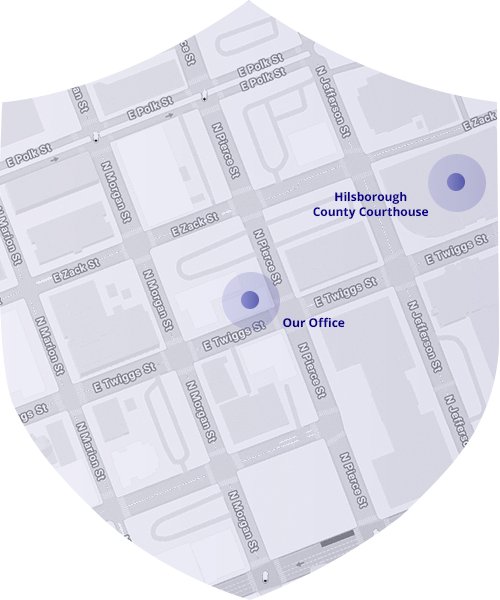
620 E. Twiggs Street, Suite 205, Tampa, FL 33602
(813) 727-7159
Serving Hillsborough, Pinellas, and Pasco Counties
The Brancato Law Firm, P.A. is a Tampa-based criminal defense practice. We are not affiliated with any other Brancato-named law firms.
Visit Us
Tampa, FL 33602
Contact Us Now
Free Legal Consultation (813) 727-7159