- Free Consultation 24/7: (813) 727-7159 Tap Here To Call Us


From First DUI to Death Penalty



Federal Hemp Ban in Florida: What Changes Nov. 12 and Dec. 11? (2026)


Updated November 12, 2026
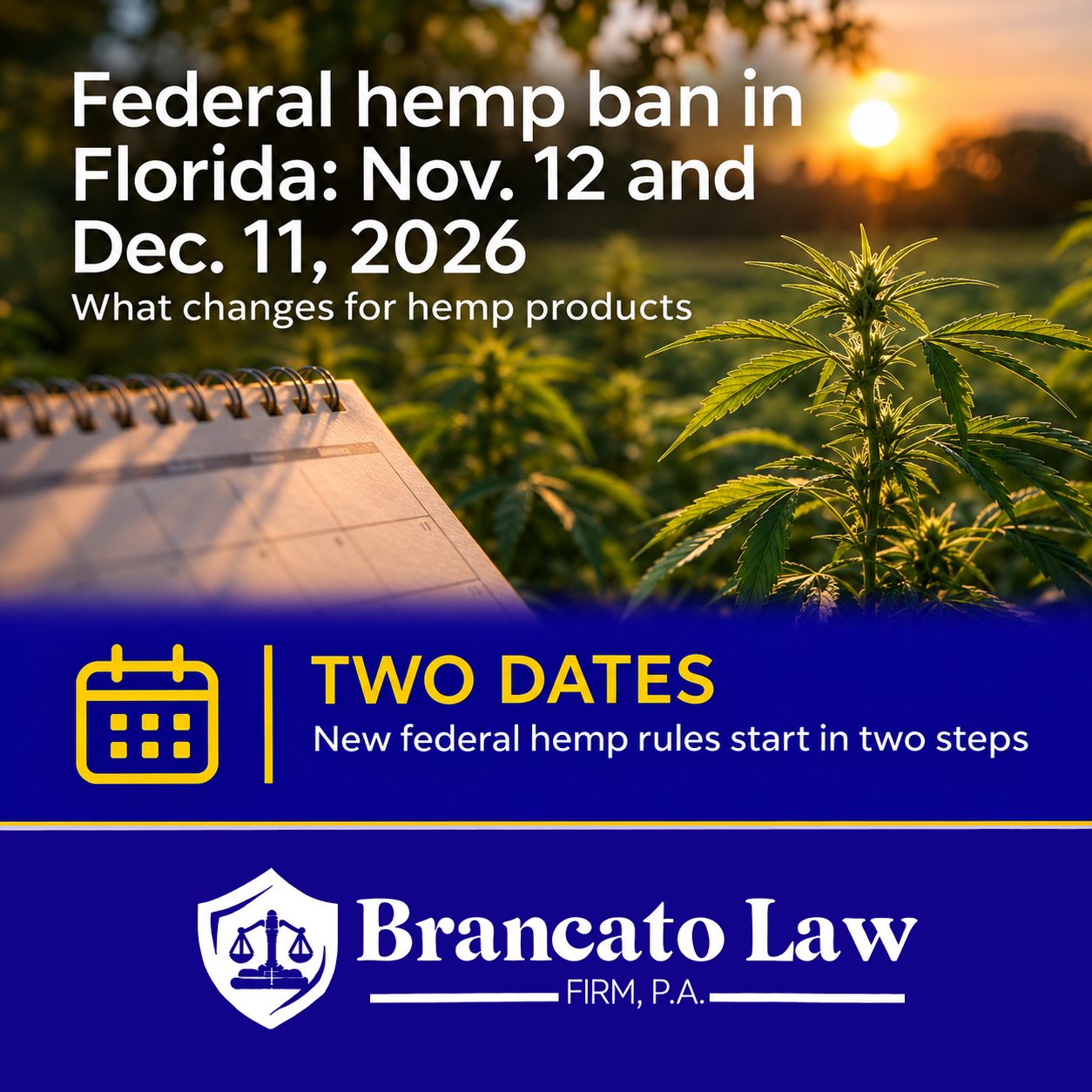
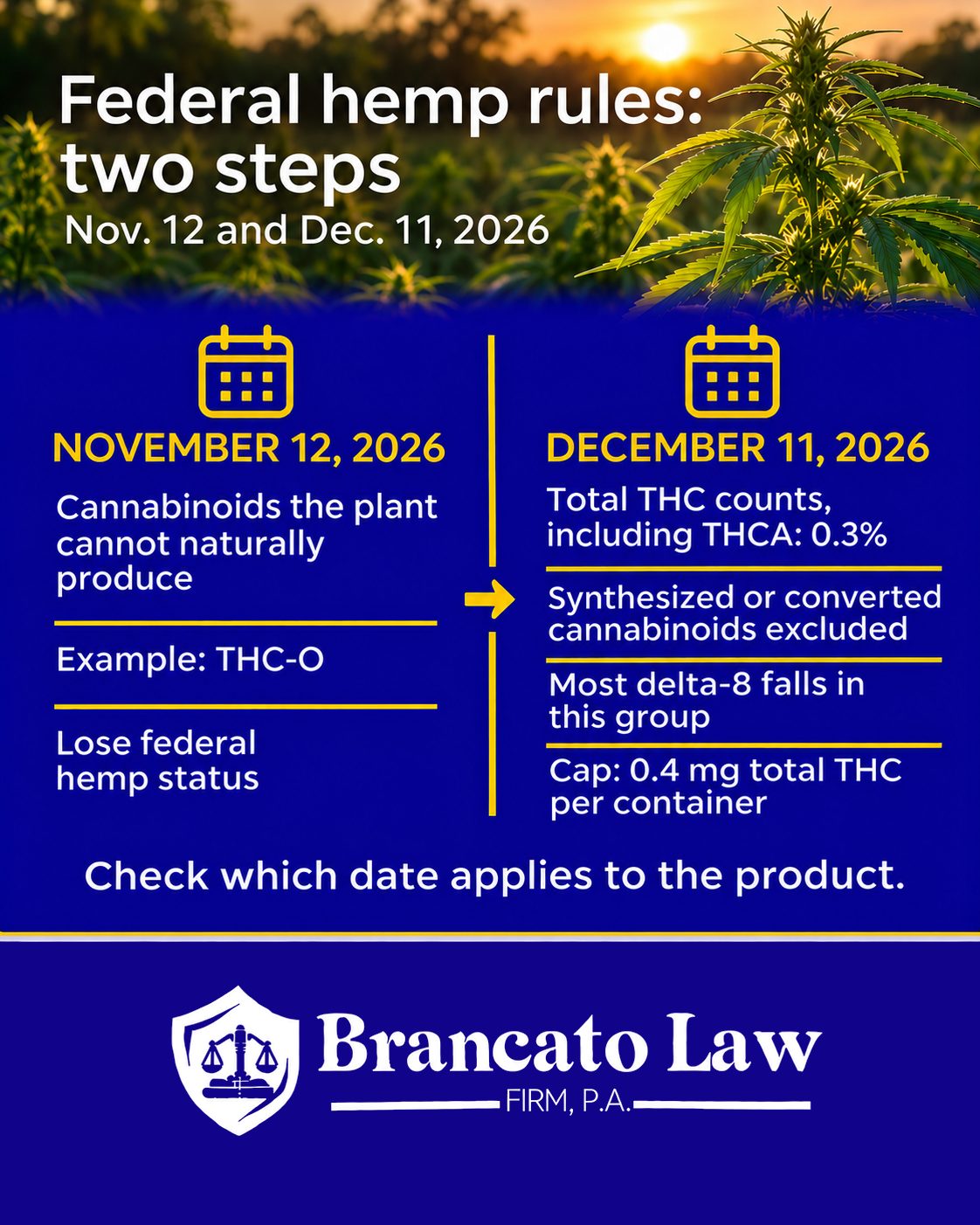
The federal hemp ban reaches Florida in two steps. On November 12, 2026, hemp products containing cannabinoids the cannabis plant cannot naturally produce, such as THC-O, stopped counting as hemp under federal law. On December 11, 2026, the rest of the new federal definition takes effect: hemp is measured by total THC including THCA, cannabinoids synthesized or converted outside the plant (which covers most delta-8) are excluded, and finished products are capped at 0.4 milligrams of total THC per container. Florida’s own hemp statute has not changed, but federal law applies in Florida, and a roadside field test cannot tell legal hemp from illegal marijuana.
Most hemp and THC cases in Hillsborough County are decided by a lab report, not by the label on the package. I’m Rocky Brancato, founder of The Brancato Law Firm, P.A., a Tampa criminal defense firm, and a former police academy instructor with more than 25 years in Hillsborough County courtrooms. As a former Chief Operations Officer of the Hillsborough County Public Defender’s Office, where I oversaw a staff of over 100 attorneys, I saw how often a drug case turns on the gap between what an officer believed at the roadside and what a chemist can prove. Our attorneys work that gap for clients holding delta-8, THCA flower, and hemp vapes, starting before charges are filed whenever we can.
What Changed for Hemp on November 12, 2026?
Starting November 12, 2026, hemp products that contain cannabinoids the Cannabis sativa plant cannot naturally produce no longer count as hemp under federal law. That is the only piece of the new federal definition that took effect today. Congress wrote the new definition in section 781 of Division B of Public Law 119-37, signed November 12, 2025, which rewrote the hemp definition in 7 U.S.C. § 1639o effective 365 days after enactment.
The Congressional Research Service explains that, starting November 12, 2026, products in this category are to be classified as marijuana under the federal Controlled Substances Act (CRS In Focus IF13136, updated September 28, 2026). Legis1, summarizing that CRS analysis on October 29, 2026, used THC-O as the example of a cannabinoid that loses its hemp exemption today. Under 21 U.S.C. § 802(16), federal law excludes from “marijuana” only hemp as defined in section 1639o, so a product that falls outside that definition is treated as marijuana.
One gap remains. Public Law 119-37 told the FDA to publish, within 90 days, a list of cannabinoids the plant can naturally produce. CRS reported that, as of September 28, 2026, no such list had been published, so no official federal list draws the line between natural and non-natural cannabinoids. Our attorneys at The Brancato Law Firm treat that missing list as a live issue in any case built on the November 12 category.
Which Cannabinoids Does the November 12 Change Cover?
THC-O is the only cannabinoid a federal agency has clearly said the cannabis plant cannot make. Because the FDA has not published the list Congress required, every other product falls into one of five groups, and the group a product lands in can decide a case.
| Group | Examples | Federal status | Why |
|---|---|---|---|
| The government says the plant cannot make it | THC-O (delta-8-THCO and delta-9-THCO) | Not hemp since November 12, 2026; DEA already treated THC-O as Schedule I | In a February 13, 2023 letter, DEA said these compounds “do not occur naturally in the cannabis plant and can only be obtained synthetically.” |
| Same chemistry, no ruling by name | HHC-O and other “-O” acetate products | Likely not hemp since November 12, 2026 | They are acetate versions of other cannabinoids, made the same way as THC-O, but no agency has ruled on them by name. |
| Disputed | HHC | DEA says Schedule I already; not hemp by December 11, 2026 at the latest | DEA’s May 4, 2026 final rule (91 FR 23913) calls HHC “a synthetic substance.” The industry points to studies reporting HHC as a minor natural component of cannabis. |
| The plant makes trace amounts, but the product sold is lab-made | THCP, delta-10, delta-8 | Not reached by the November 12 test; excluded December 11, 2026 as made outside the plant | THCP was isolated from cannabis in a 2019 Scientific Reports study. The FDA says delta-8 is made by converting CBD with additional chemicals. |
| New names with no classification | THC-JD, THC-X, PHC, and other new labels | Depends on what a lab identifies | No agency has classified these names. The answer depends on the actual compound in the product. |
DEA’s position reaches beyond the November 12 date. In the same HHC rule, DEA states that “tetrahydrocannabinols produced through chemical conversion, even when hemp derived are considered synthetically produced for purposes of the CSA” and do not count as hemp. That is the agency’s view of converted delta-8 as well, even before December 11. Hemp companies are challenging the HHC rule in the Fourth and Ninth Circuits, so this is an agency position, not a settled rule.
Under Florida law, the product name does not control. Florida’s Schedule I list in section 893.03(1)(c)190, Florida Statutes, covers synthetic cannabinoids by chemical class, including synthetic tetrahydrocannabinols and derivatives with similar structure and effects, so THC-O, HHC, and newly named compounds can be charged as Schedule I substances if a lab identifies them. Our attorneys at The Brancato Law Firm make the State prove exactly which compound its lab found and by which method, because a lab result that says only “THC” does not establish which group a product belongs to.
What Changes for Hemp and THC on December 11, 2026?
On December 11, 2026, the rest of the new federal hemp definition takes effect. Congress delayed those parts in section 2019 of Division B of Public Law 119-103, the Continuing Appropriations and Extensions Act, 2027, signed September 2, 2026. That section says that until December 11, 2026, the section 781 amendments apply “only with respect to” the non-natural cannabinoid products described above. December 11 is also the date that stopgap funding law expires. As of November 12, 2026, Congress has not passed a further delay.
Four changes take effect on December 11, 2026:
- Total THC, including THCA. Hemp must have “a total tetrahydrocannabinols concentration (including tetrahydrocannabinolic acid) of not more than 0.3 percent on a dry weight basis,” under the amended 7 U.S.C. § 1639o. The old federal test counted only delta-9 THC, which is how THCA flower was sold as hemp.
- No cannabinoids synthesized or manufactured outside the plant. This reaches most delta-8 THC. The FDA explains that the natural amount of delta-8 in hemp is very low and that manufacturers use additional chemicals to convert other cannabinoids, like CBD, into delta-8.
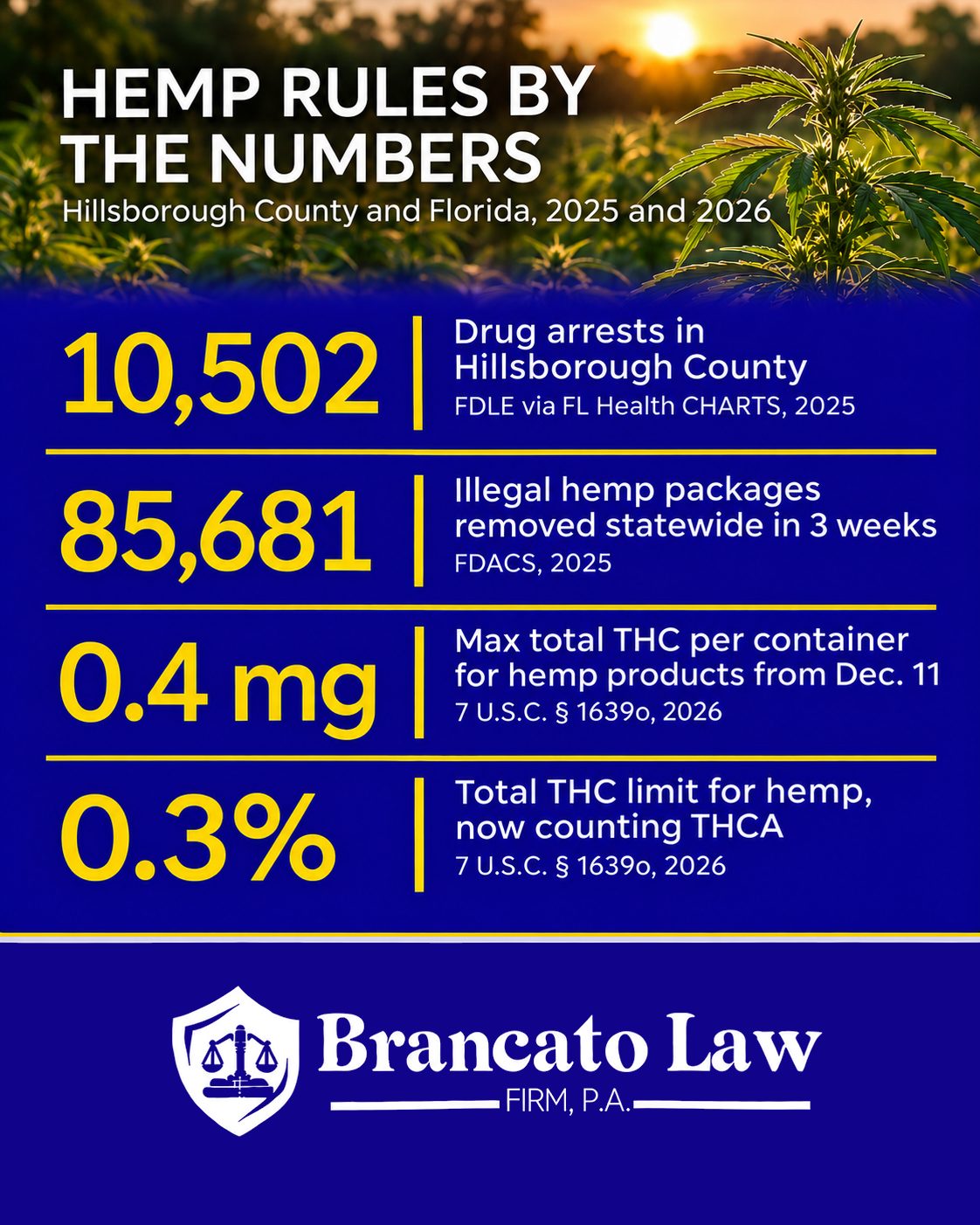
- A 0.4 milligram cap per container. A finished hemp-derived product is excluded if it contains “greater than 0.4 milligrams combined total per container” of total THC (including THCA) and other cannabinoids with similar effects. The statute defines the container as the innermost package in direct contact with the product, such as the jar, bag, bottle, can, or cartridge.
- Limits on intermediate products. Extracts, oils, and powders meant to be mixed into other products are excluded above 0.3% combined total THC, and they lose hemp status entirely if they are marketed or sold directly to consumers.
To put 0.4 milligrams in perspective, Florida’s medical marijuana law allows a single serving of a medical edible to contain up to 10 milligrams of THC under section 381.986, Florida Statutes. The new federal cap for an entire container of a hemp product is one twenty-fifth of one medical serving.
| Date | What changes under federal law | Examples of products affected |
|---|---|---|
| Before Nov. 12, 2026 | Hemp means 0.3% or less delta-9 THC by dry weight (2018 Farm Bill test). | Delta-8, THCA flower, and hemp delta-9 edibles were sold as hemp. |
| Nov. 12, 2026 | Products containing cannabinoids the plant cannot naturally produce are no longer hemp. | THC-O and other lab-created cannabinoids. |
| Dec. 11, 2026 | Total THC (including THCA) replaces delta-9; synthesized or converted cannabinoids excluded; 0.4 mg total THC cap per container; intermediate-product limits. | THCA flower and pre-rolls, most delta-8, hemp delta-9 gummies and drinks, many full-spectrum CBD products. |
Which Hemp and THC Products Are Affected in Florida?
The intoxicating hemp products behind most of these cases, delta-8, THCA flower, and hemp THC edibles, generally fall outside the federal hemp definition on December 11, 2026. The table below applies the enacted federal text to common product types. It describes legal status under the statutes, not whether a particular product’s lab report is accurate, which our attorneys check in every case.
| Product | Federal status Nov. 12 to Dec. 10, 2026 | Federal status starting Dec. 11, 2026 | Florida law |
|---|---|---|---|
| THC-O and other non-natural cannabinoids | Not hemp (DEA has treated THC-O as Schedule I since its 2023 letter) | Not hemp | Florida’s Schedule I already lists synthetic cannabinoids, including synthetic tetrahydrocannabinols, in section 893.03(1)(c)190. |
| HHC | DEA says Schedule I (May 2026 rule), disputed in court | Not hemp | Can be charged under section 893.03(1)(c)190 if a lab identifies it. |
| Delta-8 THC gummies, vapes, and edibles | Hemp if 0.3% or less delta-9, though DEA treats chemically converted THC as synthetic | Not hemp (converted outside the plant; also counts toward the 0.4 mg cap) | Florida’s hemp statute is unchanged; products must still meet section 581.217. |
| THCP and delta-10 products | Hemp if 0.3% or less delta-9, though DEA treats chemically converted THC as synthetic | Not hemp (made outside the plant) | Same as delta-8. |
| THCA flower and pre-rolls | Hemp if 0.3% or less delta-9 | Not hemp if total THC including THCA exceeds 0.3%, or the container holds more than 0.4 mg | Florida’s hemp rule already counts THCA (see below). |
| Hemp-derived delta-9 gummies and THC drinks | Hemp if 0.3% or less by weight | Not hemp if the container holds more than 0.4 mg total THC | Unchanged in statute. |
| Full-spectrum CBD oils and topicals | Hemp | Not hemp if the container holds more than 0.4 mg total THC | Unchanged in statute. |
| Hemp seeds, hemp hearts, fiber | Hemp | Industrial hemp, unaffected | Unaffected. |
Does the Federal Hemp Ban Make These Products Illegal Under Florida Law?
Not automatically. Florida’s drug law defines “cannabis” in section 893.02(3), Florida Statutes, and that definition excludes “hemp as defined in s. 581.217,” which is Florida’s own definition, not the federal one. Section 581.217 defines hemp as cannabis with “a total delta-9-tetrahydrocannabinol concentration that does not exceed 0.3 percent on a dry-weight basis,” with hemp extract measured on a wet-weight basis. The Legislature last amended that statute in 2023. The 2026 bill that would have capped hemp extract at 2 milligrams per serving and 20 milligrams per container and banned smokable hemp, Senate Bill 1270, died in the Senate Agriculture Committee on March 13, 2026.
The federal change still reaches people in Florida in three ways:
- Federal law applies here. After December 11, a product outside the federal hemp definition is marijuana under federal law, and simple possession is punishable by up to 1 year in jail and a minimum $1,000 fine under 21 U.S.C. § 844. Federal officers enforce federal law on federal property, such as MacDill Air Force Base and VA medical centers, and at ports of entry, including the cruise terminals at Port Tampa Bay.
- THCA flower was already at risk under Florida’s rule. The Florida Department of Agriculture and Consumer Services defines “total delta-9 tetrahydrocannabinol concentration” as delta-9 THC plus 0.877 times THCA in Rule 5K-4.034(2)(r), Florida Administrative Code, and caps hemp intended for human consumption at 0.3% on that measure. A hemp retailer’s challenge to the Department’s hemp rules ended when the Fifth District Court of Appeal affirmed without a written opinion in Exspo Retail, LLC v. Department of Agriculture & Consumer Services, No. 5D2024-0879 (Fla. 5th DCA Feb. 10, 2026). A per curiam affirmance without opinion does not set statewide precedent, and we have not found a Florida appellate decision in a criminal case that decides whether THCA flower over that limit is “cannabis.” With federal law now using the same total-THC approach, expect prosecutors to argue that it is.
- Supply and labeling will shift fast. Products that become federally illegal on December 11 cannot lawfully move through interstate commerce as hemp. What stays on Florida shelves after that date may be older stock, relabeled stock, or products with certificates of analysis that do not match what is in the package. In 2025, the Department reported removing 85,681 illegal hemp packages from stores in 40 counties during three weeks of its Operation Safe Summer sweep, WKMG News 6 reported.
Our attorneys at The Brancato Law Firm handle hemp and THC cases as Tampa drug crimes attorney matters from the first call, because the charge depends on what a lab can prove about a specific product on a specific date.
Can a Police Field Test Tell Hemp From Marijuana?
No. The color tests officers use at the roadside detect cannabis, but they do not measure whether THC is above or below 0.3%. Forensic chemists reported that the Duquenois-Levine test, a common presumptive test for cannabis, “is unable to differentiate between hemp and marijuana” (Acosta et al., Forensic Chemistry, Vol. 31, 2022, an NIJ-funded study). The newer 4-aminophenol (4-AP) test turns blue for THC-rich cannabis and pink for CBD-rich cannabis, but the same research group noted that “a confirmatory chemical test such as GC-FID or GC–MS is still required after a positive 4-AP test” (Acosta and Almirall, Forensic Chemistry, Vol. 26, 2021). Measuring THC content takes laboratory chromatography.
Florida’s appellate courts have reached the same conclusion. In Campbell v. State, 407 So. 3d 558 (Fla. 2d DCA 2025), a Hillsborough County man testified that the 50 bundles in his bags were hemp he bought in Oregon for $50 apiece, and a jury convicted him of cannabis trafficking. The lab tested only one bundle. The Second District reversed, holding that “legal hemp and illegal cannabis are indistinguishable by appearance, texture, and odor,” so the State had to chemically test each package it counted toward the trafficking weight. The lab analyst had also testified that her microscopic exam and Duquenois-Levine test could not tell hemp from marijuana. We cover the full decision in our post on the Campbell cannabis trafficking reversal.
The same reasoning limits searches. In Williams v. State, 421 So. 3d 809 (Fla. 2d DCA 2025) (en banc), the Second District, which hears appeals from Hillsborough, Pinellas, and Pasco Counties, held that the odor of cannabis alone no longer gives police probable cause to search a vehicle, because legal hemp and medical marijuana cannot be told apart from illegal cannabis by smell. The court followed Baxter v. State, 389 So. 3d 803 (Fla. 5th DCA 2024) (en banc) and certified the question to the Florida Supreme Court. Our guide on whether police can search your car for the smell of weed explains how that plays out at a traffic stop.
The December 11 change does not repeal those rulings. Under Florida law the State still has to prove that a substance is cannabis rather than hemp as Florida defines it, and that takes a lab. What changes is the argument about which test the lab must apply.
How Many Drug Arrests Are Made in Hillsborough County?
More than ten thousand a year. In 2025, Hillsborough County recorded 10,502 drug arrests, a rate of 666.5 per 100,000 residents, up from 8,124 in 2024, according to FDLE arrest data published by Florida Health CHARTS. Those figures cover all drug categories and count arrests, not convictions. Every one of those arrests that involves a green, leafy substance or a vape cartridge now has a hemp question built into it, and our attorneys at The Brancato Law Firm raise it from the start.
Is Possessing Delta-8 or THCA a Misdemeanor or a Felony in Florida?
It depends on the form. If the State proves a product is cannabis and not hemp, possession of 20 grams or less of plant material is a first-degree misdemeanor under section 893.13(6)(b), Florida Statutes. That misdemeanor rule does not cover resin or anything made from resin, so concentrates, many vape oils, and edibles can be charged as third-degree felonies under section 893.13(6)(a) regardless of weight. In State v. Stevenson, 307 So. 3d 784 (Fla. 4th DCA 2020), a Broward County man charged with a felony for three vape cartridges weighing 14.04 grams won dismissal of the felony because the State’s chemist could not say whether the THC came from resin or was synthetic. The court held the State must make that showing to charge a felony.
| Product | If the State proves it is not hemp | Maximum penalty | Key defense question |
|---|---|---|---|
| THCA flower, 20 grams or less | First-degree misdemeanor | 1 year in jail, $1,000 fine | Did the lab measure total THC, and on what date was the product possessed? |
| THCA flower, more than 20 grams | Third-degree felony | 5 years in prison, $5,000 fine | Was every package tested (Campbell)? |
| Delta-8 or THC vape cartridge | Third-degree felony if resin-derived or synthetic | 5 years in prison, $5,000 fine | Can the State prove the source (Stevenson)? |
| THC-O or other synthetic cannabinoid | Third-degree felony if it is a listed synthetic cannabinoid (Schedule I) | 5 years in prison, $5,000 fine | What exactly did the lab identify? |
Our post on how much weed is a felony in Florida covers weights, trafficking thresholds, and medical marijuana in detail.
What Should You Do If You Have Hemp or THC Products Now?
Keep proof of what you bought and when, and do not assume a store’s “legal” label will protect you after December 11, 2026. Practical steps:
- Keep products in the original sealed packaging with the batch number and QR code that section 581.217 requires, and keep the receipt showing the purchase date.
- Save or print the certificate of analysis for each batch. A report showing total THC, not just delta-9, is the one that matters now.
- Do not bring hemp products onto federal property, through a port of entry, or into a jail, courthouse, or school.
- Do not drive impaired. A legal product does not prevent a DUI arrest, as our post on marijuana DUI in Florida explains.
- If officers ask to search, you may decline consent. Do not explain where you bought a product or what it contains. Ask for a lawyer.
- If you own firearms, read our post on gun ownership and marijuana use in Florida. Federal law bars an “unlawful user” of a controlled substance from possessing a gun under 18 U.S.C. § 922(g)(3), and products that become marijuana under federal law on December 11 raise that issue. In United States v. Hemani, 608 U.S. 772 (2026), the Supreme Court held that prosecuting a regular marijuana user under that provision, without more proof of danger, violated the Second Amendment, but the Court left other applications open.
Could Congress Change the December 11 Date Again?
Yes, but only by passing a new law before or after December 11. CRS lists pending bills that would delay the change for two more years (H.R. 7024, H.R. 7010, and S. 3686), allow higher THC limits (S. 2112 and H.R. 9830), let states set their own definitions (S. 4315), or build a federal regulatory system for hemp products (including H.R. 7212 and S. 3474). None had been enacted as of November 12, 2026. Because December 11 is also the date the current stopgap funding law expires, the next funding bill is the most likely place for any further change. We will update this post if the date moves.
How Do Our Attorneys Defend Hemp and THC Cases?
We start with the product and the lab, then the stop. For clients under investigation, our representation before charges are filed puts the lab issues and the product records in front of the State Attorney’s Office for the 13th Judicial Circuit before it decides whether to file. Nearly every month, our front-end advocacy results in cases that are never filed. Our guide on fighting a drug charge before it is filed walks through that process, and our Florida criminal case process page explains each stage that follows.
- Pin down the date. The same THCA flower or delta-8 vape is treated differently under federal law on December 10 and December 11, 2026.
- Demand the lab work. Under Campbell, appearance, smell, and a color test are not enough. We check what was tested, by which method, and whether total THC was measured.
- Challenge the search. If the search rested on odor, we move to suppress under Williams.
- Test the felony label. For vapes, edibles, and oils, we hold the State to Stevenson.
- Use the product records. Packaging, batch numbers, certificates of analysis, and receipts can show a client bought a product sold as compliant hemp.
Our Hillsborough County criminal defense attorney team handles these cases at the courthouse two blocks from our office, and we also defend clients in Pinellas and Pasco Counties. For more about our defense strategies, visit our Drug Crimes page.
Frequently Asked Questions About the Federal Hemp Ban in Florida
Is delta-8 still legal in Florida after December 11, 2026?
Florida’s hemp statute did not change, but most delta-8 sold in stores is no longer hemp under federal law starting December 11, 2026, because it is converted from CBD outside the plant. The Brancato Law Firm treats any delta-8 case after that date as a federal-and-state issue and checks the product’s source and lab report first.
Is THCA flower illegal in Florida now?
Under federal law, THCA flower with more than 0.3% total THC, counting THCA, is marijuana starting December 11, 2026. Florida’s agriculture rule already counts THCA toward the 0.3% limit, and our attorneys at The Brancato Law Firm expect prosecutors to rely on that rule, which is why we defend THCA possession charges by attacking the lab work first.
What is the 0.4 mg THC per container rule?
Starting December 11, 2026, a finished hemp product is excluded from the federal hemp definition if its container holds more than 0.4 milligrams of total THC, including THCA and similar cannabinoids, under 7 U.S.C. § 1639o. Our attorneys at The Brancato Law Firm read the certificate of analysis against that per-container number, not the per-serving number printed on the label.
Can I be arrested in Florida for hemp products I bought legally?
Yes, an officer can arrest based on appearance, a field test, or other facts, and the lab question gets answered later. The Brancato Law Firm can step in during the investigation through pre-file advocacy to show the State Attorney’s Office the purchase records and lab issues before a charge is filed.
Can police search my car if it smells like hemp or marijuana?
In Hillsborough, Pinellas, and Pasco Counties, odor alone is no longer probable cause under Williams v. State, though officers can still rely on odor combined with other facts. Our attorneys at The Brancato Law Firm file motions to suppress when a search rested on smell, as explained in our plain smell guide.
Is HHC legal after November 12, 2026?
Under federal law, DEA says HHC has been a Schedule I controlled substance all along, and its May 2026 rule calls HHC synthetic, though hemp companies are challenging that rule in federal court. Our attorneys at The Brancato Law Firm treat any HHC case as a lab-identification fight, because Florida’s Schedule I list reaches synthetic THC compounds by chemical class rather than by brand name.
Do the November 12 and December 11 changes apply to medical marijuana patients?
No, medical marijuana bought from a licensed Florida treatment center is governed by section 381.986, not the hemp definition. The Brancato Law Firm advises patients to keep their card and dispensary packaging, because those records separate a lawful medical product from a hemp product that lost its status.
If you were stopped, searched, or arrested with delta-8, THCA flower, or a hemp vape, call before December 11 changes the analysis of your case, and before you talk to anyone about the product. The Brancato Law Firm, P.A., founded by Tampa Criminal Defense Attorney Rocky Brancato, can review the arrest report, the lab request, and your purchase records right away. Call (813) 727-7159; call us at any hour, and our office is two blocks from the courthouse. Our firm has Spanish-speaking staff, and attorney Jean-Luc Adrien speaks Spanish, Haitian Creole, and French.
The Brancato Law Firm, P.A.
620 E. Twiggs Street, Suite 205, Tampa, FL 33602
(813) 727-7159
Serving Hillsborough, Pinellas, and Pasco Counties
The Brancato Law Firm, P.A. is a Tampa-based criminal defense practice. We are not affiliated with any other Brancato-named law firms.
Visit Us

Tampa, FL 33602

Contact Us Now
Free Legal Consultation (813) 727-7159
