- Free Consultation 24/7: (813) 727-7159 Tap Here To Call Us


From First DUI to Death Penalty



Can You Be Fired for Being Arrested in Florida? (2026)


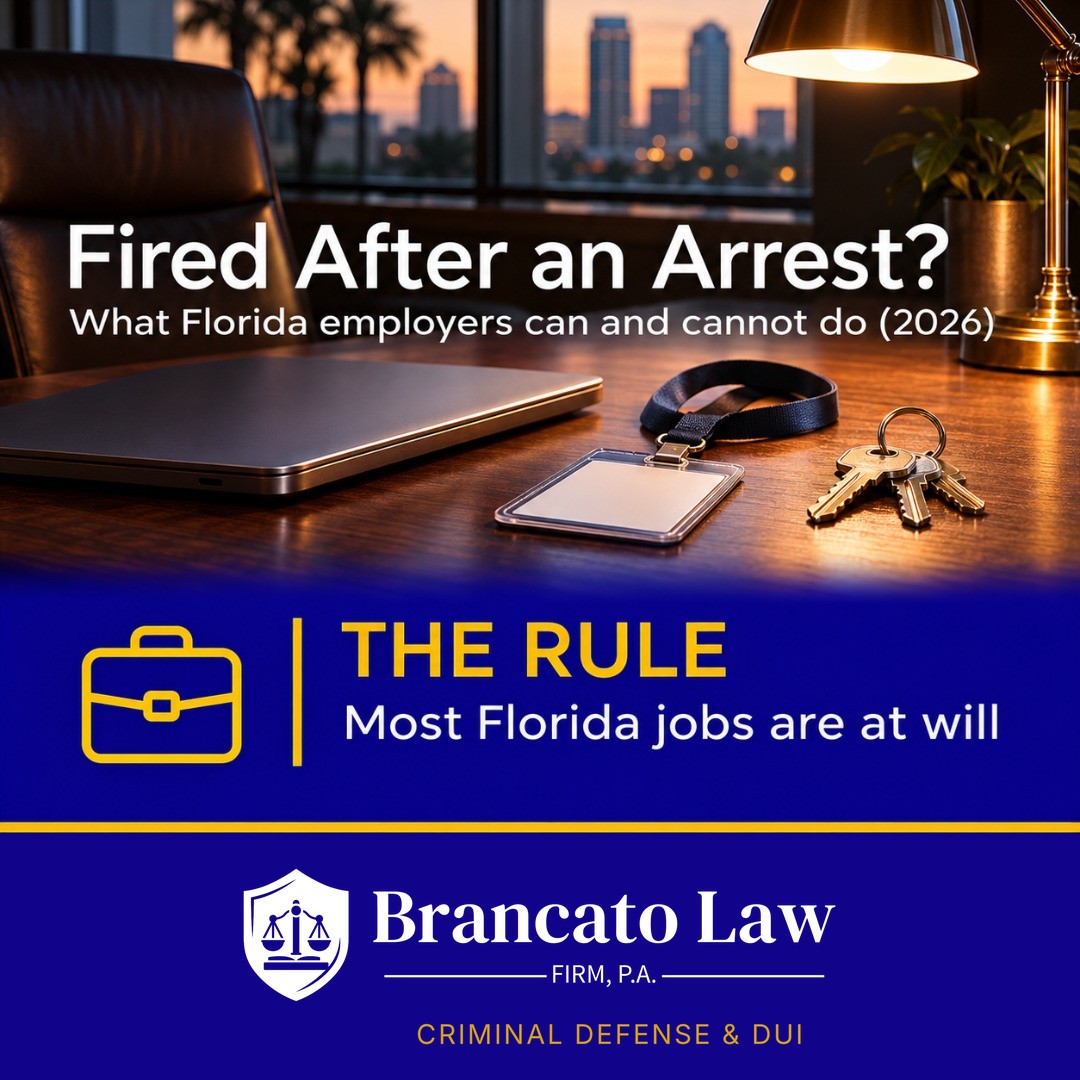
Yes. Most Florida jobs are at will, so a private employer can fire you because of an arrest even before any conviction, unless a contract, union agreement, or company policy promises otherwise. Government employers have one statutory limit: under section 112.011, Florida Statutes, a state or local agency cannot disqualify someone solely because of a prior conviction unless the crime was a felony or first-degree misdemeanor directly related to the job. Teachers, nurses, and other licensed or background-screened workers also face reporting deadlines of 48 hours to 30 days that can matter more than the arrest itself.
An arrest puts two things at risk at once: the case and the paycheck. Whether you keep your job usually depends on three facts: who you work for, whether you hold a license or a screened position, and how the criminal case ends. As founder of The Brancato Law Firm, P.A., a Tampa criminal defense firm, and a former Chief Operations Officer of the Hillsborough County Public Defender’s Office, where I oversaw a staff of over 100 attorneys, I have spent more than 25 years in Hillsborough County courtrooms. Our attorneys build the defense around the client’s job from the first call, because the way a case ends decides what an employer, a licensing board, or a background check will see later.
Can a private employer fire you for an arrest in Florida?
Yes, in most cases. Florida follows the at-will rule: when a job has no fixed term, either side can end it at any time for any reason that the law does not forbid. The Florida Supreme Court restated that rule in Smith v. Piezo Technology & Professional Administrators, 427 So. 2d 182 (Fla. 1983). In that case, a worker was fired after seeking workers’ compensation benefits, and the court held she could sue only because a specific statute, section 440.205, forbids that kind of retaliation. Florida has no comparable statute that stops a private employer from acting on an arrest.
Three things can limit a private employer:
- A contract or union agreement. Many collective bargaining agreements allow discipline only for “just cause,” which often means the employer must wait for facts beyond the arrest itself.
- The employer’s own written policy. Some handbooks call for unpaid leave while a case is pending rather than termination.
- Background check rules. If the decision rests on a report from a background screening company, federal law requires notice before the employer acts, as explained below.
Our attorneys at The Brancato Law Firm read the client’s handbook or union contract early, because those documents often decide whether the client can stay on the job while the case is pending.
Do you have to tell your employer you were arrested?
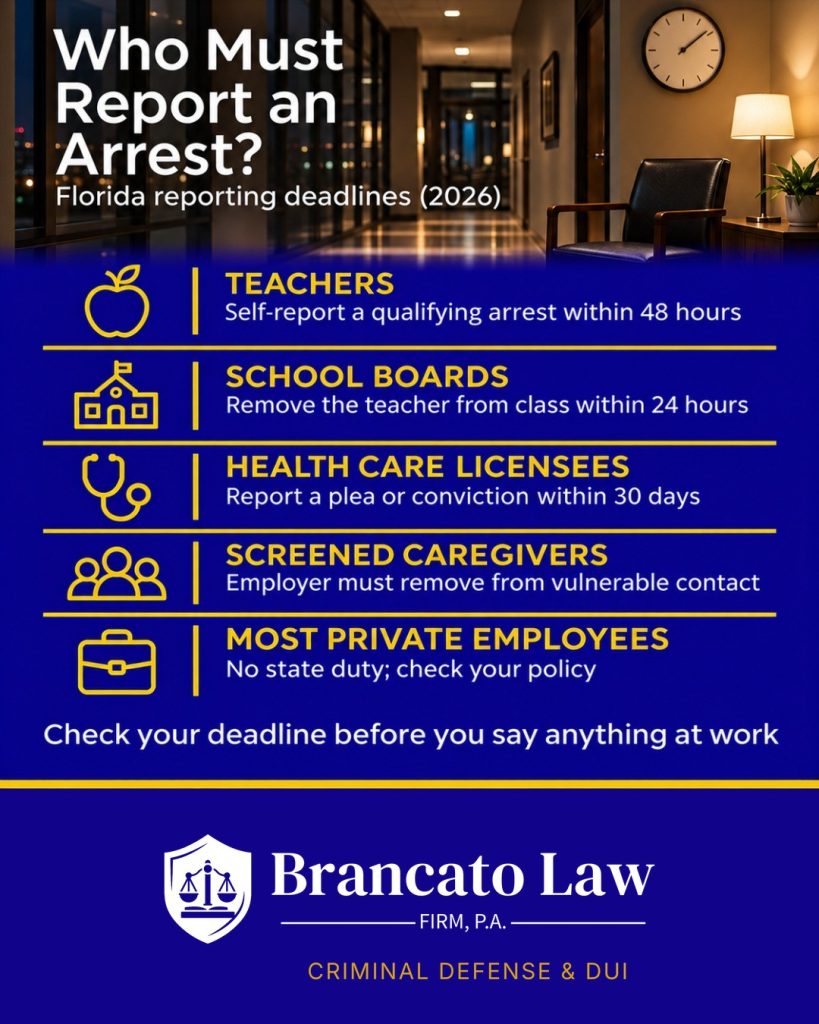
Usually not, unless a policy, contract, or license requires it. Florida law does not require a private employee to report an arrest to an employer. Several Florida statutes do impose short reporting deadlines on specific jobs:
| Who | What must be reported | Deadline | Law |
|---|---|---|---|
| Public school teachers and administrators | An arrest for any felony or for a misdemeanor listed in § 435.04(2) | 48 hours | § 1012.799(2) |
| Public school teachers and administrators | A conviction, finding of guilt, withhold of adjudication, pretrial diversion, or guilty or no contest plea, other than a minor traffic violation | 48 hours after the final judgment | § 1012.799(2) |
| Health care practitioners licensed under chapter 456 (nurses, physicians, pharmacists, and others) | A conviction, finding of guilt, or no contest plea, regardless of adjudication | 30 days, in writing to the licensing board | § 456.072(1)(x) |
| Employees in background-screened jobs under chapter 435 (child care, elder care, disability services) | The employer must act once it learns of an arrest for a disqualifying offense | Removal from contact with vulnerable persons until the arrest is resolved | § 435.06 |
For teachers, the process moves fast. Section 1012.22, Florida Statutes, requires every school board to have a policy removing an arrested teacher from the classroom within 24 hours after it learns of an arrest for a felony or a listed misdemeanor. The self-report itself “is not considered an admission of guilt,” according to section 1012.799, Florida Statutes, and it cannot be used against the teacher in any proceeding. Our guide for teachers facing criminal charges in Tampa covers the school district side.
For health care workers, the trap is in the plea. Under section 456.072, Florida Statutes, a no contest plea with adjudication withheld still triggers the 30-day report to the board. A plea that looks good in criminal court can become a separate licensing case. Our attorneys at The Brancato Law Firm weigh the license before any plea is discussed, as described in our guide to criminal defense for health care professionals.
For screened caregivers, section 435.06, Florida Statutes, says an employer that learns of an arrest for a disqualifying offense “must remove the employee from contact with any vulnerable person” until the arrest is resolved. That rule applies before any conviction.
Can a government employer fire you for an arrest?
A government employer has more limits than a private one, but fewer than most public employees expect. Under section 112.011, Florida Statutes, the state, its agencies, counties, and cities may not disqualify a person “solely because of a prior conviction” unless the crime was a felony or a first-degree misdemeanor directly related to the position. The statute speaks to convictions, not arrests, and it does not apply to law enforcement or correctional agencies, firefighter hiring, or county and city positions designated as critical to security or public safety.
Public employees often have civil service rules or union contracts that require notice and a hearing before discipline. Police and corrections officers face an internal affairs investigation and a certification review on top of the criminal case, which our guide to criminal defense for law enforcement officers explains. The Brancato Law Firm coordinates the criminal defense with those administrative deadlines so a statement made in one proceeding does not damage the other.
Will an arrest show up on an employer’s background check?
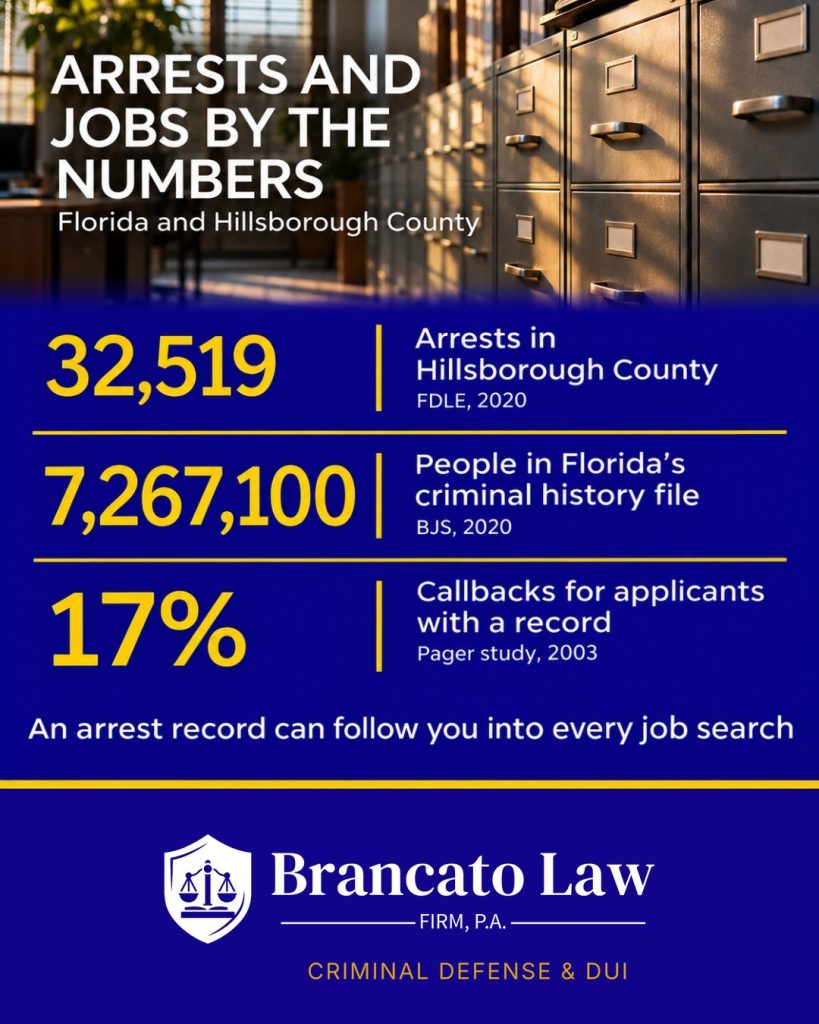
Yes, unless the record has been sealed or expunged. Florida’s criminal history file held records on 7,267,100 people as of December 31, 2020, according to the Survey of State Criminal History Information Systems, 2020, published through the Bureau of Justice Statistics. New arrests feed that file every day: FDLE’s 2020 Total Arrests by County report, the most recent county arrest table FDLE publishes, counted 32,519 arrests in Hillsborough County and 508,490 statewide that year.
Federal law sets two rules for background screening companies. Under the Fair Credit Reporting Act, 15 U.S.C. § 1681c, a screening company generally may not report an arrest record more than seven years old (or older than the governing statute of limitations, if that period is longer), but that limit does not apply to jobs paying $75,000 a year or more, and convictions can be reported with no time limit. Under 15 U.S.C. § 1681b, an employer that plans to act on a screening report must first give the worker a copy of the report and a summary of rights. That notice is the chance to correct an error, such as a dismissed case reported as open. Our guide on who can see your arrest record in Florida explains where those reports get their data.
The stakes are measurable. In The Mark of a Criminal Record (American Journal of Sociology, 2003), sociologist Devah Pager sent matched pairs of applicants to real job openings in Milwaukee. White applicants presented as having a criminal record were called back 17% of the time, half the 34% callback rate for white applicants without one.
Can you get unemployment benefits if you were fired after an arrest?
Often, yes. Under section 443.101, Florida Statutes, a worker fired for misconduct connected with work is disqualified, and a worker fired for a crime connected with the job is disqualified for up to 52 weeks once convicted or after a guilty or no contest plea. Before any plea or conviction, the arrest alone disqualifies the worker only if the employer proves by competent substantial evidence that the arrest was for a crime against the employer or its business, customers, or invitees.
An off-duty arrest that has nothing to do with the employer does not fall under that rule, although the state can still examine whether the firing involved misconduct connected with work. Because a guilty or no contest plea can change the answer, our attorneys at The Brancato Law Firm look at the timing of any plea when a client has an unemployment claim pending.
How does the outcome of the case affect your job?
The outcome decides what employers and licensing boards will see for years. The table below shows how each common result is treated.
| Case outcome | What happens to the record | Can you lawfully deny the arrest? |
|---|---|---|
| No charges filed, dismissal, nolle prosequi, or acquittal on all counts | Sealed automatically under § 943.0595, unless the charge was a forcible felony or certain sex offenses | Yes, with exceptions for criminal justice jobs, The Florida Bar, schools, and agencies serving children, the elderly, or the disabled |
| Withhold of adjudication | Eligible to petition to seal under § 943.059 if you have never been adjudicated guilty and have never sealed or expunged a record before | Yes after sealing, with the same exceptions |
| Adjudication of guilt | Generally cannot be sealed; reportable on background checks with no time limit | No |
Automatic sealing under section 943.0595, Florida Statutes, applies when no charging document is filed, the case is dismissed or dropped on all counts, or the defendant is acquitted, and it has the same effect as a court-ordered sealing. Court-ordered sealing under section 943.059, Florida Statutes, requires a $75 certificate of eligibility from FDLE and is generally available once in a lifetime.
That is why the earliest stage of the case matters most for a job. Nearly every month, cases our firm handles before charges are filed end with no charges at all, and a case that is never filed qualifies for automatic sealing. Our representation before charges are filed starts with the investigating agency and the prosecutor, before the State Attorney’s Office makes a filing decision. Our Florida criminal case process guide shows where that decision falls in the life of a case.
What should you do at work after an arrest?
- Read the policy before you say anything. Find your handbook, contract, or union agreement and look for any reporting rule and its deadline.
- Check your license. Teachers have 48 hours to report a qualifying arrest, and health care practitioners have 30 days after a plea or conviction.
- Do not discuss the facts with coworkers or supervisors. Statements at work can become evidence, and coworkers can become witnesses.
- Keep any required report short. State the charge and that an attorney is handling the case, and let your lawyer review it first.
- Plan for court dates. In many Hillsborough County criminal cases, our attorneys file a written plea of not guilty so the client does not have to miss work for the arraignment.
- Ask for the background report. If an employer cites a screening report, you are entitled to a copy before the employer acts.
Our guide on what to do after being arrested in Tampa covers the first days of the criminal case itself.
Why do the first days after an arrest matter for your job?
The deadlines that cost people their jobs are short. A teacher has 48 hours to self-report, a school board must act within 24 hours of learning of the arrest, and a screened caregiver must be removed from contact with vulnerable people as soon as the employer learns of a disqualifying arrest. Meanwhile, the State Attorney’s Office is deciding whether to file charges at all. The Brancato Law Firm uses that window to manage the report to the employer and to present the defense to the prosecutor before a charge is filed, when a no-file decision is still possible.
Frequently asked questions about losing your job after an arrest in Florida
Can my employer fire me before I am convicted in Florida?
Yes, if you are an at-will employee and no contract, union agreement, or policy requires more. Our attorneys at The Brancato Law Firm review those documents first, and our Hillsborough County criminal defense attorney page explains how we defend the case that started it.
Do I have to tell my boss about a DUI arrest in Florida?
Not under Florida law for most private jobs, but your employer’s policy or your professional license may require a report. The Brancato Law Firm helps clients decide what a policy requires and drafts any report so it does not discuss the facts of the case.
Will a dropped charge still show up on a background check in Florida?
It should not on FDLE’s public record once automatic sealing is complete, but private screening companies sometimes keep old data. When that happens, our attorneys at The Brancato Law Firm help clients dispute the report under the Fair Credit Reporting Act, and our pre-file advocacy works to keep charges from being filed in the first place.
Can a nurse lose her license over an arrest in Florida?
An arrest alone is not reportable under section 456.072, but a conviction, finding of guilt, or no contest plea must be reported within 30 days, and the board can discipline the license. The Brancato Law Firm structures plea discussions around that 30-day rule, as explained in our health care professionals guide.
Can I collect unemployment if I was fired for an arrest in Florida?
Often yes, unless the arrest was for a crime against the employer or you are later convicted of a work-related crime. Our attorneys at The Brancato Law Firm account for a pending unemployment claim when discussing any plea, under the rules in section 443.101, Florida Statutes.
Does a withhold of adjudication count as a conviction for a job application?
It depends on the question asked, because many applications and licensing rules count a withhold, and teachers and health care workers must report one. The Brancato Law Firm explains how a withhold will appear before a client accepts one, and whether it can later be sealed under section 943.059.
Talk to a Tampa criminal defense attorney about your job
Your employer, your license, and your record all turn on decisions made in the first days after an arrest. Call The Brancato Law Firm, P.A., founded by Tampa Criminal Defense Attorney Rocky Brancato, at (813) 727-7159 before you report the arrest at work, and our attorneys will review your policy, your deadlines, and the path to a no-file or a dismissal. You can call us at any hour, and our office is two blocks from the courthouse. Our firm has Spanish-speaking staff, and attorney Jean-Luc Adrien speaks Spanish, Haitian Creole, and French. Read about our Spanish and Haitian Creole criminal defense services.
For more about our defense strategies, visit our Hillsborough County criminal defense page.
The Brancato Law Firm, P.A.
620 E. Twiggs Street, Suite 205, Tampa, FL 33602
(813) 727-7159
Serving Hillsborough, Pinellas, and Pasco Counties
The Brancato Law Firm, P.A. is a Tampa-based criminal defense practice. We are not affiliated with any other Brancato-named law firms.
Visit Us

Tampa, FL 33602

Contact Us Now
Free Legal Consultation (813) 727-7159
