- Free Consultation 24/7: (813) 727-7159 Tap Here To Call Us


From First DUI to Death Penalty



Can You Withdraw a Guilty Plea Before Sentencing in Florida? (2026)


Short answer: Yes. Under Florida Rule of Criminal Procedure 3.170(f), a judge may allow you to withdraw a guilty or no contest plea at any time before sentencing, and must allow it when you show good cause, such as a plea entered through misunderstanding, misadvice, pressure, or ignorance of a defense. In September 2026, Florida’s Second District Court of Appeal held that a defendant who was never told about a possible motion to suppress his statements had good cause, whether or not that motion would have won. After sentencing, the grounds narrow sharply and the deadlines are short.
A Florida judge must let a defendant take back a plea before sentencing when the defense proves good cause, and that proof usually comes from testimony by the defendant and the lawyer who gave the advice. I have argued pleas and sentencings for more than 25 years in Hillsborough County courtrooms, and as founder of The Brancato Law Firm, P.A., a Tampa criminal defense firm, and former Chief Operations Officer of the Hillsborough County Public Defender’s Office, where I oversaw a staff of over 100 attorneys, I have seen how often a rushed plea rests on advice the client never fully understood. Our attorneys review the plea, the discovery, and the prior advice to decide whether a motion to withdraw has a real basis before sentencing closes the door.
What is the rule for withdrawing a plea before sentencing in Florida?
The rule is Florida Rule of Criminal Procedure 3.170(f). It says the court “may in its discretion, and shall on good cause, at any time before a sentence, permit a plea of guilty or no contest to be withdrawn.” Two standards sit in that sentence: the judge may allow withdrawal in its discretion, and the judge must allow it when the defense proves good cause.
Withdrawal sends the case back to where it stood before the plea, so you can plead not guilty and go to trial. The rule also says the withdrawn plea may not be used against you at trial, and section 90.410, Florida Statutes, makes evidence of a guilty plea that was later withdrawn inadmissible in any civil or criminal proceeding. Plea decisions are one stage of the Florida criminal case process, and this one has a hard stop: the sentence.
What counts as good cause to withdraw a plea in Florida?
Good cause exists when the plea was “infected by misapprehension, undue persuasion, ignorance,” was entered by someone not competent to understand it, was otherwise involuntary, or when withdrawal would serve the ends of justice. The Second District repeated that standard in Ruiz v. State, No. 2D2025-2118 (Fla. 2d DCA Sept. 9, 2026). Situations our attorneys evaluate for good cause include:
- Misadvice about the sentence. You were told to expect a sentence the judge could not or would not impose.
- A defense nobody explained. A suppression issue, a self-defense claim, or a speedy trial problem that your lawyer never discussed with you.
- Pressure. A plea entered under a short deadline, family pressure, or an implied promise that was not part of the deal.
- Misunderstood consequences. Registration, license, immigration, or professional license effects that were not explained.
- Competency concerns. Mental health or medication issues that affected your ability to understand the plea.
What did the court decide in Ruiz v. State?
In Ruiz v. State, No. 2D2025-2118 (Fla. 2d DCA Sept. 9, 2026), the Second District held that a defendant who was never told about a possible motion to suppress his statements to police had good cause to withdraw his plea before sentencing, and that the strength of the suppression motion did not matter. The court reversed his manslaughter conviction.
The State charged Emmanuel Ruiz in Manatee County with carrying a concealed firearm and manslaughter with a firearm. He was 16 at the time. He entered open pleas, meaning pleas to the court with no agreed sentence, in August 2024 and moved to withdraw them that December, before sentencing. At the hearing, his former lawyer testified that he believed there was a Miranda basis to suppress Ruiz’s statements to detectives but never discussed it, because Ruiz had said he did not want a trial. The trial court denied the motion and sentenced Ruiz to 20 years in prison followed by community control and probation.
The appellate court reversed. It wrote that “the likelihood of success of a motion to suppress is not relevant” and that the trial court should consider only whether the defendant acted on misapprehension or ignorance. Because Ruiz “was wholly unaware of the possibility of suppressing his statements,” he had good cause. The court affirmed the separate concealed firearm conviction. For more on how statements are challenged, see our post on coerced confessions and the defense.
What must a motion to withdraw a plea say?
A motion to withdraw a plea must say what went wrong and that, had you known the truth, you would not have entered the plea and would have insisted on going to trial. Leaving out that second part can sink the motion without a hearing.
In Anthony v. State, No. 4D2024-2982 (Fla. 4th DCA Apr. 1, 2026), the Fourth District affirmed the denial of a motion to withdraw a plea, citing its rule that such a motion is facially insufficient when the defendant fails to allege that “he would not have entered the plea and would have insisted on going to trial had he been properly informed.” Our attorneys draft these motions with sworn facts on both points: the specific advice or information that was missing, and why it would have changed your decision.
How is withdrawing a plea different before and after sentencing?
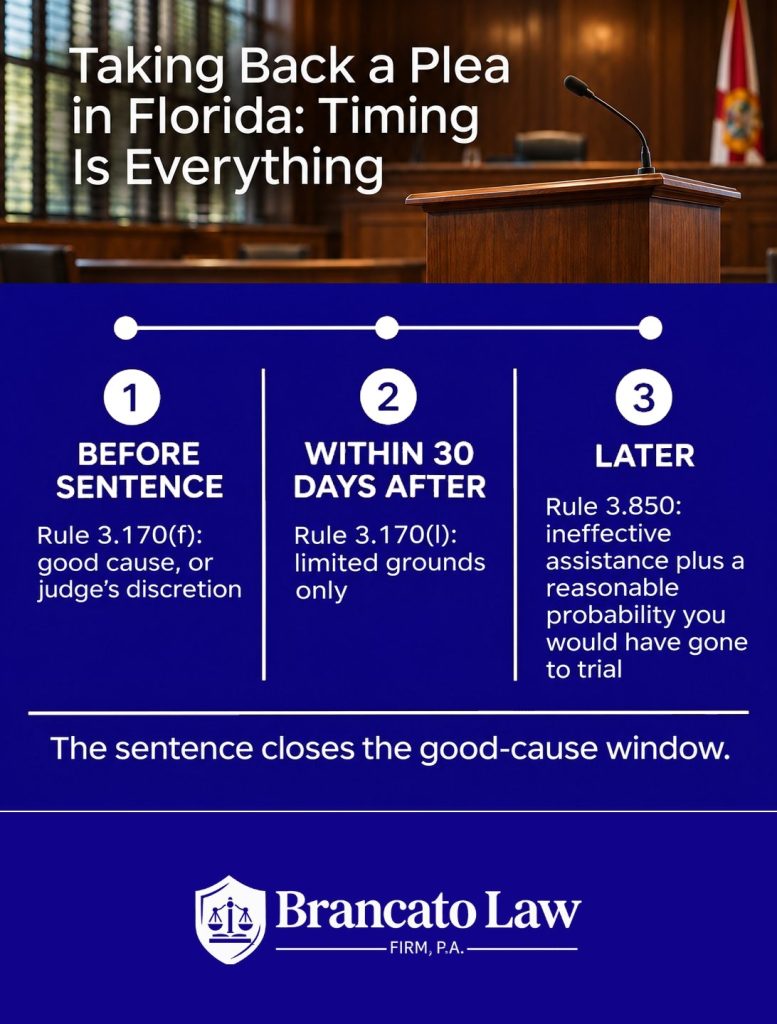
Before sentencing, the standard is good cause and the judge also has discretion. After sentencing, you have 30 days and a short list of grounds, and after that your main route is a postconviction motion claiming your lawyer was ineffective.
| Timing | Rule | What you must show |
|---|---|---|
| Any time before sentence | Rule 3.170(f) | Good cause (mandatory withdrawal) or a reason the judge accepts in discretion |
| Within 30 days after the sentence | Rule 3.170(l) | One of the limited grounds listed in Florida Rule of Appellate Procedure 9.140(b)(2)(A)(ii)(a)-(e); not available if you reserved the right to appeal a dispositive issue |
| Later, through postconviction | Rule 3.850 | Ineffective assistance and a reasonable probability you would have rejected the plea and gone to trial |
Two recent cases show how much harder the later route is. In Hernandez v. State, No. 2D2026-1292 (Fla. 2d DCA Sept. 18, 2026), a Hillsborough County defendant who entered an open plea to DUI manslaughter and vehicular homicide later claimed his lawyer’s advice about the plea was ineffective. The Second District reversed a summary denial because the trial court had not asked whether there was a reasonable probability he would have rejected the plea and insisted on trial, and it sent the claims back for a hearing unless the record conclusively refuted them. In Gerding v. State, No. 5D2026-1327 (Fla. 5th DCA Oct. 23, 2026), a Hernando County defendant claimed his lawyer misadvised him about the length of the sentence he would receive. The Fifth District remanded for the court to attach records refuting the claim or hold an evidentiary hearing, and it expressly did not decide the merits.
Both men had to clear postconviction hurdles that a defendant who moves before sentencing does not face. That is why timing is the first thing our attorneys check.
What happens at a plea withdrawal hearing in Hillsborough County?
In our experience, judges in the 13th Judicial Circuit generally set an evidentiary hearing on a motion to withdraw a plea that is facially sufficient, and the defendant’s prior lawyer is often called as a witness. That is what happened in Ruiz, where the former lawyer’s own testimony established that the suppression issue was never discussed.
Preparing for that hearing means pinning down the prior advice with documents, not memory: emails, letters, notes of plea discussions, the plea form, and the transcript of the plea colloquy. Our attorneys at The Brancato Law Firm order the plea transcript first, because what the judge asked you, and what you answered, is the State’s main response to a withdrawal motion.
How many Florida criminal cases end in a plea?
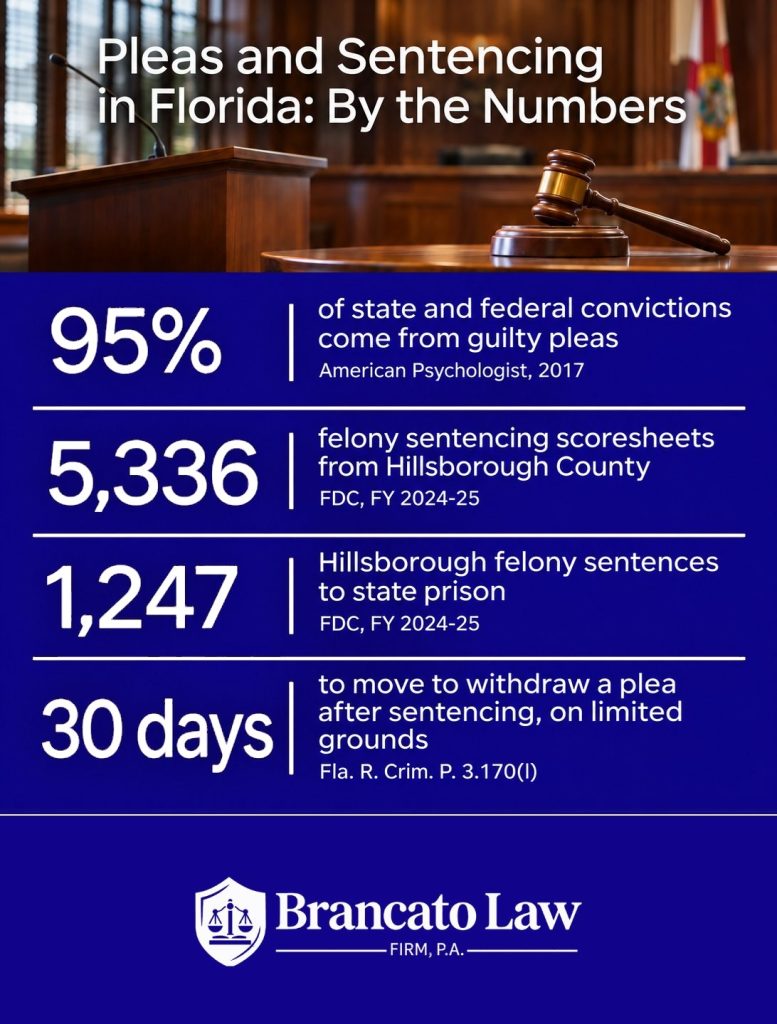
Most of them. A 2017 review in American Psychologist, “The Psychology of Defendant Plea Decision Making” by Allison Redlich, Stephanos Bibas, Vanessa Edkins, and Stephanie Madon, reports that about 95% of state and federal convictions result from guilty pleas. The authors also ask whether defendants actually understand the conditions and consequences of their pleas, which is the question a withdrawal motion puts in front of a judge.
The volume in Tampa is large. The Florida Department of Corrections’ October 2025 Criminal Punishment Code report lists 5,336 felony scoresheets received from Hillsborough County for offenders sentenced in fiscal year 2024-2025. Those sentences included 1,247 to state prison, 2,412 to county jail, 1,443 to probation, and 186 to community control. Each of those sentences was imposed after a plea or a trial, and once the sentence is pronounced, Rule 3.170(f) no longer applies.
Sentencing is not always the same day as the plea. Under section 921.231, Florida Statutes, after a plea the court may refer the case to the Department of Corrections for a presentence investigation before sentencing. That gap is the window for a motion under Rule 3.170(f).
What are the risks of withdrawing a plea?
The main risk is losing the deal. Once the plea is withdrawn, the case returns to its pre-plea posture, and an offer tied to that plea may not come back. Our post on what happens if you reject a plea deal in Florida explains how prosecutors handle offers after a rejection.
You also face trial on the original charges, with the original maximum penalties. Before filing, our attorneys weigh the strength of the State’s evidence, the defense the plea gave up, and the sentence you are likely to receive if the plea stands. For the factors that go into that choice, see our guide on deciding whether to accept a plea bargain.
Why act before your sentencing date?
Because the sentence ends the good cause window. Rule 3.170(f) applies only “before a sentence,” and after that you have 30 days and a narrow list of grounds under Rule 3.170(l). If you have doubts about your plea, a new lawyer needs time to get the plea transcript, talk with prior counsel, and file a sworn motion before the sentencing hearing.
For more about how cases move from plea to sentencing, visit our Florida Criminal Case Process guide and our Hillsborough County criminal defense page.
Frequently asked questions about withdrawing a plea in Florida
Can I withdraw my plea if I just changed my mind before sentencing?
Sometimes; the judge has discretion to allow it, but a change of heart alone is hard to fit within good cause. The Brancato Law Firm looks for the specific advice, defense, or consequence you were not told about, because that is what turns regret into a winning motion under Ruiz v. State, No. 2D2025-2118 (Fla. 2d DCA Sept. 9, 2026).
Does my old lawyer have to testify at a plea withdrawal hearing?
Often, yes, because the motion usually turns on what advice the prior lawyer gave. Our attorneys at The Brancato Law Firm prepare for that testimony with the plea transcript and any written communications, as the former lawyer’s testimony decided Ruiz.
Can I withdraw a plea after I have been sentenced in Florida?
Only within 30 days, and only on the limited grounds listed in the appellate rules, under Rule 3.170(l). After that, the route is a postconviction motion, and The Brancato Law Firm reviews whether your claim meets the reasonable-probability standard applied in Hernandez v. State, No. 2D2026-1292 (Fla. 2d DCA Sept. 18, 2026).
Can the prosecutor use my withdrawn guilty plea against me at trial?
No. Both Rule 3.170(f) and section 90.410, Florida Statutes, bar use of a withdrawn guilty plea. The Brancato Law Firm objects to any reference to the plea or plea discussions if the case goes to trial.
What if my lawyer told me I would get probation and the judge gave me prison?
Misadvice about the sentence can support withdrawal before sentencing and an ineffective assistance claim after it, as in Gerding v. State, No. 5D2026-1327 (Fla. 5th DCA Oct. 23, 2026). Our team at The Brancato Law Firm compares what you were told with the plea form and the scoresheet to see whether the claim holds up.
Your sentencing date is the deadline that matters most, so call before it arrives. The Brancato Law Firm, P.A., founded by Tampa Criminal Defense Attorney Rocky Brancato, can review your plea at (813) 727-7159, and our attorneys will start with the plea transcript and the advice you were given. Our firm has Spanish-speaking staff, and attorney Jean-Luc Adrien speaks Spanish, Haitian Creole, and French. Call us at any hour; our office is two blocks from the courthouse.
The Brancato Law Firm, P.A.
620 E. Twiggs Street, Suite 205, Tampa, FL 33602
(813) 727-7159
Serving Hillsborough, Pinellas, and Pasco Counties
The Brancato Law Firm, P.A. is a Tampa-based criminal defense practice. We are not affiliated with any other Brancato-named law firms.
Visit Us

Tampa, FL 33602

Contact Us Now
Free Legal Consultation (813) 727-7159
