- Free Consultation 24/7: (813) 727-7159 Tap Here To Call Us


From First DUI to Death Penalty



Is Fleeing and Eluding a Felony in Florida? (2026)


Updated October 22, 2026
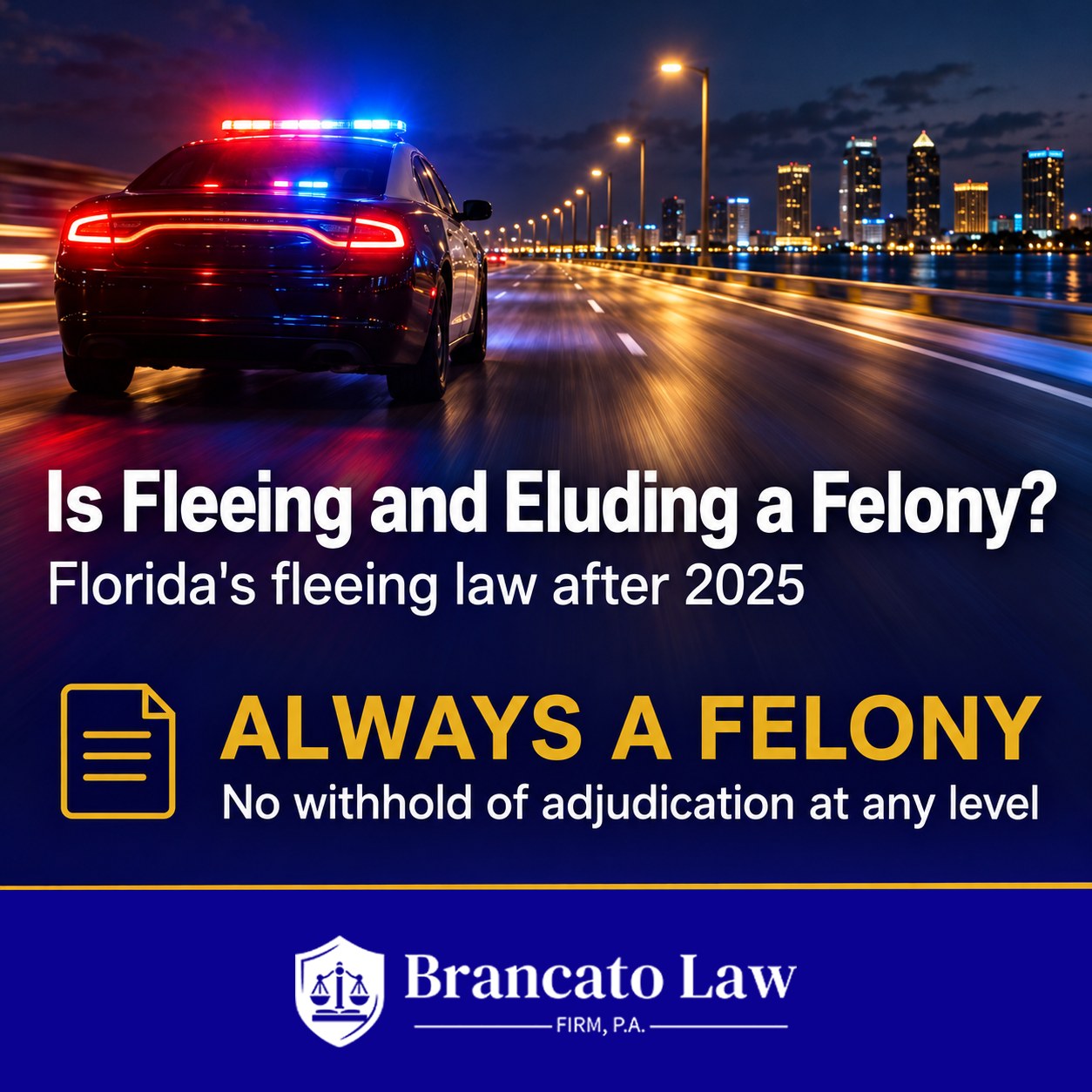
Yes. Every form of fleeing and eluding under section 316.1935 is a felony. Refusing to stop after an officer’s order is a third-degree felony, fleeing at high speed or with wanton disregard for safety is a second-degree felony, and causing serious bodily injury or death is a first-degree felony with a 3-year mandatory minimum. A court cannot withhold adjudication, the driver license must be revoked for 1 to 5 years, and since October 1, 2025, a fleeing charge after a prior fleeing conviction multiplies the sentence points by 1.5.
When a fleeing and eluding case reaches a prosecutor or a judge, the first question is what the driver knew: whether the patrol car’s lights and siren were on, whether its markings were visible, and how long the driver kept going. Those questions are familiar to me as a former police academy instructor. My name is Rocky Brancato; I founded The Brancato Law Firm, P.A., a Tampa criminal defense firm, and I have tried more than 150 jury trials to verdict. Our attorneys defend fleeing charges across Hillsborough, Pinellas, and Pasco Counties by testing that proof against the video, the dispatch records, and the statute as it reads after the 2025 changes.
Is fleeing and eluding a felony in Florida?
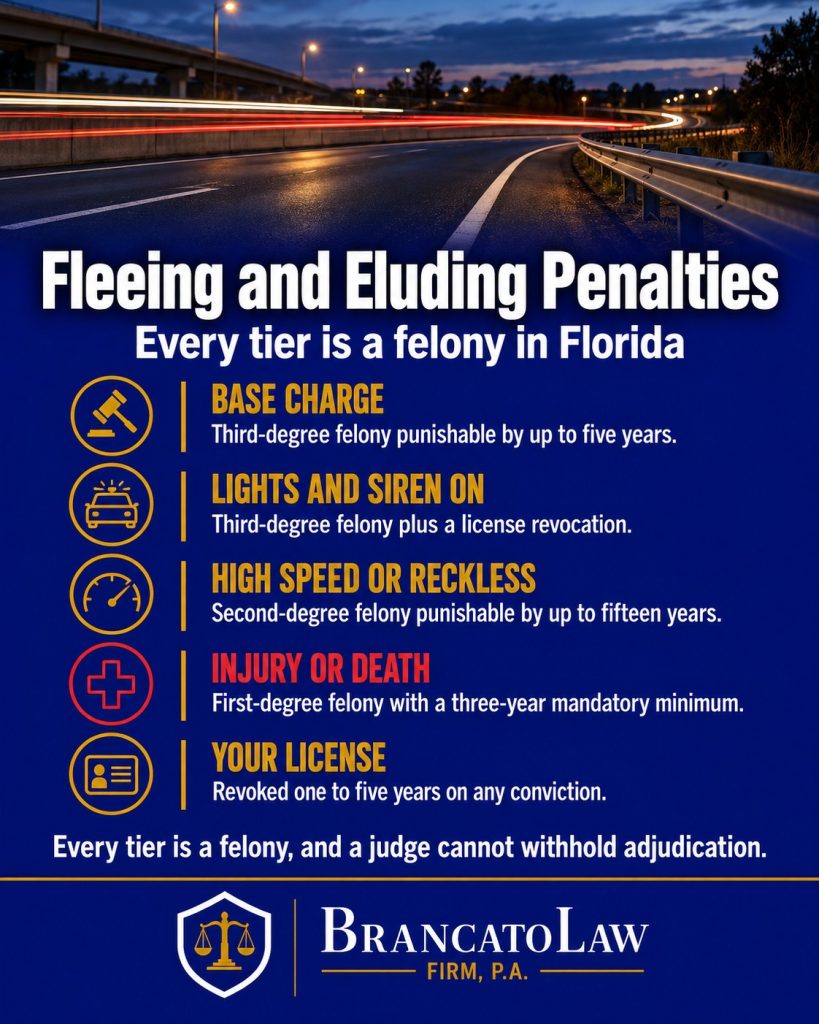
Yes, at every level. Section 316.1935, Florida Statutes makes the lowest form of fleeing a third-degree felony, and the charge climbs with speed, recklessness, injury, and a connection to a crash.
| Subsection | What the State alleges | Charge | Maximum penalty |
|---|---|---|---|
| (1) | Knowing of an officer’s order to stop, the driver willfully refused to stop, or stopped and then fled | Third-degree felony | 5 years |
| (2) | The driver fled a patrol vehicle with agency jurisdictional markings prominently displayed and siren and lights activated | Third-degree felony | 5 years |
| (3)(a) | Subsection (2) plus high speed or “wanton disregard for the safety of persons or property” | Second-degree felony | 15 years |
| (3)(b) | Subsection (3)(a) plus serious bodily injury or death to another person | First-degree felony | 30 years, 3-year mandatory minimum |
| (4)(a) | Aggravated fleeing: fleeing while unlawfully leaving a crash, causing injury or property damage | Second-degree felony | 15 years |
| (4)(b) | Aggravated fleeing causing serious bodily injury or death | First-degree felony | 30 years, 3-year mandatory minimum |
The maximums come from section 775.082, Florida Statutes. There is no misdemeanor version, and section 316.1935(6) provides that “no court may suspend, defer, or withhold adjudication of guilt or imposition of sentence for any violation of this section.” A conviction is a felony conviction. Our Tampa criminal traffic lawyer team looks for a path to a lesser charge from the first review of the file.
What does the State have to prove in a fleeing and eluding case?
It depends on the subsection. Under section 316.1935(1), the State must prove the driver had “knowledge that he or she has been ordered to stop such vehicle by a duly authorized law enforcement officer” and then willfully refused or failed to stop, or stopped and then willfully fled. Subsection (1) has no lights, siren, or marked-car element.
The more common charge under subsection (2) adds three facts about the police car: it was “an authorized law enforcement patrol vehicle,” it had “agency jurisdictional markings prominently displayed on the vehicle,” and it had its “siren and lights activated.” The statute requires both the siren and the lights.
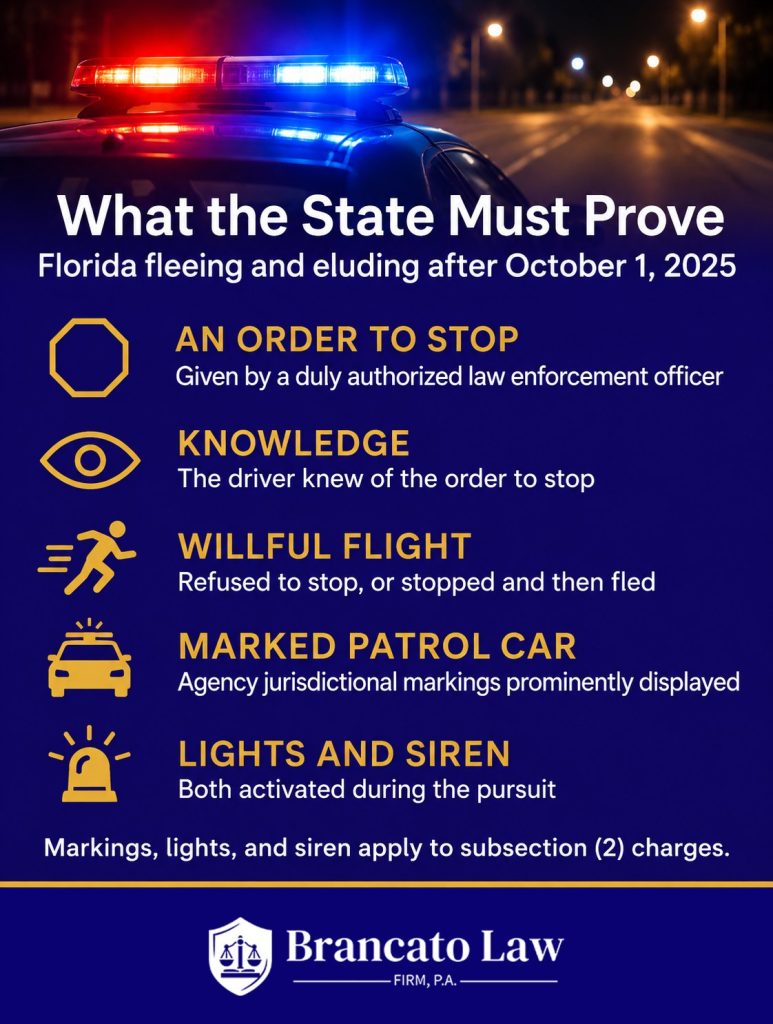
Each element is a defense point. A driver who never heard a siren, never saw lights in the mirror, or could not tell an unmarked car was police has a knowledge defense. Our attorneys at The Brancato Law Firm match the officer’s account to the dash camera, body camera, and radio timeline second by second.
What did Florida’s 2025 fleeing law change?
It changed the markings language, raised two offense rankings, and added a repeat-offender multiplier. CS/CS/HB 113, enacted as chapter 2025-75, Laws of Florida, took effect October 1, 2025. It passed the House 101 to 9 and the Senate 36 to 0.
- Markings. The law removed the requirement that the pursuing car “prominently display agency insignia.” The statute once read “agency insignia and other jurisdictional markings”; it now reads “agency jurisdictional markings.”
- Rankings. Section 921.0022, the offense severity chart that drives the sentencing scoresheet, now ranks subsection (3)(a) at Level 5 instead of Level 4 and aggravated fleeing under (4)(a) at Level 6 instead of Level 5. A higher level means more points and a higher lowest permissible sentence.
- The 1.5 multiplier. Under section 921.0024(1)(b), Florida Statutes, “If the primary offense is fleeing or attempting to elude a law enforcement officer or aggravated fleeing or eluding in violation of s. 316.1935, and in the offender’s prior record, there is one or more violation of s. 316.1935, the subtotal sentence points are multiplied by 1.5.”
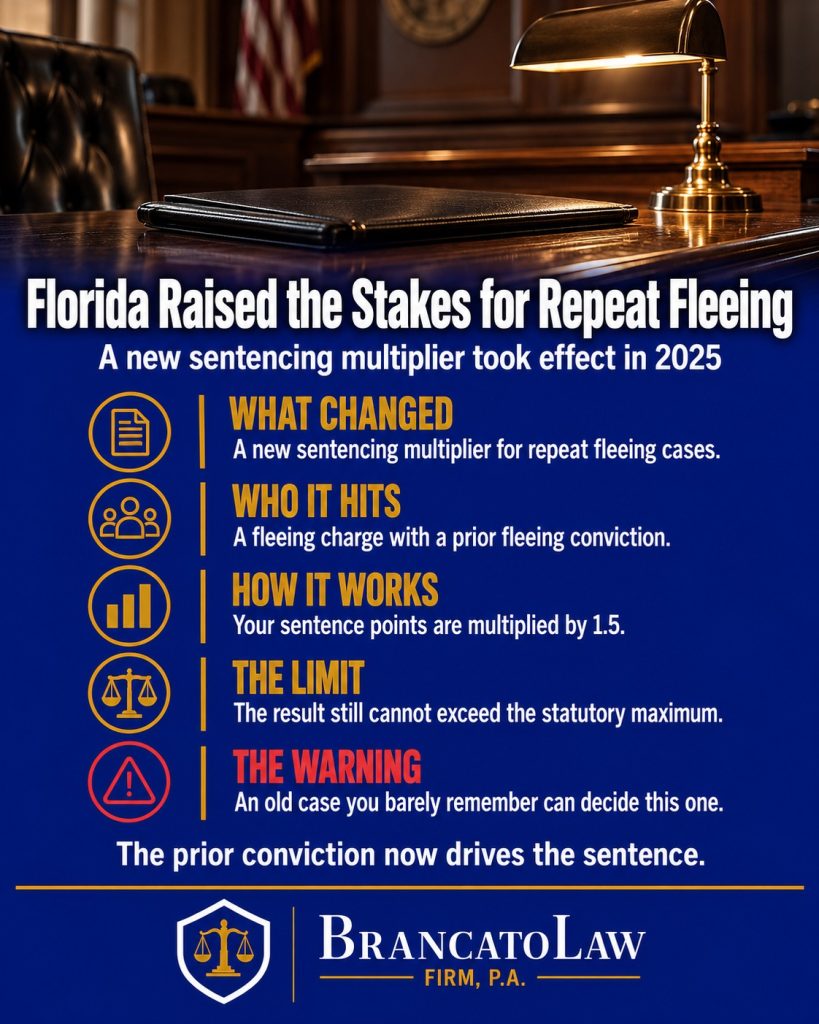
The 2025 law did not create the 3-year mandatory minimums, the ban on withholding adjudication, or vehicle forfeiture. Those were already in the statute. The offense date matters: for a chase before October 1, 2025, the older insignia element and the older rankings still apply. Our news post on Florida’s 2025 fleeing and eluding law covers the bill’s passage.
What is the mandatory minimum for fleeing and eluding?
Three years in prison, but only for the two first-degree tiers. Subsection (3)(b), fleeing at high speed or with wanton disregard that causes serious bodily injury or death, and subsection (4)(b), aggravated fleeing that causes serious bodily injury or death, each carry a “mandatory minimum sentence of 3 years imprisonment.” Under section 316.1935(6), those minimums are not eligible for gain-time or discretionary early release, except for pardon, clemency, or conditional medical release.
The other tiers have no mandatory minimum, but the scoresheet still controls. A Level 5 or Level 6 ranking, plus the 1.5 multiplier for a repeat case, can produce a prison score even when no one was hurt. Our attorneys at The Brancato Law Firm prepare an independent scoresheet and challenge every point the State adds.
Will you lose your license or your car for fleeing?
Possibly both. Section 316.1935(5) provides that “The court shall revoke, for a period not less than 1 year nor exceeding 5 years, the driver license” of anyone convicted under subsections (1) through (4). Under section 316.1935(7), a vehicle used in the offense is “deemed to be contraband” and can be forfeited under Florida’s contraband forfeiture law.
| Consequence | Rule | Source |
|---|---|---|
| Withhold of adjudication | Not allowed | § 316.1935(6) |
| License revocation | 1 to 5 years | § 316.1935(5) |
| Vehicle | Subject to forfeiture as contraband | § 316.1935(7) |
| Mandatory prison | 3 years for (3)(b) and (4)(b) | § 316.1935(3)(b), (4)(b) |
| Repeat fleeing case | Sentence points multiplied by 1.5 | § 921.0024(1)(b) |
Our attorneys at The Brancato Law Firm raise the revocation length and any forfeiture claim in negotiations, because a family car or a commercial license can be at stake.
How do our attorneys fight a fleeing and eluding charge?
We attack the element the State is weakest on, then push for a lesser charge. Three appellate cases show how the arguments work.
Markings for older offense dates. In Slack v. State, 30 So. 3d 684 (Fla. 1st DCA 2010), the officer drove a “marked patrol car” with “lights on top,” and the lights and siren were on. The First District held that was not enough because “there was no evidence of ‘agency insignia and other jurisdictional markings prominently displayed on the vehicle,'” and it directed a conviction under subsection (1) instead. The insignia requirement is gone for chases on or after October 1, 2025, but the State must still prove jurisdictional markings were “prominently displayed.”
High speed and wanton disregard. In Canidate v. State, 238 So. 3d 412 (Fla. 4th DCA 2018), a Martin County driver went 40 in a 35 zone with occasional weaving, and no person or property was affected. The court held that was not “wanton disregard,” which it defined as “a conscious and intentional indifference to consequences and with knowledge that damage is likely to be done to persons or property.” The second-degree conviction was reversed and the case sent back for a conviction under subsection (2).
Evidence from every county. In Johnson v. State, No. 1D2024-0912 (Fla. 1st DCA Nov. 5, 2025), a pursuit in marked cars with lights and sirens followed a vehicle theft. Radar captured 127 mph in Jackson County, and the court held that evidence was admissible to prove the high-speed element of a Bay County charge, because each element need not occur in the charging county. The lesson for the defense is to gather records from every agency the chase passed through.
In practice, our attorneys:
- Test knowledge. We check the video for when lights and siren came on, what the driver could see, and how long the driver drove afterward.
- Test the patrol car. We get photographs of the vehicle and its markings.
- Test speed and wanton disregard. We compare radar, GPS, and video with the road and traffic conditions.
- Test the stop. If the officer had no lawful basis for the order to stop, we challenge it. Our post on how long a traffic stop can last in Florida covers the limits on stops.
- Test identity. In chases where the driver ran from the car, we look at who was actually seen driving.
- Negotiate a reduction. Florida’s reckless driving statute, section 316.192, Florida Statutes, provides that “Fleeing a law enforcement officer in a motor vehicle is reckless driving per se,” which makes reckless driving a natural reduction target. Our guides on reckless driving in Florida and fighting a reckless driving charge explain that charge.
How often do police pursuits end in deaths?
More often than they used to, nationally. Pursuit-related deaths in the United States rose from 382 in 2015 to 532 in 2020, a 39% increase, according to NHTSA crash data reported by the Police Executive Research Forum in Vehicular Pursuits: A Guide for Law Enforcement Executives on Managing the Associated Risks (COPS Office, U.S. Department of Justice, 2023). The report counted 2,604 pursuit-related deaths from 2015 through 2020.
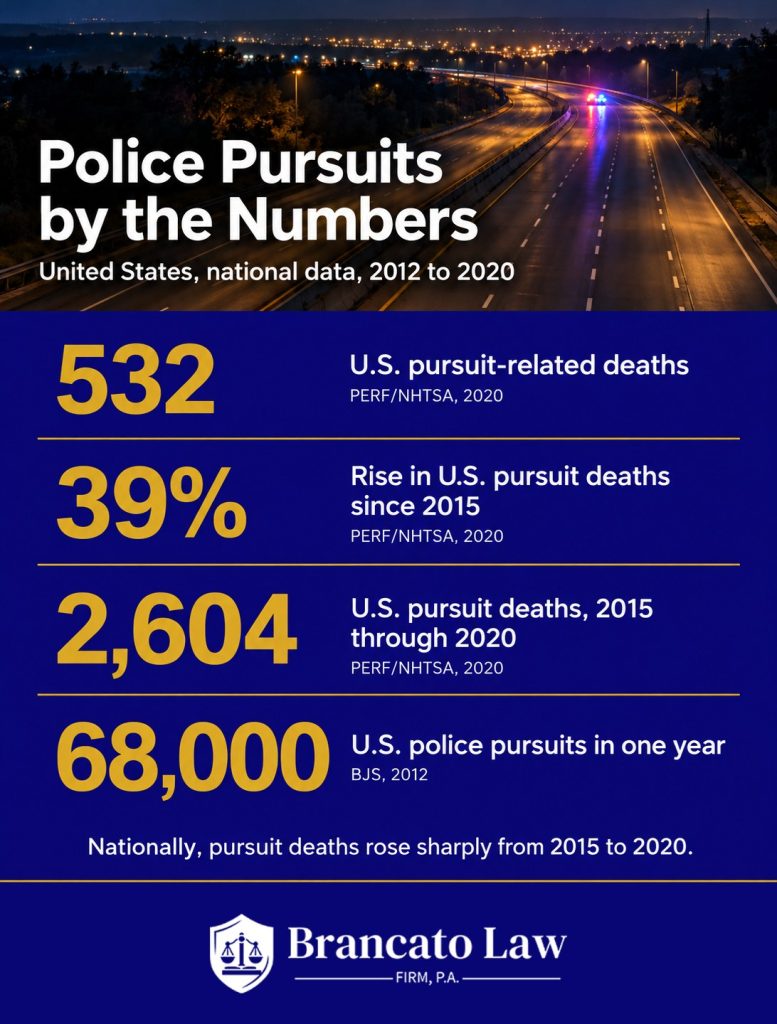
The Bureau of Justice Statistics estimated about 68,000 police pursuits in 2012, about 186 a day, in Police Vehicle Pursuits, 2012-2013 (May 2017). We could not find a published Florida count of pursuits, so these figures are national. Our attorneys at The Brancato Law Firm treat every fleeing charge as a serious felony case from the start.
What should you do after a fleeing and eluding arrest?
Get the video preserved. Dash camera, body camera, and dispatch recordings often decide fleeing cases, and every agency involved in the chase may hold a piece. A person arrested in Hillsborough County sees a judge at first appearance within 24 hours, held at the Orient Road Jail, and the State Attorney’s Office for the 13th Judicial Circuit files the charging information. Before then:
- Say nothing about the chase, including why you did not stop.
- Write down the route and times while you remember them.
- Keep your phone records, which can show calls, navigation, or location.
- Call a lawyer quickly, so preservation requests go out to every agency.
If the chase began after a crash, the case may also include a leaving the scene charge, covered in our guide on whether leaving the scene of an accident is a felony in Florida.
Frequently asked questions about fleeing and eluding in Florida
Can fleeing and eluding charges be dropped in Florida?
Yes, when the State cannot prove the driver knew of the order to stop, cannot prove the patrol car’s markings, lights, and siren, or cannot prove who was driving. The Brancato Law Firm builds those arguments from the video and presents them to the prosecutor, as described on our criminal traffic defense page.
Does the police car have to be marked in a Florida fleeing case?
For a subsection (2) charge, yes: since October 1, 2025, the car must have “agency jurisdictional markings prominently displayed,” though agency insignia is no longer required. Our attorneys at The Brancato Law Firm check the offense date first, because older cases still require insignia, as our post on the 2025 fleeing law explains.
Can you get a withhold of adjudication for fleeing and eluding in Florida?
No; section 316.1935(6) bars a court from withholding adjudication for any fleeing offense. The Brancato Law Firm therefore works to defeat the charge or negotiate a reduction to a different offense, such as reckless driving.
How long is your license revoked for fleeing and eluding in Florida?
At least 1 year and up to 5 years, under section 316.1935(5). Our attorneys at The Brancato Law Firm argue for the shortest revocation the facts support.
Can fleeing and eluding be reduced to reckless driving in Florida?
It can be, because the reckless driving statute treats fleeing in a vehicle as reckless driving per se. The Brancato Law Firm pursues that reduction when the State’s proof on knowledge or markings is weak, and our post on reckless driving in Florida explains the penalties.
What is the 1.5 multiplier for repeat fleeing in Florida?
It multiplies the subtotal sentence points by 1.5 when the primary offense is fleeing and the prior record includes a fleeing violation, under section 921.0024(1)(b). Our attorneys at The Brancato Law Firm check whether the prior actually counts and whether the offense date is on or after October 1, 2025.
Call a Tampa fleeing and eluding defense attorney
Pursuit video and dispatch recordings are easiest to secure in the first days after an arrest. The Brancato Law Firm, P.A., founded by Tampa Criminal Defense Attorney Rocky Brancato, will send preservation requests to every agency involved, test the State’s proof on knowledge and markings, and push for a reduction. Call (813) 727-7159 for a free, confidential consultation. You can call us at any hour. Our firm has Spanish-speaking staff, and attorney Jean-Luc Adrien speaks Spanish, Haitian Creole, and French. Read about our Spanish and Haitian Creole criminal defense services.
For more about our defense strategies, visit our Tampa Criminal Traffic Lawyer page.
The Brancato Law Firm, P.A.
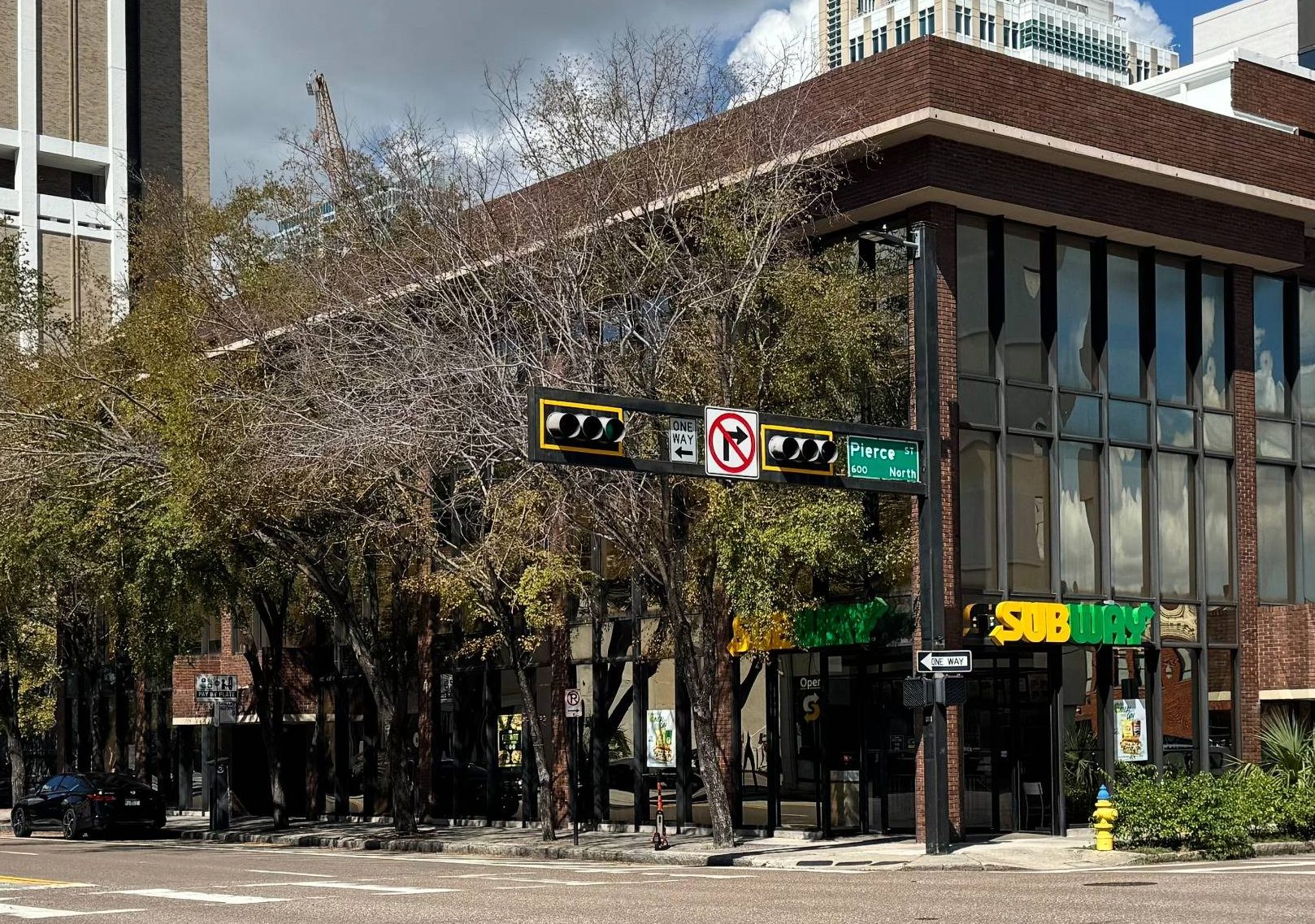
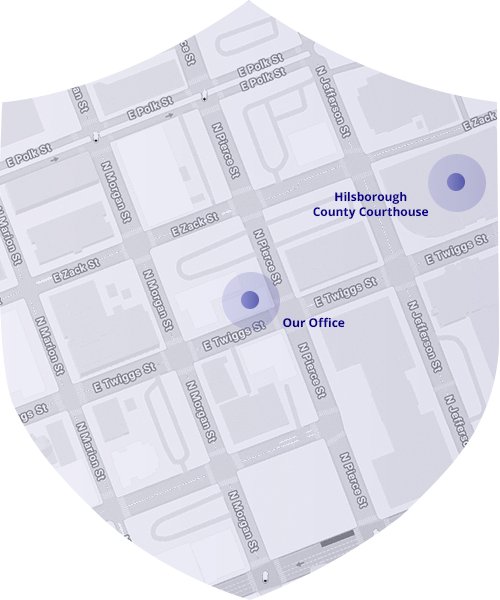
620 E. Twiggs Street, Suite 205, Tampa, FL 33602
(813) 727-7159
Serving Hillsborough, Pinellas, and Pasco Counties
The Brancato Law Firm, P.A. is a Tampa-based criminal defense practice. We are not affiliated with any other Brancato-named law firms.
Visit Us
Tampa, FL 33602
Contact Us Now
Free Legal Consultation (813) 727-7159