

From First DUI to Death Penalty



What Happens After an Out-of-State DUI in Tampa? License, Court, and Your Home State (2026)


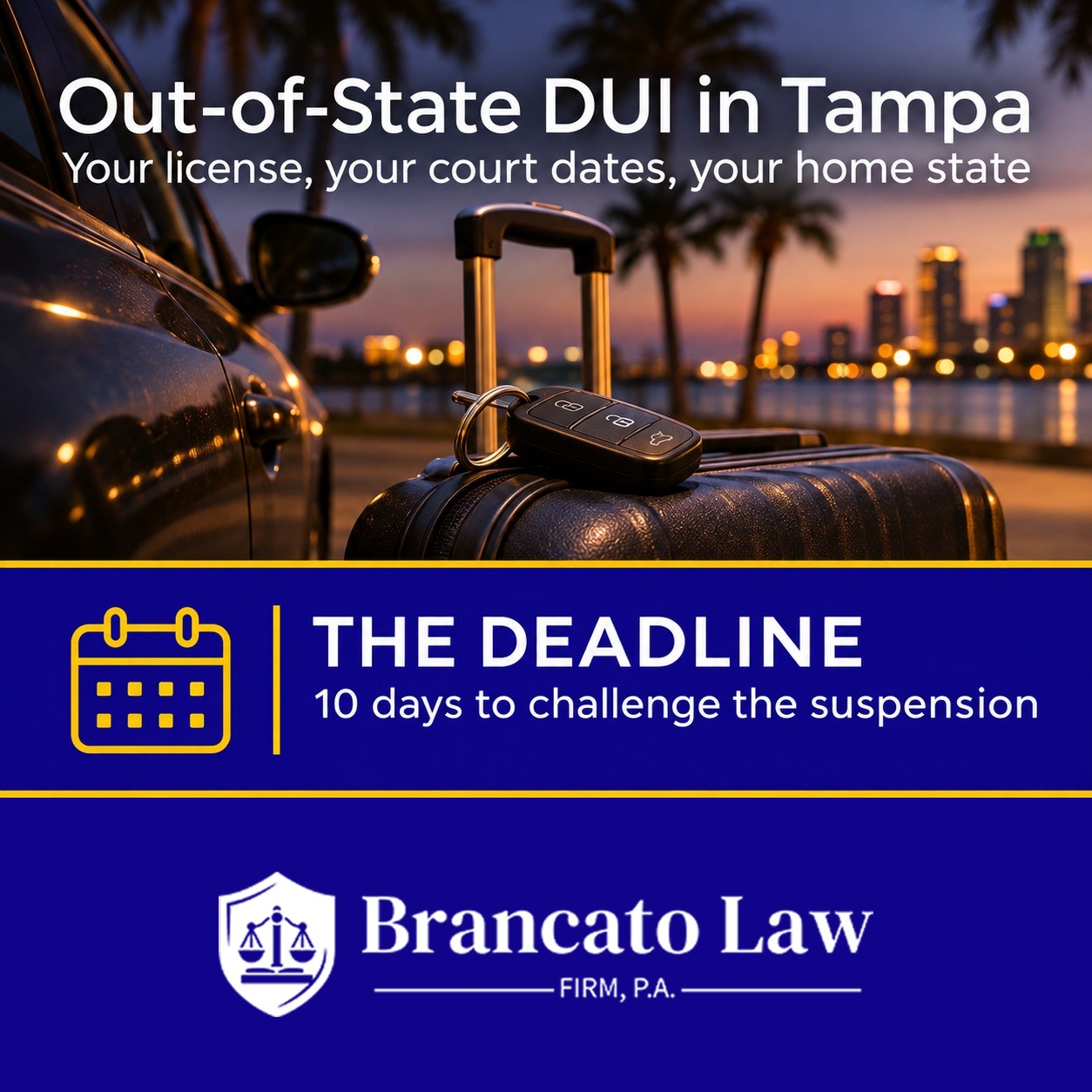
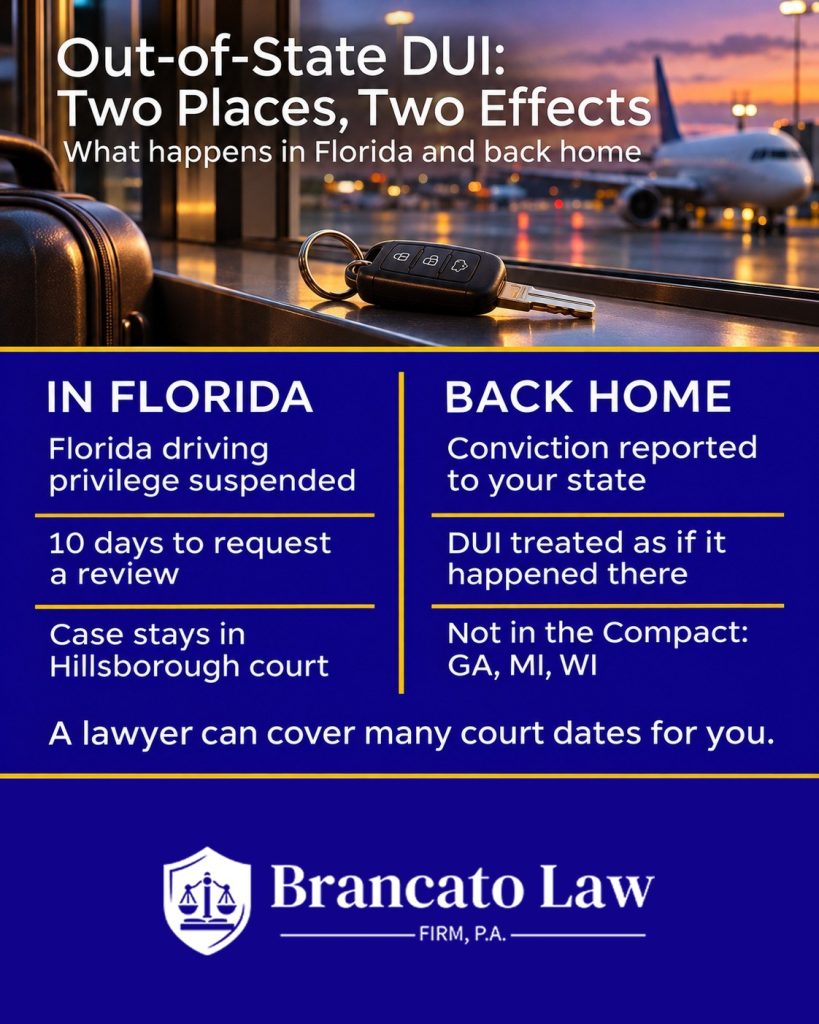
A DUI arrest in Tampa with an out-of-state license starts two Florida cases. The Department of Highway Safety and Motor Vehicles suspends your privilege to drive in Florida, 6 months for a first breath result of 0.08 or higher and 1 year for a refusal, and you have 10 days to challenge it. The criminal case stays in Hillsborough County court, but a lawyer can file a written plea of not guilty and waive your presence at pretrial conferences, so many visitors do not have to fly back for every date. If you are convicted, Florida reports it to your home state, and under the Driver License Compact your home state treats a DUI conviction as if it happened there.
A Florida judge handling a visitor’s DUI case looks at the same evidence as in any other case, and the legal standard does not change because the driver lives in Ohio or Ontario. What changes is the logistics: a 10-day license deadline that starts before most visitors get home, court dates in a courthouse far from home, and a home licensing agency that will hear about any conviction. As founder of The Brancato Law Firm, P.A., a Tampa criminal defense firm, a former police academy instructor, and a member of the National College for DUI Defense, I have handled DUI cases for more than 25 years in Hillsborough County courtrooms. For out-of-state clients, our attorneys build the case so that the client travels as little as the law allows.
Can Florida suspend an out-of-state driver’s license after a DUI arrest?
Florida does not suspend another state’s license itself, but it suspends the nonresident’s privilege to drive in Florida. Under section 322.23, Florida Statutes, the privilege a nonresident has to drive on Florida highways “shall be subject to suspension or revocation” in the same manner and for the same cause as a Florida license. The administrative DUI suspension in section 322.2615 therefore applies to visitors: 6 months for a first breath or blood result of 0.08 or higher, 1 year if a prior suspension under that section exists, and 1 year for a first refusal or 18 months after a prior refusal suspension.
Courts apply the suspension law to out-of-state drivers the same way. In Kirpalani v. Department of Highway Safety & Motor Vehicles, 997 So. 2d 502 (Fla. 4th DCA 2008), a driver with a New Jersey license was stopped for speeding, took a breath test, and had her Florida driving privilege suspended after a formal review. She argued the deputy had misstated New Jersey’s refusal penalties to get her to blow. The Fourth District denied relief, reasoning that even if the test should have been excluded, refusing would have brought a longer suspension than the 6 months she received. For a visitor, that means the hearing officer applies Florida law to a Florida stop, whatever the home state’s rules say.
Driving in Florida during the suspension is its own problem. Section 322.34 makes knowingly driving while a “driver license or driving privilege” is suspended a second-degree misdemeanor for a first conviction. A visitor who rents a car later in the trip, or who returns to Florida during the suspension, should treat the Florida privilege as gone until the suspension ends or is set aside.
What is the 10-day deadline, and does it apply to visitors?
Yes. The driver has 10 days from the date the notice of suspension is issued to request a formal or informal review, or a review of eligibility for a restricted privilege, under section 322.2615. The officer issues a 10-day temporary permit with the notice if the driver is otherwise eligible. Most visitors are home, back at work, or on a cruise ship by day 10, which is why our attorneys at The Brancato Law Firm ask out-of-state clients to call before they leave Tampa.
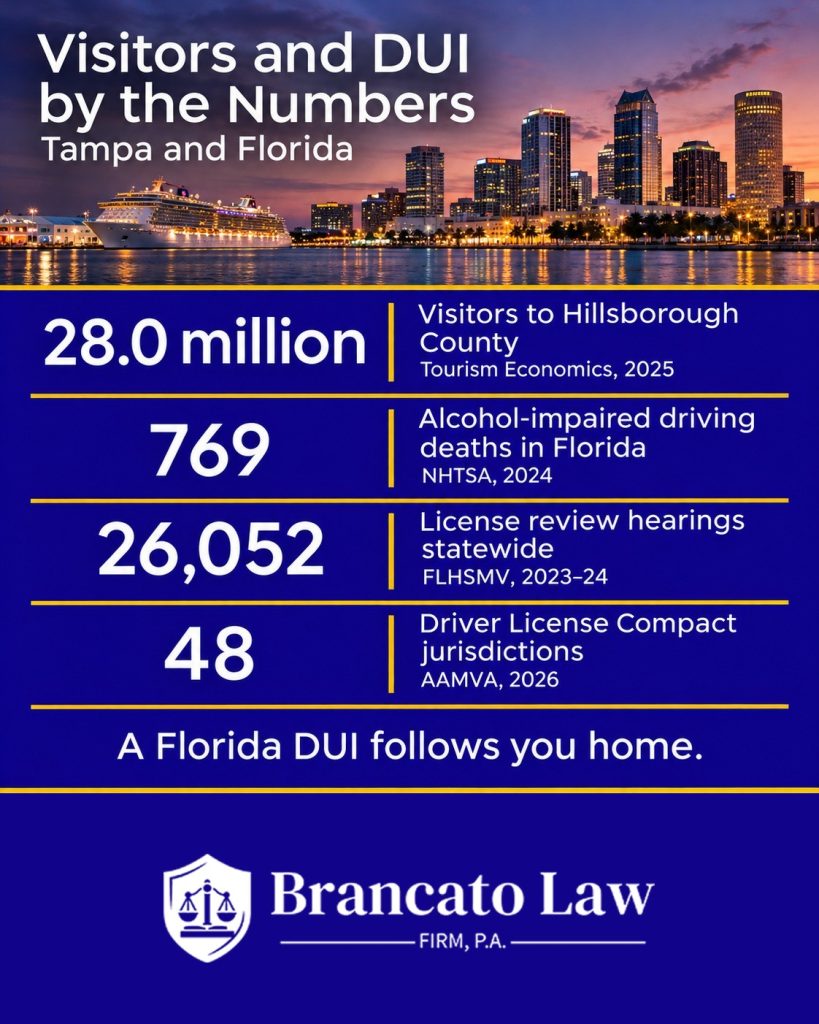
These reviews run through a busy statewide system. From July 1, 2023 through June 30, 2024, the department’s Bureau of Administrative Reviews conducted 26,052 hearings and reviews from eight offices statewide, according to a December 2024 FLHSMV Inspector General audit. A request for review does not pause the suspension, but if the department fails to schedule a formal hearing within 30 days, the statute requires it to invalidate the suspension. At the hearing, the issues are limited to probable cause and the breath result or the refusal, and our attorneys use it to question the officer under oath before the criminal case reaches a judge.
Administrative suspensions like Florida’s are common across the country. NHTSA’s Countermeasures That Work guide reports that as of July 2020, 48 states and the District of Columbia had some form of administrative license revocation or suspension law for a first offense, and it cites research finding that administrative revocation reduces alcohol-related fatal crash involvement by 5%.
What happens after a DUI arrest in Tampa if you live in another state?
A DUI arrest in Tampa follows the same steps for a visitor as for a resident. In Hillsborough County, an arrested driver is booked at the Orient Road Jail, and section 316.193(9) bars release until the driver’s breath or blood alcohol level is below 0.05, normal faculties are no longer impaired, or 8 hours have passed since the arrest. A Sheriff’s Office or Tampa Police breath test is usually given at Central Breath Testing, the Sheriff’s Office breath-testing site, before booking. The criminal case then moves through county court in the 13th Judicial Circuit, which our Hillsborough County criminal defense page describes, and the stages after that are laid out in our Florida criminal case process guide.
The volume of visitors is part of why this comes up so often in Tampa. Hillsborough County drew 28.0 million visitors in 2025, according to the Economic Impact of Visitors in Tampa, 2025 study prepared by Tourism Economics for Visit Tampa Bay. Gasparilla weekends, concerts, games, and cruise departures from Port Tampa Bay bring drivers into a city they do not know, often in rental cars. NHTSA’s State Alcohol-Impaired-Driving Estimates: 2024 Data counted 769 alcohol-impaired-driving deaths in Florida in 2024, 24% of all traffic deaths in the state.
Do you have to come back to Florida for court?
Not for every date. A defendant with a lawyer can file a written plea of not guilty instead of appearing at arraignment, and Florida’s criminal procedure rules let a defendant waive presence at pretrial conferences in writing. The Second District enforced that rule in a Hillsborough County case, Jimenez v. State, 201 So. 3d 214 (Fla. 2d DCA 2016). The defendant had filed a written waiver of appearance at all pretrial conferences, but the judge issued a capias when he was absent from a disposition hearing, citing a courtroom policy requiring every defendant to attend. The appellate court quashed the capias and held that refusing written waivers and banning attorney-filed waivers was in “direct contravention” of the rules.
Jimenez also noted that a judge may still require a defendant’s attendance for good reason, as long as the defense is clearly told that personal presence is required despite the waiver. A trial requires the defendant in court, and a plea and sentencing usually do as well. Our attorneys at The Brancato Law Firm handle the pretrial dates, keep the client informed of each setting, and ask the court in advance about the dates when travel is unavoidable.
| Court event | Usually requires travel? | Why |
|---|---|---|
| First appearance | Only if still in custody | Held within 24 hours of arrest at the jail |
| Arraignment | No, with a lawyer | A written plea of not guilty can be filed instead |
| Pretrial conferences | No, with a written waiver | Presence may be waived in writing (Jimenez) |
| Motion hearings | Sometimes | Depends on whether the defendant must testify |
| Plea and sentencing | Usually | The judge decides whether remote appearance is allowed |
| Trial | Yes | The defendant must be present |
Will your home state find out about a Florida DUI?
Yes, if it ends in a conviction. Florida is a member of the Driver License Compact, codified at section 322.44, Florida Statutes. Article III requires a member state to report each conviction of a driver from another member state to that driver’s home state. Article IV then requires the home state to give a DUI conviction “the same effect” as if the conduct had occurred at home, for purposes of suspending or revoking the license. Florida’s own statute allows the same reporting: section 322.23(2) authorizes the department to forward a record of a nonresident’s conviction to the driver’s home state.
Almost every state is in the Compact. According to the American Association of Motor Vehicle Administrators’ Driver License Compact member list, last revised in April 2026, 48 jurisdictions belong, 47 states and the District of Columbia; Georgia, Michigan, and Wisconsin are not members. Florida joined in 1967. A driver from a non-member state still needs advice about the home state’s own rules, and our attorneys check them for each client.
The Compact speaks to convictions, not arrests. How a home state treats a Florida administrative suspension that never becomes a conviction depends on that state’s own law. A dismissal, an acquittal, or a plea to a non-DUI offense changes what Florida reports, so the defense of the criminal case decides what the home state sees. In Hillsborough County, many first-time cases are resolved through the RIDR program, and our post on reducing a DUI to reckless driving explains how that reduction works.
What penalties does an out-of-state driver face for a Florida DUI?
The same penalties as a Florida resident. A first DUI conviction under section 316.193 carries a fine of $500 to $1,000, up to 6 months in jail, up to 1 year of probation, at least 50 hours of community service, DUI school, and a 10-day impoundment of the vehicle. For a rental car, the statute allows impoundment for the unexpired term of the rental agreement when it ends within 10 days. On conviction, the court revokes the Florida driving privilege for at least 180 days and up to 1 year under section 322.28. Our Tampa DUI lawyer page covers how our attorneys defend the charge itself.
Prior DUIs from other states count in Florida. Section 322.28 treats a previous out-of-state conviction for DUI, driving while intoxicated, or a similar alcohol- or drug-related traffic offense as a prior Florida DUI. A second conviction within 5 years of a prior conviction brings at least a 5-year revocation, and our post on when a third DUI becomes a felony in Florida explains how priors are proved.
How do our attorneys defend an out-of-state DUI client?
Our attorneys run the case so the client can stay home for most of it. For a typical visitor, we:
- Request the formal review within the 10 days and subpoena the officer and the breath records, so the officer’s account is on record early.
- File a written plea of not guilty and a written waiver of appearance at pretrial conferences, and handle those settings without the client present.
- Review the stop, the field sobriety exercises, and the breath test; our posts on fighting a DUI charge in Hillsborough County and refusing a breath test in Tampa explain those defenses.
- Look at what any outcome will mean on the home state’s driving record before the client agrees to a plea.
- Schedule the dates that do require travel, such as a trial, far enough ahead that the client can plan.
What should a visitor do before leaving Tampa?
Call a lawyer before the trip home, because the 10-day license deadline runs while you travel. Keep the citations, the notice of suspension, the bond paperwork, and any rental or cruise records. Do not drive in Florida on the suspended privilege, write down what happened at the stop while you remember it, and update your mailing address with the clerk so court notices reach you.
Frequently asked questions
Can I fly home after a DUI arrest in Tampa?
That depends on the release conditions in your bond paperwork; if they do not restrict travel, you can go home, but you must keep your address current and appear when required. The Brancato Law Firm confirms the release conditions and the next court date before a client leaves Florida.
Can a lawyer appear for me at my Tampa DUI arraignment?
Yes; a lawyer can file a written plea of not guilty, which takes the place of the arraignment appearance. Our attorneys at The Brancato Law Firm file that plea and a written waiver of appearance at pretrial conferences, the kind of waiver the court enforced in Jimenez.
Does a Florida DUI refusal count in my home state?
The Compact requires reporting of convictions, so a refusal suspension alone is handled under your home state’s law, while a criminal refusal conviction under section 316.1939 is a conviction Florida can report. The Brancato Law Firm reviews both sides before advising a client on a plea.
Can I get a DUI on a cruise ship terminal road or in a rental car?
Yes; Florida’s DUI statute applies to anyone driving or in actual physical control of a vehicle in the state, including rental cars and port roads. Our DUI defense attorneys at The Brancato Law Firm review whether a stop on a port or event road was lawful before anything else.
Do I need a Florida driver license to drive here as a visitor?
No; section 322.04 exempts a nonresident who carries a valid license from the home state or country. The Brancato Law Firm reminds clients that this exemption does not help once the Florida privilege is suspended after a DUI arrest.
What happens if I miss a court date in Florida while out of state?
The judge can issue a capias, an arrest warrant for failure to appear, which can follow you home. Our attorneys at The Brancato Law Firm track every setting and file the written waivers that keep a client’s absence from pretrial dates from becoming a warrant.
Talk to our attorneys before the 10 days run out
Your 10-day license window started at the arrest, and it keeps running after you leave Florida. Our attorneys can request the review, get the breath records, and file the written plea while you are home. The Brancato Law Firm, P.A., founded by Tampa Criminal Defense Attorney Rocky Brancato, represents out-of-state drivers arrested in Hillsborough, Pinellas, and Pasco Counties from an office two blocks from the courthouse. Call us at any hour at (813) 727-7159. Our firm has Spanish-speaking staff, and attorney Jean-Luc Adrien speaks Spanish, Haitian Creole, and French. For more about our defense strategies, visit our Tampa DUI defense page.
The Brancato Law Firm, P.A.
620 E. Twiggs Street, Suite 205, Tampa, FL 33602
(813) 727-7159
Serving Hillsborough, Pinellas, and Pasco Counties
The Brancato Law Firm, P.A. is a Tampa-based criminal defense practice. We are not affiliated with any other Brancato-named law firms.
Visit Us

Tampa, FL 33602

Contact Us Now
Free Legal Consultation (813) 727-7159
