- Free Consultation 24/7: (813) 727-7159 Tap Here To Call Us


From First DUI to Death Penalty



Missed a Court Date in Tampa? How to Clear a Capias (2026)


Rewrite/update date: October 13, 2026. Originally published in February 2025.
| If you missed a court date in Tampa, the judge will usually issue a capias, a court order that lets any officer arrest you. The fastest fix is for a defense attorney to file a motion to withdraw the capias and get you before the judge, ideally before the warrant is served. Under the 13th Circuit’s 2026 bond schedule, a failure-to-appear warrant that is silent on bond means no bond until you see the assigned judge, so a planned surrender with counsel beats an arrest at a traffic stop. A willful failure to appear is also a separate crime under section 843.15. |
If you just realized you missed a court date in Hillsborough County, the steps you take before the capias is served will shape the rest of your case. I’m Rocky Brancato, founder of The Brancato Law Firm, P.A., and I have spent more than 25 years in Hillsborough County courtrooms, including service as Chief Operations Officer of the Hillsborough County Public Defender’s Office, where I oversaw a staff of over 100 attorneys. At our Tampa criminal defense firm, our attorneys confirm whether a capias exists and whether it carries a bond, file the motion to withdraw it with proof of why you missed, and in many cases get the client in front of the judge the same day or the next day.
What happens when you miss a court date in Hillsborough County?
When you miss a required court date in Hillsborough County, the judge will usually issue a capias, a written order directing law enforcement to arrest you and bring you before the court. The capias stays active until it is served or withdrawn, so it can surface during a traffic stop, at work, or at home. The same missed hearing also starts several other processes at once.
A capias also stalls the underlying case, whether it is a DUI, a drug charge, a domestic violence case, a violent crime, or a criminal traffic offense. It also hands the prosecutor a new argument against your release. Our Hillsborough County criminal defense attorney page explains how our firm defends cases in the 13th Judicial Circuit.
| What can happen | Legal source | What it means for you |
|---|---|---|
| Capias issued | The judge’s order in your case | Any officer can arrest you until it is served or withdrawn |
| Bond forfeited | Fla. Stat. § 903.26 | The court must declare the bond forfeited; the clerk notifies the surety within 5 days, and payment is due within 60 days |
| No bond if the warrant is silent | 13th Circuit Administrative Order S-2025-063 | You stay in jail until your next appearance before the assigned judge |
| Recognizance bond lost | Fla. Stat. § 903.046(2)(d) | No release on your own recognizance in that case, even if you surrender |
| Possible new charge | Fla. Stat. § 843.15 | A willful failure to appear is a separate crime |
Is a capias the same as an outstanding arrest warrant?
A capias is one type of warrant: the judge in your pending case issues it, most often because you missed a hearing or violated a condition of release. An arrest warrant on a new charge and a probation violation warrant follow different rules. To check whether any warrant is out for you and learn how each type is resolved, see our guide to outstanding warrants in Tampa. Probation warrants are covered in our post on how to fight a probation violation in Florida.
How do you get a capias withdrawn in Tampa?
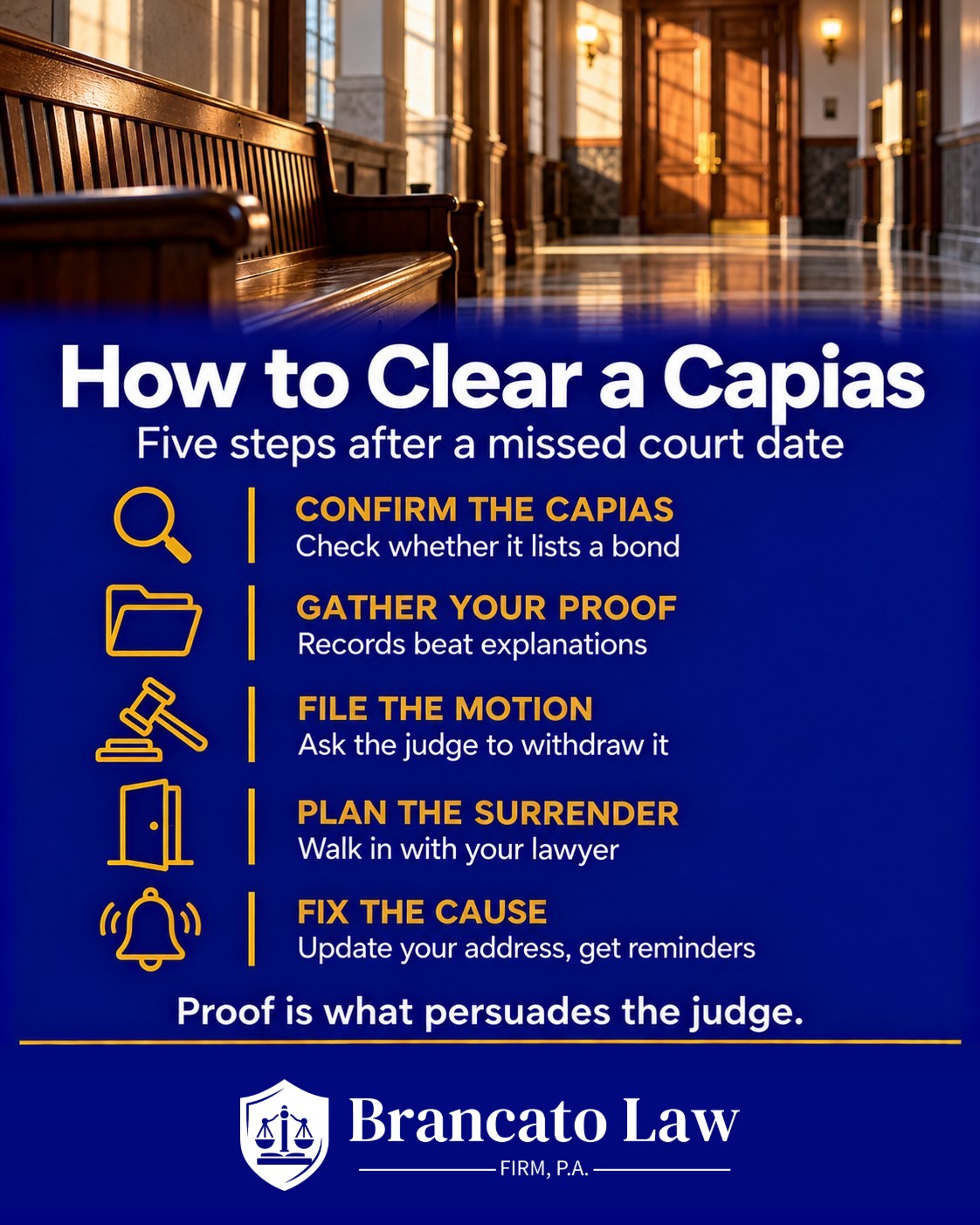
You get a capias withdrawn by having a defense attorney file a motion to withdraw the capias (also called a motion to quash or recall), set it for a hearing, and show the judge why you missed court and why you will appear from now on. The process usually runs in five steps.
- Confirm the capias and its bond. Your attorney checks the court file to confirm the capias exists and whether it lists a bond amount. That one detail decides whether a surrender can end with same-day release.
- Gather proof of why you missed. Hospital records, a notice mailed to an old address, a written waiver of appearance, or a time-stamped record of a same-day arrival carry far more weight than an explanation alone.
- File the motion and get a hearing. At the hearing, your attorney can proffer (tell the court the facts on your behalf), present documents, and call witnesses. In some cases our firm can ask the court to address the capias before you surrender.
- Plan the surrender if the judge says no. If the capias has a bond, a bond walkthrough at Orient Road, held weekdays from 9:00 a.m. to 3:00 p.m. (confirm current hours first), can let you post the bond and leave the same day. If it is a no-bond capias, a planned surrender with your attorney ready to request a prompt hearing beats waiting to be picked up.
- Fix the cause. Make sure the court has your current address, and sign up for free court date reminders so it does not happen again.
The order matters. Proof gathered in step 2 is what persuades the judge in step 3, and a judge who sees a documented, non-willful absence has room to withdraw the capias outright instead of sending you to jail to wait.
Does the reason you missed court matter?
Yes. The reason you missed court is the core of any motion to withdraw a capias, because both the crime of failure to appear and most no-bond decisions turn on whether the absence was willful. Section 843.15 applies only to a person who “willfully fails to appear.”
The Florida Supreme Court made this point in State v. Blair, 39 So. 3d 1190 (Fla. 2010). Arthur Blair went to court for a misdemeanor DUI and was told the case had been nolle prossed (dropped by the State). The State refiled it as a felony, and he never received notice of the new court date. The trial court ordered him held without bond because the notices had gone to his address on file. The Supreme Court held that a finding of willful failure to appear, standing alone, does not justify pretrial detention; the judge must also decide whether reasonable release conditions exist under Fla. Stat. § 907.041.
Prosecutors have a separate tool. Under Fla. Stat. § 903.0471, a judge may revoke pretrial release after finding probable cause that the defendant violated a release condition in a material respect. Documented facts showing the absence was a mistake are the answer to both arguments.
| Reason you missed court | Proof to bring | Why it helps |
|---|---|---|
| Medical emergency or hospital stay | Discharge papers, ER records | Shows the absence was not willful |
| Never received notice, or the date or time changed | The notice in the court file, proof of your address, the corrected order | Notice problems were central in Blair and Key |
| Your lawyer waived your appearance | The written waiver filed in the case | Rule 3.180(a)(3) allows waiver at pretrial conferences |
| You arrived late the same day | Time-stamped receipts, bus or rideshare records | Section 903.26(2)(b) gives the judge same-day discretion |
| You were in jail or a hospital elsewhere | Booking or admission records | Section 903.26(5)(b) requires discharge of the bond forfeiture |
| Car trouble or a transportation failure | Tow, repair, or rideshare records | Supports a non-willful absence |
Can your lawyer waive your appearance at a pretrial conference?
Yes, for pretrial conferences. Florida Rule of Criminal Procedure 3.180(a)(3) requires a defendant to be present at a pretrial conference “unless the defendant’s presence is waived in writing or on the record by the defendant or by the defendant’s counsel with the defendant’s consent.” Two appellate decisions on this rule came out of Hillsborough County courtrooms.
In Jimenez v. State, 201 So. 3d 214 (Fla. 2d DCA 2016), a Hillsborough defendant filed a written waiver of appearance before arraignment and did not attend a disposition hearing. The judge issued a capias under a policy posted outside the courtroom that required every defendant to attend. The Second District Court of Appeal held that the blanket policy conflicted with the rules allowing written waivers and quashed the capias. The court added that a judge can require a defendant to attend for good cause, but “defense counsel and the defendant must be clearly advised” that personal presence is required despite the waiver.
In Cannon v. State, 253 So. 3d 1200 (Fla. 2d DCA 2018), also from Hillsborough, Troy Cannon had filed a waiver of appearance and was living in Kentucky when the judge told his lawyer to notify him to appear on a set date. Because of confusion over his address and doubt about whether he was told his waiver would not be accepted, the Second District held that adequate notice was lacking and quashed the capias.
The practical lesson: a waiver protects you only for the hearings it covers, and only until the judge clearly orders you to appear in person. Ask your lawyer, in writing, whether you must attend each date on your calendar.
What does the 2026 Key v. State decision mean for a missed court date?
Key v. State, No. 6D2026-1546 (Fla. 6th DCA July 28, 2026) shows that a capias can issue even when the defendant did exactly what his lawyer told him, and that, at least in the Sixth District, a habeas petition filed while you are still free will not undo it.
Nicolas Key faced felony charges of aggravated assault with a deadly weapon and domestic violence battery in Orange County. At his January 22, 2026 arraignment, the court set a pretrial conference for March 3, 2026 at 1:30 p.m., and the scheduling order said his presence could be waived. His lawyer told him the lawyer would orally waive his appearance, so Key did not need to come. On Friday, February 27, the court issued a corrected order moving the conference to 9:00 a.m. According to Key’s petition, his lawyer found the corrected order “virtually identical” to the first one and missed the time change. Nobody appeared at 9:00 a.m., and the court issued a no-bond capias. The clerk then notified the surety that the bond would be forfeited.
Defense counsel filed a motion to withdraw the capias, an amended motion to quash it, and a motion for reconsideration or clarification. The trial court denied all three. Key, still free, petitioned the Sixth District Court of Appeal for a writ of habeas corpus. The court denied the petition because Fla. Stat. § 79.01 grants habeas to a person “detained in custody,” and an unexecuted capias is only an order to restrain him in the future. As the court put it, “we cannot agree that Petitioner can obtain a writ of habeas corpus when he is not in the present custody of a government authority.” The denial was without prejudice to Key seeking relief in the trial court or the Sixth District once he is actually detained. The court did not decide whether the capias was proper.
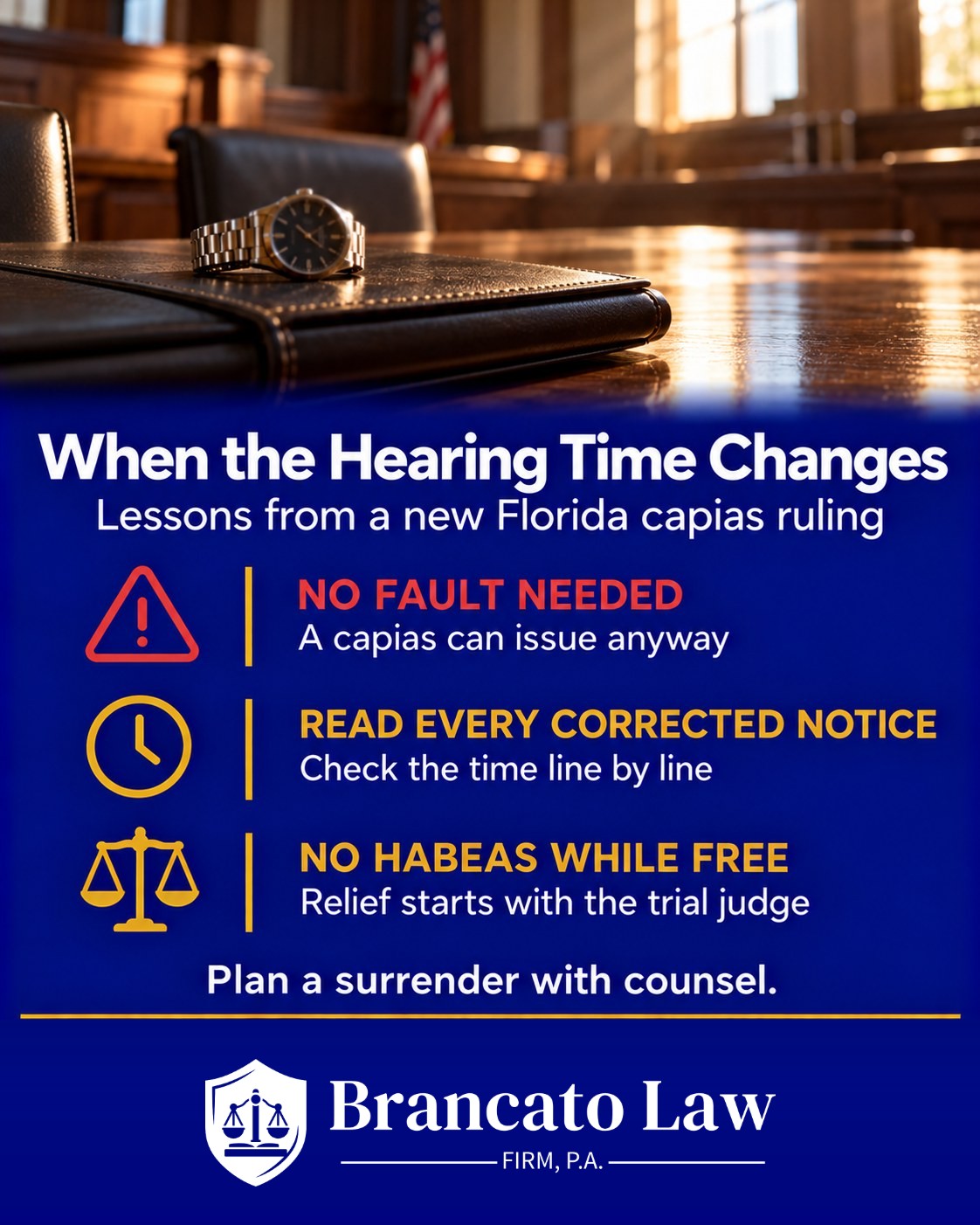
Three lessons carry over to anyone with a missed court date:
- A capias can issue even when you did nothing wrong. Key followed his lawyer’s advice and still ended up with a no-bond warrant.
- Read every corrected or amended notice line by line. Key’s petition said the corrected order came out late on a Friday for a Tuesday morning hearing.
- Once a no-bond capias issues, the realistic path runs through the trial judge and a planned surrender with counsel. Under Key, habeas becomes available after you are in custody, not before.
Hillsborough County appeals go to the Second District Court of Appeal, so Key is persuasive in Tampa but not binding. We found no Second District opinion deciding whether a person who has not been arrested can use habeas to challenge a capias. The Second District did quash Hillsborough capiases in Jimenez (by mandamus) and Cannon (a mandamus petition treated as habeas), but neither opinion says whether the defendant was in custody, and Key listed Cannon among the cases that did not settle the custody question.
Can you get out of jail quickly after an arrest on a capias?
It depends on what the capias says about bond. Under the 13th Circuit’s 2026 bond schedule, Administrative Order S-2025-063, bail for a person arrested on a failure-to-appear warrant is the amount written in the warrant; if the warrant is silent, there is no bond until the person’s next appearance before the judge assigned to the case. The same order bars release before first appearance for a person whose current arrest is for failure to appear at required court proceedings while on bail.
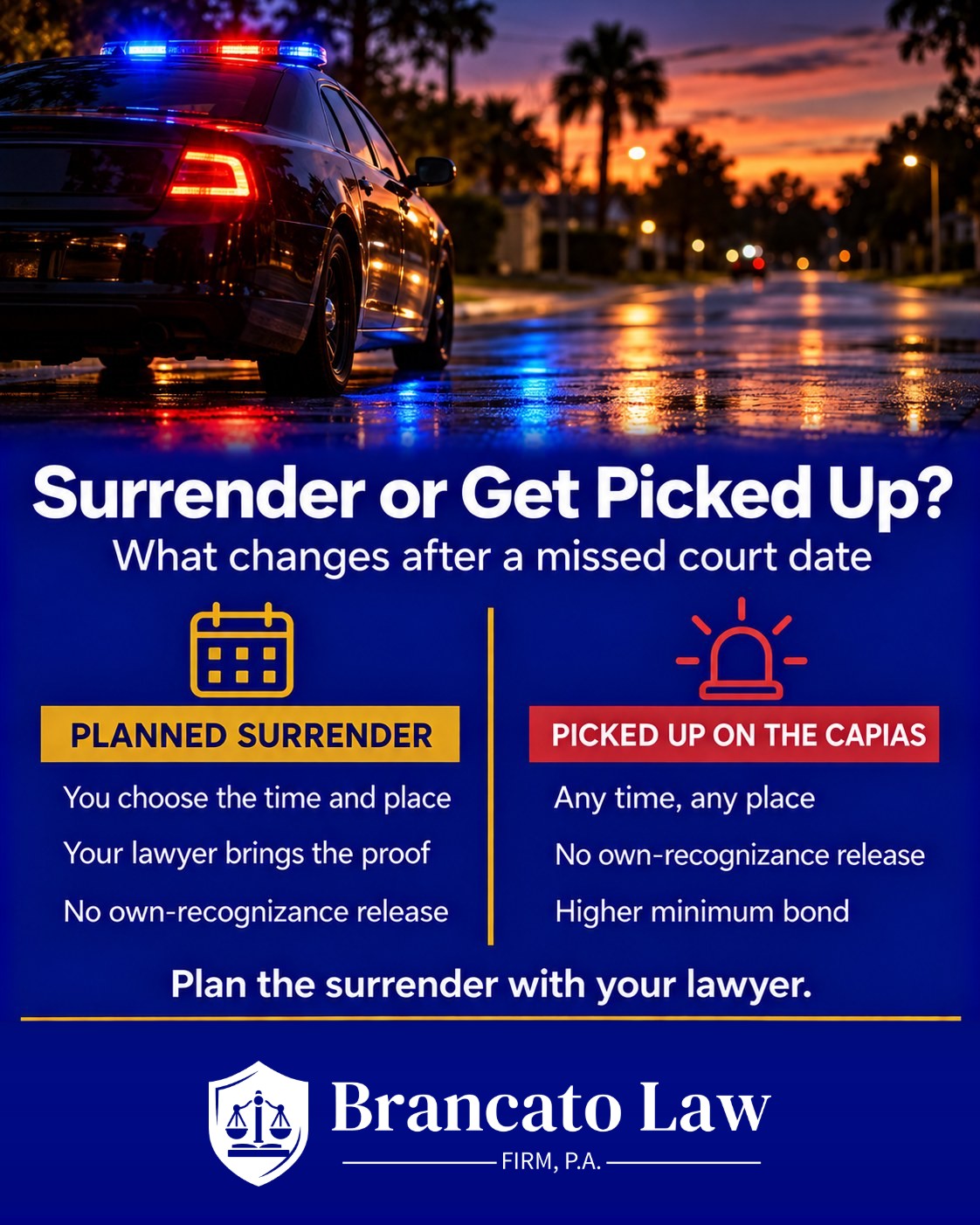
Florida law also changes your bond options once you miss court. Section 903.046(2)(d) treats a voluntary surrender better than an arrest:
| You surrender voluntarily | You are arrested on the capias | |
|---|---|---|
| Release on your own recognizance | Not available in that case | Not available in that case |
| Minimum monetary bond | No statutory minimum; the judge sets the amount | At least $2,000 or twice the original bond, whichever is greater |
| Exception | Judge has discretion if you prove circumstances beyond your control | Same exception applies |
| Timing | Planned with your attorney, on a weekday walkthrough if a bond is set | Whenever and wherever an officer finds you |
A planned surrender also lets your attorney stand next to you with the proof already in hand. That is the difference between asking the judge for release with documents in hand and asking later from inside the jail.
If you are held, habeas corpus becomes available. In Espinal v. Ryan, 31 So. 3d 818 (Fla. 3d DCA 2010), Marcos Espinal arrived fifteen minutes late after traveling from a new overnight job, and the judge issued an alias capias and estreated (forfeited) his bond. The Third District granted habeas, found the delay unintentional and minimal, ordered his immediate release, and reinstated his original bond. Our post on how a bond hearing works in Tampa covers what happens at the hearing itself.
What happens to the bond money after a missed court date?
Florida law requires the judge to declare the bond forfeited when a defendant fails to appear, which is why the bondsman or family member who posted it hears about the missed date almost immediately. Under section 903.26(2)(a), the clerk must notify the surety agent and surety company within 5 days, and the forfeiture must be paid within 60 days after that notice.
Two parts of the statute help defendants. Section 903.26(2)(b) lets the judge decide, in the interest of justice, that a same-day appearance does not warrant forfeiture and set aside a forfeiture already entered; an appearance on a later day is a forfeiture. Section 903.26(8) requires the clerk to discharge the forfeiture if the defendant is arrested and returned to the county or posts a new bond before judgment, unless the surety agent fails to pay the costs of returning the defendant.
A 2025 Pinellas County case shows the same-day rule in action. In Henderson v. Gualtieri, No. 2D2024-1286 (Fla. 2d DCA Jan. 17, 2025), according to a concurring opinion, Jerome Henderson arrived 20 minutes late to his misdemeanor trial on a public bus; the court estreated his bonds, issued a capias, doubled the bond amounts, and took him into custody when he walked in. The Second District dismissed his habeas petition as moot because his cases had been resolved, but Judge Sleet’s concurring opinion explained that the trial court had discretion under section 903.26(2)(b) to set aside the forfeiture and proceed. If you are running late, call your lawyer and keep going to the courtroom.
Can missing court become a new criminal charge?
Yes. Under section 843.15, a person released under Florida’s bail statutes (chapter 903) who willfully fails to appear commits a separate crime. If the original case is a felony, the failure to appear is a third-degree felony punishable by up to 5 years in prison under Fla. Stat. § 775.082 and a fine of up to $5,000 under Fla. Stat. § 775.083. If the original case is a misdemeanor, it is a first-degree misdemeanor punishable by up to 1 year in jail and a $1,000 fine. The statute also preserves the court’s power to punish the absence as contempt.
That means a failure-to-appear charge can carry more jail exposure than the second-degree misdemeanor it grew out of. The State still has to prove the absence was willful, which is why the proof described above matters twice: once to withdraw the capias, and again to defend against any new charge.
Are most missed court dates intentional?
Research says most are not. A 2020 study published in Science by Alissa Fishbane, Aurelie Ouss, and Anuj Shah, “Behavioral nudges reduce failure to appear for court”, tested a redesigned summons form and text message reminders in New York City. The interventions reduced failures to appear by 13 to 21 percent and led to 30,000 fewer arrest warrants over three years. The same study found that criminal justice professionals see failures to appear as relatively unintentional, while laypeople believe they are more intentional.
Florida data points the same way. In 2024, 32 county pretrial release programs serving 66,966 defendants reported that courts revoked release for 1,907 participants, or 3 percent, for failing to appear, according to the Office of Program Policy Analysis and Government Accountability’s County Pretrial Release Programs: Calendar Year 2024 (Report 25-10, December 2025). When our attorneys at The Brancato Law Firm argue that a client’s absence was a mistake, we back it with records, because that is what judges weigh.
How fast do you need to act after missing court?
Act the same day if you can. Florida law gives judges extra flexibility only for a same-day appearance, and every day the capias stays active is another day it can be served during a routine traffic stop.
| When | What happens | What to do |
|---|---|---|
| Same day | The capias may issue and the bond forfeiture is entered, but the judge can set aside the forfeiture for a same-day appearance | Call your attorney and get to the courtroom |
| Within 5 days | The clerk sends the forfeiture notice to the surety | Tell your bondsman you are resolving it |
| Within 60 days of that notice | The forfeiture payment comes due | Resolve the capias so the forfeiture can be discharged |
| Until served or withdrawn | The capias remains active | Plan a surrender with counsel instead of waiting to be picked up |
For more about our defense strategies, visit our Hillsborough County criminal defense page.
Frequently asked questions about capias warrants in Tampa
Will a capias for a missed court date go away on its own in Florida?
No. A capias stays active until it is served or a judge withdraws it, no matter how much time passes. The Brancato Law Firm confirms whether a capias is active in your case and asks the judge to withdraw it before an officer finds you. Our guide to checking for an outstanding warrant in Tampa explains the other warrant types.
Can a capias be lifted without going to jail in Hillsborough County?
Often, yes, if the judge grants a motion to withdraw the capias before it is served. Our attorneys at The Brancato Law Firm file that motion with proof of why you missed and, in some cases, ask the court to address the capias before any surrender. Learn more on our Hillsborough County defense lawyer page.
Can my lawyer go to court for me so I don’t have to appear?
For pretrial conferences, often yes: Rule 3.180(a)(3) allows your presence to be waived in writing or on the record by you or by your lawyer with your consent. Our attorneys at The Brancato Law Firm file written waivers where the rule allows them and confirm in writing which dates still require you in person, since a judge can require attendance for good cause after clear notice, as Jimenez explains.
What if I missed court because I was in jail somewhere else?
Being confined elsewhere is a recognized reason: section 903.26(5)(b) requires the court to discharge a bond forfeiture if the defendant was confined in a jail, institution, or hospital at the time of the required appearance or within 60 days after it. The Brancato Law Firm gathers the booking or hospital records and puts them before the judge to support both the forfeiture discharge and the motion to withdraw the capias.
Can a failure to appear charge be dropped in Florida?
Yes, it can be dropped or defeated when the State cannot prove the absence was willful, which section 843.15 requires. Our attorneys at The Brancato Law Firm present the medical, notice, and transportation records that show a mistake, and ask the prosecutor to drop the charge before it reaches a jury.
Does a missed court date hurt my chances of a lower bond later?
Yes. Section 903.046(2)(d) requires judges to consider any past failure to appear when setting bail or release conditions, and it bars release on recognizance in the case where you missed court. When The Brancato Law Firm asks for a bond reduction at a Tampa bond hearing, we address the missed date head-on with proof of why it happened and what has changed.
Call (813) 727-7159 before the capias finds you at a traffic stop or at work. The Brancato Law Firm, P.A., founded by Tampa Criminal Defense Attorney Rocky Brancato, will confirm whether the capias carries a bond, file the motion to withdraw it, and plan any surrender so you walk in with a lawyer and your proof. If you can still reach the courtroom today, call now, because Florida law treats a same-day appearance differently from one a day later.
The Brancato Law Firm, P.A.
620 E. Twiggs Street, Suite 205, Tampa, FL 33602
(813) 727-7159
Serving Hillsborough, Pinellas, and Pasco Counties
The Brancato Law Firm, P.A. is a Tampa-based criminal defense practice. We are not affiliated with any other Brancato-named law firms.
Visit Us

Tampa, FL 33602

Contact Us Now
Free Legal Consultation (813) 727-7159
