

From First DUI to Death Penalty



What Are Lesser Included Offenses in Florida? (2026)



A lesser included offense is a less serious crime whose elements are contained within the crime charged, so a Florida jury can find the defendant guilty of it instead of the charge. Florida divides lesser included offenses into two categories. Category 1 offenses are necessarily included in every version of the charge, and the judge must instruct the jury on them when the defense asks. Category 2 offenses are permissive: the jury hears them only when the trial evidence supports them. Deciding which lessers to request, or whether to request any, is one of the most important strategy calls in a criminal trial.
The verdict form a Florida jury takes into the deliberation room often lists more than one crime. Under the charge, it may list three or four lesser offenses, and the jury may check any one of them. I am Rocky Brancato, founder of The Brancato Law Firm, P.A., a Tampa criminal defense firm, and I have tried more than 150 jury trials to verdict over more than 25 years in Hillsborough County courtrooms. As a former Chief Operations Officer of the Hillsborough County Public Defender’s Office, where I oversaw a staff of over 100 attorneys, I watched lesser included offense decisions change outcomes in case after case. Our attorneys plan for the verdict form from the first day of a case, because the lessers the jury hears depend on how the case was charged, what evidence comes in, and what the defense asks for at the charge conference.
What is a lesser included offense in Florida?
A lesser included offense is a crime that is made up of some, but not all, of the elements of a more serious charged crime. If the State proves every element of the lesser crime but fails to prove an extra element of the charge, the jury can convict of the lesser crime. Simple robbery, for example, is a lesser included offense of robbery with a firearm: the jury can find the taking by force proved but reject the firearm.
Florida law also uses the concept at sentencing. Under section 775.021, Florida Statutes, a person may not be separately convicted and sentenced for “lesser offenses the statutory elements of which are subsumed by the greater offense.” So when a jury convicts of the charge, it does not also convict of the lessers listed beneath it on the verdict form.
What is the difference between Category 1 and Category 2 lesser offenses?
Category 1 lesser offenses are necessarily included in the charged crime, so proving the charge always proves them. Category 2 lesser offenses are permissive: they may or may not be included, depending on the facts of the case. Under Florida Rule of Criminal Procedure 3.510, the judge may not instruct on any lesser offense that the evidence does not support. The Florida Standard Jury Instructions list both categories for most crimes in a schedule of lesser included offenses.
| Category 1 (necessarily included) | Category 2 (permissive) | |
|---|---|---|
| Relationship to the charge | Every element is part of the charged crime | Elements may overlap with the charge, depending on the allegations and facts |
| Must the judge instruct? | Yes, on request. The judge “has no discretion” (Wimberly) | Only if the evidence supports it |
| Robbery with a firearm example | Robbery with a weapon, robbery, second-degree petit theft | Attempt, grand and petit theft, battery, aggravated battery, assault, aggravated assault, display of a firearm, resisting a merchant |
| If wrongly refused | One step removed: reversible under Abreau; further down: harmless-error review | Reviewed for harmless error |
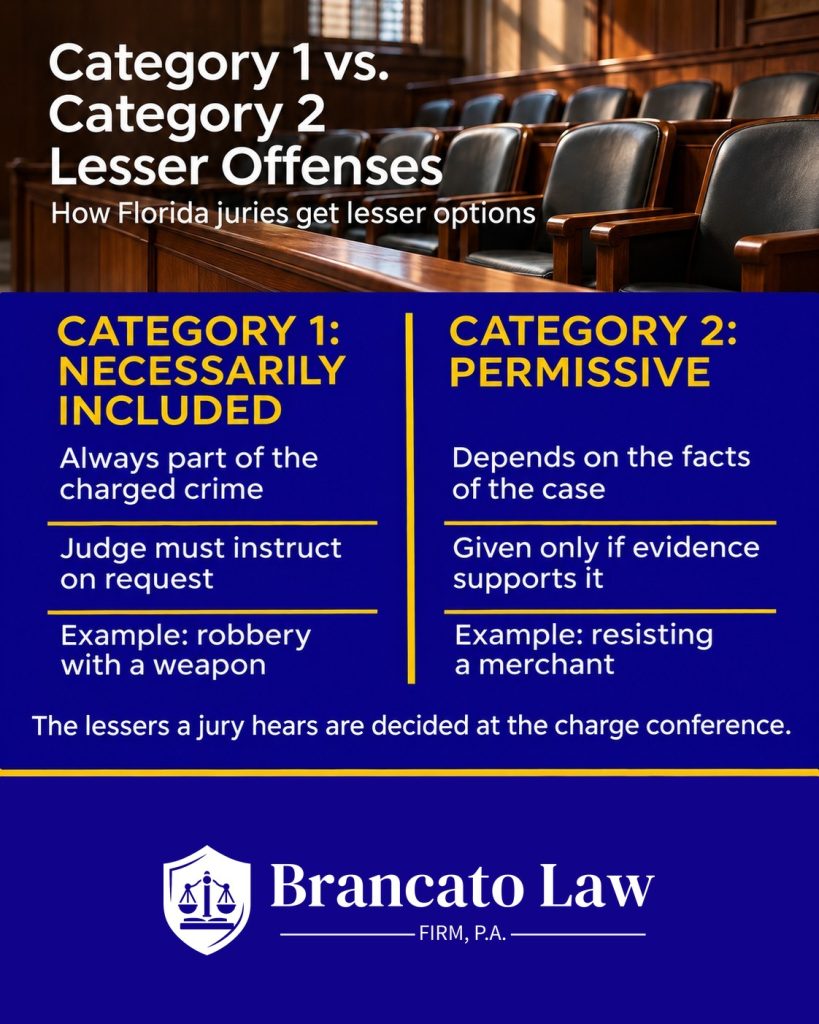
The robbery lists in that table come from Sanders v. State, 946 So. 2d 953 (Fla. 2006), where the Florida Supreme Court described the Category 1 and Category 2 lessers for robbery with a firearm under the standard jury instructions in effect at the time. The schedule is revised from time to time, so our attorneys check the current version for every charge before trial.
Does the judge have to instruct the jury on lesser included offenses?
Yes, for Category 1 offenses that the defense requests. In State v. Wimberly, 498 So. 2d 929 (Fla. 1986), a man charged with battery on a law enforcement officer asked for an instruction on a necessarily lesser included offense. The instruction was refused on the theory that the evidence showed the lesser crime could not have happened without the greater one. The Florida Supreme Court held that “the trial judge has no discretion in whether to instruct the jury on a necessarily lesser included offense,” because the requirement rests on “the jury’s right to exercise its ‘pardon power.'” It approved the reversal of the conviction and a new trial.
For Category 2 offenses, the question is whether the evidence supports the instruction. The Second District answered that question in Atmore v. State, No. 2D2024-0584 (Fla. 2d DCA Aug. 13, 2025), a Hillsborough County case. A woman charged with robbery with a weapon after taking sunglasses from a store and displaying what looked like a stun gun asked for an instruction on resisting a merchant. The trial judge refused because no employee tried to detain her. The Second District held the refusal was error, because a manager’s command to “stop doing that” could be a merchant’s reasonable effort to recover property, and physical detention is not an element.
Is it reversible error if the judge refuses a lesser offense instruction?
It depends on how far below the charge the omitted offense sits. In State v. Abreau, 363 So. 2d 1063 (Fla. 1978), the Florida Supreme Court held that “only the failure to instruct on the next immediate lesser-included offense (one step removed) constitutes error that is per se reversible.” When the omitted offense is two or more steps removed, an appellate court can find the error harmless, reasoning that a jury that passed over the next lower offense would not have chosen an even lower one.
That is what happened in Atmore. The jury had been instructed on simple robbery, theft, and assault, and still convicted of robbery with a weapon. The majority held that leaving out resisting a merchant, an offense further down the list, was harmless and affirmed. One judge dissented, reasoning that the jury’s robbery verdict did not reject theft and that a properly instructed jury could have found resisting a merchant. The split shows how much rides on getting the lesser instructions right at trial rather than relying on an appeal.
What is a jury pardon in Florida?
A jury pardon is a verdict for a lesser offense even though the evidence proved the greater charge. Florida courts have long recognized that juries can do this; Wimberly called it the jury’s “pardon power.” But the Florida Supreme Court has refused to treat a lost chance at a jury pardon as a basis for relief after trial.
In Sanders v. State, 946 So. 2d 953 (Fla. 2006), two men convicted of robbery with a firearm argued that their lawyers were ineffective for not requesting robbery with a weapon. The court held that “the possibility of a jury pardon cannot form the basis for a finding of prejudice,” so those claims can be summarily denied. In Knight v. State, 286 So. 3d 147 (Fla. 2019), an Okaloosa County case, the court went further and receded from its own precedents that had found fundamental error based on the jury pardon doctrine, while stating that it was not receding from Wimberly. The practical lesson is that lesser offense issues must be raised and argued at trial; our post on why your lawyer must object at trial explains why preserved objections matter so much on appeal.
The main Florida decisions on lesser included offenses line up as follows.
| Case | Court and year | Rule |
|---|---|---|
| State v. Abreau | Fla. 1978 | Refusing the next immediate (one step removed) lesser is per se reversible; lessers two or more steps removed get harmless-error review |
| State v. Wimberly | Fla. 1986 | The judge has no discretion to refuse a requested instruction on a necessarily lesser included offense |
| Sanders v. State | Fla. 2006 | The possibility of a jury pardon cannot show prejudice for an ineffective assistance claim |
| Knight v. State | Fla. 2019 | A lost chance at a jury pardon is not fundamental error; Wimberly still stands |
| Atmore v. State | Fla. 2d DCA 2025 (Hillsborough) | Refusing a supported permissive lesser is error, but harmless when the jury rejected the intermediate lessers |
Why do Hillsborough County cases carry so many charges?
Felony cases in the 13th Judicial Circuit carry more charges per defendant than the state as a whole. According to the Florida Office of Economic and Demographic Research 2025 criminal justice profile for the 13th Judicial Circuit, 12,317 felony defendants were filed on in fiscal year 2024-25, with 33,308 total charges. That is 2.7 charges per defendant, compared with 2.2 across Florida.
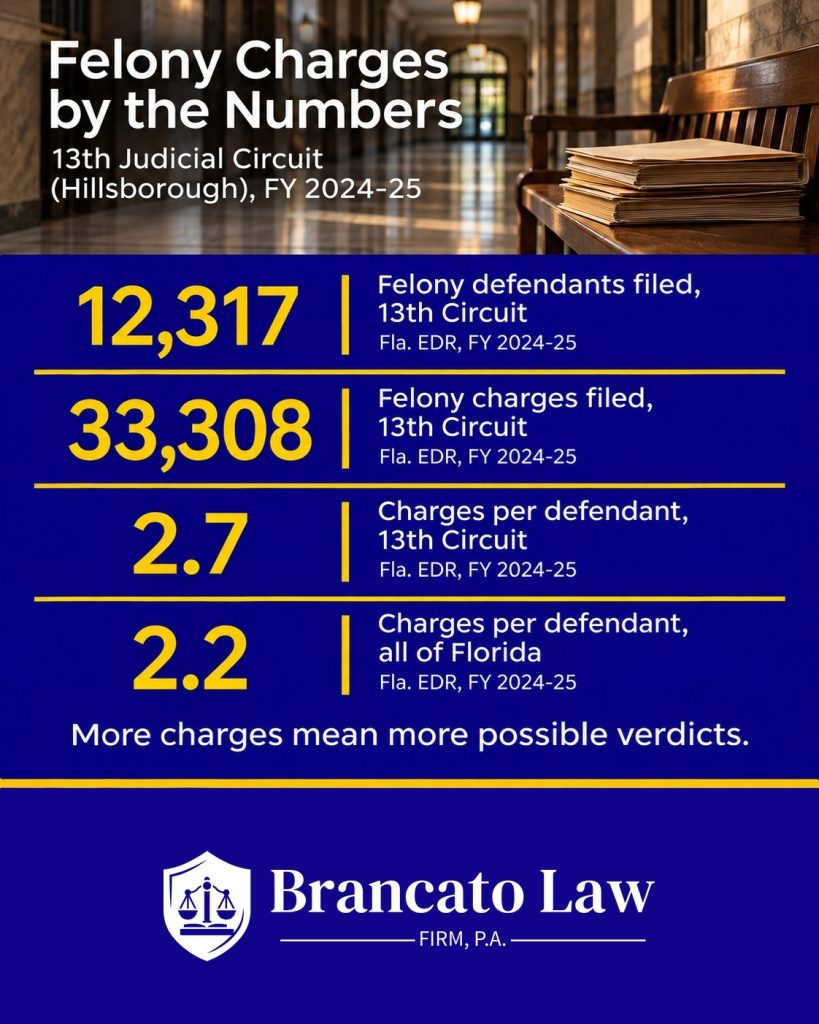
Every count on an information carries its own possible lessers, so a three-count case can put a dozen possible verdicts in front of a jury. Our attorneys map each count and its lessers early, because that map shapes plea negotiations, motions to dismiss, and the decision whether to try the case. For more about how cases move through Hillsborough courts, see our Hillsborough County criminal defense attorney page.
Should the defense ask for lesser included offense instructions?
Not always. Requesting lessers gives the jury a middle option, which can protect a client from a conviction on the most serious charge. It can also give a jury that has doubts about the charge an easy compromise when the defense would otherwise have a real chance at a full acquittal. Our attorneys weigh four questions with the client before the charge conference:
- How strong is the State’s proof of the element that separates the charge from the lesser? A weapon, a dollar amount, a victim’s age, or an injury often decides it.
- What is the sentencing gap? A lesser that drops a first-degree felony to a misdemeanor changes the stakes far more than one that drops a single degree.
- Is the defense all or nothing? A misidentification or alibi defense says the client did nothing at all, and lessers can undercut it.
- Which lessers does the evidence actually support? Category 2 instructions depend on the trial record, so the defense builds that record through cross-examination with the instructions in mind.
The decision is made at the charge conference near the end of trial, one of the stages of a Florida criminal case that most clients never hear about. Our posts on jury selection and how many jurors sit on a Florida criminal trial cover the earlier steps.
Frequently asked questions
Can a Florida jury convict me of a crime I was not charged with?
Yes, if it is a lesser included offense of a charged crime and the jury is instructed on it. Our attorneys at The Brancato Law Firm review the verdict form line by line at the charge conference so that no offense goes to the jury without a legal basis.
Can my lawyer refuse lesser included offense instructions?
Yes, the defense can choose not to request them, and sometimes an all-or-nothing verdict is the better strategy. The Brancato Law Firm makes that decision with the client after weighing the evidence on the key element and the sentencing gap, as discussed in our guide to the Florida criminal case process.
Can I be convicted of both the charge and a lesser included offense?
No. Section 775.021(4)(b) bars separate convictions for “lesser offenses the statutory elements of which are subsumed by the greater offense.” Our attorneys at The Brancato Law Firm check every judgment for dual convictions that violate double jeopardy, which an appellate court can correct.
Can I plead guilty to a lesser included offense in Florida?
Yes, if the State agrees, and pleas to a lesser offense resolve many Florida cases. The Brancato Law Firm uses the strength of the defense on the element that separates the charge from the lesser to negotiate, as our plea bargain guide explains.
Is an attempt a lesser included offense in Florida?
Often, yes. The robbery schedule described in Sanders lists attempt as a Category 2 lesser of robbery with a firearm, so a jury can hear it when the evidence supports it. Our attorneys at The Brancato Law Firm check the current schedule for every count; for how the lesser offenses work in homicide cases, see our post on second-degree murder vs. manslaughter in Florida.
What happens if the judge refuses to instruct the jury on a lesser offense?
If the refused offense is a requested Category 1 lesser one step below the charge, the conviction is usually reversed on appeal under State v. Abreau, 363 So. 2d 1063 (Fla. 1978); otherwise the appellate court reviews for harmless error. The Brancato Law Firm makes the request and the objection on the record so the issue is preserved.
For more about how a case moves from arrest to verdict, visit our Florida Criminal Case Process page.
The lesser offenses a jury will hear are shaped long before trial, by how the State words the information and by the evidence the defense develops. If your case is set for trial, or you are weighing a plea offer to a lesser charge, call The Brancato Law Firm, P.A., founded by Tampa Criminal Defense Attorney Rocky Brancato, at (813) 727-7159. Our attorneys will review each count, its lessers, and the evidence on the element that separates them. You can call us at any hour, and our office is two blocks from the courthouse. Our firm has Spanish-speaking staff, and attorney Jean-Luc Adrien speaks Spanish, Haitian Creole, and French.
The Brancato Law Firm, P.A.
620 E. Twiggs Street, Suite 205, Tampa, FL 33602
(813) 727-7159
Serving Hillsborough, Pinellas, and Pasco Counties
The Brancato Law Firm, P.A. is a Tampa-based criminal defense practice. We are not affiliated with any other Brancato-named law firms.
Visit Us

Tampa, FL 33602

Contact Us Now
Free Legal Consultation (813) 727-7159
