

From First DUI to Death Penalty



How to Fight a Felony Murder Charge in Florida? (2026)


To fight a felony murder charge in Florida, the defense attacks the link between the death and the felony: whether the State can prove the underlying felony, whether the killing happened during that felony rather than after a break in events, whether the accused was a principal in it, and whether a co-felon’s act was an independent act outside the plan. Under section 782.04, a killing during one of the listed felonies, such as robbery, burglary, or drug trafficking, is first-degree murder even with no intent to kill, punishable by death or life without parole. If someone other than a participant does the killing, it is second-degree murder punishable by up to life, and a killing during a felony that is not on the list is third-degree murder, a second-degree felony.
If your son, brother, or friend was arrested for murder even though everyone agrees he never fired a shot, the charge is almost certainly felony murder, and it can carry the same life sentence as a planned killing. I’m Rocky Brancato, founder of The Brancato Law Firm, P.A., a Tampa criminal defense firm. I meet the Florida Rule of Criminal Procedure 3.112 qualifications to try capital cases, I have tried more than 150 jury trials to verdict, and I handled homicide cases as a member of a Major Crimes Unit during more than 25 years in Hillsborough County courtrooms. Our attorneys defend felony murder cases by taking apart each link the State needs between the felony, the death, and the client.
What is felony murder in Florida?
Felony murder in Florida is an unlawful killing that happens while a person is committing or attempting certain felonies, and it does not require any intent to kill. Florida’s murder statute, section 782.04, creates three versions, depending on which felony was involved and who did the killing. The intent to commit the felony stands in for the intent to kill.
The felonies listed in section 782.04(1)(a)2. include drug trafficking under section 893.135(1), arson, sexual battery, robbery, burglary, kidnapping, escape, aggravated child abuse, aggravated abuse of an elderly person or disabled adult, aircraft piracy, a destructive device or bomb, carjacking, home-invasion robbery, aggravated stalking, murder of another person, resisting an officer with violence, aggravated fleeing or eluding with serious bodily injury or death, terrorism, and human trafficking. A death during any other felony, such as a drug deal that is not trafficking, falls under third-degree murder.
| Degree | When it applies | Classification | Maximum sentence |
|---|---|---|---|
| First-degree felony murder, s. 782.04(1)(a)2. | A participant in a listed felony, such as robbery or burglary, kills someone during the felony or the attempt | Capital felony | Death or life without parole |
| Second-degree felony murder, s. 782.04(3) | Someone who is not a participant, such as a victim or a police officer, kills a person during a listed felony | First-degree felony | Life in prison |
| Third-degree murder, s. 782.04(4) | A killing without any design to effect death during a felony that is not on the list | Second-degree felony | 15 years in prison |
Because a felony murder charge is a homicide charge, it is defended through our Tampa homicide attorney practice. For how felony murder fits beside premeditated murder, see our post on how to fight a first-degree murder charge in Florida.
What is the penalty for felony murder in Florida?
First-degree felony murder in Florida is a capital felony punished by death or by life in prison without parole under section 775.082(1)(a). Second-degree felony murder is a first-degree felony punishable by up to life, and third-degree murder is a second-degree felony punishable by up to 15 years. Whether the State can seek death depends on what the accused personally did and intended, and a death sentence requires a separate penalty phase under section 921.141.
The leading limit on the death penalty for felony murder came from a Florida case. In Enmund v. Florida, 458 U.S. 782 (1982), an elderly couple was robbed and shot at their central Florida farmhouse by two other people, and the evidence suggested Earl Enmund was waiting in a car nearby to help them escape. Florida sentenced him to death as a felony murderer. The U.S. Supreme Court reversed, holding that the Eighth Amendment does not allow a death sentence for a person who aids a felony in which others commit murder but who does not himself kill, attempt to kill, or intend that a killing take place or that lethal force be used. Five years later, in Tison v. Arizona, 481 U.S. 137 (1987), the Court allowed a death sentence for a non-shooter whose major participation in the felony was combined with reckless indifference to human life, so the client’s role is examined closely from the first day.
Juveniles are treated differently. Under section 775.082(1)(b)2., a person under 18 at the time of the offense who did not actually kill, intend to kill, or attempt to kill may receive life only if the judge finds life appropriate after a separate sentencing hearing, and a sentence of more than 15 years carries the right to a later sentence review.
Can you be charged with felony murder if you did not kill anyone?
Yes, a person can be charged with felony murder in Florida without killing anyone, as long as the State can prove the person was a principal in the underlying felony. Florida’s principal statute, section 777.011, treats anyone who aids, abets, counsels, or procures a crime the same as the person who commits it. That is how a lookout, a driver, or the person who set up a meeting can face the same murder charge as the shooter.
Florida also charges felony murder when the person killed is one of the participants. Under section 782.04(3), when a police officer or victim kills someone during a listed felony, the surviving participants can be charged with second-degree murder. The defense to that charge often turns on what the dead co-felon was doing at the moment he died, which is what happened in the Wagner case discussed below.
When does a killing count as “during” the felony in Florida?
A killing counts as during the felony in Florida when it happens in an unbroken chain of events that begins with the felony, including the escape. The felony is treated as continuing until the participants reach a place of temporary safety, so a fatal crash during a getaway can be charged as felony murder. The State has the burden to prove there was no break in that chain, and that burden is a real defense opportunity.
In Wagner v. State, 921 So. 2d 38 (Fla. 4th DCA 2006), two masked men robbed a consignment store, and a deputy chased them until he shot and killed one of the robbers. The surviving robber was convicted of second-degree murder for his partner’s death. The Fourth District Court of Appeal explained that absent “some definitive break in the chain of circumstances,” the felony continues to the time of the killing, and it held that the defense should have been allowed to present evidence that the dead robber had abandoned the escape and was deliberately provoking the deputy to shoot him. The court reversed the murder conviction and ordered a new trial. The lesson is that what a co-felon did, and why, can break the chain the State must prove.
What is the independent act defense to felony murder?
The independent act defense applies when a co-felon commits a crime that the accused did not intend, did not take part in, and could not reasonably foresee as part of the original plan. When the evidence supports it, the jury must be told that the accused is not responsible for that act. Florida Standard Jury Instruction 3.6(l) sets out those three requirements, and the defense is strongest when the plan was a lesser crime that went somewhere the client never agreed to go.
In Gary v. State, 330 So. 3d 118 (Fla. 2d DCA 2021), a Pinellas County man was charged with first-degree murder after he arranged a marijuana purchase and his companion shot and killed the seller. He testified that he did not know his companion had a gun or planned a robbery and that he ran when the gun came out. The jury convicted him of third-degree murder with a firearm, and the trial judge had refused to instruct the jury on the independent act defense. The Second District reversed for a new trial, holding that “[a] defendant is entitled to an instruction on his theory of defense however flimsy the evidence” that supports it, and that the jury, not the judge, decides how much weight that testimony deserves.
How do our attorneys fight a felony murder charge in Florida?
Our attorneys fight a felony murder charge by testing every link the State needs, because a broken link can drop the case from a capital felony to a lesser offense or to no homicide at all. These are the defenses we develop most often.
- Attack the underlying felony. If the State cannot prove the robbery, burglary, or trafficking, there is no felony murder. A drug sale that does not meet the trafficking weight under section 893.135(1), for example, cannot support first-degree felony murder.
- Challenge principal liability. Being present, being a friend of the shooter, or driving someone somewhere is not the same as aiding a felony. We examine texts, location data, and statements for proof of what the client actually knew and agreed to.
- Raise the independent act defense. When the plan was a lesser crime and a co-felon escalated it, we build the record for the independent act instruction recognized in Gary.
- Prove a break in the chain. When the death happened after the participants separated, reached safety, or abandoned the felony, we argue the killing was not “during” the felony under the rule applied in Wagner.
- Contest causation. Medical records, autopsy findings, and accident reconstruction can show that the death was caused by something other than the felony, and our network of independent forensic experts reviews the State’s conclusions.
- Suppress statements and searches. Many felony murder cases rest on a co-defendant’s accusation or the client’s own interview. We move to suppress statements taken in violation of Miranda and evidence from unlawful searches of phones and homes.
- Take death off the table. Under Enmund, a client who did not kill, attempt to kill, or intend a killing cannot be sentenced to death, and we press that point with the State Attorney’s Office before any death notice is filed.
How common are murder cases in Hillsborough County and Florida?
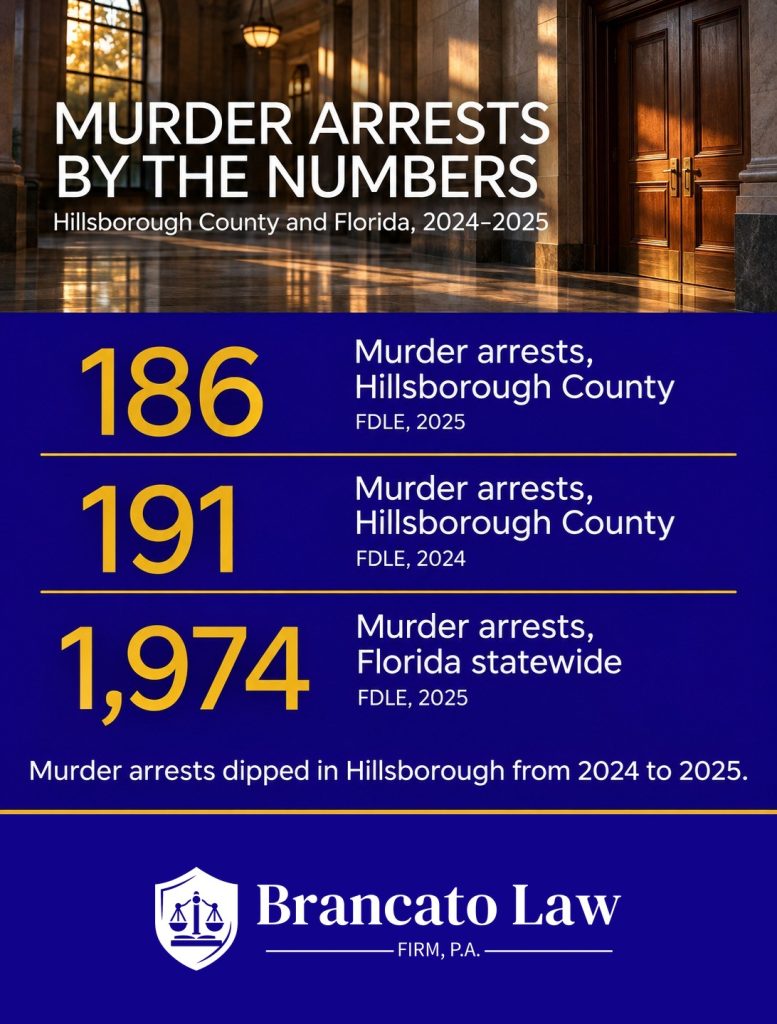
Murder arrests are less common in Hillsborough County than they were a few years ago. Florida Department of Law Enforcement (FDLE) arrest data published on the state’s FL Health CHARTS murder report show 186 murder arrests in Hillsborough County in 2025, compared with 191 in 2024 and 235 in 2023. Statewide, FDLE counted 1,974 murder arrests in 2025, down from 2,248 in 2024. The data count arrest events for all murder charges and do not separate felony murder from premeditated or second-degree murder.
Legal scholars have long questioned how far the felony murder rule should reach. In “The Origins of American Felony Murder Rules,” 57 Stanford Law Review 59 (2004), Professor Guyora Binder reviewed the historical statutes and case law and concluded that the harsh idea of strict liability for every death in every felony was never actually enacted into English law or received into American law. That history supports the narrow reading the defense asks for: the felony murder rule applies only to the felonies the Legislature listed, and only to deaths that truly happen during them.
How are felony murder cases handled in Hillsborough County?
In Hillsborough County, a felony murder arrest leads to first appearance at the Orient Road Jail within 24 hours, and a first-degree felony murder charge must go to a grand jury before the case can proceed as a capital case. The Florida Constitution requires a grand jury indictment for capital crimes, so the State Attorney’s Office for the 13th Judicial Circuit presents the case to a grand jury, sometimes weeks after the arrest. That gap is time our attorneys use to gather the evidence that can change the charge.
| Stage | What happens | What our attorneys do |
|---|---|---|
| Investigation | Detectives interview witnesses and suspects, often before anyone is charged | Keep the client from giving a statement and gather phone, video, and location records |
| Arrest and first appearance | A judge reviews probable cause at the Orient Road Jail within 24 hours | Argue for release conditions and request an Arthur hearing on bond |
| Grand jury | The State Attorney presents the case; a capital charge requires an indictment | Present evidence of the client’s limited role that can support a lesser charge |
| Death penalty decision | The State decides whether to seek death | Press the Enmund and Tison limits for a client who did not kill or intend a killing |
| Pretrial and trial | Depositions, motions to suppress, and jury instructions | Build the record for the independent act and break-in-the-chain defenses |
Bond is not automatic in a capital case. Under State v. Arthur, 390 So. 2d 717 (Fla. 1980), the Florida Supreme Court held that before a court can deny bail to a person charged with a capital offense, the State must show that “the proof of guilt is evident or the presumption is great,” and presenting the indictment alone is not enough. Even then, the judge keeps discretion to grant bail. Our attorneys request this hearing, often called an Arthur hearing, when the evidence of the client’s role is weak. You can see where these steps fall on our Florida criminal case process page, and our Hillsborough County criminal defense page covers the local courts.
Many felony murder investigations involve several suspects, and detectives often interview each one before anyone is charged. If you have been contacted about a death investigation, our representation before charges are filed can keep your words from becoming the State’s link to the felony.
Can felony murder charges be dropped or reduced in Florida?
Yes, felony murder charges can be dropped or reduced in Florida when the State cannot prove the underlying felony, the client’s role, or the connection between the felony and the death. A grand jury may return a lesser charge than first-degree murder, prosecutors may reduce the case to second-degree murder, manslaughter, or the underlying felony, and a jury may convict of a lesser offense, as the jury did in Gary. The Brancato Law Firm presents the defense evidence, including the client’s limited role and any independent act or break in the chain, to the State Attorney’s Office early, because the charging decision shapes the entire case.
Frequently asked questions about felony murder charges in Florida
Can a getaway driver be charged with felony murder in Florida?
Yes, a getaway driver can be charged with first-degree felony murder if a participant kills someone during a listed felony, because the driver is treated as a principal under section 777.011. The Brancato Law Firm challenges whether the driver knew a robbery or other felony was planned, and under Enmund a driver who did not kill or intend a killing cannot be sentenced to death. Our murder defense lawyers defend these cases in Hillsborough, Pinellas, and Pasco counties.
Can I be charged with murder if police kill my accomplice during a robbery?
Yes, section 782.04(3) allows a second-degree murder charge when someone other than a participant, such as a police officer, kills a person during a listed felony. Our attorneys at The Brancato Law Firm look at whether the felony had ended and what the accomplice was doing when he died, the issues that won a new trial in Wagner. That charge carries up to life in prison, so the details of the final moments matter.
Is a fatal overdose after a drug sale felony murder in Florida?
It can be, depending on the drug and the charge: Florida has separate first-degree murder provisions for distributing certain drugs that cause death, and a death during a drug trafficking offense is on the felony murder list. The Brancato Law Firm examines toxicology and causation closely in these cases, because the State must prove the drug it attributes to the client actually caused the death. Our post on overdose murder charges in Florida explains those rules.
Can a teenager get life in prison for felony murder in Florida?
A teenager who did not kill, intend to kill, or attempt to kill can receive life only if a judge finds it appropriate after a separate sentencing hearing under section 775.082(1)(b)2., and a sentence over 15 years carries a right to later review. Our team at The Brancato Law Firm builds the youth and mitigation record for that hearing from the start of the case. A juvenile charged with a murder punishable by life can be indicted and tried as an adult, so early representation matters.
Should I talk to detectives about a robbery where someone was killed?
No, you should not give a statement without a criminal defense attorney, because admitting you knew about the plan can supply the principal element the State needs. The Brancato Law Firm can speak with detectives for you through our pre-file advocacy and protect you from becoming a witness against yourself. Ask for a lawyer and stop talking; that request must be honored.
Is attempted felony murder a crime in Florida?
Yes, Florida treats attempted felony murder as a crime when a participant commits an act during a listed felony that could have caused death but did not. Our attorneys at The Brancato Law Firm explain the elements and defenses in our post on how to fight an attempted murder charge in Florida. Those cases often turn on the same independent act and chain-of-events questions as completed felony murder.
For more about our defense strategies, visit our Homicide page.
Our attorneys start a felony murder defense by locking down the timeline, the phone records, and the witness accounts before they disappear, often before a grand jury meets. Reach The Brancato Law Firm, P.A., founded by Tampa Criminal Defense Attorney Rocky Brancato, at (813) 727-7159; you can call us at any hour. Our firm has Spanish-speaking staff, and attorney Jean-Luc Adrien speaks Spanish, Haitian Creole, and French. Our office is two blocks from the courthouse, and we defend homicide charges in Hillsborough, Pinellas, and Pasco counties.
The Brancato Law Firm, P.A.
620 E. Twiggs Street, Suite 205, Tampa, FL 33602
(813) 727-7159
Serving Hillsborough, Pinellas, and Pasco Counties
The Brancato Law Firm, P.A. is a Tampa-based criminal defense practice. We are not affiliated with any other Brancato-named law firms.
Visit Us

Tampa, FL 33602

Contact Us Now
Free Legal Consultation (813) 727-7159
