

From First DUI to Death Penalty



How to Fight a Marijuana Grow House Charge in Florida? (2026)


Growing marijuana in Florida is a felony even with a medical marijuana card. A small personal grow is usually charged as manufacturing cannabis, a third-degree felony, while using a home or vehicle to grow for sale is a second-degree felony under section 893.1351, and 300 or more rooted plants is trafficking with a 3-year mandatory minimum. The strongest defenses attack the search of the home, the State’s proof that the accused knew about the grow and controlled the place, the plant count, and the claim that the plants were meant for sale.
In a grow house case, the State has to prove far more than the fact that plants were found. It must prove who knew about them, who controlled the house, how many of them were rooted plants, and whether any of it was meant for sale. As founder of The Brancato Law Firm, P.A., a Tampa criminal defense firm, and a former Chief Operations Officer of the Hillsborough County Public Defender’s Office, where I oversaw a staff of over 100 attorneys, I have watched those gaps decide drug cases over more than 25 years in Hillsborough County courtrooms. Our attorneys go after each element the prosecutor needs, starting with how the police got through the front door.
Is It Illegal to Grow Marijuana in Florida in 2026?
Yes. Growing any amount of marijuana in Florida is a felony in 2026, and a medical marijuana card does not change that. Florida’s medical marijuana law says a qualified patient or caregiver who cultivates marijuana “violates s. 893.13 and is subject to the penalties provided therein,” under section 381.986(12)(d), Florida Statutes. Registered patients may buy only from a licensed medical marijuana treatment center, and the Department of Health may also revoke the registration of a patient or caregiver who grows.
Recreational legalization has not changed the picture. Amendment 3 on the November 2024 ballot received 55.9% of the vote, short of the 60% Florida requires for a constitutional amendment, according to Ballotpedia’s 2024 results summary. Until the Legislature or voters change the law, our Tampa drug crimes attorney team treats every home grow as a felony case from the first day.
What Charges Can You Face for a Marijuana Grow in Florida?
A marijuana grow in Florida can be charged under three different statutes, and the plant count and the State’s theory of intent decide which one. Prosecutors often file more than one count for the same grow. The table below shows how the charges stack, with the maximum penalties from section 775.082 and section 775.083.
| Charge | Statute | What the State must show | Degree and maximum |
|---|---|---|---|
| Manufacture of cannabis (personal grow) | s. 893.13(1)(a)2. | Growing (manufacturing) cannabis, or possessing it with intent to manufacture | Third-degree felony: up to 5 years and a $5,000 fine |
| Owning, leasing, or renting a grow location | s. 893.1351(1) | Owning, leasing, or renting a place or vehicle knowing it will be used to manufacture cannabis for sale or distribution, to sell, or to traffic | Third-degree felony: up to 5 years and a $5,000 fine |
| Possessing a grow house (grow house statute) | s. 893.1351(2) | Knowingly possessing a place or vehicle with knowledge it will be used to manufacture cannabis for sale or distribution, to sell, or to traffic | Second-degree felony: up to 15 years and a $10,000 fine |
| Grow house with a minor present | s. 893.1351(3) | Same as above, and the person knew or should have known a minor was present or lived there | First-degree felony: up to 30 years and a $10,000 fine |
| Trafficking in cannabis | s. 893.135(1)(a) | 300 or more cannabis plants, or more than 25 pounds | First-degree felony with a 3-, 7-, or 15-year mandatory minimum |
The jump from a third-degree felony to a second-degree felony usually turns on one question: was the grow meant for sale? That is why the intent-to-sell evidence, covered below, is often the most important fight in the case.
When Does a Florida Grow Become Cannabis Trafficking?
A Florida grow becomes trafficking in cannabis at 300 or more cannabis plants, or more than 25 pounds of cannabis, under section 893.135(1)(a). The mandatory minimums climb with the count:
| Plants (or weight) | Mandatory minimum prison | Mandatory fine |
|---|---|---|
| 300 to 2,000 plants (over 25 lbs. and under 2,000 lbs.) | 3 years | $25,000 |
| 2,000 to 10,000 plants (2,000 lbs. to under 10,000 lbs.) | 7 years | $50,000 |
| 10,000 or more plants (10,000 lbs. or more) | 15 years | $200,000 |
The statute defines what counts as a plant, and that definition is a defense tool. A plant, seedling, or cutting counts only if it has “some readily observable evidence of root formation, such as root hairs,” and the statute says callous tissue is not enough. Clones sitting in a propagation tray, unrooted cuttings, and stems without roots should not be in the count. When the police count every green item in the room, our attorneys demand the photographs and the lab notes plant by plant, because dropping a handful of unrooted cuttings can take a case below 300 plants and out of mandatory prison.
Weight can be inflated the same way. Wet plants, stalks, root balls, and soil add pounds that have nothing to do with usable cannabis, so we ask how and when the material was weighed. Our post on Florida drug trafficking weights and mandatory minimums explains how those thresholds work across every drug.
What Does the State Have to Prove Under the Grow House Statute?
To convict under section 893.1351(2), the State must prove two separate kinds of knowledge: that the person knowingly possessed the house or vehicle, and that the person knew it would be used for sale, trafficking, or manufacturing for sale. In Thames v. State, 230 So. 3d 566 (Fla. 2d DCA 2017), a case from the appellate court that covers Tampa, a man was convicted under the statute for a car used in a $20 marijuana sale. The Second District held that the jury instruction was wrong because it left out the word “knowingly,” and explained that the Legislature “defined this crime to require both knowledge of possession of the conveyance and knowledge that the conveyance will be used” for a drug purpose. The court still denied relief because his knowledge of the car was never disputed, so the lesson is to contest knowledge at trial and to make sure the jury is told about both elements.
Both elements give the defense room. A landlord, a roommate who never entered the locked back bedroom, a relative who stored furniture in the garage, or a person who simply visited may have had access to the house without the knowledge the statute requires. The State usually tries to prove knowledge with things like a lease in the person’s name, utility bills, fingerprints on equipment, text messages, or statements made to detectives.
How Do Florida Prosecutors Prove a Grow Was for Sale?
Florida prosecutors prove intent to sell with packaging, scales, cash, ledgers, text messages, and the size of the grow, and the grow house statute gives them a shortcut at 25 plants. Under section 893.1351(4), possessing 25 or more cannabis plants is “prima facie evidence” that the cannabis is intended for sale or distribution. Prima facie evidence lets the case reach a jury; it does not require the jury to find intent to sell, and it can be answered with evidence.
Our attorneys answer it with the facts of the grow: a single tent, no packaging or scales, no buyers in the phone, a medical history that explains personal use, and harvest yields too small to support sales. Below 25 plants, the State has no presumption at all and must prove intent to sell the ordinary way. Moving a case from “grow for sale” to “personal grow” can mean the difference between a second-degree felony and a third-degree felony that qualifies for diversion.
How Do Police Find Marijuana Grow Houses?
Most Florida grow house cases start with a tip, a smell, a utility pattern, or a police visit to the front door, and each of those has constitutional limits. Indoor grows use a large amount of power for lights, fans, and air conditioning. A peer-reviewed study by Lawrence Berkeley National Laboratory scientist Evan Mills, The Carbon Footprint of Indoor Cannabis Production, Energy Policy (2012), estimated that indoor cannabis growing used about 1% of all electricity in the United States, roughly $6 billion a year. That is why detectives look at power records and why a sudden spike in a home’s usage often shows up in a search warrant affidavit.
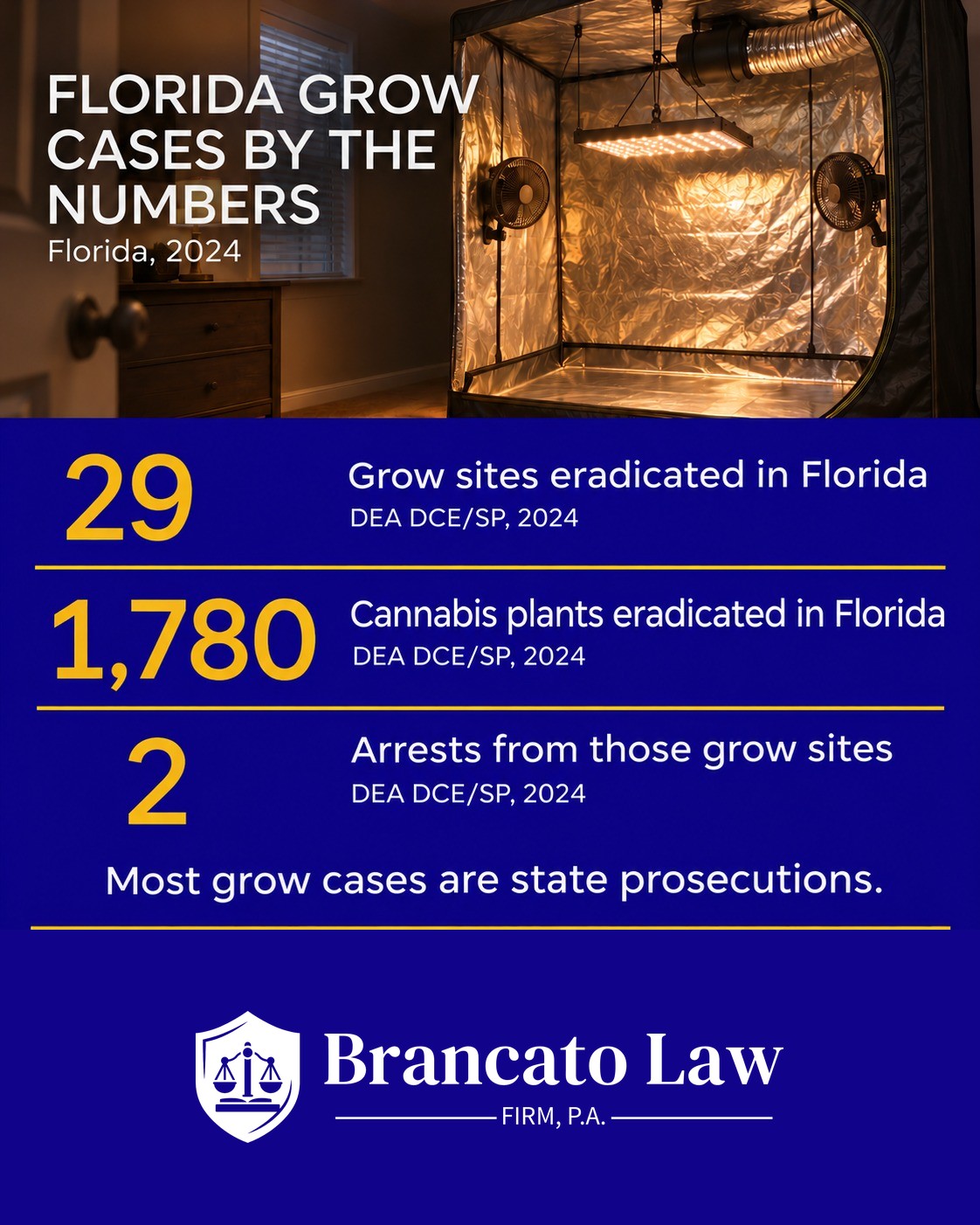
Federal enforcement plays a small role in Florida home grows. In 2024, the DEA’s Domestic Cannabis Eradication/Suppression Program reported eradicating 29 grow sites and 1,780 cannabis plants in Florida, with 2 arrests, according to the DEA’s 2024 DCE/SP statistical report. Most grow house prosecutions in Hillsborough, Pinellas, and Pasco Counties are brought in state court by the local State Attorney’s Office after investigations by sheriff’s offices and city police.
Can a Grow House Search Be Thrown Out?
Yes. A grow house search can be thrown out if the police got their information by violating the Fourth Amendment, and the home receives the strongest protection the Constitution offers. Two U.S. Supreme Court cases came directly out of marijuana grow investigations:
- Florida v. Jardines, 569 U.S. 1 (2013): Miami-Dade detectives acting on an unverified tip walked a drug-sniffing dog onto Joelis Jardines’s front porch, and the dog alerted at the door. The Court held that “the government’s use of trained police dogs to investigate the home and its immediate surroundings is a ‘search’” under the Fourth Amendment, and it affirmed the Florida Supreme Court’s ruling for Jardines.
- Kyllo v. United States, 533 U.S. 27 (2001): federal agents scanned a home with a thermal imager to detect the heat of grow lights. The Court held that using technology not in general public use to learn details inside a home is a search that is presumptively unreasonable without a warrant.
Our attorneys read every affidavit line by line. We ask whether the tip was anonymous and uncorroborated, whether officers entered the curtilage beyond what any visitor could do, whether a “knock and talk” turned into a demand, and whether the officers relied on the smell of cannabis even though legal hemp smells the same. The Second District has limited plain-smell searches, as we explain in our post on the Second DCA’s cannabis odor ruling. When a key step fails, we file a motion to suppress, and without the plants the State usually has no case.
What Are the Best Defenses to a Florida Grow House Charge?
The best defenses to a Florida grow house charge target the search, the knowledge elements, the plant count, and the intent-to-sell claim. In order, our attorneys work through these seven questions:
- Was the search legal? Warrant affidavits, porch sniffs, thermal scans, consent, and odor claims are all tested in a motion to suppress.
- Did this person know about the grow? Shared homes, locked rooms, and absentee owners leave knowledge in doubt.
- Did this person control the place? A guest, a roommate, or a landlord may not possess the house in the legal sense. Our post on when marijuana possession becomes a felony in Florida covers how constructive possession works.
- Are these rooted cannabis plants? The statute’s root-formation rule removes cuttings and clones from the count.
- Is it cannabis or hemp? The State must prove the plants are marijuana, which usually takes a lab test of THC content. Our case study on a reversed cannabis trafficking conviction shows why hemp matters.
- Was any of it for sale? No packaging, scales, buyers, or cash means the presumption at 25 plants can be rebutted and the sale-based counts challenged.
- Was a child really present? The first-degree charge requires proof that the person knew or should have known a minor was present or lived there.
Can You Get Drug Court for a Marijuana Grow in Hillsborough County?
Often, yes, when the case is a personal grow without sales. Hillsborough County runs a single drug court in Division W of the 13th Judicial Circuit with a pretrial track that dismisses the felony when the person graduates, and a Hillsborough judge must admit an eligible defendant even when the prosecutor objects unless the State proves the defendant was dealing or the judge finds prior felonies weigh against admission. That dealing exception is why the sale question matters so much in a grow case: a grow charged as manufacturing for sale is fought over drug court eligibility before anything else. Our guide to how drug court works in Hillsborough County explains the two tracks, and our Hillsborough County criminal defense page covers local procedure.
Trafficking counts with mandatory minimums are a different problem. Those cases are usually resolved through a motion to suppress, a challenge to the plant count, or a negotiated plea to a non-trafficking charge, and the stage of the case decides which tools are available. Our Florida criminal case process guide walks through each stage from arrest to sentencing.
What Should You Do If Police Searched Your Home for a Grow?
If police searched your home or left a card asking you to call, do not talk to detectives about the plants, the lease, or who lives there until you have a lawyer. Statements about who paid the electric bill or who tended the plants are the evidence the State most often uses to prove knowledge and control. A grow investigation can sit for weeks while lab results and power records come back, and that window is when pre-file advocacy can shape whether the State files a trafficking count, a sale-based count, or a lesser charge.
- Do not consent to a search or answer questions about the grow; say you want a lawyer.
- Keep the search warrant, inventory receipt, and any property receipt the officers left.
- Write down which rooms were searched, who was home, and what officers said.
- Do not remove equipment or contact others involved; it can look like tampering.
- Call a defense lawyer before any interview, first appearance, or arraignment.
Frequently Asked Questions About Florida Grow House Charges
Can I grow marijuana in Florida if I have a medical marijuana card?
No. Section 381.986(12)(d) makes cultivation by a qualified patient or caregiver a violation of section 893.13, so a card is no defense to a growing charge. The Brancato Law Firm still uses a client’s medical history to rebut the claim that the plants were meant for sale, which can lower the charge and open diversion. See our drug crimes defense page for how we handle these cases.
How many marijuana plants is a felony in Florida?
Any number of marijuana plants is a felony in Florida, because growing counts as manufacturing under section 893.13. At 25 plants the State gets a presumption of intent to sell under the grow house statute, and at 300 rooted plants the charge becomes trafficking with a 3-year mandatory minimum. Our attorneys at The Brancato Law Firm audit the count plant by plant against the statute’s root-formation rule.
Can grow house charges be dropped in Florida?
Yes. Grow house charges are dropped when the search is suppressed, when the State cannot prove who knew about and controlled the grow, or when lab testing does not confirm marijuana. The Brancato Law Firm files the motions and gathers the lease, utility, and access records that create those outcomes. If you have not been charged yet, our representation before charges are filed can make the case for a lesser charge or no charge.
Can my landlord or roommate be charged for my grow?
A landlord or roommate can be charged only if the State proves they knew the property would be used to grow for sale and, for the possession count, that they knowingly possessed it. The Second District recognized in Thames v. State that the statute has two separate knowledge elements. Our attorneys at The Brancato Law Firm build that defense with leases, access records, and testimony about who actually used the space.
Does a drug dog alert at my front door give police a warrant?
No, not on its own. Florida v. Jardines held that bringing a drug dog onto a home’s front porch to investigate is a search, so an alert gathered that way cannot support a warrant. The Brancato Law Firm reviews body camera footage and the warrant affidavit to find exactly where officers and dogs went before they asked a judge for a warrant.
Will a grow house conviction affect my home or rental?
It can. A felony drug conviction can lead to eviction under a lease, problems with future rental applications, and forfeiture claims against property tied to the grow, apart from the criminal sentence. The Brancato Law Firm weighs those consequences when we negotiate, since a withhold of adjudication or a reduced charge can protect a client’s housing. Read more about fighting a drug charge before it is filed.
Talk to a Tampa Grow House Defense Lawyer
The first decisions in a grow case, such as whether to give a statement, whether to consent to a second search, and what the State files, are often made within days of the search. The Brancato Law Firm, P.A., founded by Tampa Criminal Defense Attorney Rocky Brancato, will review the warrant, the plant count, and the evidence of sale before the State locks in its charges. Call (813) 727-7159; you can call us at any hour. Our firm has Spanish-speaking staff, and attorney Jean-Luc Adrien speaks Spanish, Haitian Creole, and French. Learn more about our Spanish and Haitian Creole criminal defense services.
For more about our defense strategies, visit our Tampa Drug Crimes Defense page.
The Brancato Law Firm, P.A.
620 E. Twiggs Street, Suite 205, Tampa, FL 33602
(813) 727-7159
Serving Hillsborough, Pinellas, and Pasco Counties
The Brancato Law Firm, P.A. is a Tampa-based criminal defense practice. We are not affiliated with any other Brancato-named law firms.
Visit Us

Tampa, FL 33602

Contact Us Now
Free Legal Consultation (813) 727-7159
