

From First DUI to Death Penalty



How to Fight a Human Smuggling Charge in Florida (2026)



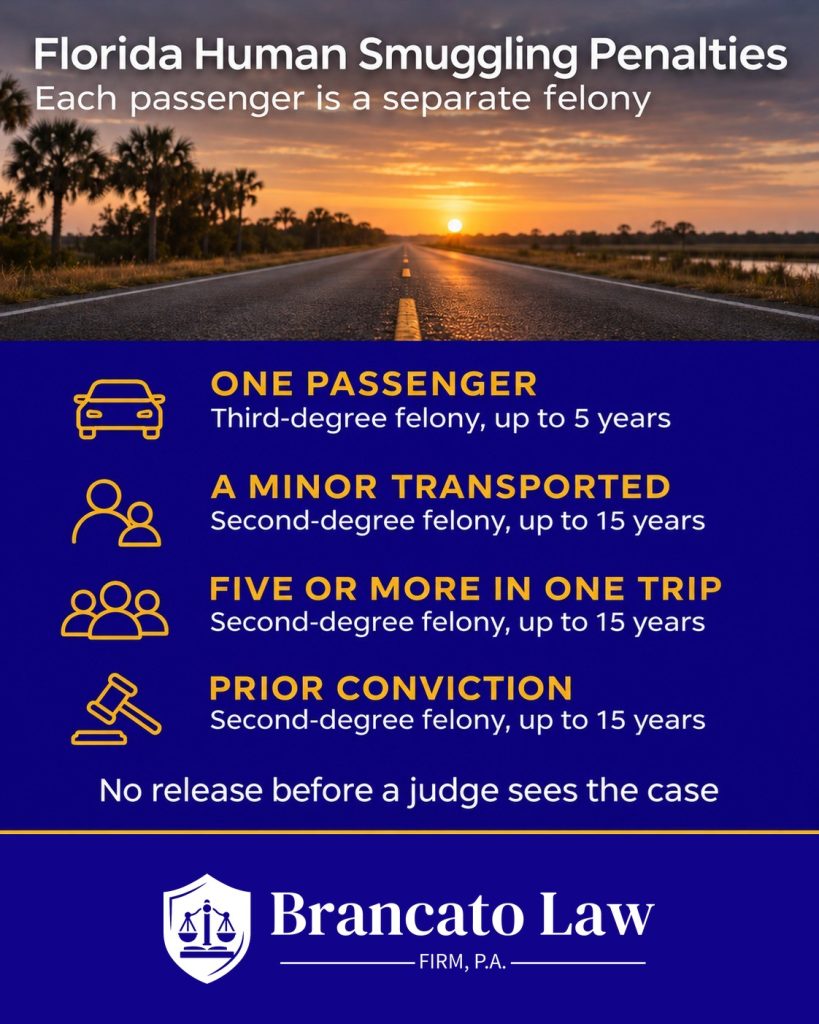
To fight a human smuggling charge in Florida, the defense holds the State to every element of section 787.07: that the accused knowingly and willfully transported the person into Florida from another state or country, and knew or reasonably should have known that the passenger had entered the United States unlawfully and had not been inspected by federal authorities since. Each passenger is a separate third-degree felony, punishable by up to 5 years in prison, and the charge becomes a second-degree felony, up to 15 years, when a minor is transported, five or more people are transported in one episode, or the accused has a prior conviction. A federal court has blocked enforcement of the law only for the plaintiffs in one lawsuit, so for everyone else it remains in force while the State’s appeal is pending.
As founder of The Brancato Law Firm, P.A., a Tampa criminal defense firm, and a former Chief Operations Officer of the Hillsborough County Public Defender’s Office, where I oversaw a staff of over 100 attorneys, I have watched immigration-related arrests become a regular part of the felony docket. I have tried more than 150 jury trials to verdict in more than 25 years in Hillsborough County courtrooms. In a human smuggling case, our attorneys focus first on what the driver actually knew about each passenger, because the statute requires proof of what the driver knew about each passenger’s immigration history.
What is human smuggling under Florida law?
Human smuggling is knowingly and willfully transporting a person into Florida when you know, or reasonably should know, that the person entered the United States in violation of law and has not been inspected by the federal government since that unlawful entry. The crime is defined in section 787.07, Florida Statutes, and the current wording took effect in 2023 through Senate Bill 1718. Our firm defends these charges alongside kidnapping and other chapter 787 offenses through our Tampa violent crime lawyer practice in Hillsborough, Pinellas, and Pasco Counties.
To convict, the State must prove each of these elements beyond a reasonable doubt for each passenger:
- The accused transported the person into Florida.
- The accused did so knowingly and willfully.
- The passenger had entered the United States in violation of law.
- The passenger had not been inspected by the federal government since that unlawful entry.
- The accused knew, or reasonably should have known, those last two facts.
Each element is a separate point of attack. A ride that starts and ends inside Florida does not meet the first element. A passenger who was stopped and processed by federal immigration officers after crossing the border may have been inspected since the unlawful entry, which can take that passenger outside the statute. And the State often has little proof of what the driver knew beyond the look of the trip.
Is Florida’s human smuggling law still enforceable in 2026?
Yes, for almost everyone. A federal injunction blocks enforcement of section 787.07 only against the plaintiffs in one lawsuit, and the State’s appeal of that injunction was still pending at the Eleventh Circuit when we checked the docket in November 2026. In Farmworker Association of Florida, Inc. v. Moody, 734 F. Supp. 3d 1311 (S.D. Fla. 2024), farmworkers and an advocacy group challenged the 2023 version of the law. The federal district court in Miami held that the plaintiffs were likely to win their claim that the law is preempted by federal immigration law, explaining that Congress has an “overwhelmingly dominant federal interest in the field” of unlawfully transporting noncitizens, and it ordered the defendants to take no steps to enforce section 787.07.
That order relied on Georgia Latino Alliance for Human Rights v. Governor of Georgia, 691 F.3d 1250 (11th Cir. 2012), where the federal appeals court that covers Florida, Georgia, and Alabama held that a similar Georgia law on transporting unlawfully present noncitizens was preempted by federal law.
The protection later shrank. In Farmworker Association of Florida, Inc. v. Uthmeier, 792 F. Supp. 3d 1306 (S.D. Fla. 2025), decided March 11, 2025, the court limited the injunction to the plaintiffs who had shown standing: the named individual plaintiffs, the Farmworker Association of Florida, and people who were members of the association as of that date. An April 2025 order kept that limit and added two more named plaintiffs. The State appealed (Eleventh Circuit No. 25-11578), and oral argument was held on July 31, 2026.
For a person charged today, that history means three things. The statute can be prosecuted unless the accused falls inside the protected group. A preemption challenge is still a live argument, and an Eleventh Circuit ruling could change the landscape quickly. And the challenge has to be raised early: in the Hernando County case discussed below, a concurring judge noted that preemption had not been argued in the trial court, so the appeals court did not decide it. Our attorneys raise preemption in a written motion to dismiss so the issue is preserved.
Does driving someone within Florida count as human smuggling?
No. Section 787.07 punishes transporting a person “into this state,” so a ride from Tampa to Orlando, or from a home in Plant City to a job site in Ruskin, is not human smuggling under the current statute. The trip must bring the passenger into Florida from somewhere else.
Where the trip did cross the state line, the State will argue that the passenger’s unlawful entry was still going on. In State v. Yanes-Blanco, 401 So. 3d 592 (Fla. 5th DCA 2025), a Florida Highway Patrol trooper stopped a Texas-plated cargo van on Interstate 75 in Hernando County, just north of Pasco County, for illegally dark tint. Twenty passengers from Mexico and Central America were in the cargo area, some wearing orange traffic vests the driver had handed out so they would look like a work crew. The trial court dismissed all twenty counts, reasoning that entry was complete once the passengers crossed the border in Texas. The Fifth District Court of Appeal reversed, holding that their entry “continued until they arrived at their destination,” so the alleged Texas-to-Orlando trip made out a prima facie case under the 2022 version of the statute. The 2023 amendment changed the wording to “has entered” and added the inspection element, so the defense now focuses on what the driver knew and whether each passenger had been inspected since entry.
What are the penalties for human smuggling in Florida?
Human smuggling is a third-degree felony for each person transported, punishable by up to 5 years in prison under section 775.082(3)(e). It becomes a second-degree felony, punishable by up to 15 years under section 775.082(3)(d), in three situations listed in section 787.07: transporting a minor, committing five or more separate offenses during a single episode, or committing a new violation after a prior conviction. A “conviction” for that purpose includes a plea of guilty or no contest even when adjudication was withheld.
| Situation | Statute | Degree and maximum |
|---|---|---|
| Transporting one person into Florida | s. 787.07(1) | Third-degree felony, up to 5 years per person |
| Each additional person transported | s. 787.07(2) | Separate offense for each person |
| Transporting a minor | s. 787.07(3) | Second-degree felony, up to 15 years |
| Five or more offenses in a single episode | s. 787.07(4) | Second-degree felony, up to 15 years |
| New violation after a prior conviction | s. 787.07(5) | Second-degree felony, up to 15 years |
Florida’s offense severity chart in section 921.0022 ranks human smuggling as a Level 4 offense. Under section 921.0024, a Level 4 primary offense scores 22 points and each additional Level 4 count adds 3.6 points. When the total is 44 points or less, the lowest permissible sentence is a non-prison sanction unless the judge decides prison is appropriate; above 44 points, the scoresheet calls for prison. Because every passenger is a separate count, a van with many passengers can push the score past that line on its own, which is why our attorneys fight over the count of passengers the State can actually prove.
Two more features raise the stakes. Section 787.07(7) requires that a person arrested for human smuggling be held in custody until brought before a judge for a pretrial release decision, so there is no release on a standard bond schedule. And Florida’s racketeering law counts chapter 787 offenses, including human smuggling, as racketeering activity under section 895.02, which lets prosecutors build a RICO case around a pattern of trips.
How often are smuggling cases prosecuted?
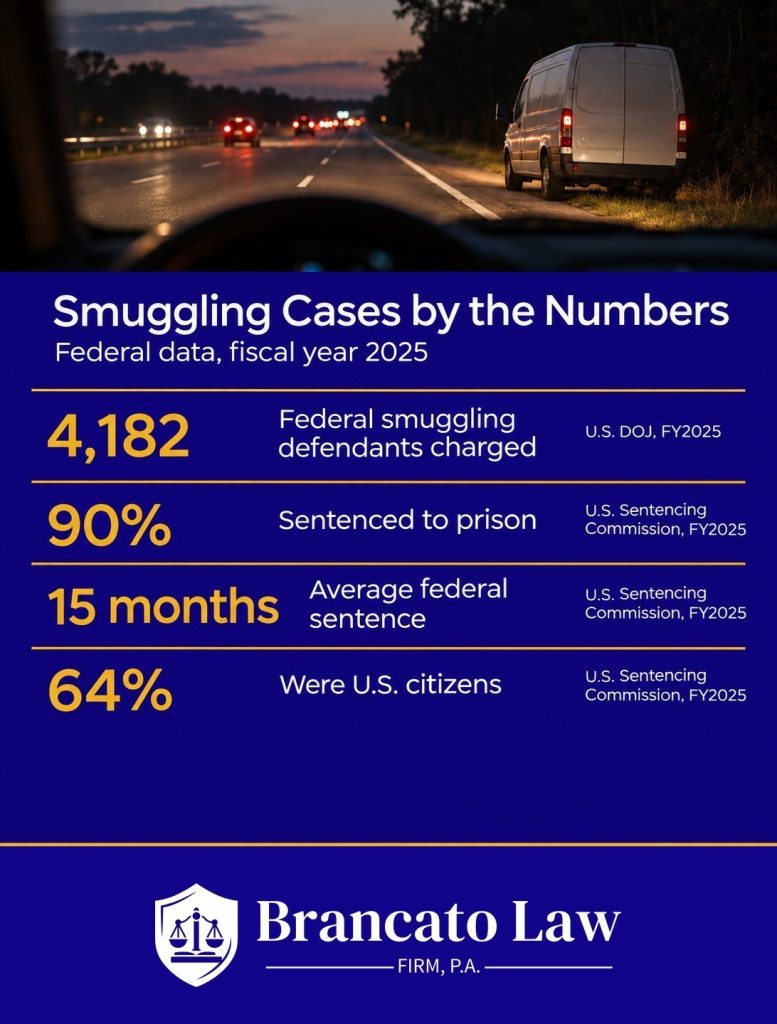
Smuggling prosecutions run in the thousands every year at the federal level. The Congressional Research Service’s May 2026 report Immigration-Related Crimes, citing U.S. Department of Justice data, shows that federal prosecutors charged 4,182 defendants under 8 U.S.C. § 1324, the federal smuggling and harboring statute, in fiscal year 2025. The CRS report explains that section 1324 makes it a felony to transport an unlawfully present person within the country in furtherance of that person’s unlawful presence, with up to 10 years in prison when the offense is committed for commercial advantage or private financial gain.
The U.S. Sentencing Commission’s fiscal year 2025 data show how those cases end: 90% of people sentenced for alien smuggling went to prison, the average sentence was 15 months, and 64% of those sentenced were United States citizens. That last figure shows that most people sentenced for smuggling in federal court are citizens themselves.
We could not find a public Florida dataset that separately counts section 787.07 arrests or convictions, so we do not estimate one. The reported Florida appeals, including the Hernando County case above, began with a traffic stop on a highway, followed by questions to the driver about who the passengers were and where the trip began.
How is Florida human smuggling different from the federal crime?
Florida’s law is narrower than the federal statute in one way and harsher in another. 8 U.S.C. § 1324 reaches transporting within the United States and harboring, while section 787.07 reaches only bringing a person into Florida. But the Florida statute counts every passenger as a separate felony and requires that the arrested person stay in jail until a judge sets release conditions.
| Issue | Florida, s. 787.07 | Federal, 8 U.S.C. § 1324 |
|---|---|---|
| Conduct | Transporting a person into Florida | Bringing in, transporting within the U.S., harboring, or encouraging unlawful entry or residence |
| Knowledge | Knows or reasonably should know of unlawful entry and no federal inspection since | Knowing or in reckless disregard of the person’s unlawful status |
| Units of prosecution | One count per person transported | Penalties computed per person |
| Basic maximum | 5 years per person (third-degree felony) | Up to 5 years per person for transporting; up to 10 years when done for commercial advantage or private financial gain |
| Release after arrest | Held until a judge decides pretrial release | Federal detention rules |
The same trip can lead to both charges. State and federal prosecutors are separate sovereigns, and a state arrest can draw federal interest when the facts suggest an organized operation.
Is human smuggling the same as human trafficking?
No. Human smuggling is about transporting a person who entered the country unlawfully, usually with the passenger’s consent. Human trafficking under section 787.06 is about using coercion to obtain labor, services, or commercial sex, and it carries far heavier penalties. Prosecutors sometimes charge both and later drop one; in some cases a defendant pleads to smuggling in exchange for dismissal of trafficking counts. Our guide on how to fight a human trafficking charge in Florida explains that offense in detail.
How do our attorneys fight a human smuggling charge?
Our attorneys work through the elements passenger by passenger and attack the investigation that produced them. The defenses we raise most often:
- No proof of knowledge. The State must prove the driver knew or reasonably should have known that each passenger entered unlawfully and was not inspected since. Nervous passengers, little luggage, or a lack of driver’s licenses do not prove the driver knew anyone’s immigration history.
- The passenger was inspected. A person who was apprehended and processed by federal immigration authorities after crossing may have been inspected since the unlawful entry. We seek the federal records that show it, because that fact can remove a count.
- No transport into Florida. If the trip began in Florida, or the State cannot prove where it began, the first element fails. Gas receipts, phone location data, and toll records cut both ways, and we review them closely.
- Count-by-count challenges. Every passenger the State cannot prove up is one less felony, and dropping below five counts in one episode removes the second-degree enhancement.
- An illegal stop or search. Most of these cases begin with a traffic stop. If the stop lacked a legal basis or was extended without reasonable suspicion, a motion to suppress can remove the statements and observations that followed.
- Federal preemption and the injunction. We file a motion to dismiss raising preemption to preserve the issue for appeal, and we check whether the accused is a protected plaintiff or a Farmworker Association member covered by the federal injunction.
- Statements taken without an interpreter or without Miranda warnings. Many drivers and passengers speak Spanish or Haitian Creole. Our attorneys and staff review recorded statements in the language they were given and challenge interviews the accused could not understand.
Traffic stop law is central here. Our guides on how long a traffic stop can last in Florida and filing a motion to suppress evidence explain how those challenges work.
Can the State use a false name or fake ID against you?
Yes. Section 787.07(6) says that proof the accused knowingly and willfully gave false identification or false information to an officer investigating human smuggling gives rise to an inference that the accused knew the passenger had entered unlawfully and had not been inspected since. An inference is not automatic proof, and the jury can reject it, but it lets the State fill the knowledge gap with the driver’s own words at the roadside. The safest course is to give required identification during a traffic stop and decline to answer questions about the passengers until you have talked with a lawyer.
What happens after a human smuggling arrest in Hillsborough County?
After an arrest, the person stays in jail until a judge decides pretrial release, because section 787.07(7) bars release before that hearing. In Hillsborough County, first appearance is usually held the day after the arrest, with the judge downtown and the arrested person appearing by video from the jail, as our guide to Hillsborough first appearance explains. Our attorneys use that short hearing to present ties to the community, work history, and family support, and to argue for conditions the person can meet. Cases in the 13th Judicial Circuit are handled through our Hillsborough County criminal defense attorney team.
Language is often the first obstacle. Families calling about a smuggling arrest frequently need to talk in Spanish or Haitian Creole, and our firm has Spanish-speaking staff, and attorney Jean-Luc Adrien speaks Spanish, Haitian Creole, and French. A noncitizen charged with any felony should also get advice from an immigration attorney about how a plea could affect immigration status, and our attorneys coordinate with that lawyer before any plea is entered.
If you learn that you are under investigation before an arrest, representation before charges are filed gives our attorneys a chance to deal with the detective and the prosecutor while the filing decision is still open. Nearly every month, cases our firm handles at this stage never get filed because of that front-end advocacy, and we decide case by case what, if anything, to provide to detectives. Our overview of the Florida criminal case process shows each stage from investigation and arrest through first appearance, plea, and trial.
| Stage | What happens | What our attorneys do |
|---|---|---|
| Traffic stop or investigation | Driver and passengers questioned; phones and receipts reviewed | Advise silence on the passengers; preserve video and records |
| Arrest | Held in jail under s. 787.07(7) | Prepare release information for the family |
| First appearance | Judge sets pretrial release conditions | Argue for release and workable conditions |
| Filing decision | State Attorney decides the number of counts and degree | Present weaknesses in knowledge, inspection, and transport proof |
| Pretrial motions | Discovery, depositions, body camera video | File motions to suppress and a motion to dismiss on preemption |
| Plea or trial | State must prove every element for each passenger | Hold the State to each count; coordinate with immigration counsel |
Frequently asked questions
Can a human smuggling charge be dropped in Florida?
Yes. Prosecutors drop or reduce these charges when the evidence does not show what the driver knew, when the trip did not begin outside Florida, or when the stop that started the case was illegal. The Brancato Law Firm presents those problems to the State Attorney’s Office early, through our violent and chapter 787 crimes defense team, before the charging decision hardens.
Is it human smuggling to drive a relative from Georgia to Florida if they are undocumented?
It can be charged that way, because section 787.07 has no exception for family members. The State still has to prove that you knew or reasonably should have known your relative entered unlawfully and has not been inspected by federal authorities since, and our attorneys at The Brancato Law Firm examine the relative’s immigration history closely because a later federal encounter can defeat that element.
Is it a crime to drive undocumented coworkers to a job site in Tampa?
Not under section 787.07, which covers only transporting a person into Florida, so a trip that begins and ends in Florida does not fit the statute. Federal law is broader, and The Brancato Law Firm reviews whether any federal exposure exists while defending the state case through pre-file advocacy when no charge has been filed yet.
Who is protected by the federal injunction against Florida’s smuggling law?
Only the named plaintiffs in the Farmworker Association lawsuit, the Farmworker Association of Florida itself, and people who were members of the association on March 11, 2025. The Brancato Law Firm checks membership records and the court’s orders when a client may fall inside that group, because a protected person cannot be prosecuted under section 787.07 while the injunction stands.
Can I be charged in both state and federal court for the same trip?
Yes. Florida and the federal government are separate sovereigns, and the same trip can violate both section 787.07 and 8 U.S.C. § 1324. Our attorneys at The Brancato Law Firm focus on the state case and on resolving it in a way that does not hand federal prosecutors new evidence.
How much jail time does a first-time human smuggling charge carry in Florida?
A single count is a third-degree felony with a 5-year maximum, and one Level 4 count with no prior record scores 22 points, below the 44-point prison line on the Criminal Punishment Code scoresheet. The Brancato Law Firm runs the scoresheet at the start of every case, because multiple passengers can turn a probation-range case into a prison-range case.
Talk to a Tampa defense attorney about a human smuggling charge
For more about our defense strategies, visit our Violent Crimes page.
A human smuggling arrest means no bond until a judge sees the case, so the first 24 hours matter. Call The Brancato Law Firm, P.A., founded by Tampa Criminal Defense Attorney Rocky Brancato, at (813) 727-7159; you can call us at any hour, and our office is two blocks from the courthouse. Our firm has Spanish-speaking staff, and attorney Jean-Luc Adrien speaks Spanish, Haitian Creole, and French.
The Brancato Law Firm, P.A.
620 E. Twiggs Street, Suite 205, Tampa, FL 33602
(813) 727-7159
Serving Hillsborough, Pinellas, and Pasco Counties
The Brancato Law Firm, P.A. is a Tampa-based criminal defense practice. We are not affiliated with any other Brancato-named law firms.
Visit Us

Tampa, FL 33602

Contact Us Now
Free Legal Consultation (813) 727-7159
