

From First DUI to Death Penalty



How to Fight a Firearm While Intoxicated Charge in Florida? (2026)


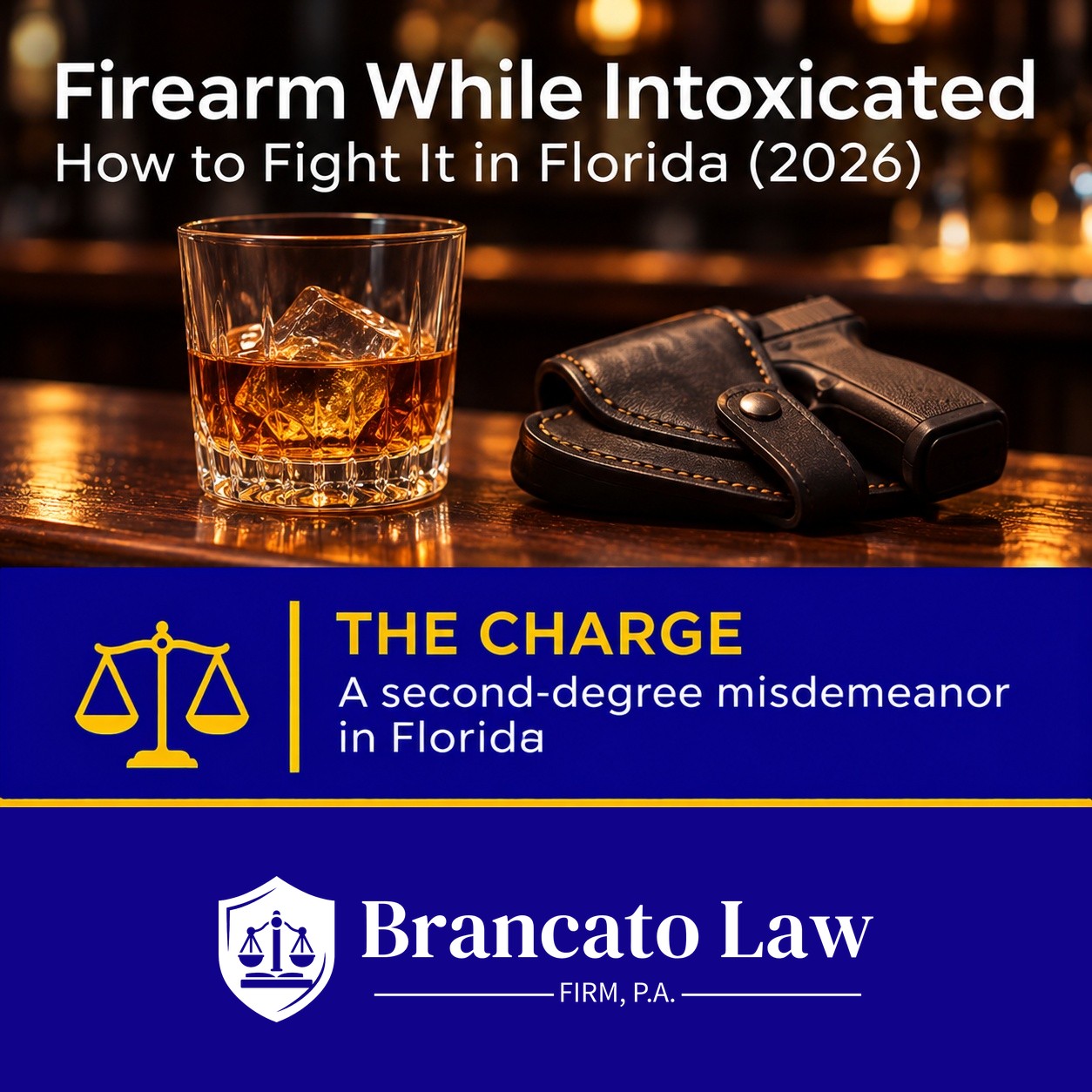
In Florida, it is a second-degree misdemeanor, punishable by up to 60 days in jail, to use a firearm while under the influence of alcohol, certain chemical substances, or a controlled substance to the extent that your normal faculties are impaired, under section 790.151. “Use” has a narrow meaning: firing the gun, or holding it loaded in your hand. A holstered gun, or a gun in a car or a bag, is not “use” under this statute, and the law does not apply to lawful self-defense. Most cases turn on whether the State can prove both the use and the impairment.
If you were arrested after handling a gun at a party, or firing one in the backyard after a few drinks, the charge on the paperwork may sound broader than the law actually is. As founder of The Brancato Law Firm, P.A., a Tampa criminal defense firm, I am a member of the National College for DUI Defense and a former police academy instructor, and I have spent more than 25 years in Hillsborough County courtrooms. Our attorneys defend these cases the way we defend impaired-driving cases: by testing the State’s proof of impairment and the officer’s reasons for the stop, one piece at a time.
Is It Illegal to Have a Gun While Drunk in Florida?
It is illegal to use a firearm while impaired, but having a gun nearby while drinking is not, by itself, a crime under section 790.151, Florida Statutes. The statute makes it unlawful for a person under the influence of alcoholic beverages, a chemical substance listed in section 877.111, or a controlled substance, “when affected to the extent that his or her normal faculties are impaired, to use a firearm in this state.” The offense is a second-degree misdemeanor, which carries up to 60 days in jail and a fine of up to $500.
Our Tampa gun crimes attorney page covers the other Florida weapons charges that are often filed alongside this one, including improper exhibition and discharging a firearm in public.
What Does “Use a Firearm” Mean Under Section 790.151?
To “use a firearm” under the statute means to discharge it or to have it “readily accessible for immediate discharge,” and the statute defines that phrase as “loaded and in a person’s hand.” That is a much narrower definition than the “readily accessible” language used elsewhere in Chapter 790. The table shows how it applies to common situations.
| Situation | Covered by s. 790.151? | Why |
|---|---|---|
| Firing a gun at a backyard party after drinking, with impaired faculties | Yes | Discharging a firearm is “use” |
| Holding a loaded handgun while visibly impaired | Yes | Loaded and in the person’s hand |
| Holding an unloaded gun while impaired | No | The definition requires the gun to be loaded |
| Gun in a holster, waistband, purse, or bag while drinking | No | Not discharged and not in hand |
| Gun in the glove box or console during a traffic stop | No under this statute, though a DUI or other charge may apply | Not discharged and not in hand |
| Impaired person fires in lawful self-defense or defense of property | No | Subsection (5) excludes lawful self-defense |
Because the definition is narrow, our attorneys read the arrest report line by line. Officers often write that a person “was in possession of” a firearm while intoxicated, which does not state the offense unless the report also shows the gun was fired or loaded in hand.
What Other Charges Come With an Impaired Gun Arrest?
A section 790.151 charge rarely stands alone. Prosecutors usually look for a second statute that fits what happened with the gun. The penalties come from section 775.082.
| Charge | Statute | Degree | Maximum jail or prison |
|---|---|---|---|
| Using a firearm while impaired | s. 790.151 | Second-degree misdemeanor | 60 days |
| Carrying with a concealed weapons license into the bar portion of a licensed establishment | s. 790.06(12) | Second-degree misdemeanor | 60 days |
| Improper exhibition of a weapon | s. 790.10 | First-degree misdemeanor | 1 year |
| Discharging a firearm in public or recklessly on residential property | s. 790.15(1) | First-degree misdemeanor | 1 year |
| Displaying, using, or carrying a concealed firearm while committing a felony | s. 790.07(2) | Second-degree felony | 15 years |
The license rule in section 790.06(12) lists, among other places, any portion of an establishment licensed to serve alcohol for consumption on the premises that is primarily devoted to that purpose. When a gun is fired during a felony, the case can escalate quickly; our post on how to fight a firearm during a felony charge explains that charge.
How Does the State Prove You Were Impaired?
The State proves impairment with breath or urine tests, officer observations, and the way the gun was handled. Under section 790.153, a person who uses a firearm in Florida must submit to a breath test for alcohol and a urine test for controlled substances when an officer has probable cause and the test is incidental to a lawful arrest, and a refusal is admissible in any criminal proceeding. When a gun used by an impaired person causes death or serious bodily injury, section 790.155 allows a blood test and lets officers use reasonable force to obtain it.
The blood alcohol rules for guns differ from DUI. Under section 790.157, a level of 0.05 or less creates a presumption that the person was not impaired, a level above 0.05 but below 0.10 creates no presumption either way, and a level of 0.10 or more is prima facie evidence of impairment. That means a 0.08 reading, the familiar DUI number, does not by itself prove impairment in a firearm case. Our attorneys use that gap, along with the timing of the test, to challenge the State’s proof.
Officer observations can fill that gap, as Brinegar v. State, 327 So. 3d 1274 (Fla. 1st DCA 2021) shows. A Bay County man fired 16 to 24 shots toward a neighbor’s home over about 20 minutes, and deputies later described slurred speech, a strong odor of alcohol, and trouble standing. The First District affirmed his convictions, including using a firearm while under the influence, and a concurring opinion explained that a jury could infer he was impaired when he fired even though his alcohol test came hours later, after he had been in custody. The lesson is that the defense must attack the observations and the timeline, not just the number.
Can Police Stop You for Having a Gun While Drinking?
Police can briefly detain you if the circumstances give them reasonable suspicion that you used a gun while impaired. In Rivera v. State, No. 3D22-443 (Fla. 3d DCA May 31, 2023), Miami-Dade officers responding to a gunshot-detection alert found shell casings and bullet holes at a house. A woman who appeared intoxicated and smelled of alcohol approached them and said she had a gun in her bag. The Third District held the officers had reasonable suspicion of a section 790.151 violation and affirmed the denial of her motion to suppress, upholding her conviction for carrying a concealed firearm without a license.
Rivera turned on the shots fired and the shell casings at the scene. Without facts suggesting the gun had been fired or held, drinking near a gun does not supply the same suspicion, and our attorneys file motions to suppress when officers search a person or bag on less. Our post on whether police can stop or frisk you for carrying a gun in Florida explains the search rules.
How Common Are Guns and Alcohol Together in Tampa Bay?
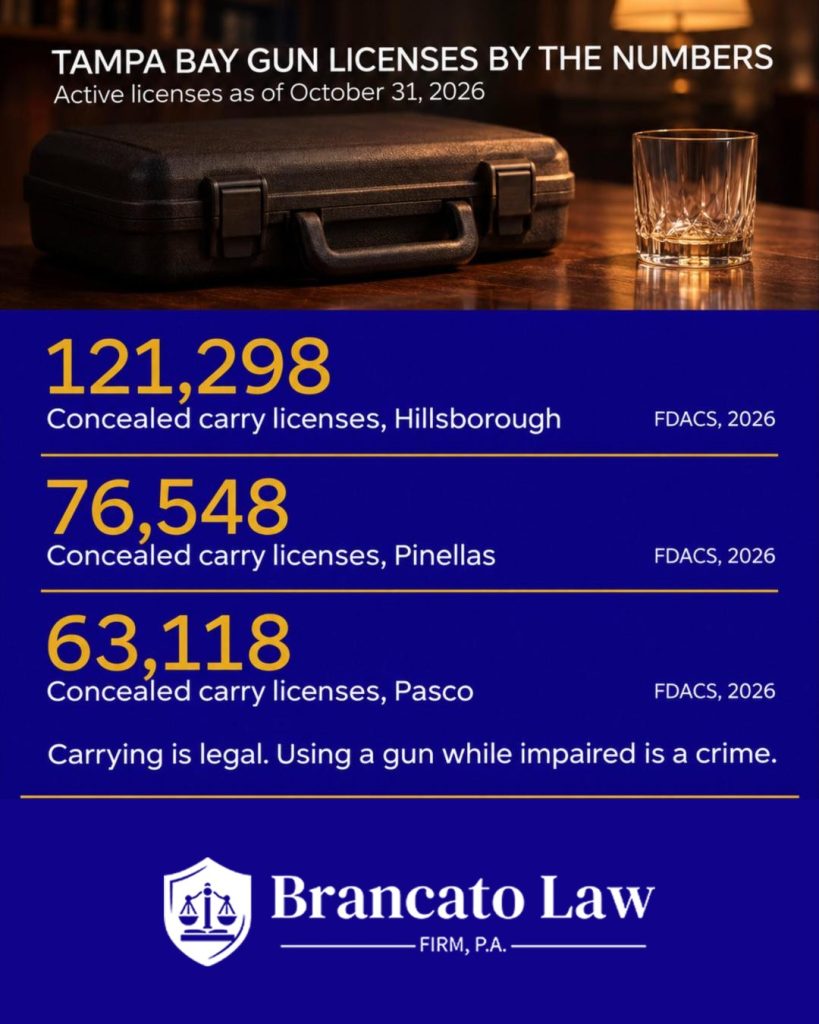
Legal gun carrying is widespread in Tampa Bay. As of October 31, 2026, Hillsborough County residents held 121,298 Florida concealed weapon or firearm licenses, Pinellas residents held 76,548, and Pasco residents held 63,118, according to the Florida Department of Agriculture and Consumer Services county license report. Those counts do not include people who carry without a license under Florida’s permitless carry law, so the real number of armed adults is higher.
Research explains why lawmakers single out alcohol. A 40-year systematic review and meta-analysis by Charles Branas, Sara Han, and Douglas Wiebe, Alcohol Use and Firearm Violence, published in Epidemiologic Reviews in 2016, found that over one third of firearm violence decedents had acutely consumed alcohol and over one fourth had consumed heavily before their deaths. The authors listed penalties for using firearms while intoxicated among the policies that deserve further study. That research explains the statute, but it does not lower the State’s burden in an individual case.
What Are the Defenses to a Firearm While Intoxicated Charge?
The defenses to a section 790.151 charge track its elements. Our attorneys test each of these:
- No “use.” The gun was not fired and was not loaded and in hand. Possession nearby is not enough under this statute.
- No impairment of normal faculties. Drinking is not the same as impairment. The State must prove the person’s normal faculties were impaired at the time of the use.
- Test results that do not prove impairment. A reading between 0.05 and 0.10 creates no presumption, and a reading of 0.05 or less creates a presumption of no impairment.
- Timing. A test taken long after the gun was handled may not show the person’s condition at the time of the use.
- Lawful self-defense or defense of property. Subsection (5) says the statute does not apply.
- Illegal detention or search. If police lacked reasonable suspicion or probable cause, the gun, the statements, and the test may be suppressed.
For intoxication issues in other criminal cases, see our post on the intoxication defense in Florida, and for the broader picture, our guide to alcohol offenses in Florida.
What Happens After an Impaired Gun Arrest in Hillsborough County?
A section 790.151 charge on its own is a misdemeanor heard in Hillsborough County Court in the 13th Judicial Circuit. In our experience, when the gun was fired, the State Attorney’s Office often files the misdemeanor alongside felony charges such as shooting into a dwelling or discharging a firearm from a vehicle, which moves the case to circuit court and raises the stakes. The seized gun is held as evidence, and getting it back after the case usually requires a request to the arresting agency and sometimes a court order. Our Florida criminal case process guide explains each stage from first appearance to resolution.
Frequently Asked Questions About Using a Firearm While Intoxicated in Florida
Can you carry a gun into a bar in Florida if you are not drinking?
No, not with a concealed weapons license into the portion of an establishment primarily devoted to serving alcohol on the premises. Section 790.06(12) makes knowingly and willfully carrying there a second-degree misdemeanor, whether or not you drink, and The Brancato Law Firm reviews the floor plan and the facts of where the gun actually was in every such case.
Is it illegal to have a gun in your car while drunk in Florida?
Not under section 790.151 alone, because a gun in a glove box or console is not fired or loaded in hand. Driving while impaired is a separate DUI offense, and our attorneys at The Brancato Law Firm defend both charges when they arise together; see our firearm charges defense page for the related gun laws.
What blood alcohol level counts as impaired with a firearm in Florida?
A level of 0.10 or more is prima facie evidence of impairment under section 790.157, and a level of 0.05 or less creates a presumption of no impairment. The Brancato Law Firm challenges readings in between, which create no presumption either way.
Can a firearm while intoxicated charge be dropped in Florida?
Yes. Prosecutors drop or reduce the charge when the report does not show the gun was fired or loaded in hand, when impairment is weak, or when the stop or search was unlawful. The Brancato Law Firm raises those points early, and our case process guide explains when charges are reviewed.
Can I refuse a breath test after a gun incident in Florida?
Section 790.153 says a person who uses a firearm shall submit to testing when the statutory conditions are met, and a refusal is admissible as evidence in a criminal case. Our attorneys at The Brancato Law Firm examine whether the arrest was lawful and the request was proper before any refusal can be used.
Does Stand Your Ground apply if I was drinking?
Section 790.151 itself says it does not apply to persons exercising lawful self-defense or defense of property. The Brancato Law Firm evaluates whether the facts support self-defense, which can defeat both the impairment charge and any related violent-crime charge; if police want to question you, our representation before charges are filed can help.
Talk to a Tampa Gun Crimes Lawyer About a Firearm While Intoxicated Charge
Call before you talk to detectives or the agency holding your gun. Our attorneys will check whether the facts meet the statute’s narrow definition of use, review any breath or urine test, and look for suppression issues in the stop. The Brancato Law Firm, P.A., founded by Tampa Criminal Defense Attorney Rocky Brancato, can be reached at (813) 727-7159, and you can call us at any hour. Our firm has Spanish-speaking staff, and attorney Jean-Luc Adrien speaks Spanish, Haitian Creole, and French. Learn more about our Spanish and Haitian Creole criminal defense services.
For more about our defense strategies, visit our Tampa Gun Crimes Defense page.
The Brancato Law Firm, P.A.
620 E. Twiggs Street, Suite 205, Tampa, FL 33602
(813) 727-7159
Serving Hillsborough, Pinellas, and Pasco Counties
The Brancato Law Firm, P.A. is a Tampa-based criminal defense practice. We are not affiliated with any other Brancato-named law firms.
Visit Us

Tampa, FL 33602

Contact Us Now
Free Legal Consultation (813) 727-7159
