

From First DUI to Death Penalty



How to Fight a Murder Charge After a Drug Overdose in Florida? (2026)


In Florida, an adult who sells or gives someone heroin, fentanyl, cocaine, methamphetamine, or another listed drug can be charged with first-degree murder if the drug is proven to have caused, or been a substantial factor in, the user’s death, under section 782.04(1)(a)3. It is a capital felony with no requirement that the seller intended to kill or was present. The case usually turns on two questions: whether this person actually distributed the drug the user took, and whether the medical examiner can prove that drug alone was enough to cause death. Lesser outcomes, including manslaughter or a plain drug charge, are often possible when either answer is uncertain.
Families often learn about a drug-distribution murder charge weeks after an overdose, when detectives finish reading the dead person’s phone. As founder of The Brancato Law Firm, P.A., a Tampa criminal defense firm, I meet the Florida Rule of Criminal Procedure 3.112 qualifications to try capital cases, I have tried more than 150 jury trials to verdict, and I handled homicide cases as a member of a Major Crimes Unit. Our attorneys start these cases with the toxicology report and the phone records, because that is where the State’s proof is usually thinnest.
Can a Drug Dealer Be Charged With Murder for an Overdose in Florida?
Yes. Section 782.04(1)(a)3., Florida Statutes, makes it first-degree murder when a death “resulted from the unlawful distribution by a person 18 years of age or older” of a listed substance, when the substance “is proven to have caused, or is proven to have been a substantial factor in producing, the death of the user.” The listed substances include all Schedule I drugs (such as heroin), cocaine, opium and its derivatives, methadone, fentanyl, carfentanil, alfentanil, sufentanil, methamphetamine, and their analogs.
The offense is a capital felony, so a conviction carries life in prison without parole or, in theory, death, under section 775.082. The State does not have to prove the seller meant to kill anyone, knew about the overdose, or was there when it happened. The statute treats distribution like the underlying felony in a felony murder case. Our Tampa homicide attorney team defends these charges as murder cases from the first day, with the same experts we would use in any death investigation.
Which Overdose Deaths Lead to Which Charges?
The charge depends on the drug, the seller’s age, and how the State frames the case. The table shows the main options in the statute.
| Situation | Statute | Charge and degree | Maximum penalty |
|---|---|---|---|
| Adult (18+) distributes a listed drug (heroin, fentanyl, cocaine, meth, and others) that caused or substantially caused the death | s. 782.04(1)(a)3. | First-degree murder, capital felony | Life without parole (death in theory) |
| Person under 18 distributes a substance they knew or should have known contained dangerous fentanyl, which caused or substantially caused the death | s. 782.04(5)(b) | Third-degree murder, second-degree felony | Up to 15 years |
| Death occurs during a drug trafficking offense under s. 893.135(1), killed by someone other than the trafficker | s. 782.04(3) | Second-degree murder, first-degree felony | Up to life |
| Death occurs while committing another non-enumerated felony, without design to kill | s. 782.04(4) | Third-degree murder, second-degree felony | Up to 15 years |
Prosecutors sometimes charge manslaughter or the underlying drug offense instead, especially when the causation proof is weak. That decision is often made before the indictment, which is why early representation before charges are filed matters in overdose investigations.
What Does “Substantial Factor” Mean in a Florida Overdose Case?
In Florida’s overdose murder statute, “substantial factor” has a specific definition: it means that the use of the substance “alone is sufficient to cause death, regardless of whether any other substance or mixture used is also sufficient to cause death,” under section 782.04(6)(a). In plain terms, when the person who died had several drugs in their system, the State must prove that the drug the defendant supplied was enough, by itself, to kill.
That definition is stricter than many people assume, and it gives the defense real ground in mixed-drug deaths. Federal law reached a similar point in Burrage v. United States, 571 U.S. 204 (2014), where a man died after a binge involving heroin, oxycodone, alprazolam, and other drugs. The experts could not say he would have lived without the heroin, and the U.S. Supreme Court held that the federal death-results enhancement requires proof that the drug was a but-for cause unless it was independently sufficient to cause death. Florida’s statute uses its own words, but the same medical question drives both: what did each drug in the toxicology report actually do?
Our attorneys answer that with independent experts. A forensic toxicologist can explain blood concentrations, tolerance, and the time between use and death, and a forensic pathologist can challenge a cause-of-death finding that simply lists every drug found. Our forensic science defense page explains how we use those experts.
How Does the State Prove the Defendant Supplied the Fatal Dose?
The State usually proves supply through the dead person’s phone: texts arranging the purchase, payment app records, and the timing of the last contact. In Jackson v. State, 292 So. 3d 1284 (Fla. 1st DCA 2020), an Escambia County man sold $40 of heroin to a man who was found dead the next morning. His defense was that the victim used that heroin and survived, then got a lethal batch from someone else later that night. The First District affirmed the conviction and life sentence, noting it was undisputed he supplied heroin for $40 and that the statute does not excuse a middleman because someone upstream was the “actual source.” The court also held that his challenge to the exclusion of a later text from another dealer was not preserved because it was never raised at the pretrial hearing.
The lessons from Jackson are practical. An alternative-source defense must be built with evidence, not speculation, and every piece of it must be raised before trial so the judge rules on it. Our attorneys subpoena the full phone extraction, not just the texts the detective selected, and we map every contact the person who died had in the hours before death.
Has Florida Prosecuted Overdose Murder Cases in Hillsborough County?
Yes. One of the leading Florida Supreme Court decisions on this statute came from a Hillsborough County prosecution. In Pena v. State, 901 So. 2d 781 (Fla. 2005), a woman was found dead on a neighborhood sidewalk from lethal doses of heroin and MDMA, and a Hillsborough grand jury indicted the man accused of supplying them. He was convicted and sentenced to life without parole. The Florida Supreme Court held that the trial court’s failure to instruct the jury that the defendant must be 18 or older was not fundamental error because his age was undisputed, and it approved the Second District’s decision.
Pena shows two things about these cases in Hillsborough. First, because the charge is a capital felony, it goes through a grand jury indictment in the 13th Judicial Circuit, not an ordinary information. Second, every element, including age, must be raised and preserved at trial, because appellate courts will not rescue an unobjected-to error when the evidence on that element was clear. Our Hillsborough County criminal defense page and Florida criminal case process guide explain how a felony moves from arrest to trial.
Who Gets Charged in Overdose Murder Cases?
Overdose homicide charges often reach friends, partners, and fellow users, not only street dealers. A Utah Law Review article by Northeastern University law professor Leo Beletsky, America’s Favorite Antidote: Drug-Induced Homicide in the Age of the Overdose Crisis (2019), built a dataset of 263 drug-induced homicide prosecutions from 2000 to 2016 and found that approximately half of the charges reached co-using friends, family members, or romantic partners of the person who died. Florida’s statute requires only “distribution” by an adult, so sharing drugs can be enough on paper.
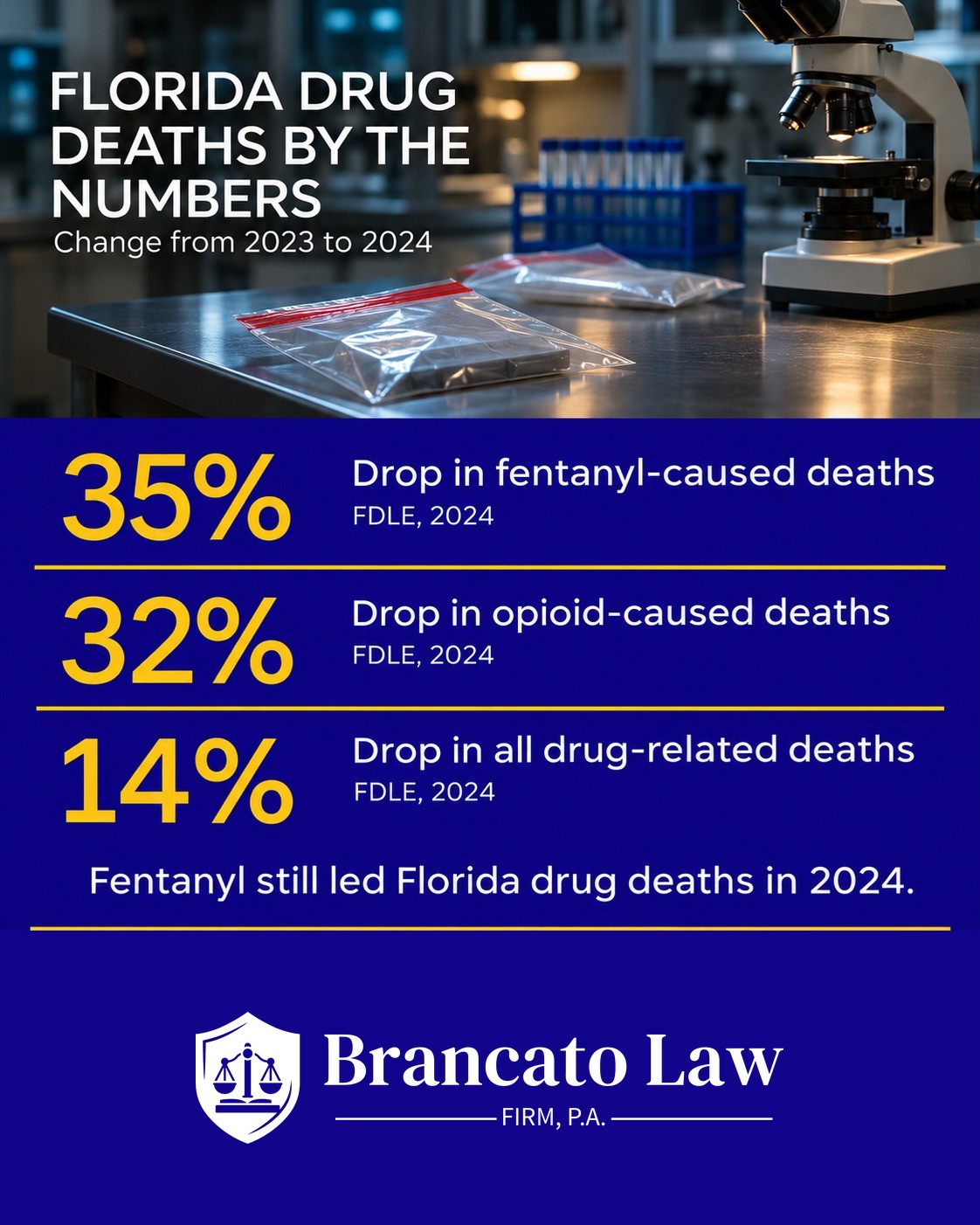
The stakes are rising alongside the drug supply. In 2024, fentanyl was the leading drug involved in deaths in Florida even as fentanyl-caused deaths fell 35% from the year before, according to the Florida Department of Law Enforcement’s release on the Medical Examiners Commission’s 2024 report. The same FDLE release reported that total drug-related deaths in Florida fell 14% in 2024 and opioid-caused deaths fell 32%. Because fentanyl is mixed into other drugs, people charged in these cases often did not know what they handed over. That does not change the elements, but it matters a great deal to prosecutors and judges deciding whether a case should be resolved as manslaughter, a drug offense, or a murder.
What Are the Defenses to a Florida Overdose Murder Charge?
The defenses to a Florida overdose murder charge focus on distribution, causation, and age. Our attorneys test the State’s case on each of these:
- No distribution by this person. The State must prove the defendant sold, delivered, or gave the drug. Shared purchases, pooled money, and a phone used by several people all raise doubt.
- A different source. If the person who died had contact with other suppliers, the drug that killed them may not be the one the defendant provided. Jackson shows this defense must be documented and raised before trial.
- Causation under the statute’s definition. In a mixed-drug death, the State must prove the defendant’s drug alone was sufficient to cause death. Toxicology timing and concentrations are central.
- The drug is not on the list. The first-degree statute covers specific substances. A death from a drug outside that list cannot support this charge.
- Age. The first-degree theory requires a distributor 18 or older. Younger defendants face the separate fentanyl provision or other charges.
- Suppression of the phone evidence. If the defendant’s own phone was searched without a valid warrant, the messages may be excluded.
Our post on how to defend against a fentanyl trafficking charge covers the drug side of these cases, and our first-degree murder defense post explains the other first-degree theories.
Does Florida’s Good Samaritan Law Protect You After an Overdose?
Only partly. Florida’s 911 Good Samaritan law, section 893.21, protects a person who seeks medical help in good faith for someone overdosing from arrest, charge, or prosecution for drug possession offenses listed in the statute, when the evidence came from calling for help. It does not list murder or drug sale offenses, and it says the protection cannot be used to suppress evidence in other prosecutions. Calling 911 is always the right choice for the person in danger, and it is also a fact our attorneys present to prosecutors and juries as evidence of a person’s real intent.
What Should You Do If Detectives Contact You After an Overdose?
Do not talk to detectives about the person who died, how they got the drugs, or your messages with them, and do not delete anything. Overdose investigations commonly start as death investigations, and statements made to help explain a tragedy often become the State’s proof of distribution. Call a defense lawyer first; pre-file advocacy can sometimes keep a case from being presented to the grand jury as murder.
- Say you want a lawyer and will not answer questions.
- Do not delete messages, payment records, or apps; that can lead to a tampering charge.
- Do not contact the family or friends of the person who died about the case.
- Write down a timeline of your contact with the person who died while it is fresh, and share it only with your lawyer.
- Expect detectives may already have the dead person’s phone.
Frequently Asked Questions About Overdose Murder Charges in Florida
Can you be charged with murder for sharing drugs with a friend who overdosed?
Yes. The statute applies to any unlawful distribution by an adult, and sharing drugs can count as distribution. The Brancato Law Firm looks closely at whether the drugs were bought together, who paid, and who actually handed them over, because those facts can defeat or reduce the charge. Our homicide defense page explains how we approach these cases.
Can overdose murder charges be dropped in Florida?
Yes. Charges are dropped or reduced when the State cannot prove the defendant supplied the fatal drug or that the drug alone was sufficient to cause death. Our attorneys at The Brancato Law Firm retain toxicology and pathology experts early to test those points before the State commits to a murder theory.
What if the person who died took several different drugs?
Then causation becomes the central fight. Florida defines substantial factor to mean the drug alone was sufficient to cause death, so a toxicology report listing several drugs does not by itself prove the defendant’s drug killed the person. The Brancato Law Firm has independent experts review concentrations and timing in every mixed-drug case.
Is an overdose murder charge eligible for bond in Florida?
Bond is harder to obtain because a capital felony can be held without bond when the proof is evident or the presumption great. The Brancato Law Firm prepares for the bond hearing by attacking the causation and distribution proof, which is the same evidence the judge weighs; see our case process guide for what happens after arrest.
Does it matter that I did not know the drug contained fentanyl?
For an adult charged under section 782.04(1)(a)3., the statute does not require knowledge of what the drug contained. Knowledge does matter under the separate provision for people under 18, and it often matters in negotiations; our attorneys at The Brancato Law Firm use it to argue for a lesser charge.
Can calling 911 protect me from a murder charge?
No. Florida’s Good Samaritan law protects only against listed possession offenses, not murder or sale. The Brancato Law Firm still presents a 911 call as strong evidence of good intent when negotiating with prosecutors.
Talk to a Tampa Defense Lawyer About an Overdose Murder Investigation
If detectives are asking about an overdose death, the case may be headed to a grand jury, and what happens before that decision matters most. Our attorneys will review the phone evidence and toxicology and contact the prosecutor before charges are filed when that helps. Call The Brancato Law Firm, P.A., founded by Tampa Criminal Defense Attorney Rocky Brancato, at (813) 727-7159. You can call us at any hour. Our firm has Spanish-speaking staff, and attorney Jean-Luc Adrien speaks Spanish, Haitian Creole, and French. Learn more about our Spanish and Haitian Creole criminal defense services.
For more about our defense strategies, visit our Tampa Homicide Defense page.
The Brancato Law Firm, P.A.
620 E. Twiggs Street, Suite 205, Tampa, FL 33602
(813) 727-7159
Serving Hillsborough, Pinellas, and Pasco Counties
The Brancato Law Firm, P.A. is a Tampa-based criminal defense practice. We are not affiliated with any other Brancato-named law firms.
Visit Us

Tampa, FL 33602

Contact Us Now
Free Legal Consultation (813) 727-7159
