

From First DUI to Death Penalty



How to Fight a Failure to Return Rental Property Charge in Florida (2026)


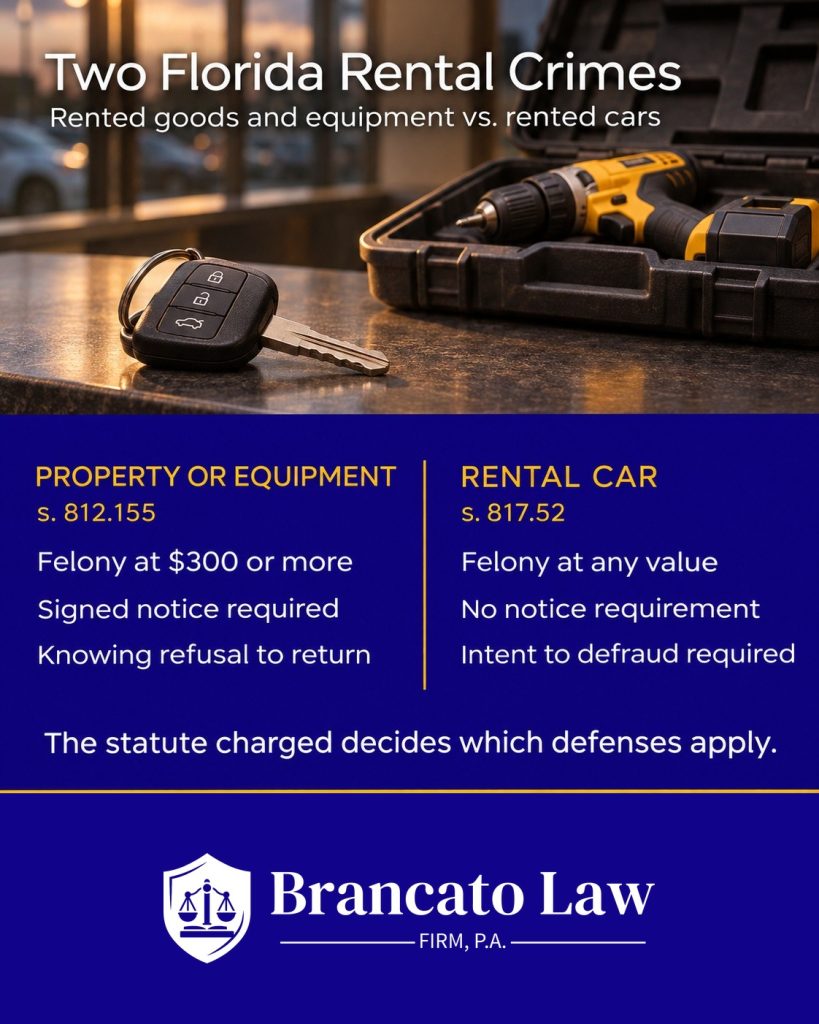
Failure to return rental property is a crime in Florida under section 812.155(3) when a person who rented or leased personal property or equipment knowingly abandons it or refuses to return it at the end of the rental period without the owner’s consent. It is a second-degree misdemeanor if the property is worth less than $300 and a third-degree felony, punishable by up to five years in prison, if it is worth $300 or more. The State cannot prosecute under this statute unless the rental agreement contains a specific warning that the renter initialed, and a missed return date alone does not prove a knowing refusal. A rented car is charged under a different statute, section 817.52(3), which requires proof of intent to defraud.
If a rental store, equipment company, or rent-to-own dealer has sent you a certified letter demanding its property back, the next five days matter, because Florida law lets the State treat a failure to return the property within five days of that demand as evidence against you. I’m Rocky Brancato. I founded The Brancato Law Firm, P.A., a Tampa criminal defense firm, after more than 25 years in Hillsborough County courtrooms that included serving as a former Chief Operations Officer of the Hillsborough County Public Defender’s Office, where I oversaw a staff of over 100 attorneys, and trying more than 150 jury trials to verdict. When a rental dispute turns into a police report, our attorneys start with the paperwork the business wrote: the rental agreement, the initialed notice, and the demand letter, because each one is a legal requirement the State has to meet.
What is failure to return rental property in Florida?
Failure to return rental property is a theft-type crime defined in section 812.155, Florida Statutes. Subsection (3) applies to anyone who, after hiring or leasing personal property or equipment under an agreement to return it at the end of the rental period, “knowingly abandon[s] or refuse[s] to return” it as agreed and without the owner’s consent. The statute covers everyday rentals such as tools, party equipment, furniture, electronics, and rent-to-own merchandise.
Section 812.155 also contains two related crimes. Subsection (1) punishes obtaining custody of property by trick, deceit, or false representation with intent to defraud, and subsection (2) punishes renting property with intent to defraud the owner of the rental payments. Those two require proof of intent to defraud. Subsection (3), the failure-to-return offense, does not: the Second District has explained that intent to defraud “is no longer an element” of that crime after a 2006 amendment.
To convict under subsection (3), the State generally has to prove:
- The accused rented or leased personal property or equipment under an agreement to return it at the end of the rental period.
- The rental period ended.
- The accused knowingly abandoned the property or refused to return it as agreed.
- The owner did not consent.
- The rental agreement contained the warning required by section 812.155(6), initialed by the renter.
Our Tampa theft and property crimes attorney page explains how our firm handles the broader family of theft charges, and our guide to what counts as theft in Florida covers the general theft statute.
What are the penalties for failing to return rental property in Florida?
The penalty for failing to return rental property depends on the value of the property. Under section 812.155(3), property worth less than $300 makes the offense a second-degree misdemeanor, punishable by up to 60 days in jail, and property worth $300 or more makes it a third-degree felony, punishable by up to five years in prison and a $5,000 fine under section 775.082 and section 775.083. Value means the market value of the property at the time and place of the offense, or replacement cost if market value cannot be determined, under section 812.012(10).
| Offense | Statute | Value | Degree | Maximum penalty |
|---|---|---|---|---|
| Obtaining property by trick or false representation | s. 812.155(1) | Under $300 | Second-degree misdemeanor | 60 days in jail |
| Obtaining property by trick or false representation | s. 812.155(1) | $300 or more | Third-degree felony | 5 years in prison, $5,000 fine |
| Renting with intent to defraud | s. 812.155(2) | Under $300 / $300 or more | Misdemeanor / third-degree felony | 60 days / 5 years |
| Failure to return rented property or equipment | s. 812.155(3) | Under $300 | Second-degree misdemeanor | 60 days in jail |
| Failure to return rented property or equipment | s. 812.155(3) | $300 or more | Third-degree felony | 5 years in prison, $5,000 fine |
| Failure to redeliver a rented car | s. 817.52(3) | Any value | Third-degree felony | 5 years in prison, $5,000 fine |
The $300 felony line has not changed since the statute was created in 1992, according to a 2018 Florida House Judiciary Committee staff analysis. A 2018 bill that would have raised the line to $750 and removed rent-to-own agreements from the statute died without becoming law, so a rented television, couch, or generator worth $300 or more can still support a felony charge.
What notice and demand does Florida require before a rental case can be prosecuted?
Florida requires the rental company to follow specific steps before it can use section 812.155 against a renter. The most important is the notice: as “a prerequisite to prosecution,” the rental agreement or an addendum must contain the statutory warning that failure to return the property and pay all amounts due is evidence of abandonment or refusal to redeliver, and the renter must initial it.
| Rule | What the statute says | Why it matters |
|---|---|---|
| Initialed notice, s. 812.155(6) | The agreement must contain the statutory warning, initialed by the renter | Without it, the State cannot prosecute under s. 812.155 |
| Demand for return, s. 812.155(5) | Demand may be made in person, by hand delivery, by certified mail with return receipt, or by courier with tracking, to the address in the contract | How and where the demand went is evidence our attorneys check first |
| Five-day window, s. 812.155(4)(b) | Failure to return within 5 days after receiving a certified or tracked demand is prima facie evidence of abandonment or refusal | It is evidence the jury may weigh, not automatic proof of guilt |
| Unpaid amounts, s. 812.155(4)(c) | Failure to pay amounts due after the rental period and after demand is prima facie evidence | Amounts due include unpaid rent and repair or replacement cost |
| Third-party possession, s. 812.155(7) | A third party having the property is no defense unless the renter documents it was taken without consent | A police report or other proof of theft matters |
Courts enforce the notice rule. In Ellsworth v. State, 89 So. 3d 1076 (Fla. 2d DCA 2012), the rental agreement used outdated language saying a failure to return was “prima facie evidence of intent to defraud” instead of the warning the 2006 amendment required. The Second District held that the notice requirement is mandatory, that substantial compliance was not enough, and ordered the renter discharged. The court added that a business in that situation could still pursue a general theft charge under section 812.014, but without the evidentiary shortcuts of section 812.155.
Small wording differences do not always help the renter. In Mejias Vializ v. State, No. 1D2022-1185 (Fla. 1st DCA July 12, 2023), an Alachua County renter signed four lease-to-own contracts for electronics, stopped paying, and did not return the items. Her agreements added the words “after written demand is made” to the statutory warning. The First District held that the extra words favored the renter and did not undo the warning, which was otherwise quoted word for word, and it affirmed the conviction.
The five-day rule is also narrower than many renters fear. The Second District has described the statute’s evidence provisions as creating a permissive inference, which a jury may accept or reject, rather than a presumption the renter must disprove.
How do our attorneys fight a failure to return rental property charge?
Our attorneys fight a section 812.155 charge by holding the rental company and the State to every requirement in the statute, and by showing the jury or the prosecutor what actually happened with the property. These are the defenses we look at first.
1. Check the contract for the initialed notice
Ellsworth makes the initialed warning a condition of prosecution. We get the complete rental agreement, every addendum, and any electronic signature records, and we compare the warning to the statute line by line. A missing warning, missing initials, or outdated wording can end a section 812.155 case.
2. Test the demand letter
The five-day window starts with a demand made the way subsection (5) requires and sent to the address in the contract. We look at how the demand was sent, where it went, when it was received, and whether the property was returned or offered back within five days.
3. Show there was no knowing refusal
The State must prove the renter knowingly abandoned or refused to return the property. A renter who tried to return it after hours, who was told an extension was fine, who was in the hospital, or who was negotiating with the store over a damage claim did not knowingly refuse. Texts, emails, and call logs with the store are often the best evidence.
4. Show the owner consented
Subsection (3) applies only when the property was kept “without the consent” of the owner. An employee’s agreement to an extension, by phone or text, is consent. Continued charges to the renter’s card for extra days can also show the business treated the rental as ongoing.
5. Challenge the value
The felony depends on the property being worth $300 or more at the time and place of the offense, which is its market value, not the price on a rent-to-own contract. Used furniture, older electronics, and worn equipment are often worth far less than the rental company’s paperwork suggests, and a value under $300 makes the case a misdemeanor.
6. Make sure the State charged the right statute
A rented car falls under section 817.52(3), which requires proof that the renter acted “with intent to defraud,” and other rented property falls under section 812.155. In State v. Sampaio, 291 So. 3d 120 (Fla. 4th DCA 2020), a Broward County man was charged under section 817.52(3) with failing to return a rented vehicle. The Fourth District held that section 812.155’s notice requirement does not apply to a section 817.52 prosecution, because the two statutes are separate, and reinstated the charge. The flip side is that a car case requires proof of intent to defraud, and our attorneys hold the State to it.
7. Document a theft or loss by someone else
If someone else took the property, section 812.155(7) makes that a defense only when the renter provides documentation that it was taken without the renter’s consent. A police report filed promptly, insurance claims, and witness statements make that defense real.
How common are rental property prosecutions in Florida?
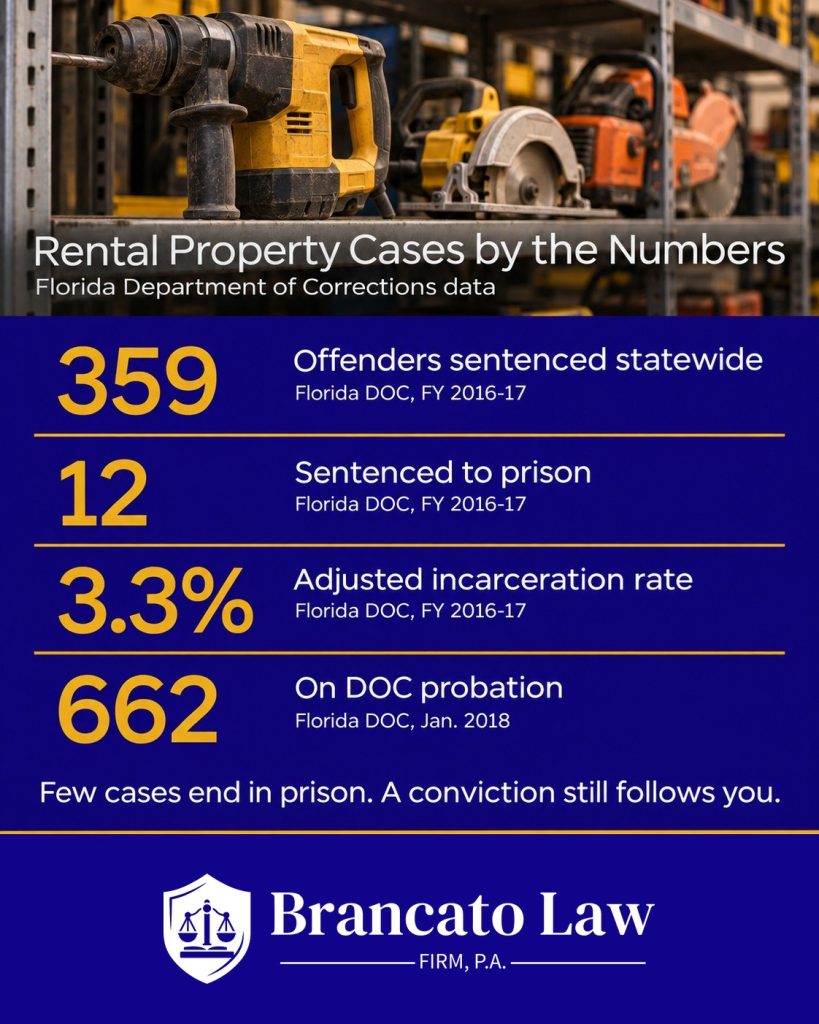
Most rental property cases in Florida end without a prison sentence, but in the latest published year hundreds of people were sentenced. According to the Florida Legislature’s Criminal Justice Impact Conference summary for CS/HB 1309 (2018), Florida Department of Corrections data showed 359 offenders sentenced for section 812.155 offenses in fiscal year 2016-17, and 12 of them were sentenced to prison, an adjusted incarceration rate of 3.3 percent. The 2018 House Judiciary Committee staff analysis reported, from Department of Corrections data as of January 2018, about 15 people in prison and 662 people on probation for these offenses.
Probation is the more common outcome, and it brings its own risks. A probation term can include restitution, and a missed payment can lead to a violation. Our guide to fighting a probation violation in Florida explains what happens then.
How much restitution can you be ordered to pay in a rental property case?
Restitution in a rental property case is generally tied to the fair market value of the property, not the full amount the renter would have paid under the contract. In Mejias Vializ, the First District reversed a restitution order based on the completed-contract amount for four lease-to-own items and sent the case back for restitution under section 775.089(7)(b), explaining that absent a showing another basis is more fair, the trial court was limited to the items’ fair market value.
A renter who disputes the amount is entitled to a hearing. In Feldman v. State, No. 2D2022-3265 (Fla. 2d DCA Oct. 6, 2023), a Pinellas County case under section 812.155(3), the Second District affirmed the conviction but reversed the restitution order because the defendant did not agree to the amount and asked for a hearing, and “the trial court was required to” hold one.
Can a rental property dispute be resolved before charges are filed?
Yes, many rental property disputes can be addressed before the State Attorney’s Office decides whether to file a charge. These cases usually begin with a business filing a report, and the decision to prosecute comes later, at the charging stage described in our guide to the Florida criminal case process. With representation before charges are filed, our attorneys can document a return, a payment, a consent to extend, or a defect in the paperwork and put it in front of the prosecutor early. Nearly every month, cases our firm handles before filing never get filed at all because of that front-end work, and we decide case by case what, if anything, to provide to detectives. Past results do not guarantee future outcomes.
If a charge has already been filed in Hillsborough County, a first-time offender may be a candidate for a diversion program. Our article on Hillsborough County diversion programs explains how those programs work. Businesses sometimes send a civil demand letter at the same time, and our post on civil theft demand letters in Florida explains how that civil claim differs from the criminal case.
Frequently asked questions about failure to return rental property in Florida
Can failure to return rental property charges be dropped in Florida?
Yes, the State Attorney’s Office can drop a section 812.155 charge, especially when the agreement lacks the initialed warning, the demand was defective, or the property was returned. The Brancato Law Firm builds that case from the rental company’s own records, and our theft and property crimes defense page explains our approach.
Is not returning a rent-to-own item a crime in Florida?
It can be, because rent-to-own merchandise is covered by section 812.155, and the First District affirmed a conviction for unreturned lease-to-own electronics in Mejias Vializ. The Brancato Law Firm reviews the lease-to-own contract for the required notice and the market value of each item, which often decides whether the charge is a felony or a misdemeanor.
What happens if I return the rental property late in Florida?
A late return is not automatically a crime, because the State must prove a knowing refusal or abandonment without the owner’s consent. Our attorneys at The Brancato Law Firm gather the receipts, messages, and billing records that show when and how the property came back.
Can a rental car company press charges if I keep the car too long in Florida?
Yes, but a rented car is usually charged under section 817.52(3), which requires proof that the renter acted with intent to defraud. The Brancato Law Firm looks at payments, extension requests, and contacts with the rental company to challenge that intent, as discussed in State v. Sampaio.
What if someone else has the rental property and won’t give it back?
Under section 812.155(7), possession by another person is not a defense unless the renter can document that the property was taken without the renter’s consent. The Brancato Law Firm helps clients assemble that documentation, starting with a police report and messages showing who had the property.
Is lying on a rental application a separate crime in Florida?
Yes, giving false information to obtain a rental can be charged separately from failing to return property. The Brancato Law Firm defends both kinds of cases, and our post on rental application fraud in Florida covers that offense.
Talk to a Tampa defense attorney about a failure to return rental property charge
For more about our defense strategies, visit our Tampa theft and property crimes page.
If a demand letter just arrived, call before the five days run out. The Brancato Law Firm, P.A., founded by Tampa Criminal Defense Attorney Rocky Brancato, can review the rental agreement and the demand right away at (813) 727-7159, and you can call us at any hour. Our office is two blocks from the courthouse. Our firm has Spanish-speaking staff, and attorney Jean-Luc Adrien speaks Spanish, Haitian Creole, and French.
The Brancato Law Firm, P.A.
620 E. Twiggs Street, Suite 205, Tampa, FL 33602
(813) 727-7159
Serving Hillsborough, Pinellas, and Pasco Counties
The Brancato Law Firm, P.A. is a Tampa-based criminal defense practice. We are not affiliated with any other Brancato-named law firms.
Visit Us

Tampa, FL 33602

Contact Us Now
Free Legal Consultation (813) 727-7159
