- Free Consultation 24/7: (813) 727-7159 Tap Here To Call Us


From First DUI to Death Penalty



Is Lying on a Rental Application a Crime in Florida? (2026)


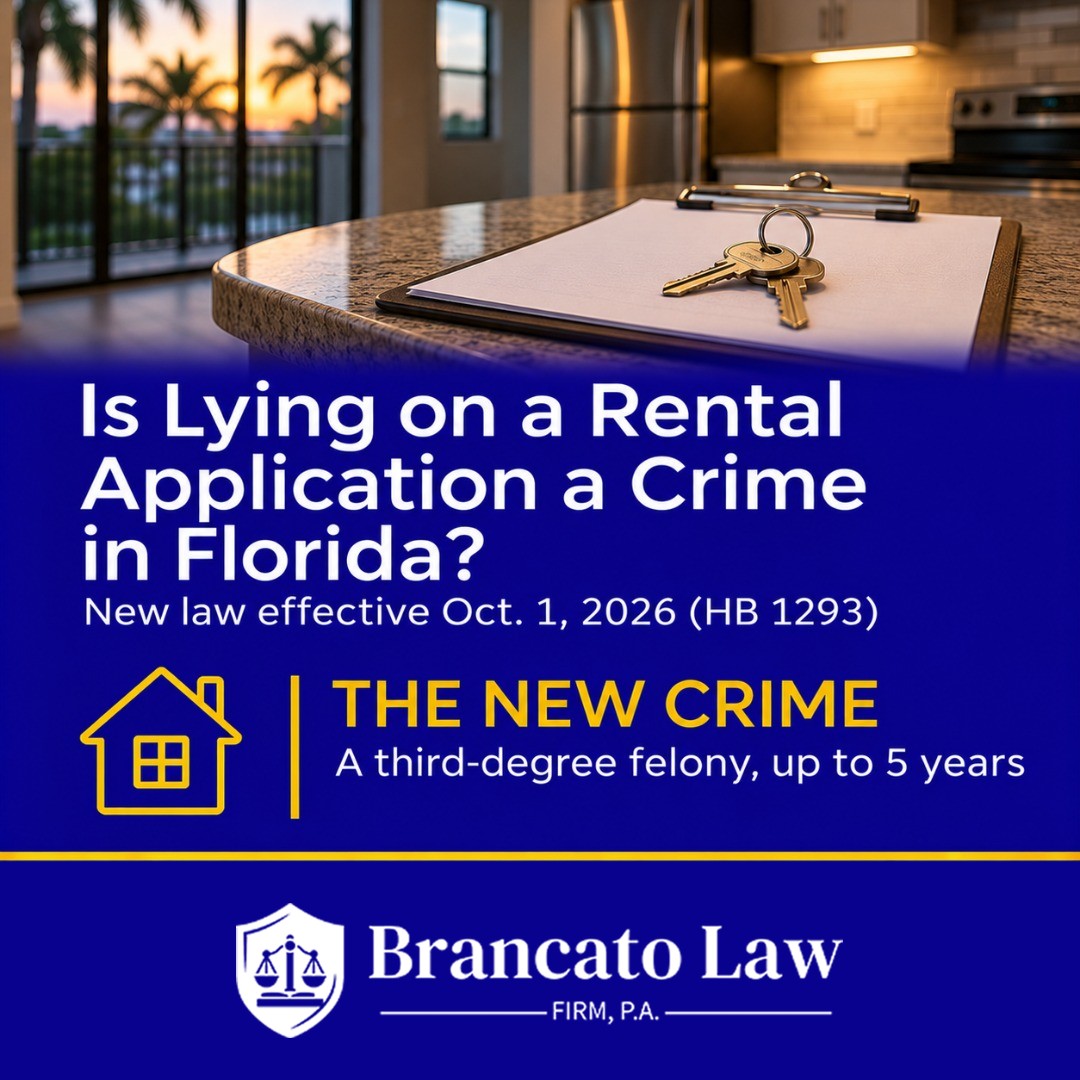
| It can be. Since October 1, 2026, section 817.537, Florida Statutes, makes it a third-degree felony to enter into and take possession of a rental home by knowingly and willfully making a materially false written statement about your identity on a rental application, presenting forged or counterfeit documents such as a fake ID, bank statement, or paystub, or impersonating the person whose name is on the application. The crime carries up to five years in prison and a $5,000 fine, and the landlord can also end the lease on 7 days’ notice with no chance to fix the problem. |
Most fraud cases are won or lost on intent, and rental application cases will be no different: the question is whether a person knowingly lied or simply made a mistake on a form. As founder of The Brancato Law Firm, P.A., a Tampa criminal defense firm, and a former Chief Operations Officer of the Hillsborough County Public Defender’s Office, where I oversaw a staff of over 100 attorneys, I have defended fraud and identity cases in Hillsborough County courtrooms for more than 25 years. Our attorneys read every word of the application and every document the landlord relied on before anything else.
This guide explains what HB 1293 (chapter 2026-143, Laws of Florida) made a crime, what it did not, why the Legislature passed it unanimously, and how these charges are defended.
What Does Florida’s New Rental Fraud Law Prohibit?
Section 817.537, Florida Statutes, titled “Fraudulent entry of a residential dwelling unit,” provides that a person may not “enter into and take possession of a residential dwelling unit” by knowingly and willfully doing any of three things:
- Lying about identity in writing. Making, or causing to be made, a materially false written statement “relating to the person’s identity” in a rental application for a residential tenancy.
- Using fake documents. Presenting forged, fictitious, or counterfeit documents to the landlord, “including, but not limited to, a driver license, an identification card, a bank statement, or a paystub.”
- Impersonation. Impersonating another person in whose name a rental application is submitted, in order to sign a lease or take possession.
A violation is a third-degree felony, punishable by up to five years in prison and a $5,000 fine. The law took effect October 1, 2026, after Governor DeSantis signed it on June 12, 2026.
What Does the New Law Not Cover?
The law is narrower than many news reports suggest, and the details matter in court. Three limits stand out in the text:
- The person must take possession. The statute requires entering into and taking possession of the unit. A false application that is rejected, or a lease that is signed but never occupied, does not complete this crime, though other fraud laws may still apply.
- Written statements must relate to identity. A false statement under the first prong must concern the applicant’s identity. Overstating income or leaving out an old eviction on the form, without a forged document, is not covered by that prong. A fake paystub or doctored bank statement, however, is covered by the second prong.
- The conduct must be knowing and willful. An honest mistake, a typo, or information entered by someone else without the applicant’s knowledge is not a crime under this statute.
Older laws still fill some gaps. Section 817.03 has long made it a first-degree misdemeanor to make a false statement in writing to obtain property or credit, and Florida’s identity theft law, section 817.568, applies when someone uses another person’s personal identification information without consent.
Why Did Florida Pass HB 1293?
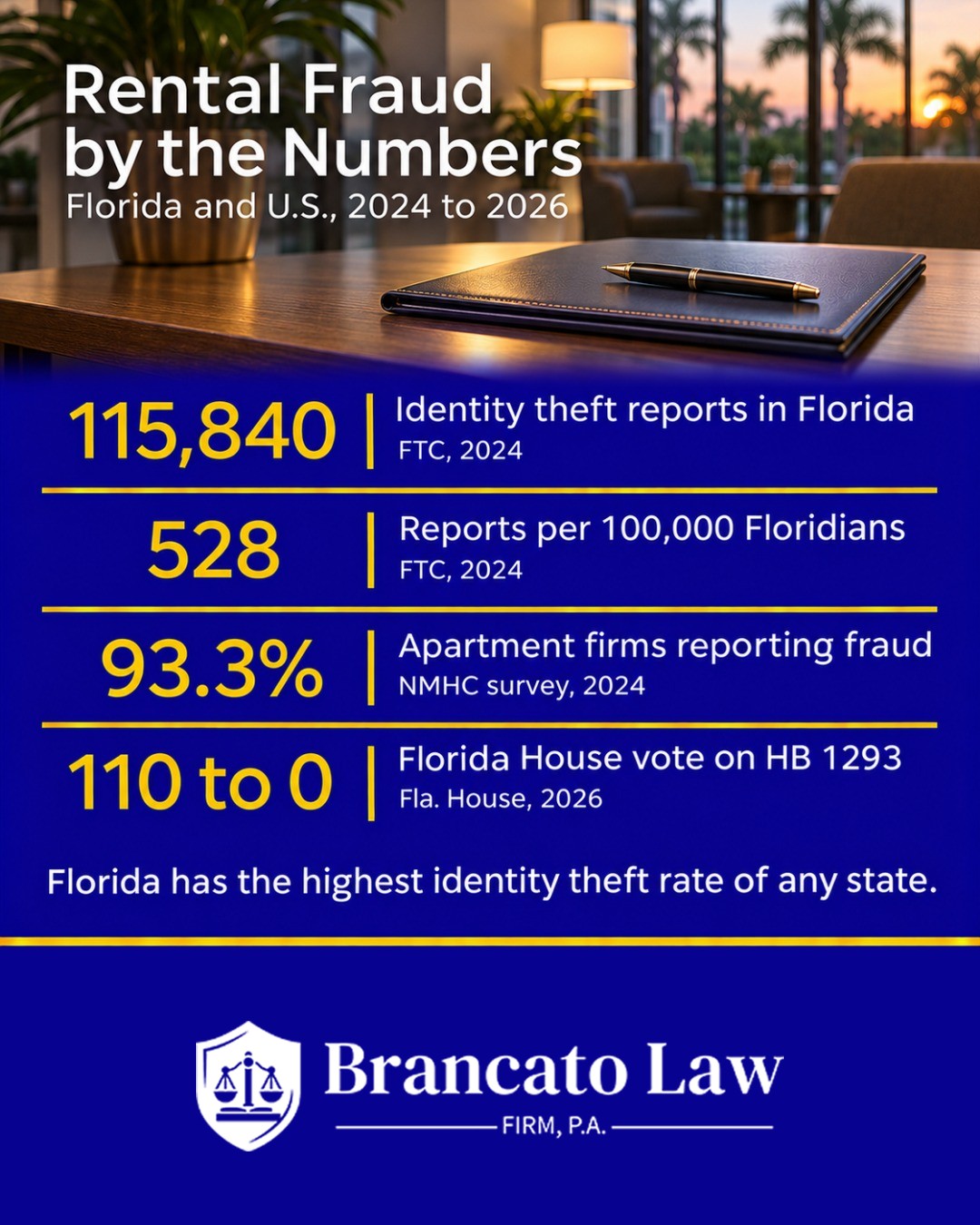
Landlords and property managers told lawmakers that application fraud has become common and harder to spot. A survey by the National Multifamily Housing Council, conducted from November 2023 to January 2024, found that 93.3% of 75 responding apartment owners, developers, and managers had experienced fraud in the prior 12 months. Of those, 84.3% reported falsified paystubs, employment references, or income documents, and 70.0% reported identity theft or fake ID documents. Respondents said fraudulent applications accounted for an average of 23.8% of their eviction filings.
Florida’s identity theft problem adds to the concern. According to the Federal Trade Commission’s Consumer Sentinel Network Data Book 2024, Floridians filed 115,840 identity theft reports in 2024, or 528 per 100,000 residents, the highest rate of any state.
Eric Garduño of the Bay Area Apartment Association told Bay News 9 that artificial intelligence is making it “harder and harder to distinguish the genuine documents from the fraudulent ones.” Tenant advocates disagreed with the approach. Charles Phillips of the St. Pete Tenants Union told the station that “criminal penalties are absolutely not necessary,” and critics warned that a felony record can make it harder to find future housing and work.
The law also builds on Florida’s 2024 squatter law, which created a fast sheriff’s removal process under section 82.036 for unauthorized occupants who were never tenants. HB 1293 addresses people who become tenants through deception. The U.S. Supreme Court has described the landlord’s underlying interest, the right to exclude, as “one of the most treasured” rights of property ownership in Cedar Point Nursery v. Hassid, 594 U.S. 139 (2021), a case about union organizers’ access to farmland that the House staff analysis cited for that principle.
How Did HB 1293 Move Through the Legislature?
The bill passed every committee and both chambers without a single “no” vote. Representative Greco sponsored the House bill, and Senator Rodriguez sponsored the identical Senate bill, SB 1224. The House Criminal Justice Subcommittee added definitions and clarified the impersonation language.
| Date (2026) | Committee or chamber | Vote |
|---|---|---|
| January 28 | House Criminal Justice Subcommittee | 17 to 0 |
| February 3 | House Judiciary Committee | 18 to 0 |
| February 11 | Full House | 110 to 0 |
| March 6 | Full Senate | 34 to 0 |
Vote tallies come from the official bill history and the House Judiciary Committee’s analysis, which projected an “indeterminate” increase in prison beds.
What Can a Landlord Do After Discovering Rental Fraud?
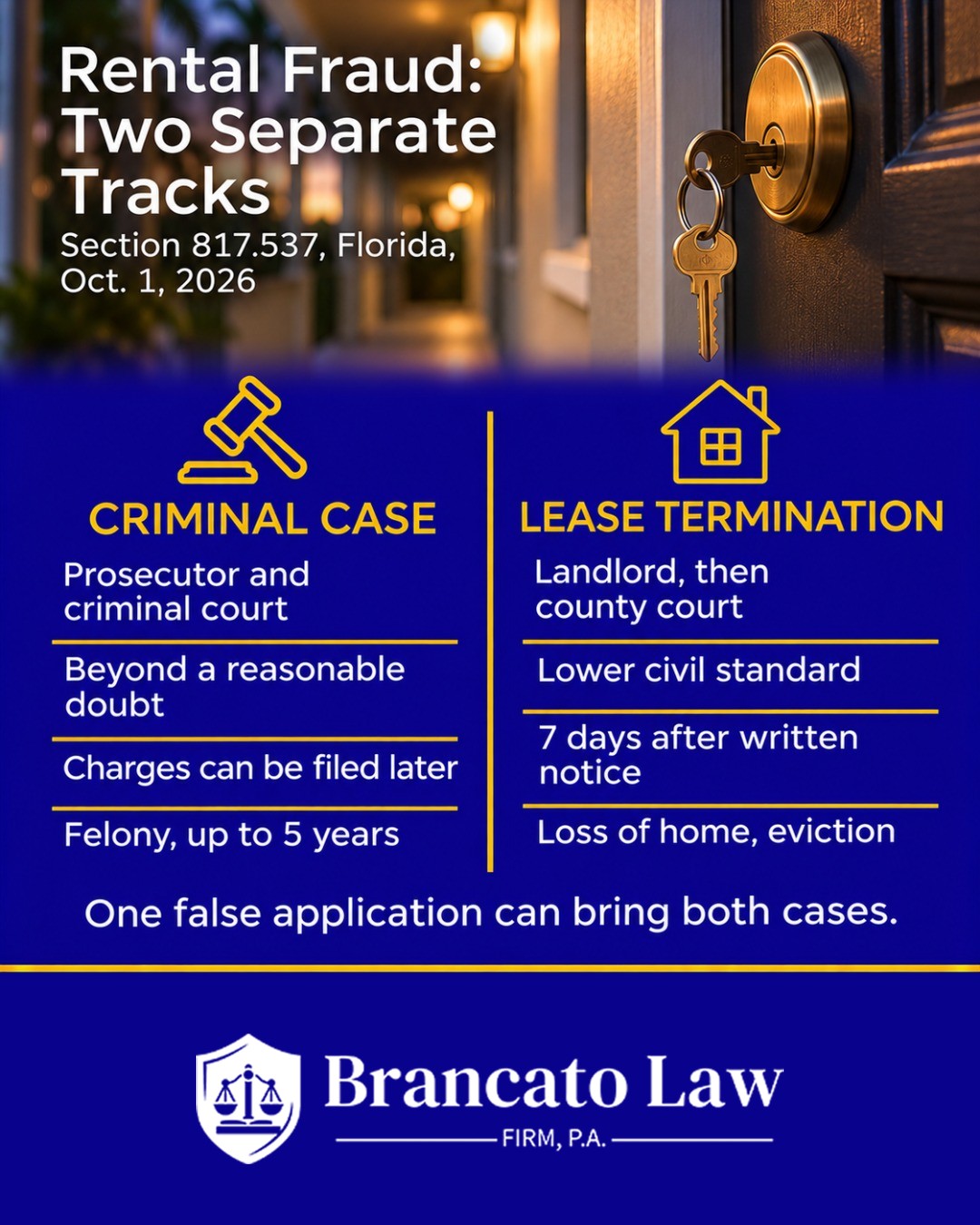
A landlord can end the lease quickly but still cannot lock a tenant out. HB 1293 amended section 83.56 so that fraudulent entry under section 817.537(2) is a lease violation that cannot be cured, “regardless of whether criminal proceedings have commenced.” The landlord can give written notice terminating the rental agreement, and the tenant has 7 days to leave.
If the tenant does not leave, the landlord must still go through a court eviction. Self-help, such as changing the locks or removing belongings, remains illegal in Florida. For tenants, a termination notice based on alleged fraud is also a warning sign that a criminal referral may follow.
| Issue | Criminal case | Civil lease termination |
|---|---|---|
| Who decides | State Attorney’s Office and a criminal court | Landlord, then county court if the tenant stays |
| Standard of proof | Beyond a reasonable doubt | Lower civil standard in an eviction case |
| Time to act | Charges can be filed later | 7 days after written notice |
| Possible outcome | Felony conviction, up to 5 years in prison | Loss of the home and an eviction judgment |
How Do You Fight a Rental Fraud Charge in Florida?
The State must prove knowledge, willfulness, materiality, and possession, and each element is open to challenge. Our Tampa white collar crime attorney team looks at these questions:
- Who prepared the application? Applications are often filled out by relatives, roommates, or third-party “approval services” that promise to get people approved. Proof that someone else made the false statement or created the document can defeat the knowledge element.
- Was the statement about identity, and was it material? A false statement under the first prong must relate to identity and be material to the landlord’s decision.
- Was the document actually forged? Screening software flags documents for many reasons, including formatting from legitimate payroll systems. The State must prove the document was forged, fictitious, or counterfeit.
- Did the person take possession? Without possession of the unit, this specific crime is not complete.
- When did it happen? The statute applies only to conduct on or after October 1, 2026.
These cases usually begin with a landlord’s complaint to police, not an arrest. If a property manager or detective has contacted you about your application, representation before charges are filed gives our attorneys a chance to resolve the dispute, often through restitution or a move-out agreement, before the State Attorney’s Office decides whether to file.
This post is part of our guide to the new Florida criminal laws that took effect October 1, 2026, which summarizes all eight laws in one place.
Frequently Asked Questions
Is lying about income on a rental application a felony in Florida?
Not by itself under the identity prong, but using a fake paystub, bank statement, or other forged document to support the claim is a third-degree felony if you take possession of the unit. The Brancato Law Firm reviews exactly what was submitted, because the difference between a false answer and a forged document can decide the charge.
Can I be arrested if my roommate lied on our rental application?
Only if the State can prove you knowingly and willfully participated in the false statement or fake document. Our attorneys at The Brancato Law Firm build a timeline of who filled out and submitted each part of the application.
Is using an “approval service” for a rental application illegal?
It can be, if the service creates fake paystubs, bank statements, or references that you knowingly submit. Applicants are sometimes misled by these services, and The Brancato Law Firm treats proof of what you were told as central to the defense, as explained by our fraud defense attorneys.
Can my landlord evict me for rental application fraud?
Yes. A landlord can terminate the lease with 7 days’ written notice and no opportunity to cure, but must still file an eviction case if you do not leave. Our attorneys at The Brancato Law Firm handle the criminal side and can coordinate with your landlord-tenant counsel.
What is the penalty for rental application fraud in Florida?
It is a third-degree felony punishable by up to five years in prison and a $5,000 fine, and a conviction can follow you into future housing and job applications. The Brancato Law Firm pursues outcomes such as diversion or dismissal after restitution where the facts support them.
Does the 2026 rental fraud law apply to squatters?
It applies to people who obtain a rental through a false identity, fake documents, or impersonation. Squatters who never had a lease are handled under Florida’s 2024 squatter removal law and trespass laws, and our attorneys at The Brancato Law Firm defend both kinds of cases.
Talk to a Tampa Fraud Defense Lawyer Today
For more about our defense strategies, visit our White Collar Crimes practice page.
A fraud complaint from a landlord can become a felony charge weeks or months later. Our attorneys will review the application, the documents, and who prepared them, and we will work to resolve the matter before charges are filed when we can. Call The Brancato Law Firm, P.A., founded by Tampa Criminal Defense Attorney Rocky Brancato, at (813) 727-7159. Call us at any hour; our office is two blocks from the courthouse. Our firm has Spanish-speaking staff, and attorney Jean-Luc Adrien speaks Spanish, Haitian Creole, and French.
The Brancato Law Firm, P.A.
620 E. Twiggs Street, Suite 205, Tampa, FL 33602
(813) 727-7159
Serving Hillsborough, Pinellas, and Pasco Counties
The Brancato Law Firm, P.A. is a Tampa-based criminal defense practice. We are not affiliated with any other Brancato-named law firms.
Visit Us

Tampa, FL 33602

Contact Us Now
Free Legal Consultation (813) 727-7159
