

From First DUI to Death Penalty



How to Fight a Carjacking Charge in Florida? (2026)


To fight a carjacking charge in Florida, the defense tests whether the State can prove that the accused took a motor vehicle from the person or custody of another, and that force, violence, assault, or fear was used as part of a continuous series of events with that taking. Carjacking under section 812.133, Florida Statutes, is a first-degree felony even when no weapon is carried, punishable by up to 30 years in prison, and up to life when a firearm or other deadly weapon is carried, with 10-20-Life mandatory minimums when a firearm is involved. The most common defenses are mistaken identity, force that was separate from the taking of the car, a dispute over a borrowed or shared vehicle, and evidence that supports only a theft charge.
As founder of The Brancato Law Firm, P.A., a Tampa criminal defense firm, and a former Chief Operations Officer of the Hillsborough County Public Defender’s Office, where I oversaw a staff of over 100 attorneys, I know how often a carjacking charge grows out of facts that look, up close, like an argument over a borrowed car. Carjacking is charged one degree above unarmed robbery, so the label alone can add years to a sentence. Across more than 25 years in Hillsborough County courtrooms and more than 150 jury trials to verdict, I have learned that these cases turn on the sequence of events, and our attorneys rebuild that sequence minute by minute from video, phone records, and the 911 call.
What is carjacking in Florida?
Carjacking is robbery of a motor vehicle. Section 812.133(1), Florida Statutes, defines it as “the taking of a motor vehicle which may be the subject of larceny from the person or custody of another, with intent to either permanently or temporarily deprive the person or the owner of the motor vehicle, when in the course of the taking there is the use of force, violence, assault, or putting in fear.”
The State must prove three things beyond a reasonable doubt:
- The accused took a motor vehicle from the person or custody of another.
- Force, violence, assault, or putting in fear was used in the course of the taking.
- The accused intended to deprive the person or owner of the vehicle, permanently or temporarily.
Two points surprise people. A temporary taking counts, so a person who meant to return the car can still be convicted. And the force can come before, during, or after the taking, as long as the force and the taking form “a continuous series of acts or events” under section 812.133(3)(b). Our Tampa violent crime lawyer page explains how our firm defends carjacking, robbery, and other violent felonies.
What are the penalties for carjacking in Florida?
Carjacking is always a first-degree felony. The weapon allegation decides whether the maximum is 30 years or life, and a firearm adds mandatory minimum prison terms.
| What the State alleges was carried | Degree | Maximum prison |
|---|---|---|
| Firearm or other deadly weapon | First-degree felony | Life |
| No firearm, deadly weapon, or other weapon | First-degree felony | 30 years |
Carjacking is one of the offenses listed in Florida’s 10-20-Life law, section 775.087(2)(a). If the accused actually possessed a firearm, the minimum is 10 years; if the firearm was discharged, 20 years; and if the discharge caused death or great bodily harm, 25 years to life. Under section 775.082(9), a carjacking committed within 3 years of release from prison also qualifies for prison releasee reoffender sentencing, which requires the statutory maximum. Our posts on Florida’s 10-20-Life law and prison releasee reoffender sentencing explain those enhancements.
How is carjacking different from robbery and grand theft of a car?
Carjacking requires force or fear connected to taking a vehicle from a person or the person’s custody. Taking a car without force or fear is usually grand theft of a motor vehicle, a third-degree felony under section 812.014, and taking other property by force is robbery under section 812.13.
| Question | Carjacking (812.133) | Robbery (812.13) | Grand theft of a motor vehicle (812.014) |
|---|---|---|---|
| What is taken? | A motor vehicle | Money or other property | A motor vehicle |
| Force, violence, assault, or fear required? | Yes, in the course of the taking | Yes, in the course of the taking | No |
| Degree with no weapon | First-degree felony | Second-degree felony | Third-degree felony |
| Maximum with no weapon | 30 years | 15 years | 5 years |
That gap is why our attorneys focus on the force element. If the State cannot connect force or fear to the taking of the car itself, the case may support only a theft charge, and the sentencing exposure drops from 30 years to 5. Our post on robbery in Florida explains the robbery statute in more detail.
When does taking car keys by force count as carjacking?
Taking keys by force or fear and then driving off in the victim’s car can be carjacking, even if the car was parked outside. In Young v. State, 141 So. 3d 161 (Fla. 2013), a man was cutting drywall alone inside a house he was renovating when the defendant approached with a gun, took his phone, keys, and wallet from his pockets, walked outside, and drove away in his truck. The Florida Supreme Court held that “the putting in fear of the victim in order to take the victim’s keys before walking outside and driving away in the victim’s car constitutes a continuous series of events,” and it affirmed the carjacking conviction.
The Court rejected the argument that the robbery ended at the door. It also pointed to evidence that the truck was the goal and not “an afterthought to the robbery of the other property.” That detail is where many defenses live. When a car is taken later, by someone who found keys after a separate confrontation ended, the State must still prove a continuous series of events. Our attorneys at The Brancato Law Firm build the timeline to show any break between the force and the taking.
How do Tampa defense attorneys fight a carjacking charge?
The strongest defenses challenge identity, the link between force and the taking, the relationship between the people involved, and the firearm allegation. Our attorneys work through each one:
- Mistaken identity. Carjackings are fast, often at night, and often involve a weapon that draws the victim’s eye. We test every lineup and show-up identification.
- Force separate from the taking. If the confrontation ended before the car was taken, or the car was taken by someone else, the force may not be “in the course of the taking.”
- Borrowed or shared vehicles. Disputes between partners, roommates, or acquaintances over a car the accused had permission to use can be charged as carjacking. Texts, payment records, and prior use of the car often show what really happened.
- No taking from the person or custody. The State must show the victim had custody or control of the vehicle at the time.
- The firearm allegation. Whether a real firearm was actually possessed or discharged decides the 10-20-Life minimum, and the State must prove it.
- Presence is not participation. Riding in a car after it was taken, without taking part in the force, does not make a person a principal to carjacking.
- Suppression. Statements taken without Miranda warnings and evidence from unlawful searches of phones or cars can be excluded.
How reliable are carjacking identifications?
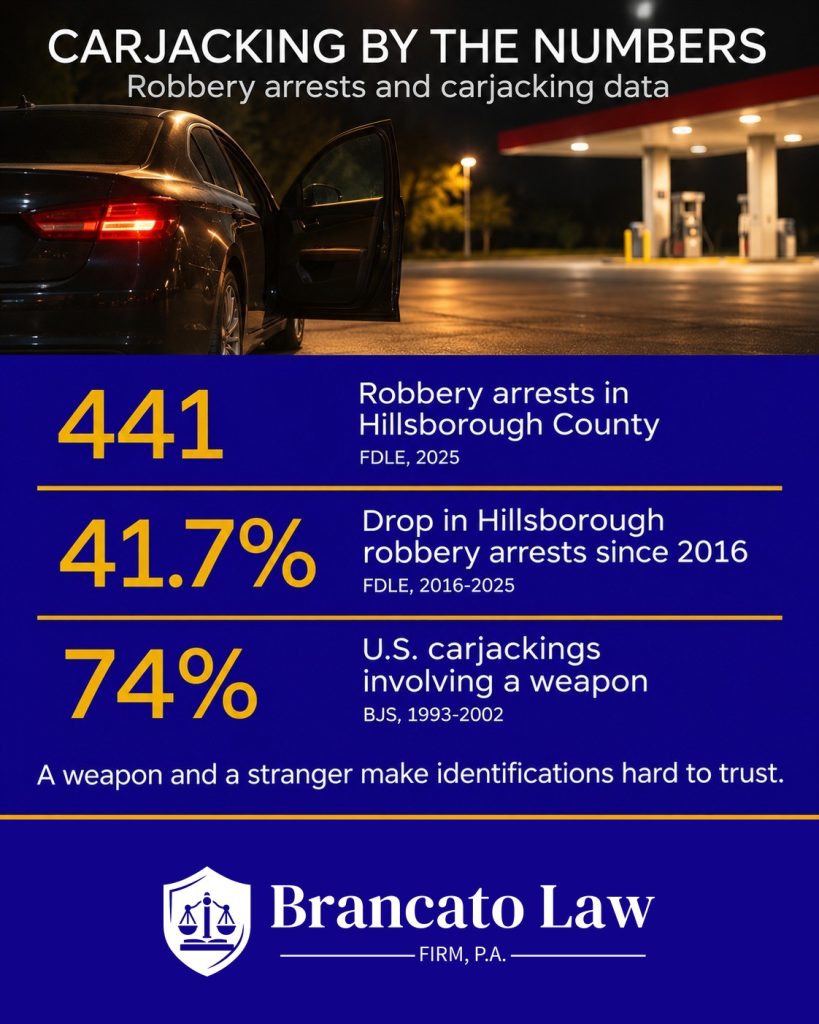
Carjacking identifications are often unreliable because the victim sees a stranger briefly, under stress, with a weapon present. A Bureau of Justice Statistics report, Carjacking, 1993-2002, published in 2004, found that a weapon was used in 74 percent of carjacking victimizations and a firearm in 45 percent, and that 93 percent of carjackings occurred in cities or suburbs. Those figures are older, but they describe the conditions that make identifications hard: a weapon, a stranger, and seconds to look.
Florida’s eyewitness identification statute, section 92.70, requires most police lineups to be run by an independent administrator or a blind alternative method, and it requires officers to tell the witness that the perpetrator might not be in the lineup. When officers skip those steps, the judge must consider that failure on a motion to suppress, and the jury can be told to weigh it. The Brancato Law Firm requests the lineup paperwork and any recording in every carjacking case.
How common are robbery arrests in Hillsborough County?
Robbery arrests in Hillsborough County have dropped over the past decade. In 2025, Hillsborough County recorded 441 robbery arrests, down from 757 in 2016, a 41.7 percent decline, according to Florida Department of Law Enforcement arrest data published by the Florida Department of Health on FLHealthCHARTS. Florida recorded 6,462 robbery arrests statewide in 2025. The dataset does not report carjacking as a separate category.
Lower arrest numbers have not softened charging. Our attorneys at The Brancato Law Firm see carjacking filed in the 13th Judicial Circuit whenever a car changes hands during a confrontation, because the first-degree felony and firearm minimums give prosecutors leverage in plea talks.
What happens after a carjacking arrest in Hillsborough County?
After an arrest, the accused sees a judge at first appearance within 24 hours. In Hillsborough County, the judge sits downtown and the arrested person appears by video from the jail, at 1:30 p.m. on weekdays and 10:00 a.m. on weekends and holidays, and the judge decides bond, release conditions, or detention. Because carjacking is a violent first-degree felony, the State often asks for high bond or pretrial detention. Our guide to the Florida criminal case process explains each stage that follows.
- Do not discuss the case with detectives, cellmates, or anyone on a recorded jail call.
- Save texts, payment apps, and messages that show permission to use the car or the history between the people involved.
- Preserve phone location data and receipts that show where you were.
- Do not contact the alleged victim.
- Call a defense attorney before first appearance if possible. If detectives are still investigating, representation before charges are filed can influence what the State Attorney’s Office files.
Frequently asked questions about carjacking charges in Florida
Can carjacking charges be dropped in Florida?
Yes. Prosecutors drop or reduce carjacking charges when the identification is weak, the force was separate from the taking, or the facts show a dispute over a car the accused was allowed to use. The Brancato Law Firm assembles that evidence early and presents it to the State Attorney’s Office, often through pre-file advocacy before charges are filed.
Is it carjacking if I meant to give the car back?
Yes, it can be. The statute covers an intent to deprive the owner of the car “permanently or temporarily,” so a plan to return the car is not a defense to carjacking by itself. Our attorneys at The Brancato Law Firm focus instead on whether force or fear was part of the taking, which is the element that separates carjacking from a lesser theft charge.
Can I be charged with carjacking for taking my partner’s car during an argument?
Yes, if the State claims you used force or fear to take a car that was in your partner’s custody. These cases often turn on who owned the car, who had permission to drive it, and whether the force was part of the taking. The Brancato Law Firm gathers the texts, title, and payment history that tell that story, and our Tampa carjacking defense page describes this work.
Is carjacking a life felony in Florida?
Not technically. Carjacking is a first-degree felony, but when a firearm or other deadly weapon was carried, the statute allows a term of years up to life. Our attorneys at The Brancato Law Firm attack the weapon allegation early because it sets both the maximum and any 10-20-Life minimum.
Can a teenager be charged as an adult for carjacking in Florida?
Yes. Florida law lets prosecutors file adult charges against some juveniles accused of serious felonies, and carjacking is among the offenses that can be charged in adult court. The Brancato Law Firm argues for keeping a young client in juvenile court, and our post on juvenile and student cases explains what is at stake.
Can I get bond on a carjacking charge in Hillsborough County?
Often, but not always. The first appearance judge decides bond or detention, and the State frequently seeks pretrial detention for violent first-degree felonies. The Brancato Law Firm prepares bond arguments with work, family, and residence information, and our post on bond hearings in Tampa explains the process.
Talk to a Tampa carjacking defense attorney
Video from gas stations, doorbells, and traffic cameras is often overwritten within days, and it can decide whether force was part of the taking. Our attorneys will move to preserve it from the first call. Call The Brancato Law Firm, P.A., founded by Tampa Criminal Defense Attorney Rocky Brancato, at (813) 727-7159. You can call us at any hour, and our office is two blocks from the courthouse. Our firm has Spanish-speaking staff, and attorney Jean-Luc Adrien speaks Spanish, Haitian Creole, and French. For more about our defense strategies, visit our Violent Crimes page.
The Brancato Law Firm, P.A.
620 E. Twiggs Street, Suite 205, Tampa, FL 33602
(813) 727-7159
Serving Hillsborough, Pinellas, and Pasco Counties
The Brancato Law Firm, P.A. is a Tampa-based criminal defense practice. We are not affiliated with any other Brancato-named law firms.
Visit Us

Tampa, FL 33602

Contact Us Now
Free Legal Consultation (813) 727-7159
