

From First DUI to Death Penalty



How to Fight a Burglary Tools Charge in Florida? (2026)


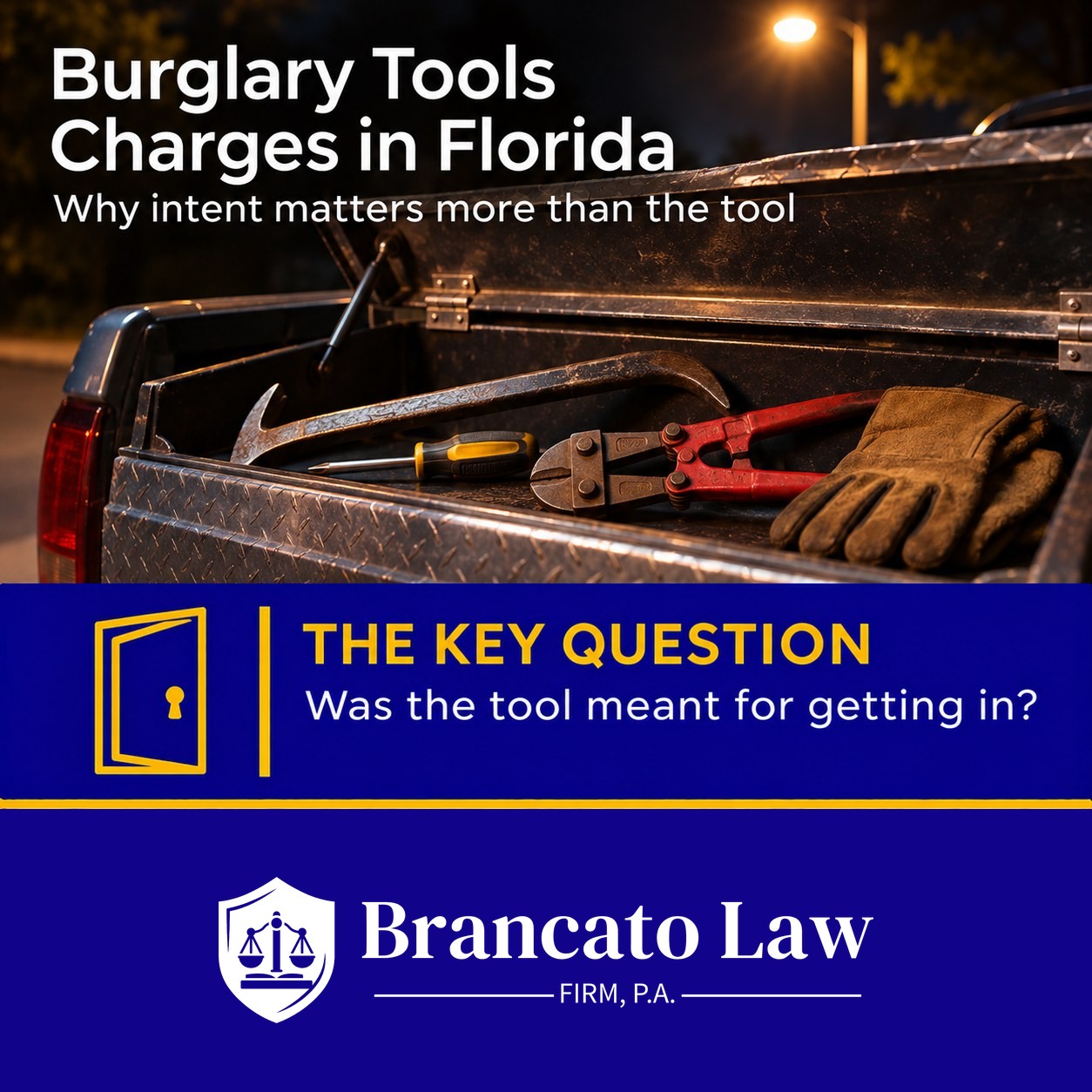
To fight a possession of burglary tools charge in Florida, the defense attacks intent: under section 810.06, the State must prove you had the tool intending to use it to get into a building, vehicle, or property unlawfully, not just that you had a screwdriver, a flashlight, or gloves. The charge is a third-degree felony with up to 5 years in prison. The Florida Supreme Court has held that a tool used only to steal after entry, rather than to get in, does not qualify, and that gloves and other clothing are not burglary tools at all.
A Florida judge looking at a burglary tools charge asks one question first: what does the evidence show this person planned to do with this tool? I’m Rocky Brancato, founder of The Brancato Law Firm, P.A., a Tampa criminal defense firm, and I have tried more than 150 jury trials to verdict over more than 25 years in Hillsborough County courtrooms. Our attorneys defend burglary tools charges in Hillsborough, Pinellas, and Pasco Counties, usually alongside the burglary, trespass, or vehicle charge that came with them.
What is possession of burglary tools in Florida?
Possession of burglary tools is having any tool, machine, or implement with the intent to use it, or let someone else use it, to commit a burglary or trespass. The crime is defined in section 810.06, Florida Statutes, and it is a third-degree felony. The statute does not list forbidden tools. A screwdriver, a pry bar, bolt cutters, a slim jim, or a window punch can all qualify, and the same items are legal to own and carry every day.
That is why the case turns on intent, not on the tool. The charge usually appears with a burglary count under section 810.02, which our guide to fighting burglary charges in Florida explains, or with a trespass count. Our attorneys cover the full range of these cases on our Tampa theft and burglary defense attorney page.
What does the State have to prove?
The State must prove two things: that you possessed the item, and that you intended to use it (or allow its use) to commit a burglary or trespass. Florida courts have narrowed both elements in ways that matter in real cases.
| Element | What the State must show | What our attorneys test |
|---|---|---|
| Possession | You had the tool on you or under your control | Was it in a shared car, a work truck, or someone else’s bag? |
| A tool, machine, or implement | An object that can help someone get in | Is it clothing, such as gloves, which the Florida Supreme Court says does not count? |
| Intent to commit a burglary or trespass | You meant to use it to unlawfully enter | Was it used, or meant, only for some other purpose, such as work or theft after entry? |
What are the penalties for possession of burglary tools in Florida?
Possession of burglary tools is a third-degree felony punishable by up to 5 years in prison and a $5,000 fine. The Criminal Punishment Code ranks it at Level 4 in section 921.0022, the same level as burglary of an unoccupied structure or vehicle.
| Charge | Degree | Maximum prison | Offense level |
|---|---|---|---|
| Possession of burglary tools (s. 810.06) | Third-degree felony | 5 years | Level 4 |
| Burglary of an unoccupied structure or conveyance, unarmed (s. 810.02(4)) | Third-degree felony | 5 years | Level 4 |
| Trespass in a structure or conveyance, no one inside, unarmed (s. 810.08(2)(a)) | Second-degree misdemeanor | 60 days | Not scored as a felony |
A Level 4 offense alone does not require a state prison sentence for a person with no prior record, so probation, a withhold of adjudication, or diversion is often possible. The bigger danger is the felony itself: a burglary tools count can turn a misdemeanor trespass arrest into a felony case, and dismissing it can bring the whole case back to misdemeanor level.
How do our attorneys fight a burglary tools charge in Florida?
Our attorneys fight burglary tools charges by separating the tool from the entry. These are the four defenses we look at first:
- The item is not a “tool, machine, or implement.” Gloves and other clothing do not qualify.
- The tool was not used or meant for getting in. A tool used to steal or drive away after entry does not make the count.
- No proof of intent. Ordinary tools carried for work or daily life do not prove a plan to break in.
- No possession. A tool in a shared car, a borrowed truck, or a friend’s backpack may not be yours.
Gloves are not burglary tools: what Green shows
Clothing cannot support the charge. In Green v. State, 604 So. 2d 471 (Fla. 1992), a man was arrested wearing a jumpsuit and garden gloves and was convicted of possessing burglary tools based on the gloves. The Florida Supreme Court reversed, holding that “items of personal apparel, such as common gloves, are not included” in the statute. The Court recognized that gloves can help avoid fingerprints, but they do not “actually facilitate the breaking and entering” of a building.
The tool must be for getting in: what Calliar shows
A tool used to steal after entry is not a burglary tool. In Calliar v. State, 760 So. 2d 885 (Fla. 1999), the Florida Supreme Court quashed a burglary tools conviction and adopted the rule that the State must show the defendant “used, or actually intended to use,” the tool to commit a burglary or trespass. The Court approved a Third District case in which a screwdriver was used to break a car’s steering column and start the car: that proved a theft, but not a burglary tool, because there was no evidence the screwdriver was used to get inside. In the Court’s words, the crime is “possession of tools used or intended to be used to unlawfully enter the premises of another.”
A Hillsborough County case: what T.R.C. shows
The rule protects people in our own courthouse. In T.R.C. v. State, No. 2D18-4295 (Fla. 2d DCA Feb. 19, 2020), a young defendant identified by his initials was arrested in Hillsborough County in a car that had been left unlocked with the key in the glove box, and officers found two blue latex gloves in his pocket. He was found guilty of possession of burglary tools along with other charges. The Second District reversed the burglary tools count and ordered it dismissed, explaining that “there was no evidence to suggest T.R.C. used any tool to facilitate his entry into the vehicle,” and that the gloves, as in Green, could not be burglary tools. When a vehicle burglary arrest in Hillsborough County includes a tools count, our attorneys ask first how the car was actually entered.
Why do burglary tools charges so often fail on the facts?
Because many burglaries involve no tool at all. The Bureau of Justice Statistics separates burglaries into forcible entry, attempted forcible entry, and unlawful entry without force, and its 2010 report on victimization during household burglary (covering 2003 to 2007) found that damaging or removing a door was the most common type of entry in forcible burglaries. In the unlawful entry cases where a resident was home, 18% of residents said someone inside let the offender in. A tool charge only fits a case where something was used, or meant to be used, to get in.
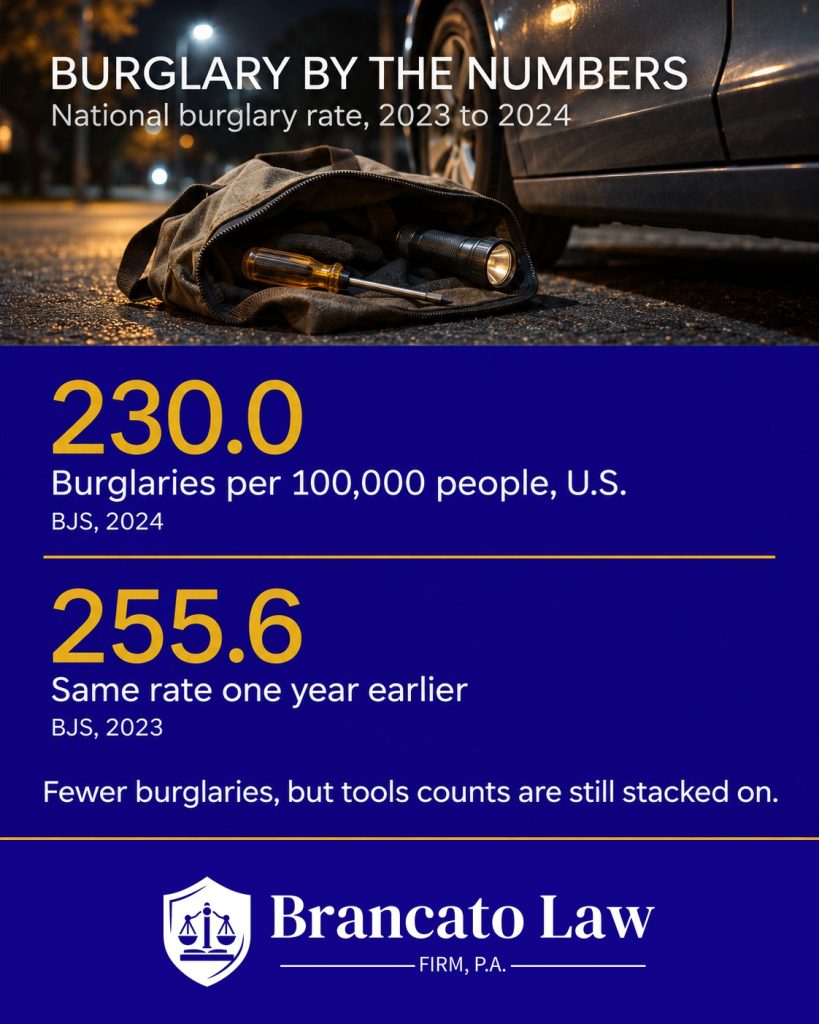
Burglary is also less common than it was. According to the Bureau of Justice Statistics report Crime Known to Law Enforcement, 2024 (March 2026), the national burglary rate fell from 255.6 per 100,000 people in 2023 to 230.0 per 100,000 in 2024. Fewer cases do not mean softer charging, though: in Hillsborough County vehicle burglary arrests, a tools count is often added on top of the burglary or theft charge, and it is frequently the weakest count in the information.
What should you do if you are charged with possession of burglary tools?
If you are charged with possession of burglary tools, do not explain to police why you had the tools, and get a lawyer involved before the State files its formal charges. Your explanation may be completely innocent, but police reports often record it in a way that sounds like an admission. Our attorneys provide representation before charges are filed to give the prosecutor the innocent explanation in a form that helps you.
- Keep proof of why you had the tools: pay stubs, a contractor license, work orders, or a boss who can confirm your job.
- Write down who else used the car or bag where the tools were found.
- Do not post about the arrest or discuss it on recorded jail calls.
- Ask about diversion. First-time offenders may qualify for a pretrial program, as explained in our guide to the Hillsborough County PTI program.
If you are arrested, the case moves to first appearance within 24 hours, where bond is set. Our guide to the stages of a Florida criminal case explains what comes next, from arraignment to trial.
Frequently asked questions about burglary tools charges in Florida
Can a burglary tools charge be dropped in Florida?
Yes. Prosecutors often drop the tools count when the evidence shows no tool was used to get in, when the item is clothing such as gloves, or when the person had an innocent reason to carry it. The Brancato Law Firm raises those problems early, and our Tampa burglary defense lawyers often resolve the tools count before trial.
Is it illegal to carry a screwdriver or crowbar in my car in Florida?
No. Carrying ordinary tools is legal; the crime requires proof that you intended to use them to commit a burglary or trespass, as Calliar v. State makes clear. Our attorneys at The Brancato Law Firm use work records and the circumstances of the stop to show why the tools were there.
Are gloves or a mask considered burglary tools?
Gloves are not, because the Florida Supreme Court held that clothing is not a “tool, machine, or implement” under section 810.06. The Brancato Law Firm moves to dismiss or for acquittal when a tools count rests only on apparel, the same argument that won in the Hillsborough County case of T.R.C. v. State.
Can I be charged with burglary tools if no burglary happened?
Yes. The crime is complete when a person has the tool with the required intent, even if no break-in occurs, so the State relies on circumstances such as location, time, and behavior. Our attorneys at The Brancato Law Firm challenge those inferences, and our guide to trespass charges in Florida explains the related misdemeanor that often comes with these arrests.
Will a burglary tools conviction go on my record if I am a juvenile?
A juvenile case is handled differently, but a delinquency adjudication can still follow a young person into school and job applications. The Brancato Law Firm looks for juvenile diversion first and pushes to keep a tools count from becoming the felony on a young client’s record.
For more about our defense strategies, visit our Theft and Property Crimes page.
The tools count is often the easiest charge in the case to beat, but the State’s first filing decision comes quickly. Talk to our attorneys about what the police report says and how the tools were actually found: call The Brancato Law Firm, P.A., founded by Tampa Criminal Defense Attorney Rocky Brancato, at (813) 727-7159. Call us at any hour; our office is two blocks from the courthouse. Our firm has Spanish-speaking staff, and attorney Jean-Luc Adrien speaks Spanish, Haitian Creole, and French.
The Brancato Law Firm, P.A.
620 E. Twiggs Street, Suite 205, Tampa, FL 33602
(813) 727-7159
Serving Hillsborough, Pinellas, and Pasco Counties
The Brancato Law Firm, P.A. is a Tampa-based criminal defense practice. We are not affiliated with any other Brancato-named law firms.
Visit Us

Tampa, FL 33602

Contact Us Now
Free Legal Consultation (813) 727-7159
