- Free Consultation 24/7: (813) 727-7159 Tap Here To Call Us


From First DUI to Death Penalty



How to Fight a Burglary Charge in Florida (2026)


Updated October 22, 2026
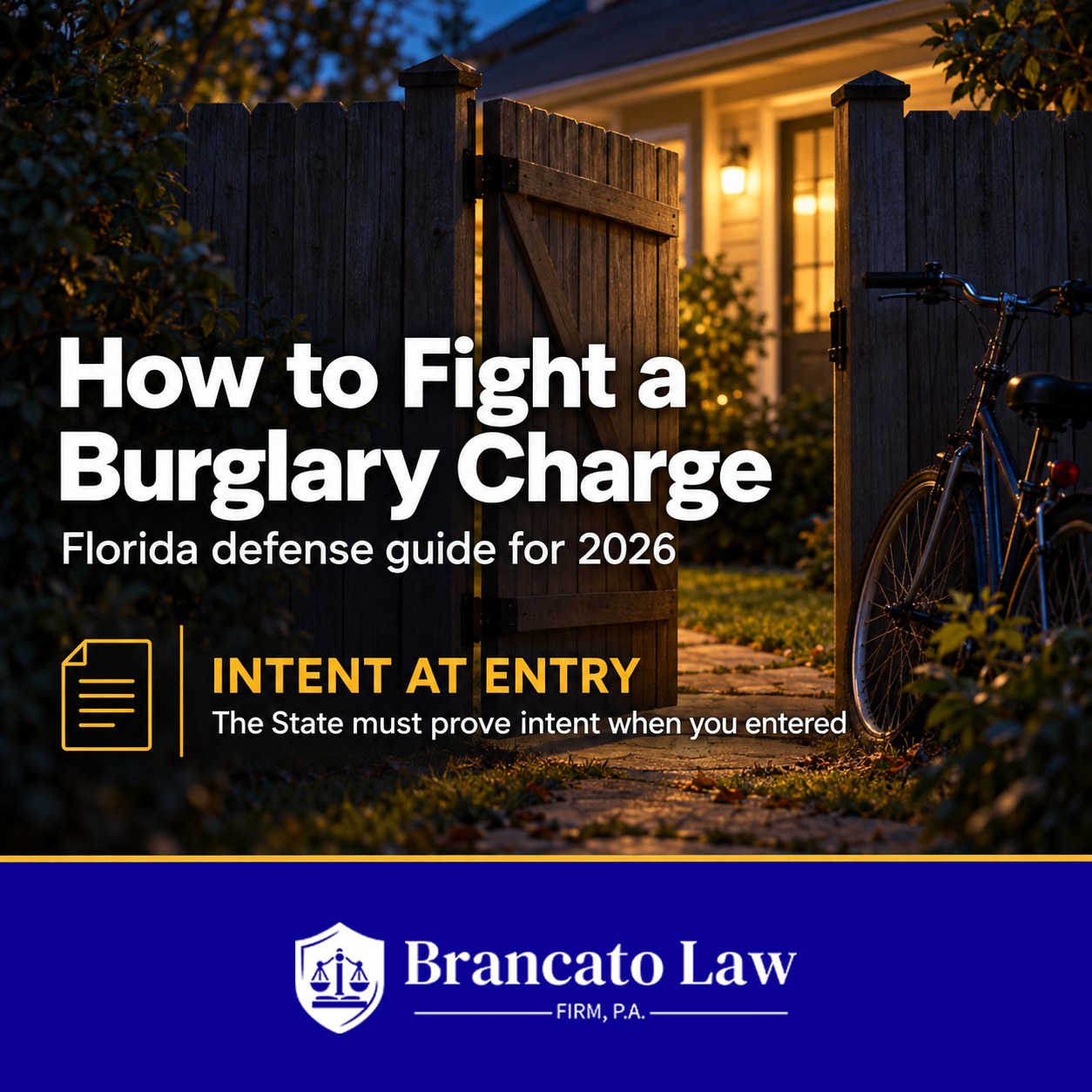
To fight a burglary charge in Florida, make the State prove intent: that you meant to commit a crime inside at the moment you entered or remained. Under section 810.02, an entry without that intent is not burglary, and an entry into a place open to the public or one you were invited into is not burglary unless one of the statute’s “remaining in” theories applies. Other defenses test whether the place was a dwelling, structure, or conveyance (a yard counts only if it is enclosed), whether the State can use the stealthy-entry inference, and whether the facts fit trespass, a misdemeanor in most cases. Burglary ranges from a third-degree felony to a first-degree felony punishable by life.
If you were arrested for burglary in Hillsborough County, the case against you probably rests less on what was taken than on what the State says you intended when you walked in. My name is Rocky Brancato. Before I founded The Brancato Law Firm, P.A., a Tampa criminal defense firm, I served in the Major Crimes Unit of the Hillsborough County Public Defender’s Office, and I have spent more than 25 years in Hillsborough County courtrooms. Our attorneys defend burglary charges of every degree in Hillsborough, Pinellas, and Pasco Counties, from car burglaries to armed burglary of a dwelling, and we start with the intent evidence and the exact place the State says you entered.
What does the State have to prove in a Florida burglary case?
The State must prove that you entered or remained in a dwelling, structure, or conveyance with the intent to commit an offense inside. For offenses after July 1, 2001, section 810.02(1)(b), Florida Statutes, defines burglary two ways:
- Entering “a dwelling, a structure, or a conveyance with the intent to commit an offense therein, unless the premises are at the time open to the public or the defendant is licensed or invited to enter.”
- Remaining in a dwelling, structure, or conveyance, even after a licensed or invited entry, “a. Surreptitiously, with the intent to commit an offense therein; b. After permission to remain therein has been withdrawn, with the intent to commit an offense therein; or c. To commit or attempt to commit a forcible felony.”
The three “remaining in” theories have a history. In Delgado v. State, 776 So. 2d 233 (Fla. 2000), the Florida Supreme Court held that after a consensual entry, “remaining in” covered only surreptitious remaining. The Legislature responded with the current text for offenses after July 1, 2001. So when a case begins with an invitation, such as a guest, a contractor, or a former partner, our attorneys ask which of the three theories the State is using and whether it can prove it. Our Hillsborough County criminal defense attorney team builds the defense around that answer.
What counts as a dwelling, structure, or conveyance?
Each term has a statutory definition, and the definition often decides the degree. Under section 810.011, Florida Statutes:
| Term | Statutory definition (key words) |
|---|---|
| Structure | “a building of any kind, either temporary or permanent, which has a roof over it, together with the curtilage thereof” |
| Dwelling | “a building or conveyance of any kind, including any attached porch,” with a roof, “designed to be occupied by people lodging therein at night, together with the curtilage thereof” |
| Conveyance | “any motor vehicle, ship, vessel, railroad vehicle or car, trailer, aircraft, or sleeping car,” and “to enter a conveyance” includes “taking apart any portion of the conveyance” |
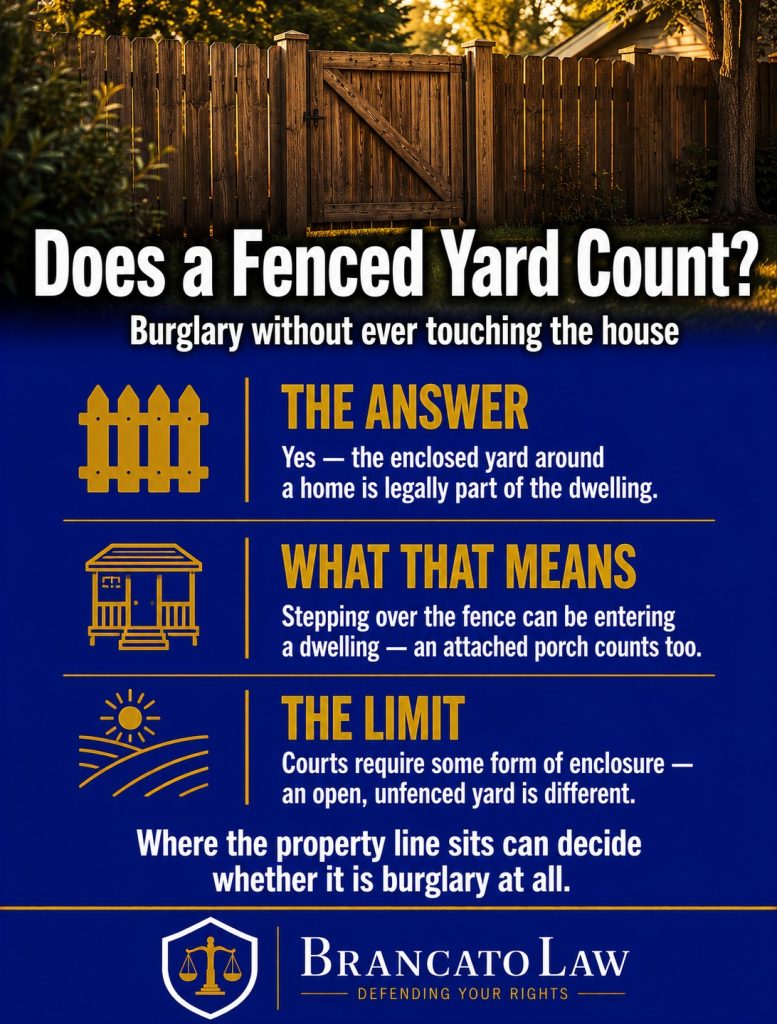
The statute does not define curtilage, and the courts require an enclosure. In State v. Hamilton, 660 So. 2d 1038 (Fla. 1995), two men took outboard motors from a boat in a backyard bordered only by “several unevenly spaced trees,” and the homeowner shot one of them. The Florida Supreme Court held that the burglary statute carries forward “the common law requirement of some form of an enclosure in order for the area surrounding a residence to be considered part of the ‘curtilage.'” The burglary charge, and the felony murder charge built on it, could not stand.
A porch is different, because the statute names it. In Sublett v. State, 403 So. 3d 239 (Fla. 4th DCA 2025), a homeowner entered the screened porch she rented month to month to a tenant, who had told her repeatedly to “stay out,” and took part of the tenant’s medical marijuana. The Fourth District held the porch was a dwelling and that the tenant’s occupancy was “possession which is rightful as against the burglar,” so owning the house did not authorize the entry. Our post on whether a porch is a dwelling under Florida burglary law covers the porch cases in more detail.
What are the penalties for burglary in Florida?
The degree depends on what kind of place was entered, whether anyone was inside, and whether there was a weapon, an assault, or damage. The table reflects section 810.02 as it reads in 2026; the text has not changed since 2021.
| Circumstance | Degree | Maximum penalty |
|---|---|---|
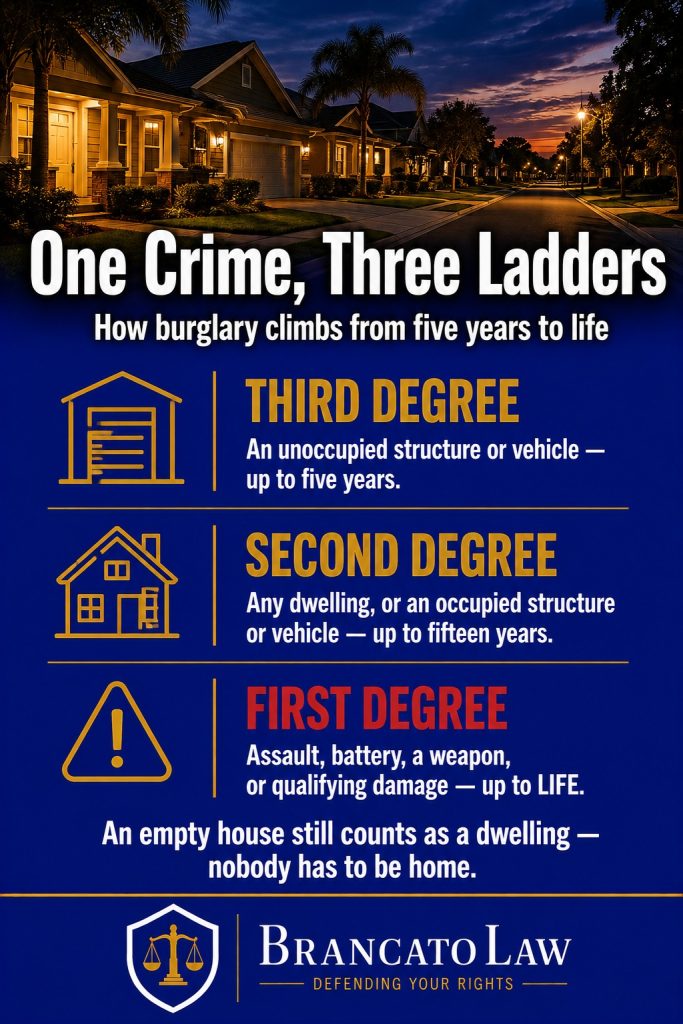
| Assault or battery on any person; being or becoming armed inside with explosives or a dangerous weapon; using a motor vehicle to damage the building; or causing more than $1,000 in damage | First-degree felony | Up to life in prison |
| Any dwelling, occupied or not; a structure or conveyance with a person inside; an authorized emergency vehicle; or a structure or conveyance entered to steal a controlled substance | Second-degree felony | 15 years in prison, $10,000 fine |
| An unoccupied structure or unoccupied conveyance | Third-degree felony | 5 years in prison, $5,000 fine |
Firearms add a mandatory minimum. Burglary is on the 10-20-Life list in section 775.087(2)(a), Florida Statutes, so actual possession of a firearm during a burglary carries a 10-year minimum, except burglary of a conveyance, which carries 3 years. Our guide to Florida’s 10-20-Life law explains the higher tiers. The Brancato Law Firm checks every fact the State uses to move a case up the table, because the difference between “occupied” and “unoccupied,” or a dwelling and a structure, can be 10 years of exposure.
What happens if a burglary happens during a state of emergency?
The charge goes up one degree if the burglary was made easier by the emergency. Under the closing paragraphs of section 810.02(3) and (4), a burglary committed during a riot, or in a county under a state of emergency declared by the Governor, is raised one degree when “the perpetration of the burglary is facilitated by conditions arising from the emergency.” Those conditions are “civil unrest, power outages, curfews, voluntary or mandatory evacuations, or a reduction in the presence of or response time for first responders or homeland security personnel.” A second-degree burglary becomes a first-degree felony, and a third-degree burglary becomes a second-degree felony.
The same paragraphs add a release rule: a person arrested for a burglary under these conditions “may not be released until the person appears before a committing magistrate at a first appearance hearing.” During a Governor-declared emergency, such as a hurricane, section 810.011 also treats the remnants of a damaged building in the covered area as a structure or dwelling “regardless of absence of a wall or roof.” Our attorneys at The Brancato Law Firm make the State prove the link between the emergency and the alleged burglary, which the statute requires and arrest reports often skip.
How do you fight a burglary charge in Florida?
You fight a burglary charge by attacking the element the State proves least directly, which is usually intent. These are the defenses our attorneys raise most often:
- No intent at the time of entry. In C.G. v. State, No. 3D24-1813 (Fla. 3d DCA Aug. 27, 2025), a juvenile case, the Third District held that “the State must establish the juvenile’s intent to commit an offense at the time he enters,” and reversed because “the State did not present evidence of intent to commit an offense therein when C.G. entered the yard.” The burglary was reduced to simple battery. A crime committed after an entry does not, by itself, prove the person entered intending it.
- The entry was not stealthy. The State often relies on the inference in section 810.07, Florida Statutes: entry “stealthily and without consent of the owner or occupant thereof is prima facie evidence of entering with intent to commit an offense.” In Lanzo v. State, 73 So. 3d 817 (Fla. 5th DCA 2011), the defendant was seen “at the open garage door of a house on a residential street during daylight hours and in full view of any passerby,” then walked away and spoke with the homeowner and police. The Fifth District held that “stealthily” means “surreptitious, furtive, or sly,” that the jury should not have heard the instruction, and ordered a new trial. An entry through an open door in daylight may not be stealthy.
- The place was open, or you were invited. The statute excludes premises “open to the public” and entries where “the defendant is licensed or invited to enter.” The State must then prove one of the three remaining-in theories.
- The place does not qualify. An unenclosed yard is not curtilage under Hamilton. If the State cannot prove a roof, an enclosure, or that a vehicle was a conveyance, the burglary charge fails or drops a degree.
- The State has the wrong person. Video, fingerprints, and phone location records must connect the client to the entry itself, not just to the neighborhood or to property found later.
Companion counts need their own proof. In Russell v. State, No. 2D2024-1373 (Fla. 2d DCA Aug. 28, 2026), a Tampa case, a homeowner found two strange bicycles at his back gate, and Tampa police called out Russell and a codefendant carrying watches, cameras, and other items. The appellate court left the burglary conviction in place (it was not challenged) and reversed the grand theft count because there was no testimony about depreciation or fair market value, reducing it to second-degree petit theft. Our guide on how to fight a theft charge in Florida explains how value is proven.
Is trespass a lesser charge than burglary?
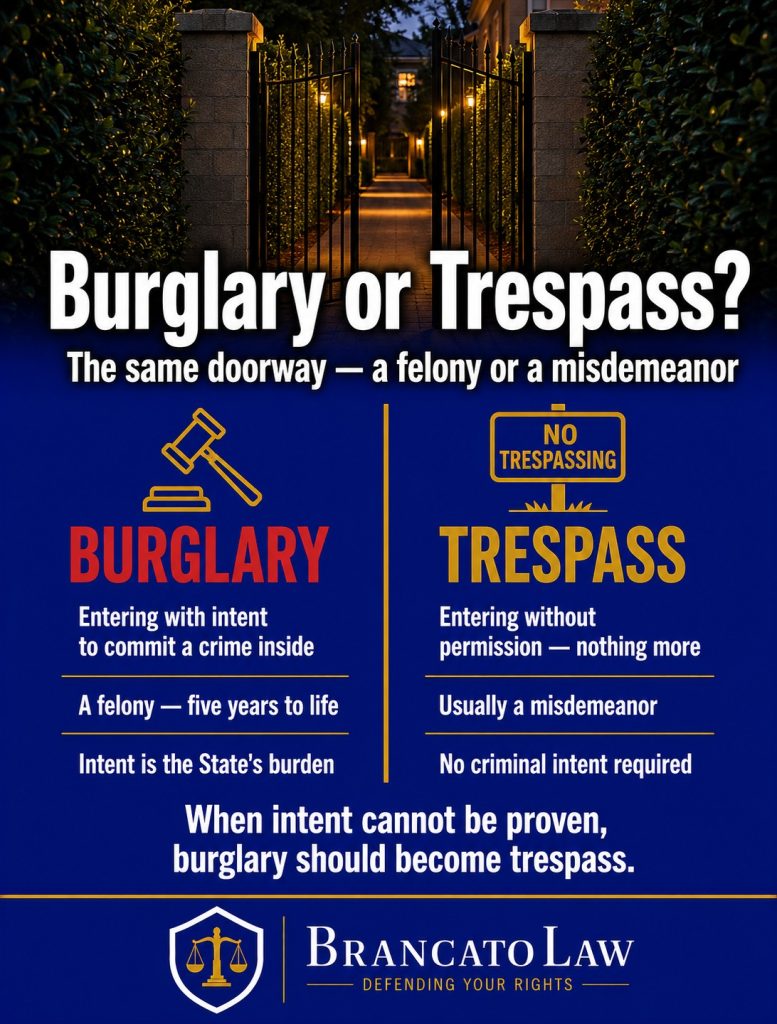
Yes. Trespass is the most common lesser offense in a burglary case, and it is usually a misdemeanor. The difference is intent: trespass needs only an unauthorized entry or refusal to leave, while burglary requires intent to commit an offense inside.
| Charge | Statute | Usual degree |
|---|---|---|
| Burglary of a dwelling, structure, or conveyance | § 810.02 | Third-degree felony to first-degree felony punishable by life |
| Trespass in a structure or conveyance | § 810.08 | Second-degree misdemeanor; first-degree misdemeanor if a person is inside; third-degree felony if armed |
| Trespass on property, including the unenclosed curtilage of a home | § 810.09 | First-degree misdemeanor; third-degree felony if armed |
The unenclosed yard is trespass territory. Section 810.09 covers entering “the unenclosed curtilage of a dwelling” with intent to commit an offense there. Florida also added a new trespass felony in 2025: chapter 2025-30, Laws of Florida, created section 810.09(2)(k), which makes it a third-degree felony to trespass on an area secured by law enforcement and posted as a designated restricted site. Our post on trespass in Florida covers those charges, and The Brancato Law Firm often argues for trespass as the right outcome when intent cannot be proven.
How common are burglary arrests in Hillsborough County?
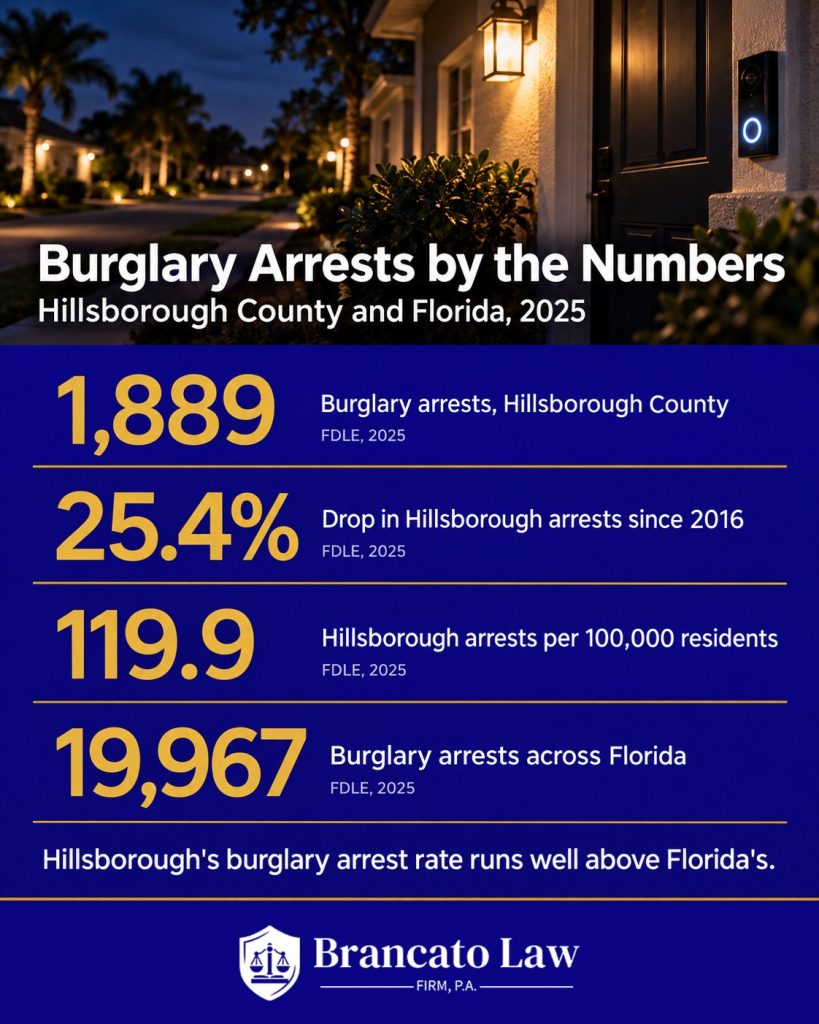
Common, though less so than a decade ago. In 2025, Hillsborough County recorded 1,889 burglary arrests, according to FDLE arrest data published by Florida Health CHARTS, down from 2,531 in 2016, a 25.4% drop. Florida recorded 19,967 burglary arrests in 2025. Hillsborough’s 2025 arrest rate was 119.9 per 100,000 residents, compared with 85.4 per 100,000 for Florida as a whole. These figures count arrest events, not reported burglaries.
Many burglary accusations involve people who know each other. A Bureau of Justice Statistics report by Shannan Catalano, Victimization During Household Burglary (2010), found that about 7% of household burglaries from 2003 to 2007 involved violence, and in those violent burglaries the victim knew the offender 65% of the time. When the accused and the accuser have a history, consent, invitation, and withdrawn permission become the center of the case, and our attorneys at The Brancato Law Firm gather the texts and witnesses that show it.
What happens after a burglary arrest in Hillsborough County?
A person arrested for burglary in Hillsborough County sees a judge at first appearance within 24 hours, usually at the Orient Road Jail. Burglary is on the list of charges that require a first appearance before release, and burglary of a dwelling is a “dangerous crime,” so the judge cannot grant nonmonetary release at that hearing. The State Attorney’s Office for the 13th Judicial Circuit then decides what to file in the charging information, and that decision is the first chance to move the case from burglary to trespass.
Take four steps after a burglary arrest:
- Say nothing about why you were there. Intent is the State’s hardest element, and a casual explanation can supply it.
- Preserve your own evidence. Texts showing an invitation, a key, a lease, or a work order can defeat the case.
- Identify video now. Doorbell, neighborhood, and business cameras often overwrite in days.
- Get a lawyer involved before the filing decision. Our attorneys contact the prosecutor with the facts that support a lesser charge or no charge.
Frequently asked questions about burglary charges in Florida
Can burglary charges be dropped in Florida?
Yes. Burglary charges can be dropped or reduced to trespass when the State cannot prove intent at entry, when the place does not qualify, or when an invitation or consent defeats the entry element. The Brancato Law Firm presents those facts to the State Attorney’s Office before the filing decision whenever possible.
Is entering a fenced backyard burglary in Florida?
It can be. An enclosed yard is curtilage, so entering it with intent to commit an offense can be charged as burglary of the dwelling, while an unenclosed yard is not curtilage under State v. Hamilton. Our attorneys at The Brancato Law Firm look at photos and surveys of the fence line, because a gap or missing enclosure can change the charge.
Can you be charged with burglary of your own home in Florida?
Yes, if someone else has the right to occupy it. In Sublett, a homeowner was convicted of burglary for entering the porch she rented to a tenant, and The Brancato Law Firm reviews leases and landlord-entry rights in these cases, as our porch burglary post explains.
Is breaking into a car a felony in Florida?
Yes. Burglary of an unoccupied conveyance is a third-degree felony, and burglary of a conveyance with a person inside is a second-degree felony. The Brancato Law Firm checks whether the State can prove entry and intent, keeping in mind that under section 810.011(3) “to enter a conveyance” includes taking apart any portion of it, as described on our Hillsborough County criminal defense page.
What is the difference between burglary and trespass in Florida?
Burglary requires intent to commit an offense inside, and trespass does not. Our attorneys at The Brancato Law Firm often negotiate or try burglary cases toward trespass, which our trespass guide covers in full.
Should I talk to a detective who wants to ask about a burglary?
No, not without a lawyer, because intent is usually proven from the accused person’s own words and an interview can create the evidence the State lacks. The Brancato Law Firm provides pre-file advocacy and can speak with the detective on your behalf.
Talk to our Tampa burglary defense attorneys
Doorbell and neighborhood camera video often disappears within days, and the filing decision can come soon after. The Brancato Law Firm, P.A., founded by Tampa Criminal Defense Attorney Rocky Brancato, will identify the video, gather the texts and documents that show permission, and press the State on intent before it files. Call (813) 727-7159 for a free, confidential consultation, and call us at any hour. Our firm has Spanish-speaking staff, and attorney Jean-Luc Adrien speaks Spanish, Haitian Creole, and French. Read about our Spanish and Haitian Creole criminal defense services.
For more about our defense strategies, visit our Hillsborough County Criminal Defense page.
The Brancato Law Firm, P.A.
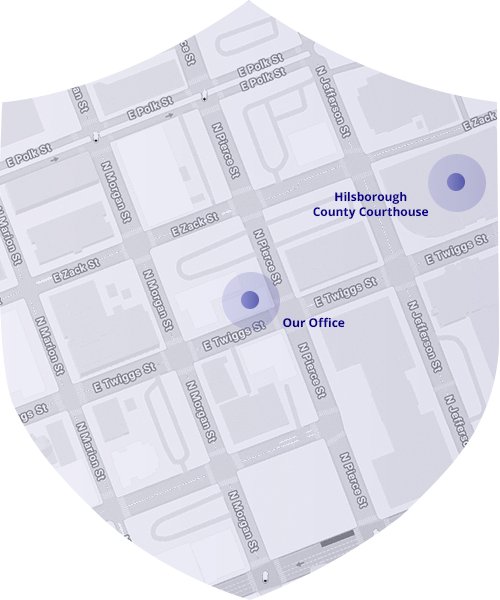
620 E. Twiggs Street, Suite 205, Tampa, FL 33602
(813) 727-7159
Serving Hillsborough, Pinellas, and Pasco Counties
The Brancato Law Firm, P.A. is a Tampa-based criminal defense practice. We are not affiliated with any other Brancato-named law firms.
Visit Us
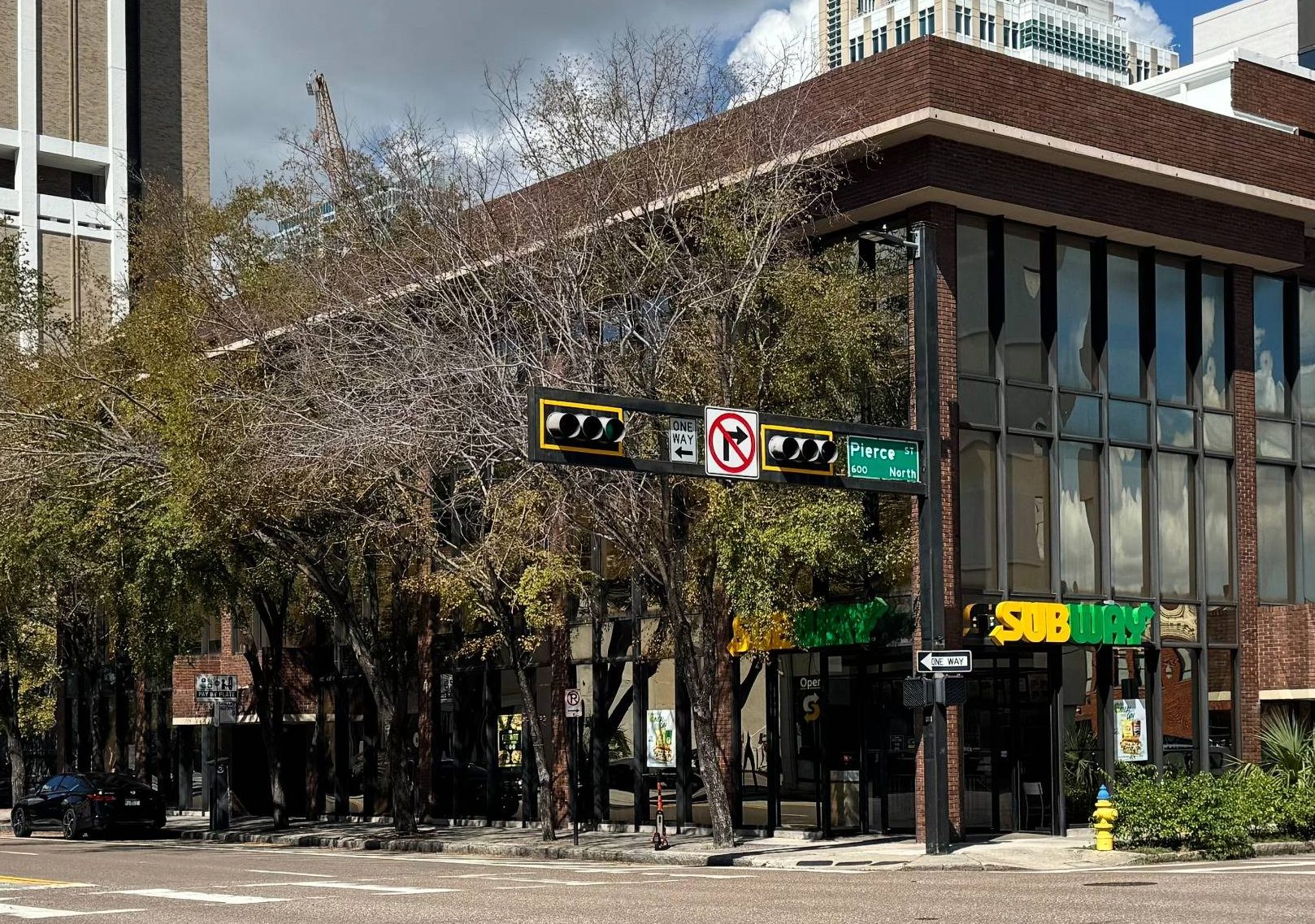
Tampa, FL 33602
Contact Us Now
Free Legal Consultation (813) 727-7159