

From First DUI to Death Penalty



How to Fight an Altered Serial Number Gun Charge in Florida? (2026)



Florida has two separate serial number crimes under section 790.27. Knowingly altering or removing a manufacturer’s or importer’s serial number from a firearm with intent to disguise its identity is a third-degree felony, punishable by up to 5 years in prison. Knowingly possessing, selling, or delivering a firearm whose serial number was unlawfully altered or removed is a first-degree misdemeanor, punishable by up to 1 year in jail. For the possession charge, Florida courts require proof that the person knew the number was altered or removed, not just that they had the gun, and that knowledge element is where many of these cases are won.
Most altered-serial-number cases begin as something else: a traffic stop, a search for drugs, or a gun found in a glove box. As founder of The Brancato Law Firm, P.A., a Tampa criminal defense firm, I taught search and seizure law as a former police academy instructor, and I have tried more than 150 jury trials to verdict in more than 25 years in Hillsborough County courtrooms. Our attorneys defend these charges by testing how the gun was found, whether the State can prove knowledge, and what the crime lab can actually show about the serial number.
What Is the Florida Law on Altered or Removed Gun Serial Numbers?
Section 790.27, Florida Statutes, creates two offenses. Subsection (1) makes it unlawful to knowingly alter or remove the manufacturer’s or importer’s serial number from a firearm “with intent to disguise the true identity thereof.” Subsection (2) makes it unlawful to knowingly sell, deliver, or possess any firearm on which the serial number “has been unlawfully altered or removed.” The statute does not apply to antique firearms, which section 790.001 defines separately.
Our Tampa gun crimes attorney page explains how this charge fits with the other Florida firearm offenses that are usually filed alongside it.
What Are the Penalties for an Altered Serial Number Charge?
The two offenses carry very different penalties. The altering offense is a felony, and the possession offense is a misdemeanor.
| Offense | Subsection | Degree | Maximum jail or prison | Maximum fine |
|---|---|---|---|---|
| Knowingly altering or removing a serial number with intent to disguise the gun’s identity | 790.27(1) | Third-degree felony | 5 years | $5,000 |
| Knowingly possessing, selling, or delivering a firearm with an unlawfully altered or removed serial number | 790.27(2) | First-degree misdemeanor | 1 year | $1,000 |
The altering offense is not listed in the Criminal Punishment Code ranking chart, so as an unlisted third-degree felony it falls at Level 1, the lowest level. In practice, the bigger exposure usually comes from the charges filed with it. A person with a prior felony faces possession of a firearm by a convicted felon, a second-degree felony with a 3-year minimum for actual possession, and a restored serial number that matches a theft report can lead to theft or stolen property charges. Our post on whether a convicted felon can own a gun in Florida explains that charge.
Does the State Have to Prove You Knew the Serial Number Was Removed?
Yes. For the possession offense, the State must prove the person knew the serial number had been altered or removed, not only that they knowingly possessed the gun. In K.D.T. v. State, 128 So. 3d 254 (Fla. 2d DCA 2013), Hillsborough County sheriff’s deputies smelled marijuana, searched a parked car, and found a handgun in an unlocked glove box near a juvenile passenger, who made statements claiming the gun. On that model, the serial number was on a separate plate, and the plate was missing. The Second District held that mere possession was not enough to prove knowledge without more, such as an admission or evidence that the removal was obvious, and it ordered the serial number charge dismissed.
Knowledge can still be proved by inference, and the defense has to raise the issue in the trial court. In B.L.S. v. State, 14 So. 3d 1087 (Fla. 5th DCA 2009), the Fifth District affirmed a juvenile adjudication for possessing a revolver with an altered serial number, finding a “fair inference” of knowledge even without direct evidence. The court also noted that the defense had argued only that the gun was not in the young man’s possession and never raised knowledge of the altered number below. The lesson is that our attorneys argue every element, separately and on the record, in a motion for judgment of acquittal.
What Does the State Have to Prove for Each Offense?
| Element | Altering or removing (felony) | Possessing, selling, or delivering (misdemeanor) |
|---|---|---|
| The item is a firearm, not an antique | Required | Required |
| A manufacturer’s or importer’s serial number was altered or removed | Required | Required, and it must have been done unlawfully |
| The accused did the altering or removing | Required | Not required |
| Intent to disguise the firearm’s true identity | Required | Not required |
| Knowing possession, sale, or delivery | Not required | Required |
| Knowledge that the number was altered or removed | Part of the knowing act | Required (K.D.T.) |
Because the felony requires proof that this person did the altering with intent to disguise, it is charged far less often than the possession misdemeanor. A worn or damaged number is not the same as an altered one, and the State has to prove the number was changed on purpose.
How Often Do Untraceable Guns Turn Up in Florida?
Serial numbers are how police trace a gun, and Florida agencies trace a large number of them. In 2024, law enforcement recovered and traced 36,766 firearms in Florida, including 2,551 recovered in Tampa, according to ATF firearms trace data for Florida. A gun without a readable serial number cannot be traced to its first retail buyer, which is the reason the Legislature punishes altering it.
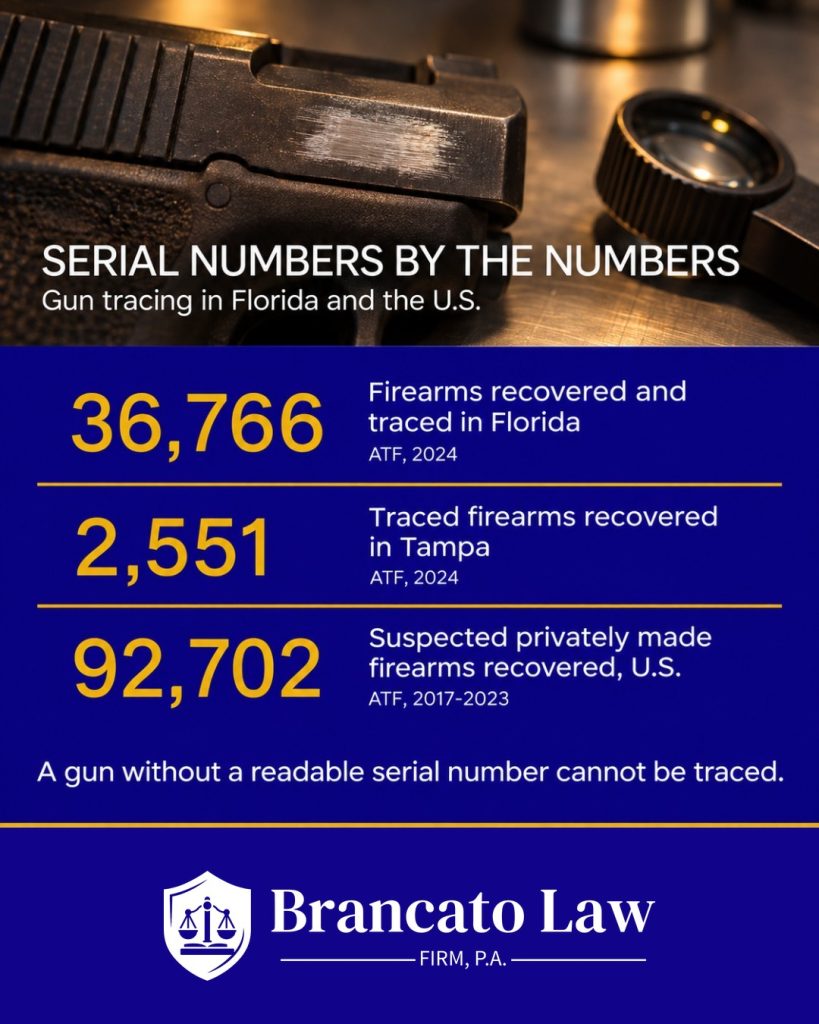
Guns that never had a serial number are a growing share of recoveries. According to the U.S. Department of Justice announcement of ATF’s National Firearms Commerce and Trafficking Assessment, published in January 2025, 92,702 suspected privately made firearms, often called “ghost guns,” were recovered and reported nationally between 2017 and 2023. By its words, section 790.27 covers a manufacturer’s or importer’s serial number that was altered or removed, so a homemade gun that never carried one does not fit that language, although other charges may apply.
Can a Crime Lab Restore a Removed Serial Number?
Often, yes, and that matters to the defense. Stamping a serial number compresses the metal below the surface, so labs can sometimes recover a ground-off number with chemical etching or magnetic particle inspection. In a 2014 report funded by the National Institute of Justice, researchers tested magneto-optical sensor technology on five metals and one composite used by gun makers, called chemical etching and magnetic particle inspection the “current two gold standards” in restoration, and found the sensor outperformed both on the tested samples, though it works only on flat surfaces.
For the defense, a restoration report is a double-edged piece of evidence. A restored number can tie the gun to a theft report and add charges, but a failed or partial restoration can leave the State unable to prove the number was ever there or how it was removed. In our experience in Hillsborough County, lab results on recovered guns often arrive weeks after arrest, so our attorneys request the lab file and the examiner’s notes early, and our forensic science defense team reviews the methods used.
What Are the Defenses to an Altered Serial Number Charge?
Our attorneys test each part of the State’s case:
- No knowledge of the alteration. Under K.D.T., possession alone does not prove the person knew the number was removed, especially when it was on a small or separate plate.
- No possession. A gun in a shared car or home must be tied to the accused. Proximity is not possession, and the State must prove knowledge and control.
- Not unlawfully altered. Wear, rust, a damaged plate, or a factory variation is not an unlawful alteration.
- Never serialized or antique. An antique firearm is excluded, and a gun that never had a manufacturer’s or importer’s number does not fit the statute’s words.
- No intent to disguise. For the felony, the State must prove the person altered the number to hide the gun’s identity.
- Illegal search. A gun found during an unlawful stop or search can be suppressed, which usually ends the case.
Our post on whether police can stop or frisk you for carrying a gun in Florida explains the search rules, and our guide to dealing in stolen property in Florida covers the charge prosecutors add when a restored number matches a theft report.
Is Possessing a Gun With a Removed Serial Number Also a Federal Crime?
It can be. Federal law, 18 U.S.C. § 922(k), separately prohibits knowingly possessing, receiving, or transporting a firearm that has moved in interstate commerce and has had its manufacturer’s or importer’s serial number removed, obliterated, or altered. Most cases in Hillsborough, Pinellas, and Pasco Counties are charged in state court under section 790.27, but the federal statute is one reason a gun case can draw federal attention when it involves trafficking or a person with a prior felony.
What Happens After an Altered Serial Number Arrest in Tampa?
A section 790.27 possession charge on its own is a misdemeanor heard in Hillsborough County Court, while the felony altering charge and any felon-in-possession charge go to circuit court in the 13th Judicial Circuit. After arrest, the person sees a judge at first appearance, usually within 24 hours, and bond is set on each count. Our Florida criminal case process guide explains each stage, and our Hillsborough County criminal defense page covers the local courts.
Frequently Asked Questions About Altered Serial Number Gun Charges in Florida
Is it illegal to buy a used gun with a scratched serial number in Florida?
Knowingly possessing a firearm whose serial number was unlawfully altered or removed is a first-degree misdemeanor, so buying one knowing the number was removed is a crime. The Brancato Law Firm looks at what the buyer could actually see and what the seller said, because the State must prove knowledge of the alteration.
Can an altered serial number charge be dropped in Florida?
Yes. Prosecutors drop or reduce the charge when the State cannot prove knowledge, the gun cannot be tied to the accused, or the search was illegal. The Brancato Law Firm presses those weaknesses early; learn more on our firearm charges defense page.
Is removing the serial number from my own gun a crime in Florida?
Yes, if it is done knowingly with intent to disguise the gun’s true identity, it is a third-degree felony even when you own the gun. Our attorneys at The Brancato Law Firm examine whether the evidence actually shows intent to disguise or only damage or wear.
Do ghost guns violate Florida’s serial number law?
Section 790.27 addresses a manufacturer’s or importer’s serial number that was altered or removed, so a privately made gun that never had one does not fit those words. The Brancato Law Firm reviews how a homemade gun was built and possessed, since other state or federal charges may still apply; our pre-file advocacy work can help if you are under investigation.
Will police get my gun back to me after an altered serial number case?
Usually not, because a firearm with an altered or removed serial number cannot lawfully be possessed. The Brancato Law Firm can review whether the number was actually altered, which affects both the case and the property.
What if the gun was found in a car with several people?
The State must prove which person knowingly possessed the gun and knew the serial number was altered. Our attorneys at The Brancato Law Firm examine seating, ownership, statements, and forensic testing, as explained in our case process guide.
Talk to a Tampa Gun Crimes Lawyer About an Altered Serial Number Charge
What you tell detectives about where the gun came from can create the knowledge the State otherwise lacks, so speak with a lawyer before answering questions. Our attorneys will review the stop, the lab work, and the evidence of knowledge, and we will tell you plainly where the case is weakest. Call The Brancato Law Firm, P.A., founded by Tampa Criminal Defense Attorney Rocky Brancato, at (813) 727-7159. You can call us at any hour. Our firm has Spanish-speaking staff, and attorney Jean-Luc Adrien speaks Spanish, Haitian Creole, and French. Learn more about our Spanish and Haitian Creole criminal defense services.
For more about our defense strategies, visit our Tampa Gun Crimes Defense page.
The Brancato Law Firm, P.A.
620 E. Twiggs Street, Suite 205, Tampa, FL 33602
(813) 727-7159
Serving Hillsborough, Pinellas, and Pasco Counties
The Brancato Law Firm, P.A. is a Tampa-based criminal defense practice. We are not affiliated with any other Brancato-named law firms.
Visit Us

Tampa, FL 33602

Contact Us Now
Free Legal Consultation (813) 727-7159
