- Free Consultation 24/7: (813) 727-7159 Tap Here To Call Us


From First DUI to Death Penalty



What Is a Drug Recognition Expert (DRE) in Florida? (2026)


| A drug recognition expert (DRE) is a police officer trained to decide whether a driver is impaired by drugs rather than alcohol, and which of seven drug categories is most likely responsible. In Florida, officers are certified through a program run by the Institute of Police Technology and Management at the University of North Florida. The DRE reaches an opinion through a 12-step evaluation of the driver’s eyes, vital signs, balance, and statements. A DRE is not a doctor or a toxicologist, and the opinion is only as reliable as the evaluation behind it. |
In most drug DUI cases there is no breath number to show the jury, so the State builds its case around an officer trained to read drug impairment in a driver’s eyes, pulse, and balance. I learned how officers are trained to build that kind of testimony as a former police academy instructor, and I am a member of the National College for DUI Defense. As founder of The Brancato Law Firm, P.A., a Tampa criminal defense firm, I have tried more than 150 jury trials to verdict, and our attorneys take DRE evaluations apart one step at a time: the officer’s training file, the video, the vital signs, and the toxicology.
What does a drug recognition expert do in a Florida DUI case?
A drug recognition expert gives the State an opinion that a driver was impaired by drugs and names the drug category the officer believes caused it. Florida’s DUI law, section 316.193, Florida Statutes, makes it a crime to drive while impaired by alcohol, by a chemical substance listed in section 877.111, or by any controlled substance under chapter 893. A breath test measures only alcohol. When a driver blows a low number but still appears impaired, the arresting officer may call a DRE, usually to a police station or jail after the arrest.
The DRE tries to answer three questions. Is the driver impaired? Is the impairment caused by a medical problem or by drugs? If drugs, which category? That opinion often becomes the center of the State’s case when the charge involves marijuana, prescription medication, or illegal drugs. Our Tampa DUI lawyer page explains how The Brancato Law Firm defends these cases from arrest through trial, and our posts on marijuana DUI charges in Florida and DUI for prescription drugs in Florida cover the drug-specific issues.
How does a police officer become a drug recognition expert in Florida?
A Florida officer becomes a DRE by finishing a classroom phase, a supervised field phase, and a recertification every two years. The Institute of Police Technology and Management (IPTM) at the University of North Florida runs Florida’s Drug Recognition Expert program, and the Florida Department of Transportation funds it for Florida officers.
| Requirement | What Florida’s program requires |
|---|---|
| Prerequisites | 24-hour standardized field sobriety course, 16-hour ARIDE course, and DUI arrest experience that includes court testimony |
| Endorsements to apply | Written endorsement from an Assistant State Attorney in the officer’s circuit and a recommendation from the chief or sheriff |
| Classroom phase | About nine days (72 hours), with at least 80% on both written exams and demonstrated field sobriety proficiency |
| Field certification | At least 12 supervised drug influence evaluations within three months, a final knowledge exam, and endorsements from two DRE instructors |
| Keeping the certification | Recertification every two years, including at least four evaluations in that period |
One of those requirements matters in every Tampa Bay case. Before an officer can enter Florida’s DRE program, an Assistant State Attorney in that officer’s judicial circuit must endorse the application in writing. In Hillsborough County, that means a prosecutor from the 13th Judicial Circuit’s State Attorney’s Office. In Pinellas and Pasco Counties, it means the 6th Circuit’s office. The DRE who testifies against a driver was vouched for by the same office prosecuting the case, which is one reason our attorneys request the officer’s full certification file, evaluation log (often called a rolling log), and recertification history before any deposition.
DREs are also scarce. A January 2024 Florida Department of Highway Safety and Motor Vehicles report on impaired driving counted 54 certified DREs in the entire Florida Highway Patrol. FHP Troop C, headquartered in Tampa and covering Hillsborough, Pinellas, Pasco, Polk, Hernando, Citrus, and Sumter Counties, had 11 of them, the most of any troop. Those figures cover only FHP; sheriff’s offices and city police departments train their own DREs. The same FLHSMV report shows Florida recorded 617 drug-confirmed crashes and 367 drug-confirmed traffic deaths in 2022. Nationally, IPTM reports more than 8,000 certified DREs, about 1.1% of all law enforcement officers.
What are the 12 steps of a DRE evaluation?
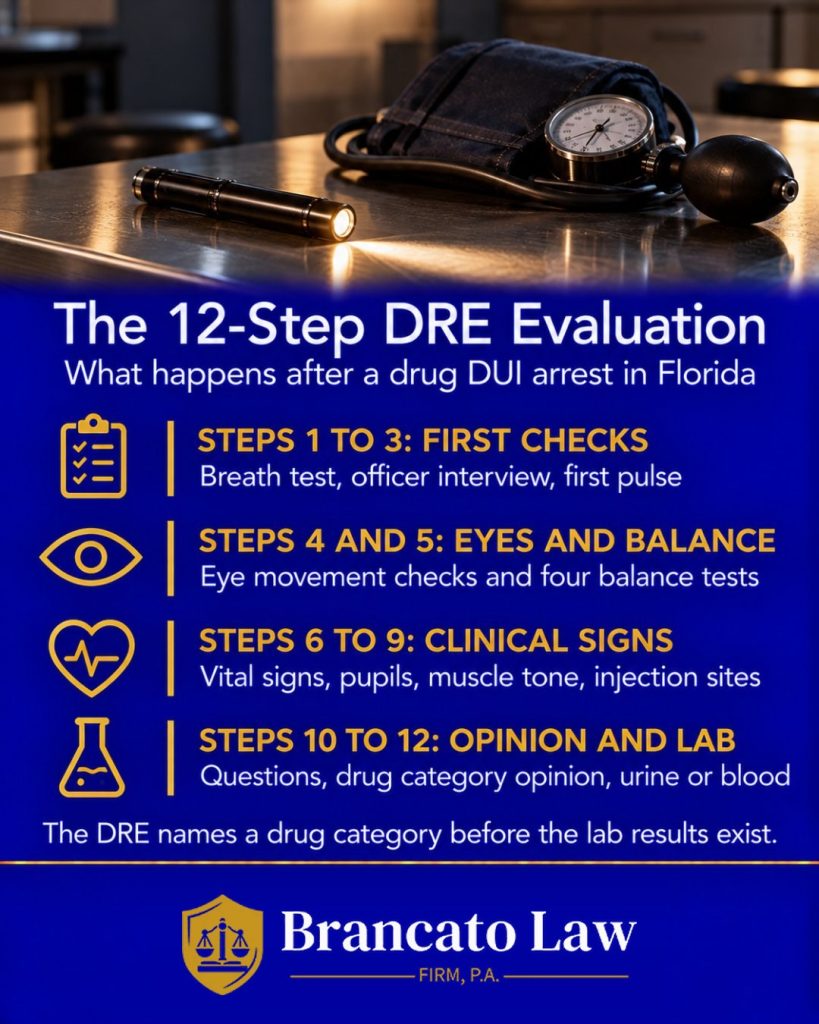
A DRE evaluation follows a standardized 12-step protocol, and the officer is trained to complete every step in order. The steps below come from the AAA Foundation for Traffic Safety’s 2019 review, Drug Evaluation and Classification: Review of the Program and Opportunities for Enhancement. The right-hand column shows what The Brancato Law Firm’s attorneys examine at each step.
| Step | Name | What the DRE does | What our attorneys examine |
|---|---|---|---|
| 1 | Breath alcohol test | Measures alcohol to rule it in or out | Whether the breath result alone explains the observations |
| 2 | Interview of the arresting officer | Hears the driving pattern, statements, and items found | Whether the arresting officer’s conclusions shaped the DRE’s opinion |
| 3 | Preliminary examination | Checks for injury or illness and takes the first pulse | Whether medical causes were actually ruled out |
| 4 | Eye examinations | Horizontal and vertical gaze nystagmus, lack of convergence | Lighting, positioning, and natural nystagmus |
| 5 | Divided attention tests | Walk and Turn, One Leg Stand, Modified Romberg Balance, Finger to Nose | Footwear, surface, age, weight, and injuries |
| 6 | Vital signs | Blood pressure, body temperature, and a second pulse | Equipment, recording errors, and the driver’s normal baseline |
| 7 | Dark room examinations | Pupil size, reaction to light, and rebound dilation | How pupil size was measured and recorded |
| 8 | Muscle tone | Judges whether muscles are rigid or flaccid | How subjective the call was |
| 9 | Injection sites | Looks for injection marks | Whether marks have an innocent explanation |
| 10 | Statements and other observations | Questions the driver about drug use | Whether Miranda warnings were given first |
| 11 | Evaluator’s opinion | Names the drug category or categories | Whether the recorded signs support that category |
| 12 | Toxicological examination | Collects urine or blood for lab testing | Whether the lab result matches the opinion |
Step 2 deserves attention. The DRE usually hears the arresting officer’s account before examining the driver, so our attorneys look at whether the DRE read borderline signs to fit a conclusion someone else had already reached. Step 11 also comes before step 12, which means the DRE commits to a drug category before anyone knows what the lab will find.
Step 10 raises a constitutional issue. In Allred v. State, 622 So. 2d 984 (Fla. 1993), the Florida Supreme Court reviewed DUI arrests in which officers asked arrested drivers to recite the alphabet out of order. The court held that the request was custodial interrogation under the Florida Constitution, so Miranda warnings were required before the incriminating answers could be used. Applying the test from Allred v. State, 622 So. 2d 984 (Fla. 1993), questions put to an arrested driver about what drugs were taken and when are designed to draw an incriminating answer, which makes them interrogation as well.
What are the seven drug categories a DRE can name?
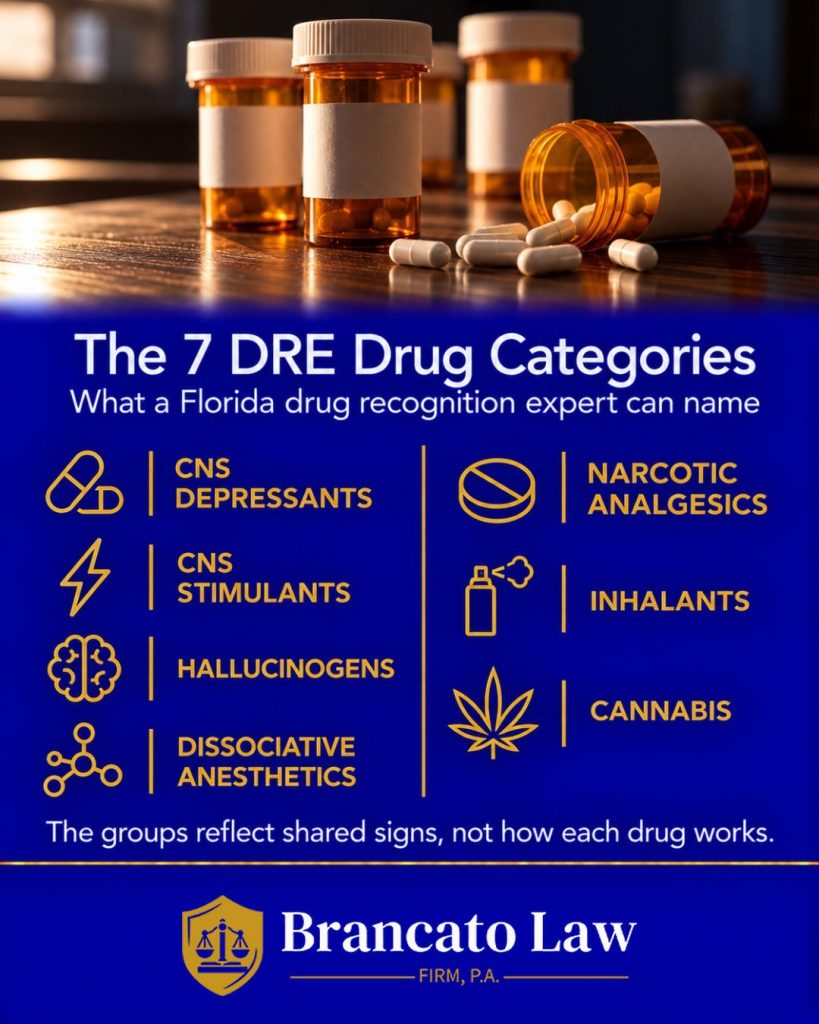
A DRE can name one or more of seven drug categories, grouped by the signs and symptoms the drugs tend to produce. The AAA Foundation’s review notes that these groupings reflect shared signs and symptoms rather than how the drugs work pharmacologically.
| Drug category | Common examples |
|---|---|
| CNS depressants | Alcohol, benzodiazepines such as alprazolam (Xanax), barbiturates |
| CNS stimulants | Cocaine, methamphetamine, prescription amphetamines such as Adderall |
| Hallucinogens | LSD, psilocybin mushrooms, MDMA |
| Dissociative anesthetics | PCP, ketamine, dextromethorphan (DXM) |
| Narcotic analgesics | Heroin, fentanyl, oxycodone, morphine |
| Inhalants | Aerosol sprays, glue, paint thinner |
| Cannabis | Marijuana, THC concentrates, THC edibles |
The categories matter in court because many signs overlap. Dilated pupils, a fast pulse, or poor balance can fit more than one category, and each can also have a medical cause. Several categories include lawful prescriptions, so a driver taking medication exactly as prescribed can still be accused of DUI. Our attorneys at The Brancato Law Firm compare each sign the DRE recorded against the category the DRE named, because an opinion that ignores inconsistent signs is open to attack.
Is a drug recognition expert’s opinion admissible in Florida?
Yes, Florida courts have admitted DRE testimony, but the leading appellate decision is nearly 30 years old and was decided under an evidence standard Florida no longer uses. In Williams v. State, 710 So. 2d 24 (Fla. 3d DCA 1998), a county court certified four questions to the Third District Court of Appeal about whether DRE evidence had to pass the Frye “general acceptance” test for scientific evidence. The Third District held that the general portion of the DRE protocol, meaning the vital signs, pupil checks, field sobriety exercises, and similar observations, was not scientific, so Frye did not apply. The court held that DRE testimony was admissible as relevant evidence of impairment once the State laid a proper foundation. It also held that horizontal gaze nystagmus (HGN) results come in when a qualified DRE administered the test correctly, but HGN alone cannot prove a blood alcohol level of 0.08 or more.
Judge Cope dissented in part in Williams v. State, 710 So. 2d 24 (Fla. 3d DCA 1998). He would have excluded the scientific portion of the evaluation and the officer’s opinion that specific drugs caused the impairment, writing that the drug examiner “is not a toxicologist or other scientist.”
The Williams majority relied in part on State v. Meador, 674 So. 2d 826 (Fla. 4th DCA 1996), a DUI case in which the Fourth District held that HGN is scientific evidence and cannot be admitted as a lay observation without a proper scientific foundation. State v. Meador, 674 So. 2d 826 (Fla. 4th DCA 1996) also held that officers describing balance exercises should avoid words like “test,” “pass,” and “fail” that give the exercises an unwarranted scientific aura. Our attorneys use both decisions to hold the State to its foundation before a DRE says a word to the jury.
Can a DRE opinion be challenged under Florida’s Daubert standard?
Yes. Florida now judges expert testimony under the Daubert standard, which asks whether an opinion rests on sufficient facts or data, reliable principles and methods, and a reliable application of those methods to the case. The Legislature amended section 90.702, Florida Statutes, in 2013, and the Florida Supreme Court adopted the amendment as a rule of evidence in In re Amendments to the Florida Evidence Code, 278 So. 3d 551 (Fla. 2019).
Williams v. State, 710 So. 2d 24 (Fla. 3d DCA 1998) was decided under Frye, and its reasoning turned on whether the protocol was “scientific.” Section 90.702 covers scientific, technical, and other specialized knowledge, so it reaches the part of a DRE’s testimony that does the most damage: the opinion that a particular drug category caused the impairment. As of this writing, our research has not found a published Florida appellate opinion that re-examines the DRE protocol under Daubert. That leaves the question open in Hillsborough, Pinellas, and Pasco courtrooms, and The Brancato Law Firm evaluates a Daubert challenge in every case where a DRE’s category opinion is central to the State’s proof.
What did New Jersey’s Supreme Court decide about DRE testimony in 2023?
New Jersey’s highest court admitted DRE testimony in 2023 but placed four limits on it, and Florida defense lawyers can cite that decision as persuasive authority. In State v. Olenowski, 255 N.J. 529 (2023), a driver struck a telephone pole, showed slurred speech and balance trouble, and was evaluated by a certified DRE at police headquarters. After a special master took extensive testimony, the New Jersey Supreme Court held on November 15, 2023, that DRE testimony meets a Daubert-type reliability standard, but only with these safeguards:
- The DRE may testify only that the evaluation is “consistent with” use of one or more drug categories, and may not testify that drugs actually caused the driver’s impairment.
- When feasible, the State must make a reasonable attempt to obtain a blood or urine toxicology report. If it does not, and has no persuasive justification, the DRE’s opinion must be excluded.
- The defense must have a fair opportunity to impeach the DRE and present its own evidence.
- Model jury instructions on DRE evidence should be considered.
The opinion also exposed a gap in the data. The defense pointed to 105 New Jersey evaluations in which toxicology found no drugs, and in 82 of them a DRE had still opined that the driver was drug-impaired. The court declined to treat that as a 78% false-positive rate because the sample was skewed, and it also rejected the State’s claimed 3% error rate. In State v. Olenowski, 255 N.J. 529 (2023), the court concluded that DRE accuracy could not be reliably calculated from the New Jersey data. The decision does not bind Florida courts, but our attorneys use its framework to ask Florida judges to limit what a DRE can say.
How accurate are drug recognition experts?
Research shows DREs can often recognize that a driver is impaired, but the evidence that they can name the right drug category is weaker. The AAA Foundation’s 2019 review by Douglas J. Beirness and Amy J. Porath found that laboratory studies generally support officers’ ability to detect impairment but do not strongly support their accuracy in identifying the drug class, with high miss and false-alarm rates for some categories. The authors reported that field studies show higher accuracy, but those studies probably undercount false negatives because drivers without outward signs are rarely evaluated. They also noted that the standardized field sobriety tests were developed and validated for alcohol, not drugs, and that much of the DRE research predates 2000.
A 2021 National Highway Traffic Safety Administration study, Exploring the Predictive Validity of Drug Evaluation and Classification Program Evaluations (DOT HS 813 013), found that a set of 22 signs and symptoms correctly sorted 86.5% of 2,253 evaluations into the right drug category, dropping to 75.6% for drug combinations. The study used only evaluations already confirmed by toxicology, and its authors stated it was not meant to determine the accuracy of DREs.
| Source | Finding | Why it matters in a Florida DUI case |
|---|---|---|
| AAA Foundation, 2019 | Lab studies support detecting impairment, not identifying the drug class | The category opinion is the weakest part of DRE testimony |
| AAA Foundation, 2019 | Field sobriety tests were validated for alcohol, not drugs | Balance exercises prove less in a drug case |
| NHTSA, 2021 | 86.5% single-category and 75.6% combination classification, using only toxicology-confirmed cases | Not a real-world error rate for DRE opinions |
| Olenowski, 2023 | Accuracy could not be reliably calculated from New Jersey’s data | New Jersey’s data could not supply a reliable error rate |
How do our attorneys challenge DRE evidence in a Florida DUI case?
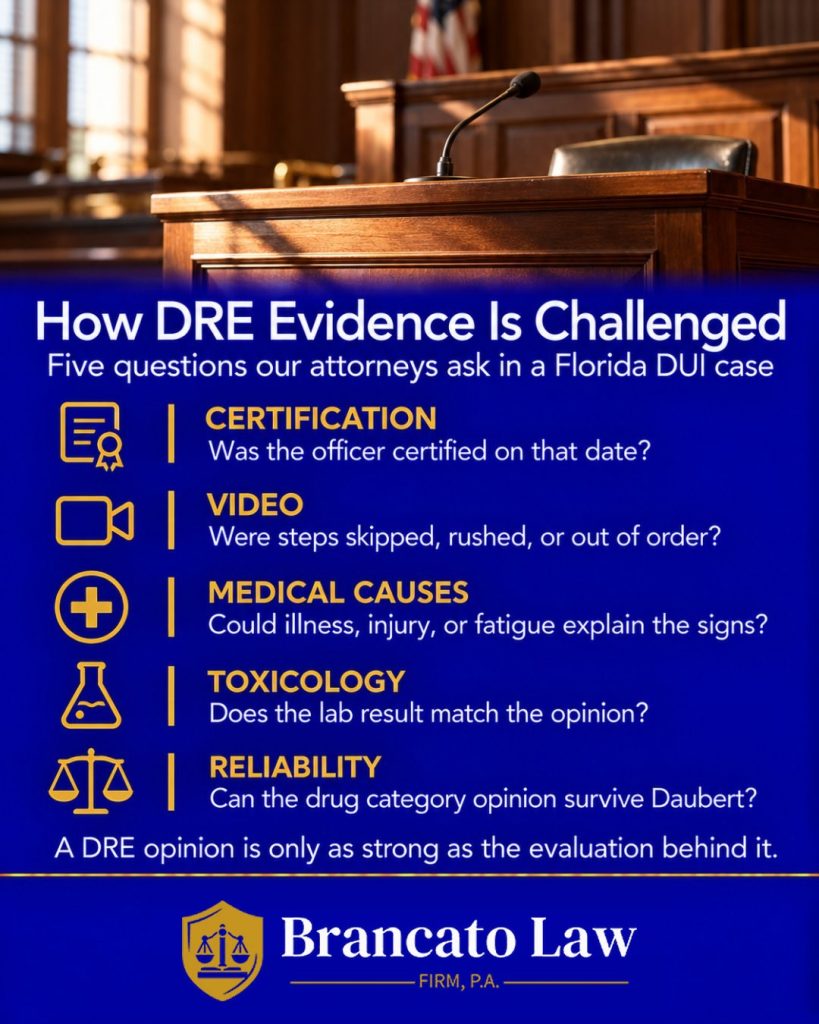
Our attorneys challenge DRE evidence by testing the officer, the evaluation, and the toxicology separately, because a weakness in any one of them can undercut the opinion. In a typical case, The Brancato Law Firm works through six areas:
- Certification and records. Confirm the DRE was certified and current on the date of the evaluation, and obtain the evaluation log, training records, and recertification history.
- Video and timing. Obtain jail and body camera video and compare it to the DRE’s written report to find steps that were skipped, rushed, or done out of order.
- Medical explanations. State v. Meador, 674 So. 2d 826 (Fla. 4th DCA 1996) recognized that nystagmus has causes other than alcohol, including natural causes, seizure medications, barbiturates, and other depressants, and that fatigue, age, and eye debris can affect results. Injuries, illness, and fatigue can also produce signs a DRE may read as drug impairment.
- Toxicology mismatch. If the lab finds no drug, or a drug in a different category than the DRE named, the opinion loses its footing. Presence alone is also not impairment. Under State v. Sercey, 825 So. 2d 959 (Fla. 1st DCA 2002), a DUI manslaughter case involving THC, the State may introduce evidence that a drug was present even without a level tied to impairment, but it still must prove the driver’s normal faculties were impaired.
- Daubert and limiting motions. Move to exclude or limit the category opinion under section 90.702, using State v. Olenowski, 255 N.J. 529 (2023) as persuasive authority for a “consistent with” limit and State v. Meador, 674 So. 2d 826 (Fla. 4th DCA 1996) to keep out “pass” and “fail” language.
- Independent experts. Bring in a toxicologist or other qualified expert to explain what the signs and lab results do and do not show. Our post on why expert witnesses matter in Florida criminal cases and our Tampa criminal forensic science attorney page explain how we use them.
For more on the balance exercises that make up step 5, see our post on how to challenge field sobriety tests in Tampa.
Do you have to take a DRE evaluation or a urine test in Florida?
Florida law treats the DRE’s physical evaluation and a chemical test differently. No statute suspends a license for declining the eye checks and balance exercises, but the Florida Supreme Court held in State v. Taylor, 648 So. 2d 701 (Fla. 1995) that a driver’s refusal to perform field sobriety tests is admissible at trial as evidence of consciousness of guilt, where the officer explained the tests and warned of the consequences of refusing.
A urine test carries harsher consequences. Under section 316.1932, Florida Statutes, a driver lawfully arrested for DUI can be asked for a urine sample when the officer has reasonable cause to believe the driver was under the influence of chemical or controlled substances. A first refusal brings a one-year license suspension, and the refusal is admissible in the criminal case. Since October 1, 2025, even a first refusal is a crime under section 316.1939, Florida Statutes: a first refusal is a second-degree misdemeanor, and a refusal after a prior refusal suspension is a first-degree misdemeanor. Our post on Trenton’s Law and Florida’s 2025 DUI penalties explains that change, and our post on whether police can take your blood without a warrant in Florida covers blood draws. Every one of these decisions has consequences, which is why The Brancato Law Firm reviews exactly what the officer said and when.
What should you do in the first 10 days after a drug DUI arrest?
Act within 10 days, because that is the deadline to request review of the license suspension under section 322.2615, Florida Statutes. The early weeks also decide whether the evidence needed to challenge the DRE is still available.
| When | What happens | Why it matters |
|---|---|---|
| Night of the arrest | DRE evaluation, urine or blood collection, notice of suspension | The DRE’s opinion is written before the lab results exist |
| Within 10 days | Deadline to request formal or informal review of the suspension | Missing it gives up the chance to contest the suspension |
| First weeks of the case | Requests for jail, patrol car, and body camera video | Video can be lost if no one asks for it |
| When toxicology arrives | Lab report confirms or contradicts the DRE’s category | A mismatch can undercut the State’s main witness |
| Discovery | Deposition of the DRE and review of the certification file | Training gaps and protocol errors come out here |
Do not discuss what you took, or when, with anyone other than your lawyer. Our post on how to protect your driver’s license after a DUI arrest in Florida walks through the administrative side, and The Brancato Law Firm can file the review request for you.
Frequently asked questions about drug recognition experts in Florida
Can a DRE tell what drug I took without a blood or urine test?
No. A DRE offers an opinion about a drug category based on physical signs, and only a laboratory test can identify a specific substance. The Brancato Law Firm compares the DRE’s predicted category against the lab report in every case, because a mismatch can undercut the opinion.
Is a drug recognition expert a doctor or medical expert?
No. A DRE is a police officer who completed about 72 hours of classroom training and at least 12 supervised evaluations. At The Brancato Law Firm, we use that training record to show jurors the limits of what the officer is qualified to say, a point Judge Cope made in his partial dissent in Williams v. State, 710 So. 2d 24 (Fla. 3d DCA 1998).
Can I get a DUI in Florida for taking my legal prescription?
Yes. Florida’s DUI statute covers any controlled substance under chapter 893 when it impairs your normal faculties, and a valid prescription is not a defense by itself. Our attorneys at The Brancato Law Firm focus on whether the State can prove actual impairment, as explained in our post on DUI for prescription drugs in Florida.
Does a positive THC test prove I was impaired while driving?
No. Florida courts allow evidence that THC was present, but the State must still prove your normal faculties were impaired at the time you drove. The Brancato Law Firm challenges the gap between a positive test and real impairment, which we cover in our post on driving after using medical marijuana.
Can DRE testimony be excluded in Florida?
It can be excluded or limited when the State cannot lay a proper foundation or when the opinion fails the reliability test in section 90.702. When a DRE is the State’s key witness, The Brancato Law Firm files the motions that test that foundation, and our page on defending DUI charges in Tampa describes the process.
Do I have to answer the DRE’s questions about drug use?
No. You have the right to remain silent, and after an arrest, questions about drug use fall under the custodial interrogation rule the Florida Supreme Court applied in Allred v. State, 622 So. 2d 984 (Fla. 1993). If you already answered, our attorneys at The Brancato Law Firm review the video to see whether those statements can be suppressed.
Can a drug DUI charge be reduced or dropped in Florida?
Yes, it can, depending on the evidence. The Brancato Law Firm looks early for errors in the DRE evaluation, a toxicology report that contradicts the officer, and grounds for a motion to exclude, any of which can lead prosecutors to reduce or drop a charge, though no outcome is guaranteed. Our post on how to fight a DUI charge in Hillsborough County explains the process.
Talk to a Tampa DUI defense attorney about your DRE case
For more about our defense strategies, visit our Tampa DUI Lawyer page.
Ten days is all Florida allows to challenge a license suspension after a DUI arrest, and the DRE’s records and video are easiest to secure early. Call The Brancato Law Firm, P.A., founded by Tampa Criminal Defense Attorney Rocky Brancato, at (813) 727-7159. Our attorneys will start by requesting the evaluation, the video, and the toxicology report.
The Brancato Law Firm, P.A.
620 E. Twiggs Street, Suite 205, Tampa, FL 33602
(813) 727-7159
Serving Hillsborough, Pinellas, and Pasco Counties
The Brancato Law Firm, P.A. is a Tampa-based criminal defense practice. We are not affiliated with any other Brancato-named law firms.
Visit Us

Tampa, FL 33602

Contact Us Now
Free Legal Consultation (813) 727-7159
