- Free Consultation 24/7: (813) 727-7159 Tap Here To Call Us


From First DUI to Death Penalty



Hillsborough E-Bike Speed Limits: Can Police Stop and Search You? (2026)


Note: Hillsborough County approved this ordinance on November 10, 2026, but the final ordinance text has not been posted publicly as of this writing. The details below come from the county’s meeting recap and news reports. We will update this post with the ordinance itself once it is posted.
Hillsborough County’s new e-bike rules set speed limits of 10 mph on sidewalks, 15 mph on shared paths and trails, and 28 mph on roads and bike lanes, and they also cover scooters and traditional bicycles. Police can stop a rider they reasonably believe is breaking one of these rules, but a stop for a noncriminal traffic violation allows only a detention long enough to write a citation, not an arrest or a search. Whether the county attached criminal penalties to these violations will decide how far a stop can go, and that question will be answered by the final ordinance text.
If your son or daughter was stopped on an e-bike in Hillsborough County, the stop itself may turn out to be the most important part of the case, especially if it led to a search of a backpack or pockets. I’m Rocky Brancato, founder of The Brancato Law Firm, P.A., a Tampa criminal defense firm. As a former police academy instructor, I taught officers criminal procedure, and as former Chief Operations Officer of the Hillsborough County Public Defender’s Office, where I oversaw a staff of over 100 attorneys, I saw how many cases begin with a minor traffic stop. Our attorneys challenge bicycle and e-bike stops in Hillsborough County criminal cases when the stop or search went further than the law allows.
What Are Hillsborough County’s New E-Bike Speed Limits?
Hillsborough County commissioners unanimously approved new rules for e-bikes, motorized scooters, other micromobility devices, and traditional bicycles on November 10, 2026. As reported by FOX 13, Bay News 9, and WFLA, the speed limits are:
| Where you are riding | Reported speed limit |
|---|---|
| Sidewalks | 10 mph |
| Shared-use paths and trails | 15 mph |
| Roads, shoulders, bike lanes, and bike paths | 28 mph |
The reported rules also ban wheelies, stunt riding, towing, and street takeovers, and they require riders to yield to pedestrians and signal before passing. According to FOX 13, deputies will start with warnings, civil fines will start at $50 and rise to $500 for repeat violations, and habitual offenders can have their devices impounded. Bay News 9 reported that parents may be held responsible for a child’s repeat violations. The county’s own meeting recap says the ordinance carries both criminal and civil penalties, without saying which violations carry which.
Two questions are still open until the text is posted. The first is where the rules apply: FOX 13 reported that they govern Tampa, Temple Terrace, and Plant City until those cities adopt their own rules, while Florida Daily reported they apply only in unincorporated Hillsborough County at first. The second is when citations begin: WFLA reported that riders will not be cited where the rules are not posted in the area they are riding.
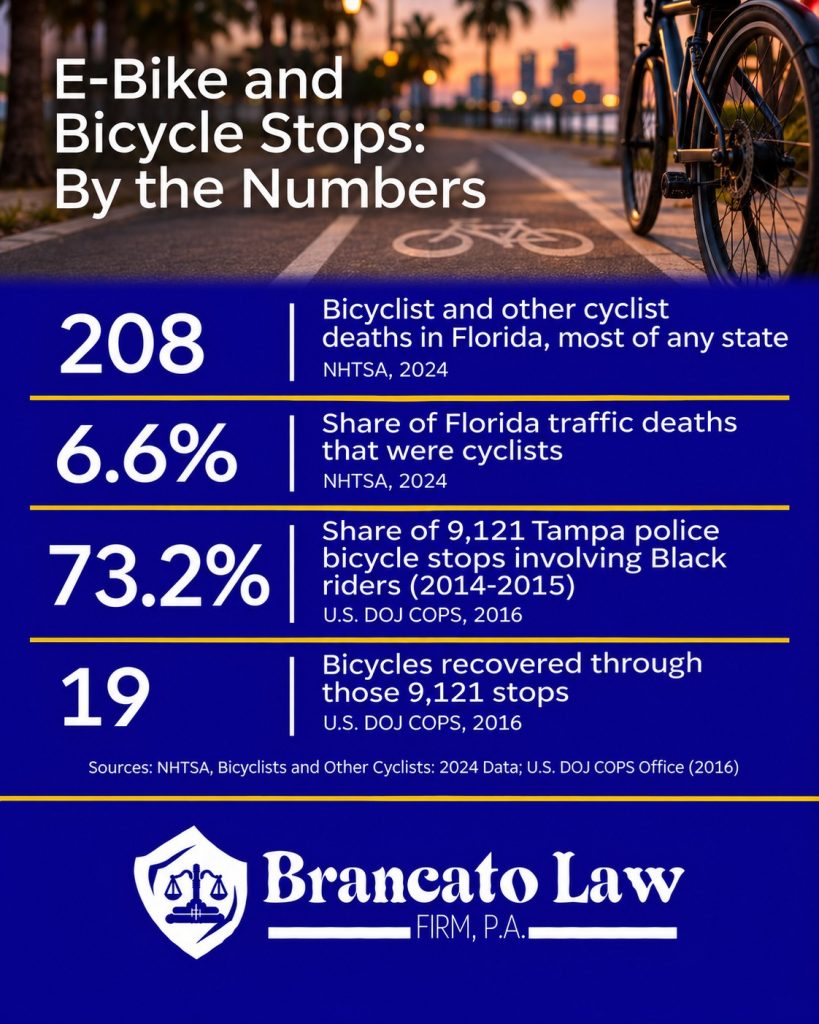
The safety concern behind the rules is real. In 2024, Florida had 208 bicyclist and other cyclist deaths, more than any other state and 6.6 percent of all Florida traffic deaths, according to the National Highway Traffic Safety Administration’s Bicyclists and Other Cyclists: 2024 Data report (Table 6). Nationwide, the U.S. Consumer Product Safety Commission reported an estimated 360,800 emergency room visits and 233 deaths tied to micromobility devices from 2017 through 2022, with injuries rising nearly 21 percent from 2021 to 2022.
Can Police Stop You on an E-Bike for Speeding?
Yes. An officer can stop an e-bike rider who the officer reasonably believes is violating a traffic law or a valid traffic ordinance, including a speed limit. Under § 316.20655(1), Florida Statutes, an electric bicycle “is a vehicle to the same extent as a bicycle,” and its rider carries the duties of a bicycle operator. In Whren v. United States, 517 U.S. 806 (1996), adopted in Florida by Holland v. State, 696 So. 2d 757 (Fla. 1997), the courts held that a stop supported by probable cause of a traffic violation is valid regardless of the officer’s real motive. The Florida Supreme Court in Thomas v. State, 614 So. 2d 468 (Fla. 1993), a case about an Orlando man stopped on a bicycle without a bell, said an officer “clearly is entitled to stop a vehicle for a traffic violation.”
The officer does not need a radar reading to make the stop. In State v. Allen, 978 So. 2d 254 (Fla. 2d DCA 2008), the Second District Court of Appeal, which covers Hillsborough, Pinellas, and Pasco Counties, upheld a stop where a detective testified that a car appeared to be speeding and that he had to drive well over 50 mph in a 25 mph zone to catch up. A visual guess has limits, though. In State v. Howard, 411 So. 3d 558 (Fla. 5th DCA 2025), the Fifth District agreed that an officer’s one-second visual estimate of a car’s speed from a parking lot was not a well-founded basis for a speeding stop.
E-bike speed limits are harder to enforce than car speed limits. The margins are small (a sidewalk rider at 13 mph is over a 10 mph limit), many bicycles have no speedometer, and radar evidence is admissible under § 316.1906(2) only when conditions permit the clear assignment of speed to a single vehicle, which is difficult on a crowded path. Our attorneys at The Brancato Law Firm ask how the officer measured the speed, from how far away, and for how long, because a weak basis for the stop can undo everything that followed it. Learn more on our Tampa criminal traffic lawyer page.
Can Police Search You After an E-Bike Stop?
Usually not, if the only violation is a noncriminal traffic rule. In Thomas v. State, 614 So. 2d 468 (Fla. 1993), the Florida Supreme Court held that when a person is charged with violating an ordinance “regulating conduct that is noncriminal in nature, such as in the traffic control area,” the officer may detain the person only “for the limited purpose of issuing a ticket, summons, or notice to appear,” and “a full custodial arrest in such situations is unreasonable.” No lawful arrest means no search incident to arrest.
Tampa has been here before. In L.B.B. v. State, 998 So. 2d 1217 (Fla. 2d DCA 2009), a Tampa officer arrested a juvenile for riding a bicycle without a bell under a City of Tampa ordinance and found marijuana in the search. The Second District reversed and ordered the juvenile discharged, holding that “a bicycle infraction is noncriminal in nature and that a person cannot be arrested for such infraction,” and that the officer could not rely on an ordinance whose penalty Thomas had effectively invalidated years earlier, because “police officers are charged with knowledge of the law.”
The answer changes if a violation is truly criminal. In State v. Coleman, 320 So. 3d 890 (Fla. 2d DCA 2021), the Second District held that an officer who sees a violation of an ordinance that carries possible jail time may make a full custodial arrest and search incident to it. Under § 125.69(1), county ordinance violations are prosecuted like misdemeanors with up to 60 days in jail and a $500 fine unless the county provides a different enforcement method. That is why the criminal penalties mentioned in the county’s recap matter, and why Thomas may make them unenforceable for riding conduct that state law treats as a civil traffic infraction.
| If the violation is… | Can police stop you? | Can police arrest you? | Can police search you? |
|---|---|---|---|
| A noncriminal traffic rule (civil citation) | Yes, with a reasonable basis | No (Thomas; L.B.B.) | No search incident to arrest; only with consent, a warrant, or separate legal grounds |
| A criminal ordinance violation the officer sees | Yes | Yes, under § 901.15(1) (Coleman) | Yes, a search incident to a lawful arrest |
| Any stop, if the officer believes you are armed | Yes | Depends on the violation | A pat-down for weapons only, under § 901.151(5) |
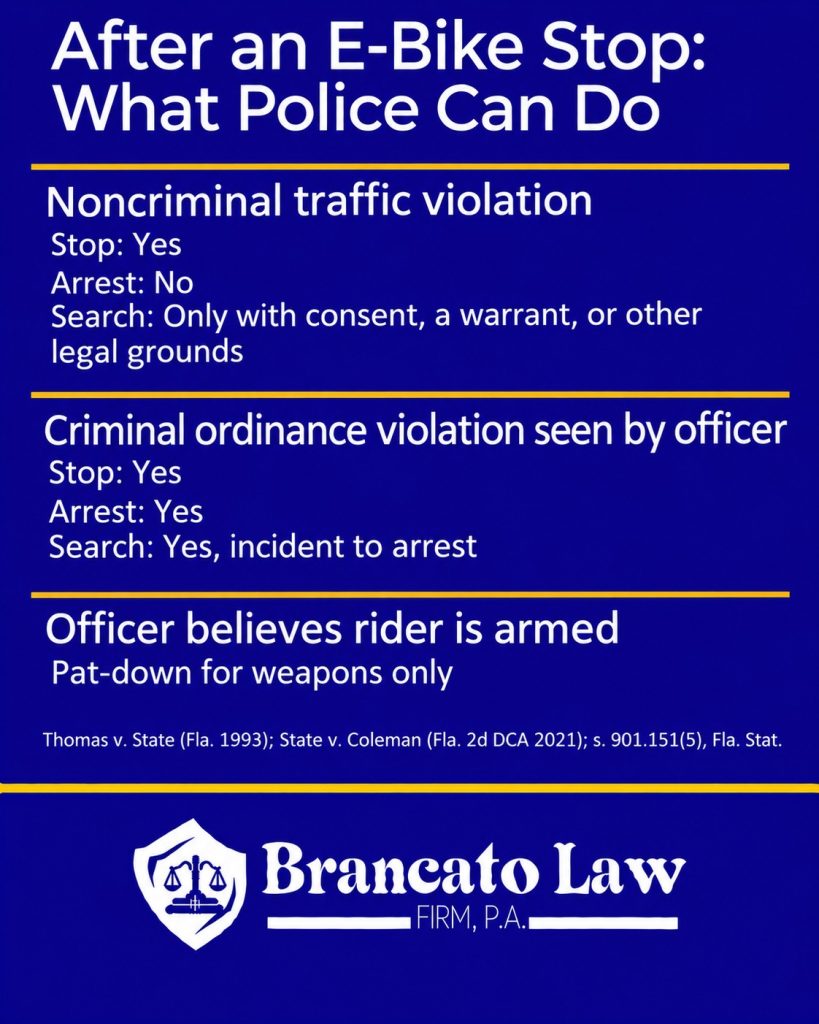
Even a lawful stop has a time limit. In Rodriguez v. United States, 575 U.S. 348 (2015), the U.S. Supreme Court held that a stop justified only by a traffic violation becomes unlawful if it is “prolonged beyond the time reasonably required to complete th[e] mission” of issuing the ticket. A pat-down is a separate step: under Florida’s Stop and Frisk Law, § 901.151(5), an officer may search for weapons only with probable cause to believe the person is armed with a dangerous weapon, and only to the extent necessary to find it. A rider can also decline a request to search a backpack, and a search based on “consent” is only as good as the consent was voluntary. Read more about how long a traffic stop can last in Florida.
Does Hillsborough County Have the Power to Set E-Bike Speed Limits?
Mostly yes, on roads, sidewalks, and paths the county controls. Florida law expressly allows it: § 316.20655(1) says local governments may adopt “an ordinance governing the operation of electric bicycles on streets, highways, sidewalks, and sidewalk areas under or within the local government’s jurisdiction,” and may restrict e-bikes on paths and trails they control. Section 316.008(1)(h) lets local authorities regulate the operation of bicycles, and § 316.008(7)(a) lets a county regulate e-bikes on sidewalks, as long as the ordinance restricts them to a maximum speed of 15 mph there. A 10 mph sidewalk limit fits within that cap, and the Legislature’s express permission is the main reason the county can treat e-bikes differently from cars.
There are limits. First, these powers cover streets and highways “under their jurisdiction,” so a county ordinance does not automatically reach state highways or city-owned streets and paths, such as those within the City of Tampa. Second, § 316.002 makes it unlawful for a local authority “to pass or to attempt to enforce any ordinance in conflict with” Chapter 316, and Thomas held that a local government “may not enact an ordinance imposing criminal penalties for conduct essentially identical to that which has been decriminalized by the state.” Third, under § 316.189(3), a change to a speed zone does not take effect until the zone is posted with clearly legible signs, which matches the county’s reported plan not to cite riders where the rules are not posted.
The state has not changed the picture. The Legislature passed CS/SB 382 (2026), a statewide e-bike bill that included a speed limit near pedestrians, but the Governor vetoed it on June 25, 2026, according to the Florida Senate’s bill history. For now, e-bike rules in Hillsborough County come from the county ordinance and existing state law.
Can Police Use an E-Bike Stop to Investigate Something Else?
Yes, within limits. Under Whren and Holland, a stop based on a real traffic violation is not invalid just because the officer hoped to find drugs or a weapon. Bicycle stops in Tampa have been studied for exactly this reason. A 2016 U.S. Department of Justice technical assistance report, An Examination of Racial Disparities in Bicycle Stops and Citations Made by the Tampa Police Department, found that Black riders made up 73.2 percent of 9,121 documented bicycle stops from January 2014 through August 2015, while Tampa’s population was 26.2 percent Black, and that only 19 bicycles were recovered through those stops. The report found that cutting back the stops had no discernible effect on crime, and it stated that its findings did not prove racial profiling.
Because pretext does not void a stop, the defense focus is on what happened after it: whether the stop lasted longer than needed to write the citation, whether any search had a lawful basis, and whether the officer had a reasonable basis for the speed or other violation to begin with. An officer who makes an objectively unreasonable mistake about what an ordinance covers gets no help from Heien v. North Carolina, 574 U.S. 54 (2014), which allows only reasonable mistakes of law. When evidence comes from an unlawful stop or search, our attorneys file a motion to suppress.
What Should a Parent Do After an E-Bike Stop?
Most e-bike stops will end with a warning or a civil citation. When a stop turns into an arrest or a search, these steps protect the case:
- Write down the details the same day. Where the stop happened, the time, whether speed limit signs were posted there, what the officer said about the speed, and how the officer measured it.
- Ask what was searched and why. Find out whether your child was asked for consent, patted down, or told to empty a backpack, and whether the officer said your child was under arrest.
- Keep the citation and any notice to appear. The paperwork shows whether the officer treated the violation as civil or criminal.
- Tell your child never to run or resist. Flight can create a new charge even when the original stop was weak; see our post on resisting an officer without violence.
- Call a defense attorney before any juvenile intake or court date if the stop led to a drug, weapon, or resisting charge. Body camera video should be requested early.
For students, an arrest can also trigger school discipline; see our guide for Tampa students and parents. Stops of young riders in groups can also lead to street takeover charges, which are separate crimes under state law. Each stage of a case, from first appearance to trial, is explained on our Florida criminal case process page.
E-Bike Stop and Search FAQs
Can police stop my child on an e-bike in Hillsborough County?
Yes, if the officer reasonably believes your child broke a traffic law or a valid county rule, such as riding faster than 10 mph on a sidewalk. The Brancato Law Firm looks closely at how the officer judged the speed, because a small margin and no radar make the basis for the stop easy to question.
Can police search my child’s backpack after an e-bike stop?
Not as a matter of course. For a noncriminal traffic violation, the Florida Supreme Court held in Thomas that an officer may detain a rider only long enough to write a citation, so there is no search incident to arrest; a search needs consent, a warrant, or separate legal grounds. Our attorneys at The Brancato Law Firm file motions to suppress when a search went past those limits.
Is an e-bike speeding violation a crime in Hillsborough County?
That depends on the final ordinance text, which has not been posted yet. The county says the ordinance has both criminal and civil penalties, and news reports describe civil fines from $50 to $500; The Brancato Law Firm will update this post once the text shows which violations are which.
Do the new e-bike rules apply in Tampa?
It is not settled yet. One report says the county rules govern Tampa, Temple Terrace, and Plant City until those cities adopt their own, while another says they apply only in unincorporated areas at first, and county powers under Chapter 316 extend to roads under the county’s jurisdiction; our attorneys at The Brancato Law Firm check where a stop happened and who controls that road or path.
Can I get a ticket if there is no speed limit sign for e-bikes?
WFLA reported that riders will not be cited where the rules are not posted in the area. Florida law also says a change to a speed zone does not take effect until it is posted with legible signs under § 316.189(3), and The Brancato Law Firm raises missing signs as a defense when they apply.
Can a drug or gun charge be dismissed if the e-bike stop was illegal?
It can, if the evidence came from an unlawful arrest or search and the court suppresses it; in L.B.B., a Tampa bicycle case, the appeals court ordered the juvenile discharged. The Brancato Law Firm reviews the stop, the search, and the body camera video in every case that began with a bicycle or e-bike stop; see our criminal traffic defense page.
Talk to a Tampa Defense Attorney About an E-Bike Stop
Body camera video and the officer’s notes are easiest to get early, so the time to call is before the first court date or juvenile intake. Call The Brancato Law Firm, P.A., founded by Tampa Criminal Defense Attorney Rocky Brancato, at (813) 727-7159; you can call us at any hour. Our firm has Spanish-speaking staff, and attorney Jean-Luc Adrien speaks Spanish, Haitian Creole, and French.
For more about our defense strategies, visit our Criminal Traffic page.
The Brancato Law Firm, P.A.
620 E. Twiggs Street, Suite 205, Tampa, FL 33602
(813) 727-7159
Serving Hillsborough, Pinellas, and Pasco Counties
The Brancato Law Firm, P.A. is a Tampa-based criminal defense practice. We are not affiliated with any other Brancato-named law firms.
Visit Us

Tampa, FL 33602

Contact Us Now
Free Legal Consultation (813) 727-7159
