

From First DUI to Death Penalty



What Is a Habitual Felony Offender in Florida? (2026)


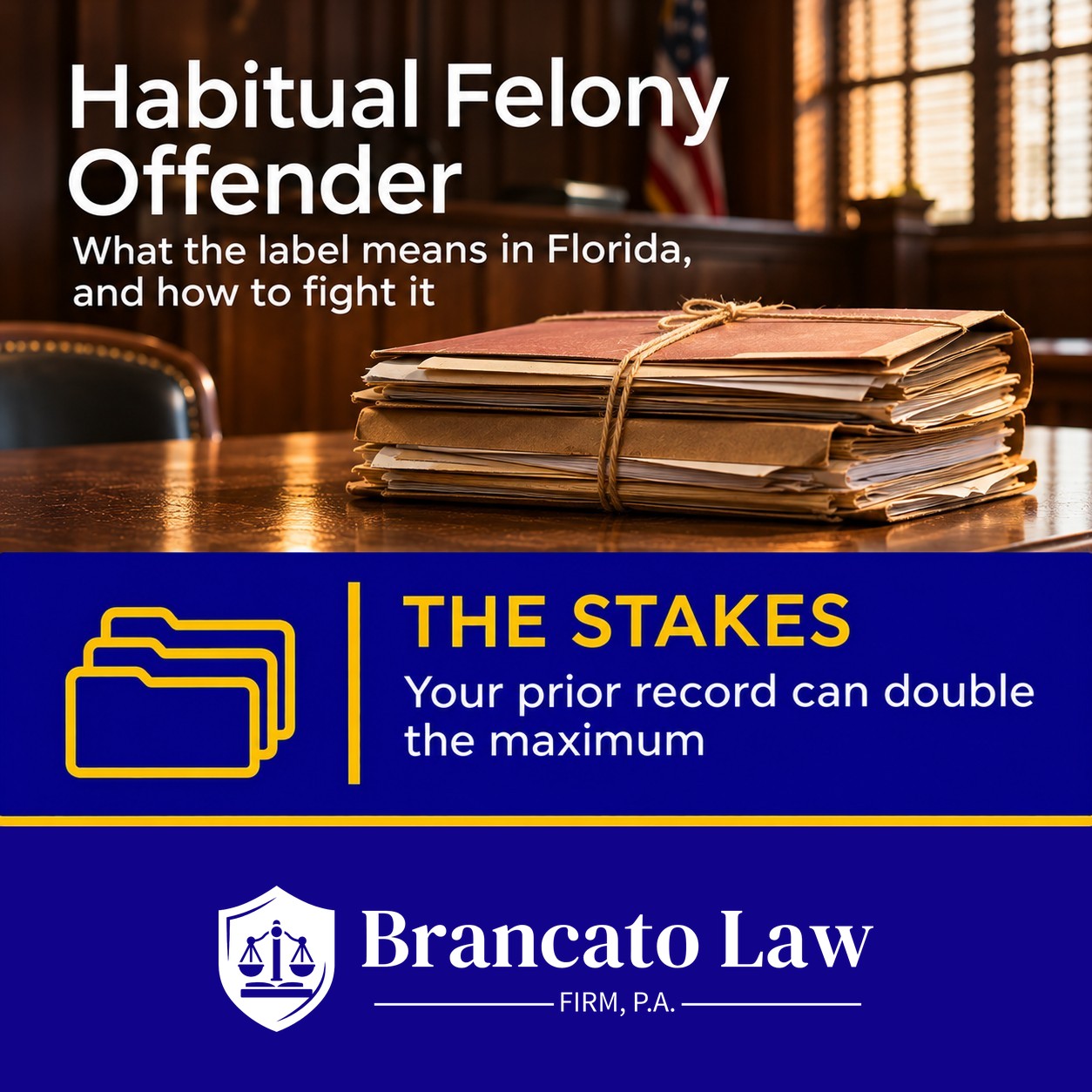
A habitual felony offender in Florida is a person the court finds has two or more prior felony convictions and committed the new felony within five years of the last conviction or release, or while still serving a sentence. Under section 775.084, Florida Statutes, that finding raises the maximum sentence: up to 10 years for a third-degree felony instead of 5, up to 30 years for a second-degree felony instead of 15, and life for a first-degree felony. The State must serve written notice before a plea or sentencing and prove the prior record with reliable documents, and a judge can decline the designation if it is not needed to protect the public.
A Florida judge can impose a habitual offender sentence only after the State serves written notice and proves the prior record with certified court documents, so most of these fights turn on paperwork and dates. I’m Rocky Brancato, founder of The Brancato Law Firm, P.A., a Tampa criminal defense firm, and a former Chief Operations Officer of the Hillsborough County Public Defender’s Office, where I oversaw a staff of over 100 attorneys. I have spent more than 25 years in Hillsborough County courtrooms. When a client receives a habitual offender notice, our attorneys pull every prior judgment, check each date against the statute, and look for the gap that keeps the enhancement off the table.
What does habitual felony offender mean in Florida?
A habitual felony offender (HFO) is a sentencing designation, not a separate crime. The State files a new charge in the normal way, and then asks the judge, in a separate sentencing proceeding, to find that the defendant’s prior record qualifies for an extended prison term. Under section 775.084(1)(a), the judge must find four things:
- The defendant has two or more prior felony convictions in Florida, or out-of-state, federal, or foreign convictions that are substantially similar to Florida felonies and were punishable by more than one year.
- The new felony was committed while the defendant was serving a prison sentence, probation, or other supervision for a prior felony, or within 5 years of the last prior felony conviction or release from that sentence, whichever is later.
- The new felony, and one of the two qualifying priors, is not a section 893.13 charge for buying or possessing a controlled substance.
- No conviction the State relies on has been pardoned or set aside in a postconviction proceeding.
Two counting rules matter in almost every case. A prior felony counts only if it was sentenced separately before the new offense and separately from the other prior being counted, under section 775.084(5). And a withhold of adjudication on probation or community control counts as a prior conviction for this statute under section 775.084(2), even though it is not a conviction for most other purposes. Our firm handles habitual offender notices at every stage of the Florida criminal case process, from the plea offer through sentencing and appeal.
How much more prison time does a habitual offender designation add?
An HFO designation roughly doubles the maximum sentence for second- and third-degree felonies and allows life for a first-degree felony. The ordinary maximums come from section 775.082, Florida Statutes; the habitual maximums come from section 775.084(4). A habitual felony offender designation raises the ceiling but sets no minimum, so the judge can still impose less than the habitual maximum. The habitual violent felony offender (HVFO) designation adds a mandatory period before release.
| Degree of the new felony | Ordinary maximum | Habitual felony offender maximum | Habitual violent felony offender |
|---|---|---|---|
| Third-degree felony | 5 years | 10 years | Up to 10 years; no release for 5 years |
| Second-degree felony | 15 years | 30 years | Up to 30 years; no release for 10 years |
| First-degree felony | 30 years | Life | Life; no release for 15 years |
| Life felony | Life | Life | Life; no release for 15 years |
A sentence imposed under the habitual offender statute is not governed by the Criminal Punishment Code’s scoresheet rules in section 921.002, which is why the habitual maximum can exceed what the scoresheet would otherwise allow. Our post on what happens when the lowest permissible sentence exceeds the maximum explains how the scoresheet works when no enhancement applies.
What are the four Florida habitual offender designations?
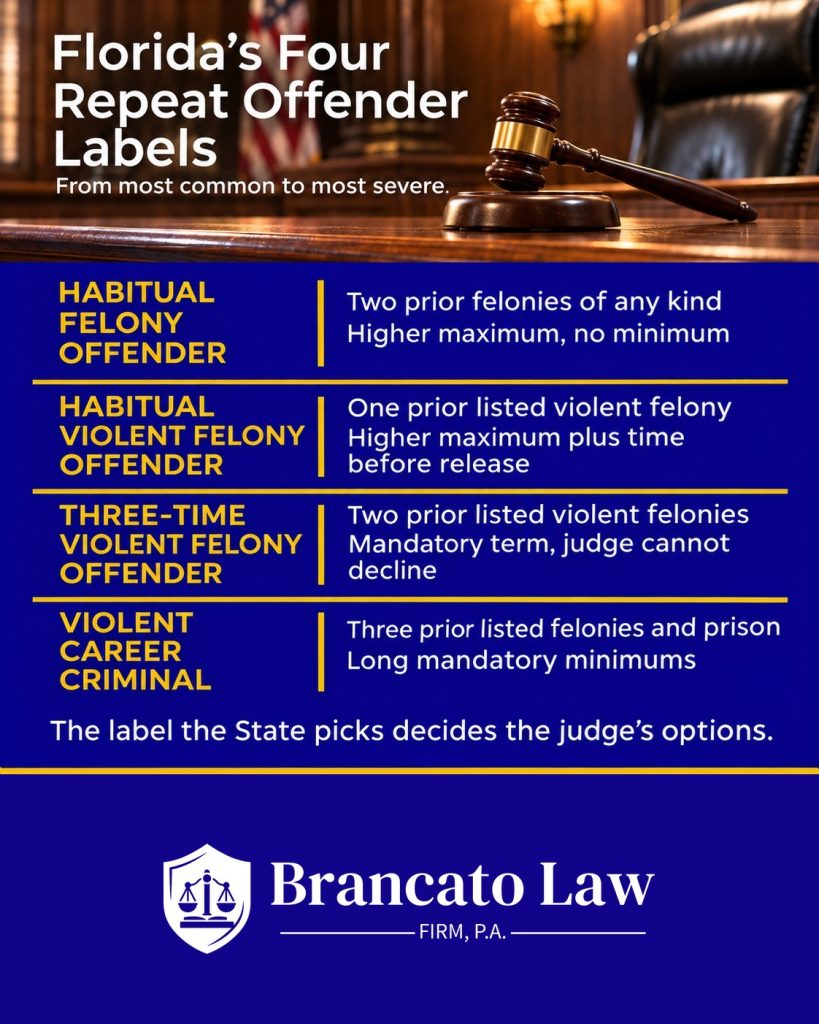
Section 775.084 creates four separate designations, and each one has its own prior-record test and its own penalties. Habitual felony offender is the broadest and the most common; the other three require violent priors. The Brancato Law Firm reads the State’s notice closely, because the label the prosecutor chooses decides whether the judge has any discretion at all.
| Designation | Prior record required | Can the judge decline? | Sentence |
|---|---|---|---|
| Habitual felony offender (HFO) | Two or more prior felonies (any type), within the 5-year window | Yes, with written reasons | Up to 10, 30 years, or life by degree; no minimum |
| Habitual violent felony offender (HVFO) | One prior conviction for an enumerated violent felony, within the 5-year window | Yes, with written reasons | Same maximums as HFO, plus 5, 10, or 15 years before release |
| Three-time violent felony offender | Two or more prior enumerated violent felonies, and the new charge is also enumerated | No | Mandatory 5, 15, or 30 years, or life; release only when the sentence expires |
| Violent career criminal (VCC) | Three or more prior forcible felonies or other listed offenses, plus a prior state or federal prison term | Yes, with written reasons | Life; up to 40 years with a 30-year minimum; or up to 15 years with a 10-year minimum |
The HVFO list in section 775.084(1)(b) covers arson, sexual battery, robbery, kidnapping, aggravated child abuse, aggravated abuse of an elderly person or disabled adult, aggravated assault with a deadly weapon, murder, manslaughter, aggravated manslaughter of an elderly person, disabled adult, or child, unlawful use of a destructive device or bomb, armed burglary, aggravated battery, and aggravated stalking. The three-time violent list adds home invasion robbery and carjacking. The violent career criminal list starts with any forcible felony under section 776.08. Because these designations so often follow robbery, battery, and burglary charges, our Tampa violent crime lawyer page explains how our attorneys defend the underlying charge.
How many people in Florida carry a habitual or career offender label?
Florida had over 19,000 career offenders, according to a January 23, 2026 Florida Senate Criminal Justice Committee bill analysis of SB 1332, which cited 2024 figures from the Florida Department of Law Enforcement. Florida law defines a career offender as a person designated a habitual violent felony offender, violent career criminal, three-time violent felony offender, or prison releasee reoffender, and each of those people must register. The same analysis said about 9,400 of them were not incarcerated. Our post on career offender registration in Florida explains the registration duties that follow those designations.
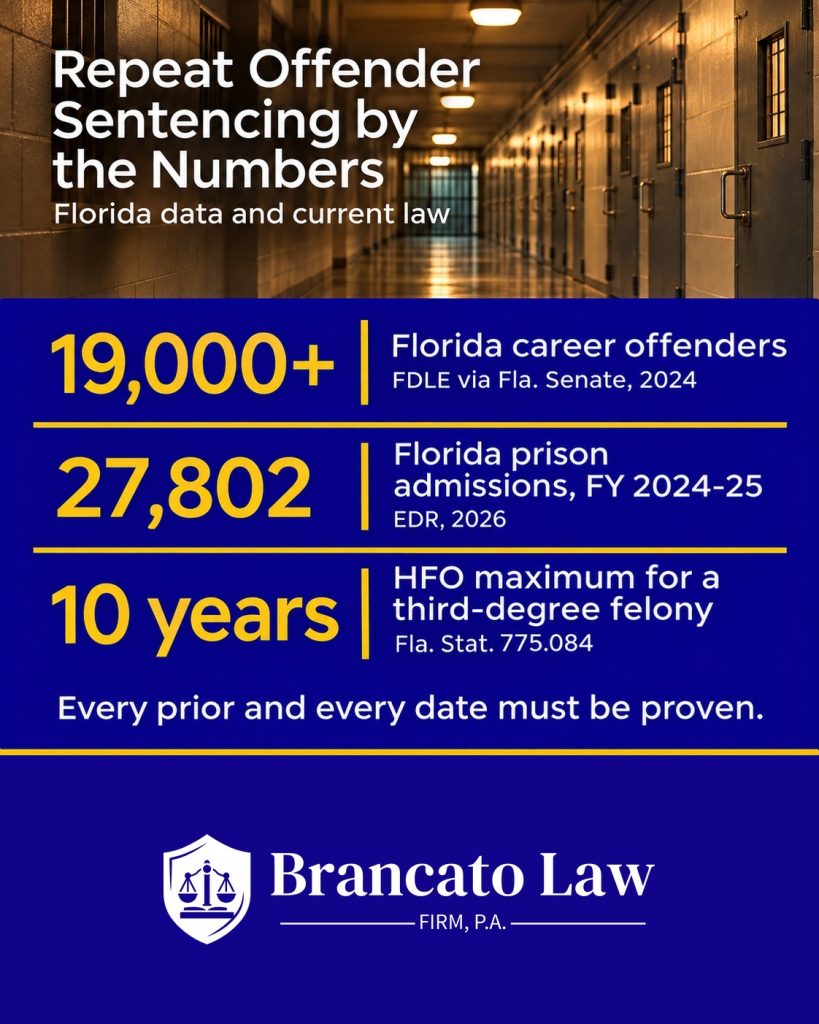
The habitual offender laws operate inside a large prison system. Florida admitted 27,802 people to state prison in fiscal year 2024-25, according to the Legislature’s Office of Economic and Demographic Research in its July 2026 Criminal Justice Trends report. The supporters of repeat-offender laws argue that longer terms deter people who already have felony records, and some research supports a modest effect. A study of California’s three-strikes law by Eric Helland and Alexander Tabarrok, published in the Journal of Human Resources in 2007, found that the law reduced felony arrest rates among people with two strikes by 17 to 20 percent. In an individual case, the judge still has to decide whether this sentence is needed to protect the public.
Does the State have to give notice before seeking a habitual offender sentence?
Yes. Section 775.084(3)(a) requires written notice served on the defendant and the defense attorney a sufficient time before the plea or sentencing to allow the defense to prepare. In Ashley v. State, 614 So. 2d 486 (Fla. 1993), the Florida Supreme Court reviewed the case of a man who pleaded no contest to battery on a correctional officer; the State filed its habitual offender notice three days after the plea was accepted. The Court held that before a judge accepts a guilty or no contest plea from a defendant who may be habitualized, the defendant must receive written notice and the judge must confirm the defendant personally understands the possibility and reasonable consequences of habitualization, including the maximum habitual term. The Court vacated the habitual sentence.
If the notice was late, or the plea colloquy never mentioned the habitual maximum, the enhanced sentence may be vulnerable even years later. Later cases hold that the notice requirement can be satisfied when the written plea agreement itself spells out the habitual offender sentence, so our attorneys read the plea paperwork as closely as the notice. Our guide on how to decide whether to accept a plea bargain in Florida covers what to weigh before signing.
How does the State prove you qualify as a habitual felony offender?
The State must prove each qualifying fact by a preponderance of the evidence, in open court, with the defendant’s full rights of confrontation and cross-examination, under section 775.084(3)(a). In practice that means certified copies of prior judgments, often matched to the defendant by a fingerprint examiner, and records showing release dates. The court must also obtain and consider a presentence investigation report before imposing an HFO or HVFO sentence.
In Tianga v. State, 146 So. 3d 1235 (Fla. 2d DCA 2014), a Lee County case from the Second District, which also hears appeals from Hillsborough, Pinellas, and Pasco Counties, the State proved five prior cocaine possession convictions with certified judgments and fingerprints but relied on a Department of Corrections tracking form, with no fingerprints or photograph, for the other priors. The State conceded that the form did not sufficiently identify Tianga as the person named in it. The court reversed the habitual sentence and sent the case back for resentencing, allowing the enhancement only if the State could produce proper documentation.
How do our attorneys fight a habitual offender designation?
Our attorneys fight a habitual offender notice in six ways, usually at the same time, because each one can independently keep the enhancement out of the sentence:
- Audit the priors. We pull the certified judgment for every prior the State lists and check the identity proof, the degree of each offense, and whether an out-of-state conviction is truly similar to a Florida felony.
- Count the dates. The new offense must fall within 5 years of the last qualifying conviction or release, and each counted prior must have been sentenced separately. A single plea date for two cases can turn two priors into one.
- Apply the drug-possession exclusion. A new possession charge under section 893.13 cannot be habitualized, and possession priors cannot supply both qualifying convictions.
- Attack a prior in postconviction. A prior conviction that is set aside no longer counts, so we review older cases for a defective plea or another viable postconviction claim.
- Ask the judge to decline. For HFO, HVFO, and violent career criminal notices, the judge may find the enhancement is not necessary to protect the public and must then give written reasons. We build that record with treatment, employment, family support, and mitigation evidence that feeds the presentence investigation.
- Negotiate the notice away. Because the prosecutor chooses whether to seek the enhancement, the notice is often part of plea negotiations, and withdrawing it can be worth more than any reduction in the charge.
Our office is two blocks from the courthouse on East Twiggs Street, where Hillsborough County felony cases, including habitual offender sentencings, are heard. For more about our defense strategies across the 13th Judicial Circuit, visit our Hillsborough County criminal defense attorney page.
Does Erlinger mean a jury must decide habitual offender status?
It is an open fight, and so far Florida appellate courts have not reversed habitual sentences on this ground. In Erlinger v. United States, 602 U.S. 821 (2024), the U.S. Supreme Court held that a jury, not a judge, must decide whether a defendant’s past offenses were committed on separate occasions before a federal mandatory prison term applies, and that a judge may determine only what crime, with what elements, the defendant was convicted of. Florida’s habitual offender statute asks the judge to find more than that, including the timing of the new offense against prior release dates.
Florida’s district courts have so far avoided deciding the question by finding any error harmless. In Scott v. State, 413 So. 3d 276 (Fla. 5th DCA 2025), a Brevard County defendant sentenced as an HFO for trafficking and firearm offenses argued that a jury had to make the HFO findings. The Fifth District assumed, without deciding, that Erlinger applies to Florida’s HFO statute, but affirmed because each of his sentences was at or below the ordinary statutory maximum. In Kenyon v. State, No. 4D2023-1856 (Fla. 4th DCA Mar. 11, 2026), an Indian River County case, the Fourth District likewise assumed error and held it harmless because no rational jury would have found the qualifying facts differently. The issue must still be raised and preserved at sentencing, and our post on the prison releasee reoffender law tracks how Florida courts are handling the same Erlinger argument for PRR sentences.
What should you do after receiving a habitual offender notice?
Act before any plea is entered, because the notice changes what every offer is worth. These steps protect your options:
- Do not accept a plea offer until your lawyer has confirmed whether you actually qualify and what the habitual maximum would be.
- Gather what you have on your prior cases: case numbers, plea dates, sentencing dates, and release or termination dates from prison or probation.
- Tell your lawyer about every prior case in any state, including any withhold of adjudication, since a withhold counts for this statute.
- Start building mitigation now, such as treatment records, work history, and letters, because the judge’s decision to decline the designation depends on it.
- If you are also on probation, ask about the risk of a violation; our guide on how to fight a probation violation in Florida explains that process.
Frequently asked questions about habitual felony offender sentencing in Florida
Can a habitual felony offender notice be withdrawn in Florida?
Yes. The prosecutor decides whether to seek a habitual sentence, so the State can withdraw the notice, and the judge can decline an HFO or HVFO sentence by finding it is not needed to protect the public. The Brancato Law Firm often focuses plea negotiations on removing the notice, and our Hillsborough County defense attorneys build the mitigation record that supports a judge’s decision to decline.
Does a withhold of adjudication count as a prior felony for habitual offender sentencing?
Yes. Under section 775.084(2), being placed on probation or community control without an adjudication of guilt is treated as a prior conviction for habitual offender purposes. Our attorneys at The Brancato Law Firm check each withhold in a client’s history, because many people are surprised to learn that a case they thought was behind them counts here.
Do out-of-state convictions count toward habitual felony offender status in Florida?
They can. A conviction from another state, the federal system, or a foreign country counts as a qualified offense if it is substantially similar in elements and penalties to a Florida offense and was punishable by more than one year. The Brancato Law Firm compares the elements of the out-of-state statute line by line, because a mismatch removes that prior from the count.
How is the five-year window measured for habitual felony offender status?
The new felony must be committed within 5 years of the last qualifying conviction, or within 5 years of release from the prison sentence or supervision imposed for it, whichever date is later. Our attorneys at The Brancato Law Firm build a timeline from certified records for every client, and a single wrong release date can take a case outside the window. See our case process guide for where sentencing fits in the life of a case.
What is the difference between a habitual felony offender and a prison releasee reoffender?
A habitual felony offender designation depends on the number and timing of prior felonies and raises the maximum sentence, while a prison releasee reoffender designation depends on committing a listed felony within 3 years of release from prison and requires the statutory maximum. The Brancato Law Firm defends both, and our prison releasee reoffender guide explains the PRR rules in detail.
Can a judge give less than the habitual maximum sentence?
Yes, for a habitual felony offender. The HFO statute sets only maximum terms, so the judge can impose any lawful sentence up to the habitual cap, while HVFO, three-time violent felony offender, and violent career criminal sentences carry minimum terms. Our attorneys at The Brancato Law Firm present mitigation at the sentencing hearing aimed at the lowest sentence the law allows.
Talk to a Tampa defense attorney about a habitual offender notice
The time to challenge a habitual offender notice is before you enter a plea, while every prior conviction and date can still be tested. Call The Brancato Law Firm, P.A., founded by Tampa Criminal Defense Attorney Rocky Brancato, at (813) 727-7159; our attorneys will review the State’s notice and your prior record and tell you whether the enhancement can be defeated. You can call us at any hour. Our firm has Spanish-speaking staff, and attorney Jean-Luc Adrien speaks Spanish, Haitian Creole, and French.
The Brancato Law Firm, P.A.
620 E. Twiggs Street, Suite 205, Tampa, FL 33602
(813) 727-7159
Serving Hillsborough, Pinellas, and Pasco Counties
The Brancato Law Firm, P.A. is a Tampa-based criminal defense practice. We are not affiliated with any other Brancato-named law firms.
Visit Us

Tampa, FL 33602

Contact Us Now
Free Legal Consultation (813) 727-7159
