- Free Consultation 24/7: (813) 727-7159 Tap Here To Call Us


From First DUI to Death Penalty



What Is Career Offender Registration in Florida? (2026)


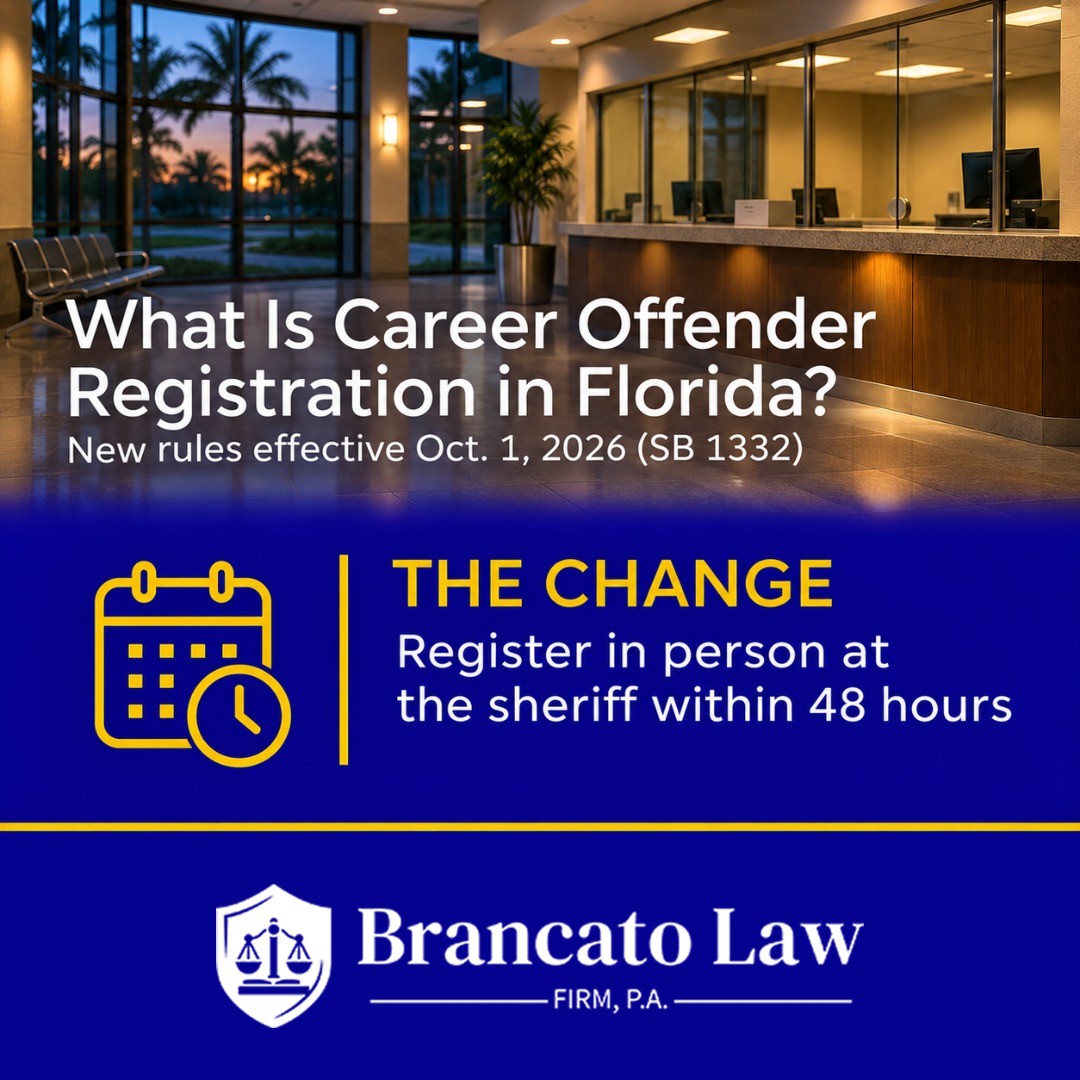
| Career offender registration is a lifetime duty under Florida’s Career Offender Registration Act, section 775.261, for anyone designated a habitual violent felony offender, violent career criminal, three-time violent felony offender, or prison releasee reoffender. Since October 1, 2026, a career offender must register in person at the sheriff’s office within 48 hours, report a new residence after just 3 days, reregister in person every birth month, and carry a driver license or ID marked “775.261, F.S.” Most failures to register or report are third-degree felonies, and each failure is a separate offense. |
Anyone who finished a prison releasee reoffender or habitual violent felony offender sentence in Florida is now living under stricter rules than the day they walked out. As founder of The Brancato Law Firm, P.A., a Tampa criminal defense firm, I have spent more than 25 years in Hillsborough County courtrooms, including as a former Chief Operations Officer of the Hillsborough County Public Defender’s Office, where I oversaw a staff of over 100 attorneys. I have seen how a sentencing designation chosen in a plea conference follows a person for life. Our attorneys look at registration consequences before any plea that could carry one of these designations.
This guide explains what SB 1332 (chapter 2026-151, Laws of Florida) changed, who it covers, why the Legislature acted, and how career offender registration charges are defended.
Who Has to Register as a Career Offender in Florida?
A “career offender” under section 775.261, Florida Statutes, is anyone designated as one of four types of repeat offender:
- A habitual violent felony offender under section 775.084.
- A violent career criminal under section 775.084, sometimes called a “GORT” sentence.
- A three-time violent felony offender under section 775.084.
- A prison releasee reoffender under section 775.082(9), the designation for someone who commits a listed violent felony within three years of release from prison.
Registration is triggered by the designation, not by the crime. Two people convicted of the same robbery can face completely different futures depending on whether the State sought, and the court imposed, a PRR or habitual offender designation. Our guide on what a prison releasee reoffender is in Florida explains how that designation works.
The duty lasts for life. A career offender may petition the circuit court for removal only after being released from confinement, supervision, or sanction for at least 20 years without any arrest for a felony or misdemeanor. A full pardon or a conviction set aside in postconviction proceedings also ends the requirement.
What Did SB 1332 Change on October 1, 2026?
SB 1332 rewrote the act to make career offender registration work much more like sex offender registration. These are the major changes:
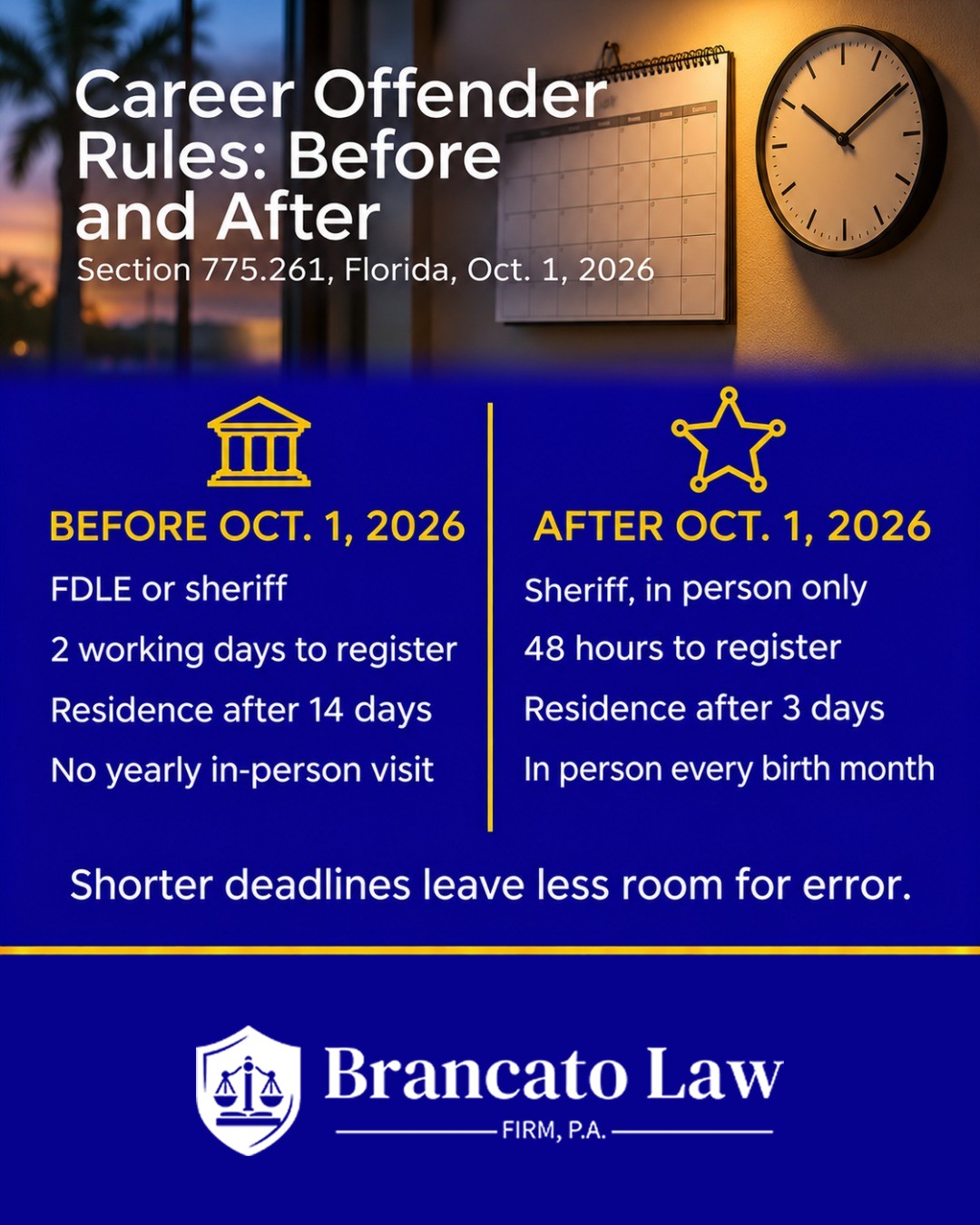
| Requirement | Before October 1, 2026 | After October 1, 2026 |
|---|---|---|
| Where to register initially | FDLE or the county sheriff | In person at the sheriff’s office only |
| Initial registration deadline | 2 working days | 48 hours |
| When a place counts as a residence | 14 days | 3 days |
| Reporting changes (address, job, vehicle, phone) | 2 working days | 48 hours, in person for residence changes |
| Reregistration | Not required in person each year | In person every year during the birth month |
| Driver license or ID | Standard license | Must be marked “775.261, F.S.” on the front |
| Information required | Basic identifying and address information | Adds tattoos, fingerprints, palm prints, phone numbers, employer, vehicles with VIN and tag, passport, immigration documents, and professional licenses |
| Helping a career offender avoid registration | First-degree misdemeanor | Third-degree felony |
The 3-day rule is the change most likely to catch people. A “temporary residence” now includes any place a career offender stays for 3 or more days in the aggregate during a calendar year, including vacations and business trips in or out of Florida. The first day is not counted, and any part of a calendar day counts as a day. A long weekend at a relative’s house can now trigger a reporting duty.
The law also requires anyone who leaves Florida to report in person at least 48 hours before departing. A person who reports an intent to vacate a residence but stays, and then fails to report within 48 hours, commits a second-degree felony punishable by up to 15 years in prison.
Why Did Florida Tighten Career Offender Registration?
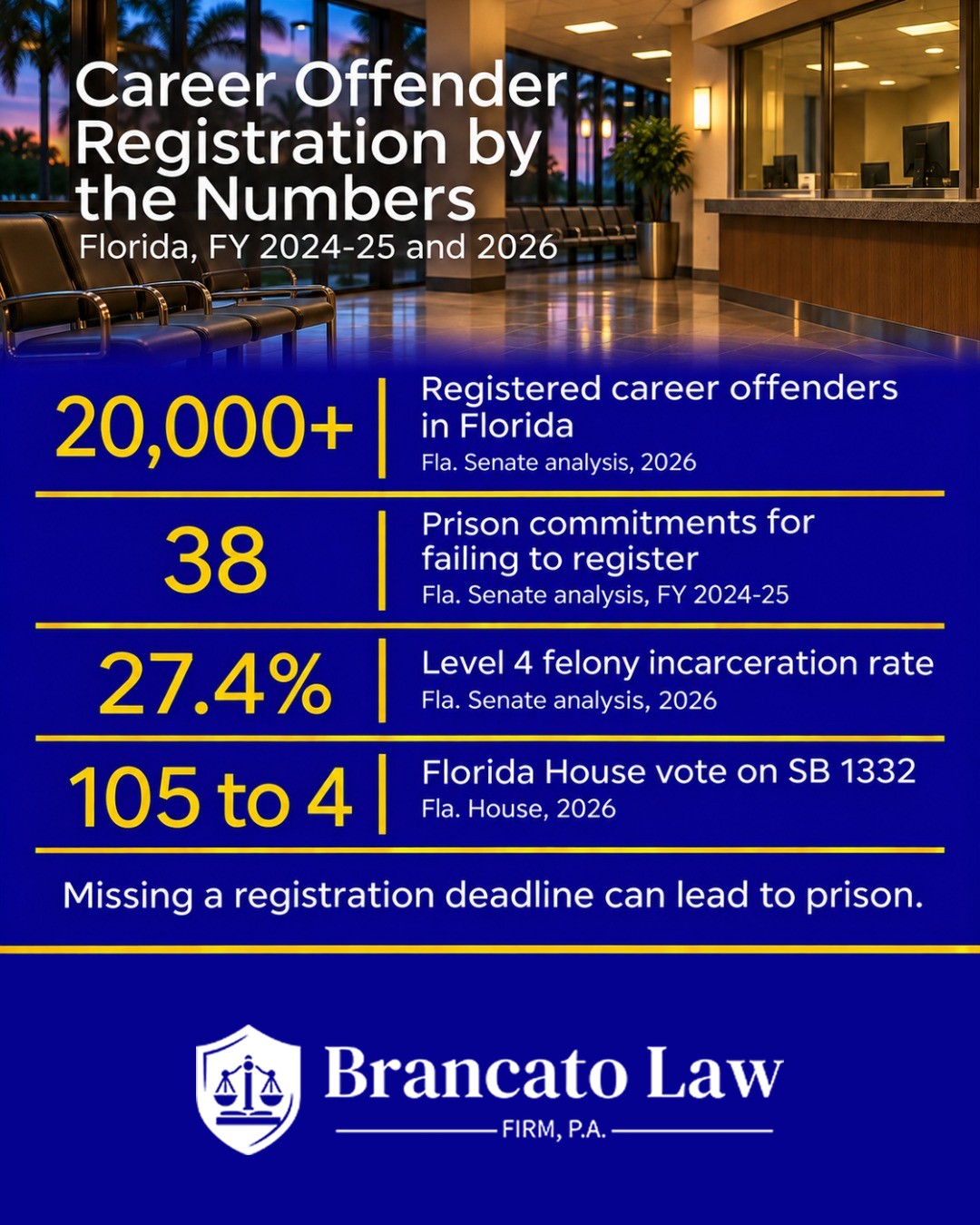
The Legislature’s stated goal was to make the career offender rules similar to the sex offender rules and to close compliance gaps. According to the Senate Fiscal Policy Committee’s analysis of SB 1332, Florida has more than 20,000 registered career offenders. About 6,800 live in the community, and about 1,200 had absconded or were at unknown locations when the bill was filed.
The act itself dates to 2002 and took effect January 1, 2003. The Senate analysis describes registration as “merely a status” and “not a punishment,” the same legal theory courts have used to uphold sex offender registration. That characterization matters, because it is the reason registration can be imposed and expanded without the protections that apply to criminal sentences.
SB 1332 was sponsored by Senator Jonathan Martin, and the House companion was HB 931 from the Criminal Justice Subcommittee. It passed with little opposition:
| Date (2026) | Committee or chamber | Vote |
|---|---|---|
| January 26 | Senate Criminal Justice Committee | 7 to 0 |
| February 18 | Senate Appropriations Committee on Criminal and Civil Justice | 8 to 0 |
| March 2 | Senate Fiscal Policy Committee | 18 to 0 |
| March 5 | Full Senate | 36 to 1 |
| March 11 | Full House | 105 to 4 |
Vote tallies come from the official bill history. Governor DeSantis signed the bill on June 16, 2026.
Do Offender Registries Reduce Crime?
The research on registries is mixed at best, and most of it concerns sex offender registries rather than career offender lists. In an influential study published in the Journal of Law and Economics in 2011, economist Amanda Agan analyzed state and national data and found little evidence that sex offender registries reduced sex offenses or that registered offenders reoffended less. Florida has not published an evaluation of whether career offender registration reduces violent crime.
What the data does show is that enforcement produces prison sentences. The same Senate analysis reports 38 new prison commitments in fiscal year 2024-25 for failing to register or report under section 775.261. It also reports a 9.7% incarceration rate for a Level 1 third-degree felony and a 27.4% rate for a Level 4 second-degree felony, the levels these registration crimes generally score at. Because SB 1332 makes every missed report a separate offense, those numbers are likely to rise.
What Are the Penalties for Failing to Register as a Career Offender?
Most registration failures are third-degree felonies, punishable by up to five years in prison and a $5,000 fine. Section 775.261 lists the conduct that qualifies, including failing to register, failing to reregister, failing to report a change of address, job, phone number, or vehicle, failing to answer address verification mail within 3 weeks, and knowingly giving false information. The statute adds that “each instance of failure to register or report changes to the required information” is a separate offense.
| Violation | Degree | Maximum penalty |
|---|---|---|
| Failing to register, reregister, or report required changes | Third-degree felony | 5 years and $5,000 |
| Staying after reporting an intent to vacate and not reporting within 48 hours | Second-degree felony | 15 years and $10,000 |
| Helping a career offender evade law enforcement (harboring, concealing, lying) | Third-degree felony | 5 years and $5,000 |
The “assisting” crime affects family members. A spouse, parent, or roommate who has reason to believe a career offender is out of compliance and hides the person or gives police false information, with intent to help the person avoid law enforcement, can now be charged with a felony.
How Do You Fight a Career Offender Registration Charge?
Registration cases turn on status, notice, and proof of the specific failure. Our Tampa violent crimes lawyer team checks these issues first:
- Is the person actually a career offender? The duty depends on a designation in the judgment. In Mederos-Morales v. State, 222 So. 3d 1234 (Fla. 5th DCA 2017), a Putnam County man who pleaded to failing to register as a career offender claimed he did not meet the definition. The appeals court said his postconviction motion had to address every possible designation, including prison releasee reoffender, and gave him a chance to amend. The lesson is that the judgment and sentence must be read line by line.
- Was the designation properly removed? In McDonald v. State, 40 So. 3d 849 (Fla. 3d DCA 2010), the State agreed to waive a violent career criminal enhancement before the defendant’s plea. The Third District held that he “should have received a new sentence without requiring career offender registration” and reversed. When a designation is waived, the registration requirement should go with it.
- Did the person know about the new rules? Many career offenders were released years ago and have never been told about the 3-day rule, the birth-month reregistration, or the license marking. Notice and knowledge are often central defenses.
- Can the State prove the residence? The State must prove the person stayed at a place long enough to trigger a duty. Hotel records, phone data, and witness accounts often conflict.
- Is each count supported? Because each failure is a separate offense, prosecutors may file multiple counts from one lapse. Our attorneys challenge counts that duplicate the same conduct.
How Can You Avoid a Career Offender Designation in the First Place?
The best time to address career offender registration is before sentencing. A PRR or habitual offender designation is often a choice the State makes in charging and plea negotiations. Our attorneys negotiate for sentences without those designations when the facts allow, and we explain the lifetime registration consequence to every client before a plea. Our guide on what happens if you reject a plea deal in Florida explains how those negotiations work.
This post is part of our guide to the new Florida criminal laws that took effect October 1, 2026, which summarizes all eight laws in one place.
Frequently Asked Questions
How long do career offenders have to register in Florida?
For life, unless the person receives a full pardon, has the qualifying conviction set aside, or petitions for removal after at least 20 years since release with no arrests. The Brancato Law Firm reviews eligibility for removal and the paperwork needed to support a petition.
Do I have to report a vacation as a career offender?
Yes, if you stay somewhere for 3 or more days in the aggregate during a calendar year, because that place becomes a temporary residence under the new definition. Our attorneys at The Brancato Law Firm advise registrants to report travel in advance rather than risk a felony for a family trip.
Is the career offender list public in Florida?
Yes. FDLE maintains a public registry, and the information may be released by any appropriate means, including online and by phone. The Brancato Law Firm explains to clients what information will be public before any plea that carries a career offender designation.
Can my family get in trouble for helping me?
Yes, if they hide you, harbor you, or give false information to police with intent to help you avoid law enforcement while you are out of compliance, which is now a third-degree felony. Our attorneys at The Brancato Law Firm defend family members charged with assisting as well as the registrant.
What does “775.261, F.S.” on my driver license mean?
It identifies the license holder as a registered career offender under section 775.261, and since October 1, 2026, career offenders must obtain a license or ID with that marking. The Brancato Law Firm helps clients confirm whether they are actually required to carry the marking, through our violent crimes defense practice.
Can I still be charged under the old rules for something before October 1, 2026?
Yes, for conduct that violated the rules in effect at the time, but the new 48-hour and 3-day requirements apply only to conduct on or after October 1, 2026. Our attorneys at The Brancato Law Firm compare the dates of every alleged failure to the law in effect when it happened.
Talk to a Tampa Defense Lawyer About Career Offender Registration
For more about our defense strategies, visit our Violent Crimes practice page.
A missed report can become a new felony, so the time to get advice is before the deadline. Our attorneys will review your judgment, your designation, and your reporting history, and we will tell you exactly what the new law requires of you. Call The Brancato Law Firm, P.A., founded by Tampa Criminal Defense Attorney Rocky Brancato, at (813) 727-7159. Call us at any hour; our office is two blocks from the courthouse. Our firm has Spanish-speaking staff, and attorney Jean-Luc Adrien speaks Spanish, Haitian Creole, and French.
The Brancato Law Firm, P.A.
620 E. Twiggs Street, Suite 205, Tampa, FL 33602
(813) 727-7159
Serving Hillsborough, Pinellas, and Pasco Counties
The Brancato Law Firm, P.A. is a Tampa-based criminal defense practice. We are not affiliated with any other Brancato-named law firms.
Visit Us

Tampa, FL 33602

Contact Us Now
Free Legal Consultation (813) 727-7159
