

From First DUI to Death Penalty



Can a DUI Be Expunged or Sealed in Florida? (2026)


No. A DUI conviction cannot be sealed or expunged in Florida, because section 316.656 requires the judge to adjudicate guilt on every DUI, and the sealing and expunction statutes exclude any case that ended in an adjudication of guilt. A DUI arrest can be sealed or expunged when the charge is dropped, dismissed, or ends in an acquittal. A DUI reduced to reckless driving with adjudication withheld may be eligible for sealing if the person has never been adjudicated guilty of a crime and has never sealed or expunged another record.
Florida judges have no power to withhold adjudication on a DUI, and that single rule decides most questions about clearing a DUI record. As founder of The Brancato Law Firm, P.A., a Tampa criminal defense firm, and a former Chief Operations Officer of the Hillsborough County Public Defender’s Office, where I oversaw a staff of over 100 attorneys, I have watched that rule shape plea decisions over more than 25 years in Hillsborough County courtrooms. Our attorneys look at sealing eligibility before a client decides whether to accept a plea, because once a DUI conviction is entered, the record is permanent.
Can a DUI conviction be sealed or expunged in Florida?
No. A DUI conviction stays on a Florida criminal record permanently. Section 316.656(1), Florida Statutes, says no court may “suspend, defer, or withhold adjudication of guilt” for a violation of the DUI statute, section 316.193. Every DUI plea or guilty verdict therefore ends in an adjudication of guilt.
That adjudication is what blocks relief. Florida’s sealing statute, section 943.059, allows a petition only if the person “has not been adjudicated guilty of” any of the acts stemming from the arrest. The expunction statute, section 943.0585, has the same requirement. DUI does not appear on the list of offenses barred from sealing in section 943.0584. It does not need to, because the mandatory adjudication rule already keeps a DUI conviction out.
Can a judge withhold adjudication on a DUI in Florida?
No, with one narrow exception for youthful offenders. In State v. Whitaker, 590 So. 2d 1029 (Fla. 1st DCA 1991), a driver with three prior DUI convictions pleaded no contest, and the circuit judge withheld adjudication and placed him on probation. The First District Court of Appeal held that section 316.656(1) is mandatory and sent the case back “with directions to pronounce adjudication of guilt.” A plea agreement cannot change that result.
The exception is youthful offender sentencing. In Sloan v. State, 884 So. 2d 378 (Fla. 2d DCA 2004), the Second District, which hears appeals from Hillsborough County, reversed a DUI manslaughter judgment and held that “if the trial court classifies a defendant as a youthful offender, section 316.656(1) is inapplicable.” Youthful offender sentencing under section 958.04 applies only to a felony committed before the defendant turned 21, so this exception matters mainly in felony DUI cases involving young drivers.
What happens to the record if a DUI is dropped, dismissed, or ends in acquittal?
The criminal history record is sealed automatically. Under section 943.0595, the Florida Department of Law Enforcement (FDLE) must seal a record when no charging document was filed, when the charge was dismissed or dropped by nolle prosequi as to all counts, or when a judge or jury found the person not guilty on all counts. The clerk sends the disposition to FDLE, and the court file becomes confidential. No petition is needed, and the statute sets no limit on how many times a person may receive an automatic sealing.
Automatic sealing has limits. The statute says other criminal justice agencies may keep their records, so a police report can still exist inside the agency. For a fuller remedy, a person whose DUI was dropped, dismissed, or ended in acquittal can petition to have the record expunged under section 943.0585. Because no plea was entered in those cases, the 10-year sealing period that applies to some expunctions does not apply. The person must still meet the other requirements, including never having been adjudicated guilty of a criminal offense and never having sealed or expunged another record.
Can a DUI reduced to reckless driving be sealed?
Often, yes. Reckless driving under section 316.192 is not covered by the mandatory adjudication rule, so a judge may withhold adjudication on it. If adjudication is withheld, the person has no prior adjudication of guilt, has never sealed or expunged another record, and has finished probation, the reckless driving record can be eligible for court-ordered sealing. After the record has been sealed for 10 years, section 943.0585(1)(h) allows a petition to expunge it.
In Hillsborough County, this is how the State Attorney’s RIDR program (Reducing Impaired Driving Recidivism) ends for drivers who complete it. A qualifying first-time offender finishes DUI school, community service, and other sanctions, then pleads to reckless driving and receives a withhold of adjudication and 12 months of probation. Our post on the RIDR program in Hillsborough County covers who qualifies, and our post on a DUI reduced to reckless driving in Florida explains the plea itself. Our Hillsborough County criminal defense page describes how these cases move through the 13th Judicial Circuit.
One limit applies before any reduction. Section 316.656(2)(a) says no judge may accept a guilty plea to a lesser offense from a person whose breath or blood test showed 0.15 or more. A high test result can close off the reckless driving route unless the test itself is suppressed or excluded.
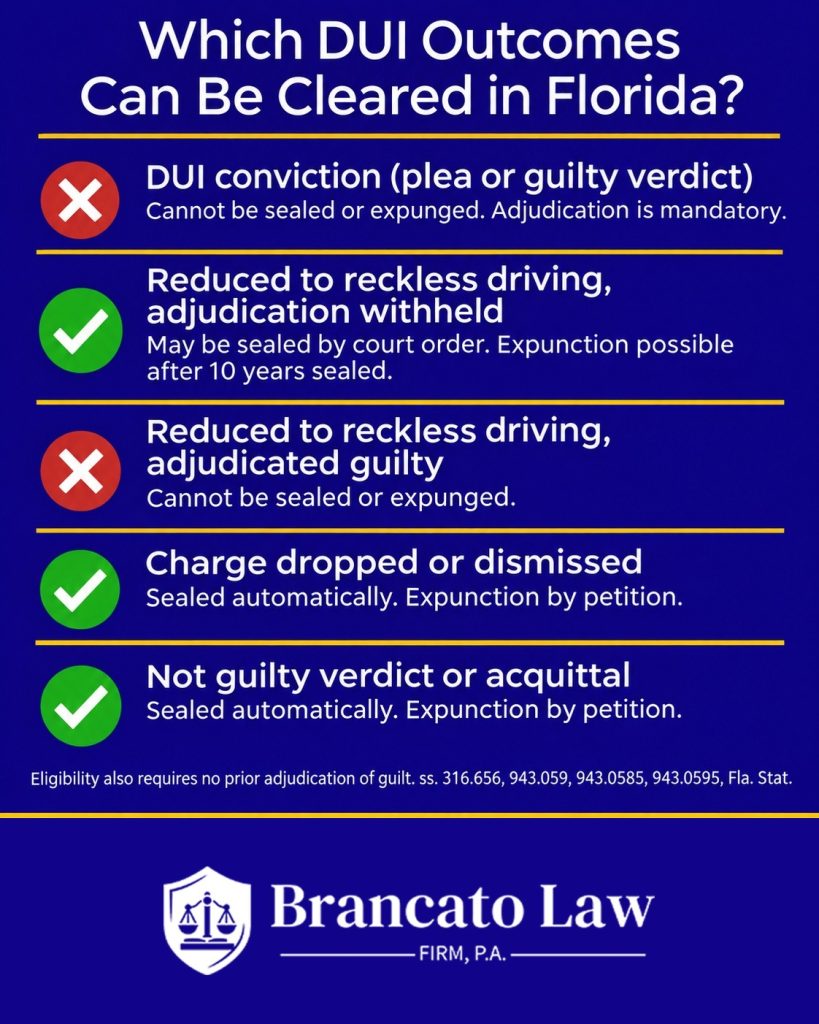
The table below shows where each common DUI outcome leaves the criminal record under sections 943.059, 943.0585, and 943.0595.
| Case outcome | Can the record be sealed? | Can the record be expunged? |
|---|---|---|
| DUI conviction (plea or guilty verdict) | No. Adjudication is mandatory under s. 316.656 | No |
| Reduced to reckless driving, adjudication withheld | Yes, by court order, if the person meets s. 943.059 | After 10 years of sealing, if otherwise eligible |
| Reduced to reckless driving, adjudicated guilty | No | No |
| Charge dropped, no information filed, or dismissed | Sealed automatically under s. 943.0595 | Yes, by petition, with no 10-year wait |
| Not guilty verdict or judgment of acquittal | Sealed automatically under s. 943.0595 | Yes, by petition, with no 10-year wait |
Does a DUI conviction stop you from sealing other records?
Yes. A DUI conviction is an adjudication of guilt for a criminal offense, and section 943.059(1)(b) allows sealing only for a person who has never been adjudicated guilty of a criminal offense in Florida. One DUI conviction can therefore block the sealing of an unrelated old arrest.
Timing does not help. In Hunt v. State, 670 So. 2d 1180 (Fla. 3d DCA 1996), a man asked to seal an older criminal case and argued that his DUI conviction should not count because it came after that crime. The Third District disagreed: the DUI conviction came before the petition, so the trial judge properly considered it. The court also noted that a judge may deny sealing in its discretion, and section 943.059(4)(e) still says any request “may be denied at the sole discretion of the court.”
Who can still see a sealed or expunged DUI arrest?
A sealed record is confidential, but it is not gone. Section 943.059 makes it available to the person, the person’s attorney, criminal justice agencies, Florida judges, and certain licensing and employment agencies. The person may lawfully deny the arrest in most settings, but not when applying to a criminal justice agency, to The Florida Bar, or for jobs and licenses with agencies that serve children, the elderly, or the disabled, among other listed exceptions. Our post on who can see your arrest record in Florida covers the public side, including mugshot sites.
| Sealing (s. 943.059 or s. 943.0595) | Expunction (s. 943.0585) | |
|---|---|---|
| What happens to the record | Kept but made confidential | Physically destroyed by agencies; FDLE keeps a confidential copy |
| Who can still see it | The person, the person’s attorney, criminal justice agencies, judges, and listed licensing and employment agencies | Available only by court order, except FDLE discloses its existence to criminal justice agencies and listed licensing and employment agencies |
| Typical DUI path | Reckless driving with a withhold, or automatic sealing after a dropped charge or acquittal | Dropped, dismissed, or acquitted DUI, or reckless driving after 10 years sealed |
| How often | Court-ordered sealing generally once; automatic sealing has no limit | Generally once, unless expunging a record sealed for 10 years |
Sealing and expunction statutes deal with criminal history records. Your driver license record is a separate file kept by the Department of Highway Safety and Motor Vehicles under chapter 322, so our attorneys review both records when advising a client on a DUI case.
How should sealing affect a DUI plea decision?
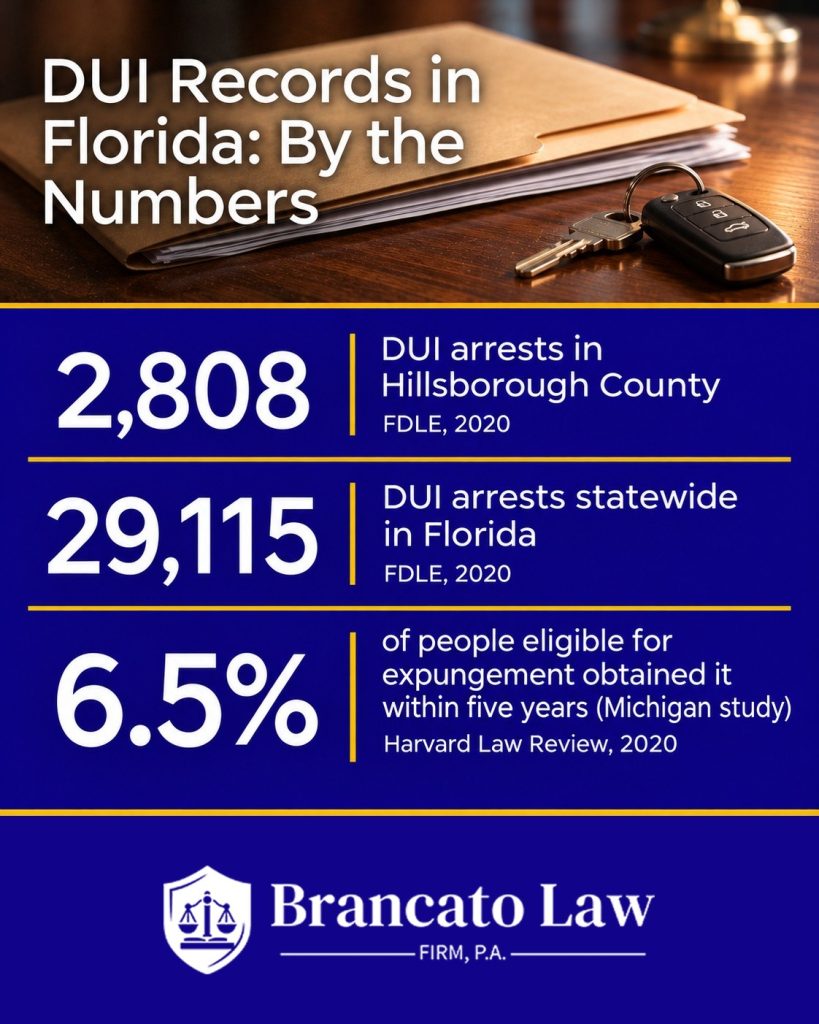
Sealing eligibility belongs in every DUI plea discussion, because it is lost the moment a DUI conviction is entered. The number of people affected is large. The Florida Department of Law Enforcement’s 2020 arrest totals by county counted 2,808 DUI arrests in Hillsborough County and 29,115 statewide that year.
In Expungement of Criminal Convictions: An Empirical Study, published in the Harvard Law Review in 2020, J.J. Prescott and Sonja B. Starr studied Michigan records and found that just 6.5% of people eligible for expungement obtained it within five years. Those who did saw their wages rise by more than 22% within one year compared with their prior trajectory.
At the plea stage of the Florida criminal case process, our attorneys weigh three questions with each client. Does the person already have an adjudication of guilt that blocks sealing anyway? Can the evidence support a dismissal, an acquittal, or a reduction to reckless driving with a withhold? Is a breath or blood result of 0.15 or more standing in the way of a reduction, and can that result be challenged? For clients who hold or want a professional license, these answers can matter more than the fine or the probation term. Our Tampa DUI lawyer page explains how we prepare a DUI case for trial when a plea would cost the client a clean record.
How do you seal or expunge a DUI arrest in Florida?
Court-ordered sealing and expunction follow the same basic steps:
- Get a certified copy of the final disposition from the clerk of court in the county where the case was filed.
- Apply to FDLE for a certificate of eligibility. For sealing, section 943.059 sets a $75 processing fee, and the certificate is valid for 12 months.
- File a petition in the circuit court with the certificate and a sworn statement that you meet the eligibility requirements and have no other sealing or expunction petition pending.
- Attend the hearing if the court sets one.
- After the order is entered, confirm that FDLE, the clerk, and the arresting agency have complied.
For a dropped or dismissed DUI, check first whether automatic sealing already happened under section 943.0595, then decide whether to pursue a full expunction.
Frequently asked questions about sealing and expunging a DUI in Florida
Does a DUI ever come off your criminal record in Florida?
No. A DUI conviction cannot be sealed or expunged at any point, because it always ends in an adjudication of guilt under section 316.656. The Brancato Law Firm therefore focuses on the outcomes that can be cleared, such as a dismissal, an acquittal, or a reduction with a withhold.
Can a DUI arrest be expunged if the charges were dropped?
Yes, if you meet the other requirements of section 943.0585, including never having been adjudicated guilty of a crime and never having sealed or expunged another record. Our attorneys at The Brancato Law Firm check your full record before you pay the FDLE application fee, and our post on juvenile expungement in Florida covers the separate rules for records from before age 18.
Can you seal a DUI if you completed RIDR in Hillsborough County?
You can often seal the reckless driving record that RIDR produces, because RIDR ends with a plea to reckless driving and a withhold of adjudication. The Brancato Law Firm confirms that probation has ended and that no earlier adjudication blocks eligibility before filing for a certificate.
Does sealing a DUI arrest remove it from your driving record?
Sealing and expunction deal with criminal history records held by FDLE, the clerk, and criminal justice agencies. Your driver license record is kept separately by the Department of Highway Safety and Motor Vehicles under chapter 322, and The Brancato Law Firm reviews both before advising a client on what an employer or insurer may see.
Can a DUI be expunged in Florida after 10 years?
No. Time does not change the rule for a DUI conviction, because the bar comes from the mandatory adjudication, not from a waiting period. The 10-year rule in section 943.0585 applies only to a record that was sealed after a withhold, such as reckless driving, and The Brancato Law Firm tracks that date for clients who qualify. Our DUI defense attorneys can review an older case to see what relief remains.
Can DUI charges be dropped in Florida?
Yes. Prosecutors drop or reduce DUI charges when the stop was unlawful, the breath or blood test was unreliable, or the evidence of impairment is weak, and a dropped DUI is sealed automatically under section 943.0595. Our attorneys at The Brancato Law Firm build the case for dismissal or reduction from the stop forward, and our post on how to fight a DUI charge explains the defenses.
Protect your record before you enter a plea
Before you accept any DUI plea, find out whether it will close the door on sealing your record for good. The Brancato Law Firm, P.A., founded by Tampa Criminal Defense Attorney Rocky Brancato, reviews DUI cases in Hillsborough, Pinellas, and Pasco Counties for dismissal, reduction, and sealing options, and the 10-day license deadline after an arrest leaves little time to start. Call us at any hour at (813) 727-7159. Our firm has Spanish-speaking staff, and attorney Jean-Luc Adrien speaks Spanish, Haitian Creole, and French. For more about our defense strategies, visit our DUI defense page.
The Brancato Law Firm, P.A.
620 E. Twiggs Street, Suite 205, Tampa, FL 33602
(813) 727-7159
Serving Hillsborough, Pinellas, and Pasco Counties
The Brancato Law Firm, P.A. is a Tampa-based criminal defense practice. We are not affiliated with any other Brancato-named law firms.
Visit Us

Tampa, FL 33602

Contact Us Now
Free Legal Consultation (813) 727-7159
