

From First DUI to Death Penalty



Can Police Take Your DNA at the Jail in Florida? (2026)


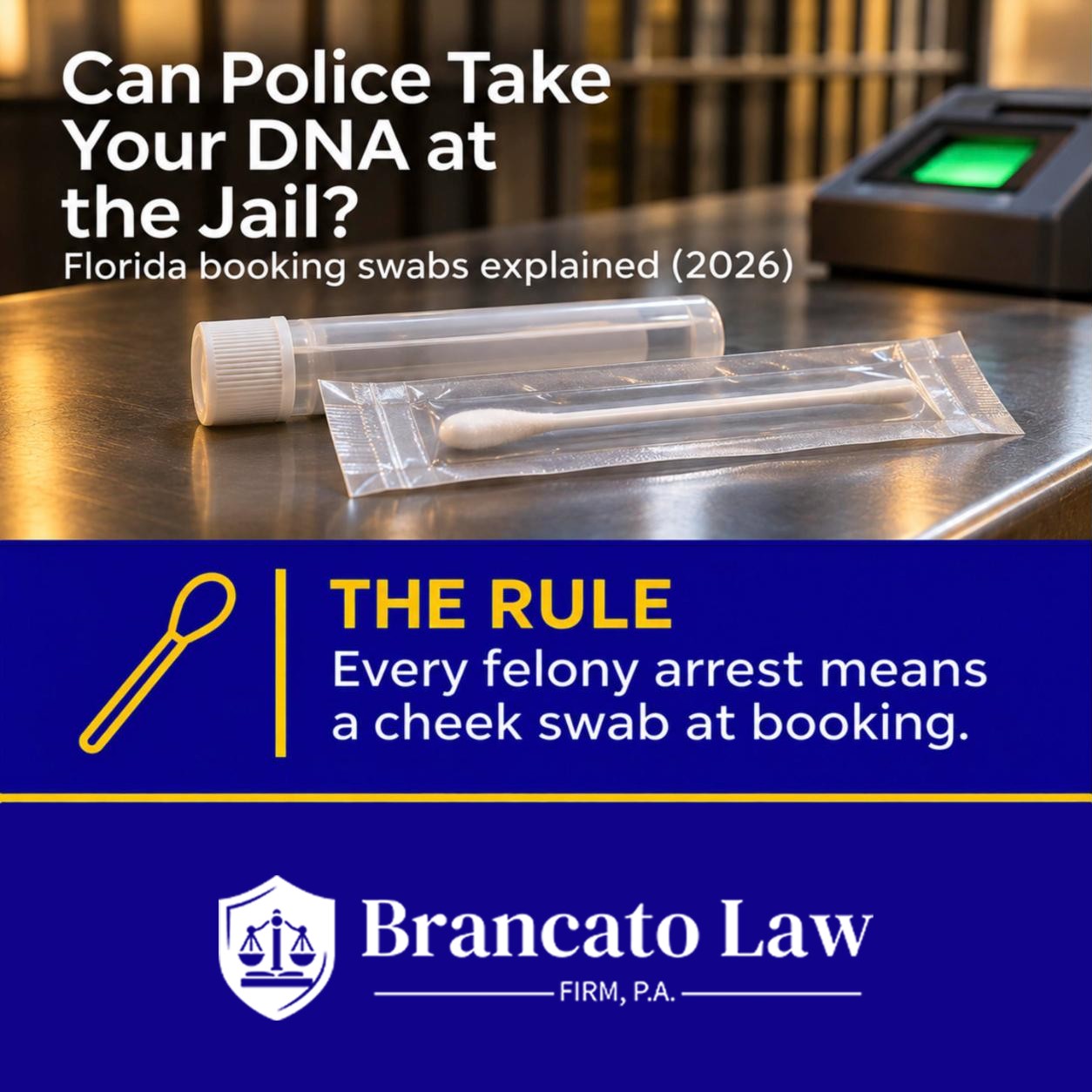
Yes. Florida law requires every person arrested for a felony or attempted felony to give a DNA sample, usually a cheek swab, when they are booked into jail. No warrant, consent, or conviction is needed, and the U.S. Supreme Court upheld this kind of booking swab in 2013. If your charges are later dropped, dismissed, or end in acquittal, Florida will remove your DNA from the state database, but only if you send FDLE the court paperwork yourself.
If a deputy swabbed the inside of your cheek during booking, you were not singled out. The swab is part of the same routine as fingerprints and a mug shot for anyone booked on a felony in Florida. I’m Rocky Brancato, founder of The Brancato Law Firm, P.A., a Tampa criminal defense firm. I am a former police academy instructor who taught criminal procedure, and the former Chief Operations Officer of the Hillsborough County Public Defender’s Office, where I oversaw a staff of over 100 attorneys. Our attorneys deal with jail DNA in two ways: getting it removed from the database when a case ends without a conviction, and challenging the lab work when a database match becomes the State’s evidence.
Is It Legal for the Jail to Take My DNA Without a Warrant?
Yes, for a felony arrest. Section 943.325 of the Florida Statutes makes anyone arrested for a felony or attempted felony a “qualifying offender” and requires that person to give a DNA sample at the time they are booked into a jail, correctional facility, or juvenile facility (§ 943.325(2)(g), (3)(a), Fla. Stat.). The law defines a DNA sample as a buccal (cheek) swab or other approved specimen.
The constitutional question was settled in Maryland v. King, 569 U.S. 435 (2013). In 2009, Alonzo King was arrested in Wicomico County, Maryland, on first- and second-degree assault charges for menacing a group of people with a shotgun, and booking staff swabbed his cheek under that state’s DNA Collection Act. His profile matched an unsolved 2003 rape, and he was convicted. The Supreme Court held, 5 to 4, that taking and analyzing a cheek swab after an arrest supported by probable cause is a legitimate booking procedure, like fingerprinting, and is reasonable under the Fourth Amendment.
Florida’s law reaches further than the Maryland law in King. Maryland’s statute covered people charged with crimes of violence or burglary, and attempts. Florida’s covers every felony arrest, including a third-degree felony drug possession charge. The King Court described the swab as a booking procedure for “serious” offenses, and that limit has not been tested in a Florida appellate decision we have found.
Who Has to Give a DNA Sample in Florida?
A Florida “qualifying offender” includes adults and juveniles. The table below shows who must give DNA and when, under section 943.325.
| Who | When the sample is taken | Statute |
|---|---|---|
| Anyone arrested for a felony or attempted felony | At booking into jail or a juvenile facility | § 943.325(2)(g)2.c., (7)(b) |
| Anyone convicted of a felony or attempted felony | At booking, or before release if not jailed | § 943.325(2)(g)2.a., (7)(d)-(e) |
| Anyone convicted of certain misdemeanors (stalking, voyeurism, obscenity and computer pornography offenses, dressing-room surveillance, gang-related offenses) | After conviction | § 943.325(2)(g)2.b. |
| Anyone in custody who is subject to a federal immigration detainer | When the agency receives the detainer | § 943.325(2)(g)2.d., (7)(f) |
| People in state prison or on probation, community control, or other supervision | Before release, or through the supervising agency | § 943.325(7)(a), (c) |
A misdemeanor arrest alone does not make you a qualifying offender. If you were booked only on a misdemeanor and still swabbed, tell your lawyer. That sample falls outside the statute’s arrest category.
When Did Florida Start Taking DNA From Everyone Arrested for a Felony?
Florida phased in arrestee DNA collection over eight years, and the last phase covering all remaining felonies began January 1, 2019. The Legislature tied each phase to funding.
| Start date | Felony arrests covered | Chapter |
|---|---|---|
| January 1, 2011 | Homicide, assault and battery, sexual battery, lewd and lascivious offenses | Chs. 782, 784, 794, 800 |
| January 1, 2013 | Burglary and trespass, theft and robbery | Chs. 810, 812 |
| January 1, 2015 | Kidnapping and weapons offenses | Chs. 787, 790 |
| January 1, 2017 | Drug offenses | Ch. 893 |
| January 1, 2019 | All remaining felonies | All |
A 2023 Florida Senate staff analysis states it plainly: Florida law requires every person arrested for a felony or attempted felony to submit a DNA sample at booking.
What Happens to the DNA After the Jail Swabs You?
The jail sends the swab to the Florida Department of Law Enforcement (FDLE), which develops a DNA profile and stores it in the statewide database and the FBI’s Combined DNA Index System (CODIS). FDLE’s rule tells collecting agencies to forward samples within 7 working days (Fla. Admin. Code R. 11D-6.003). Your profile is then searched against DNA from unsolved crimes across Florida and the country.
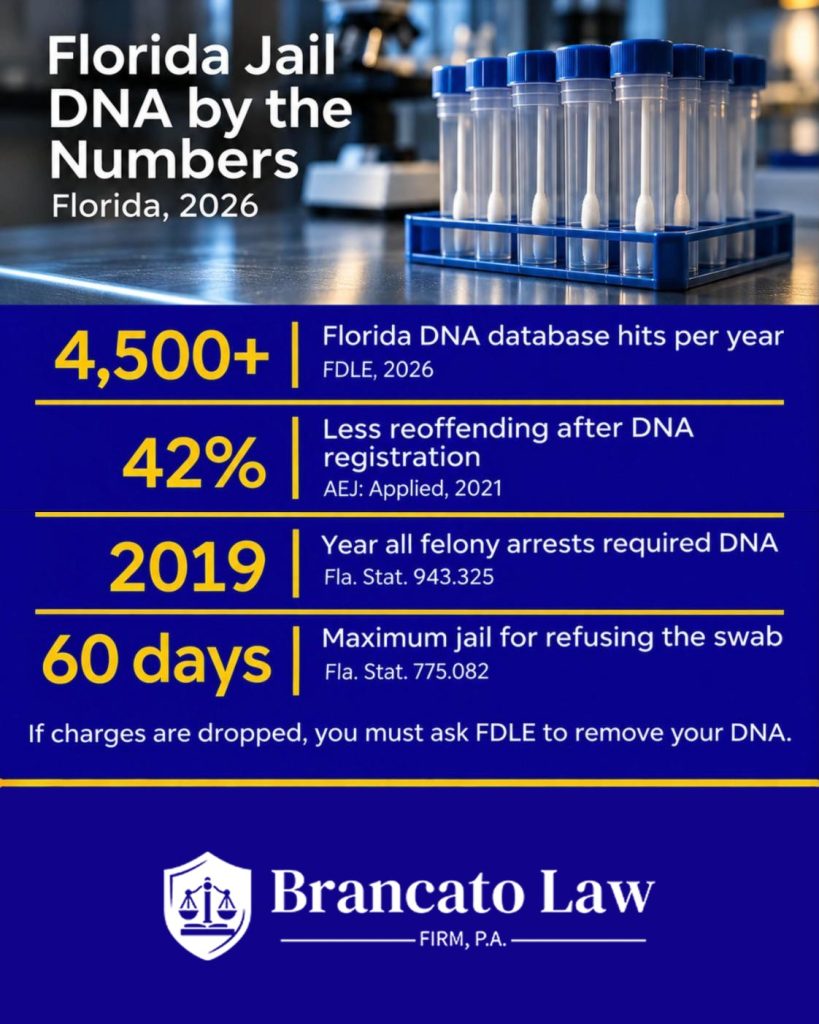
Those searches produce results. FDLE reports that the Florida DNA Database averages over 4,500 hits to unsolved crimes per year (FDLE DNA Database page, 2026).
Some Florida jails now run the swab through a Rapid DNA machine at the booking desk, which can return a CODIS search in under two hours. The Florida Sheriffs Association lists 11 sheriff’s offices in the state’s first Rapid DNA booking pilot. Hernando, Manatee, and Sarasota were on that list. Hillsborough, Pinellas, and Pasco were not, so in our area the swab still typically goes to FDLE’s lab.
Florida limits how the profile can be used. The analysis may be used only for law enforcement identification and identifying missing persons or human remains, and it may not be used to identify any medical or genetic condition (§ 943.325(13)(b)). Results go only to criminal justice agencies and are otherwise confidential.
Can I Refuse the DNA Swab at Booking?
You can refuse, but refusing is its own crime and the jail can take the sample anyway. A person required to give DNA who willfully refuses commits a second-degree misdemeanor (§ 943.325(15)(a)), punishable by up to 60 days in jail (§ 775.082(4)(b), Fla. Stat.). The statute also lets deputies and corrections officers use reasonable force when a qualifying offender refuses, and it shields them from civil and criminal liability for doing so (§ 943.325(8)).
Refusing gains nothing and adds a charge. The better move is to give the swab, say nothing else about your case, and ask for a lawyer.
Can I Get My DNA Out of the Database If My Case Is Dropped?
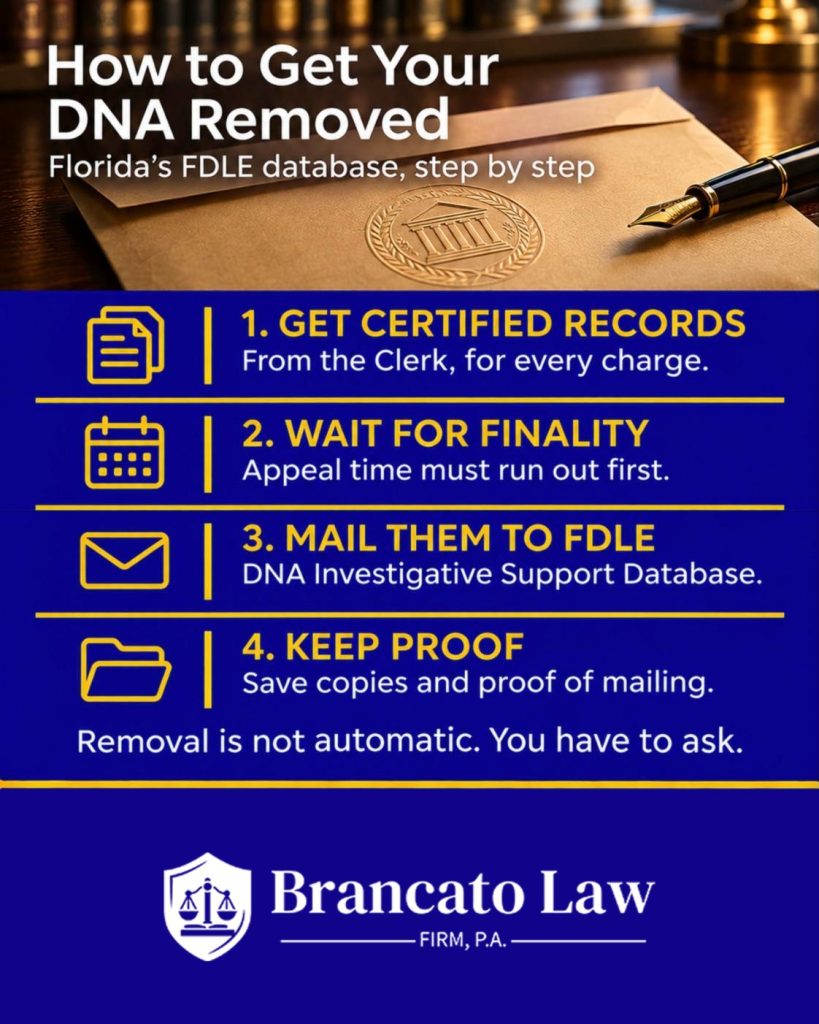
Yes, but FDLE does not do it on its own. You have to ask, and you have to prove the outcome with certified court records. Under section 943.325(16), FDLE must remove an arrest-based DNA profile and any stored sample once it receives proof for each charge that the charge was never filed, was dismissed, or ended in acquittal.
| How the charge ended | Certified document to send FDLE |
|---|---|
| State Attorney declined to file | Certified No Information, or official proof no charge was filed within the time allowed |
| State Attorney dropped the case | Certified Nolle Prosequi |
| Judge dismissed the charge | Certified final order of dismissal |
| Jury or judge found you not guilty | Certified judgment of acquittal or verdict |
| Conviction overturned | Certified final order reversing on direct appeal or setting aside in postconviction |
The order must be final. A dismissal the State can still appeal does not qualify yet. FDLE will also refuse removal if you are required to give DNA for another reason, such as a separate felony conviction.
The steps are:
- Get a certified copy of the disposition for every charge from the Clerk of Court in the county where you were charged.
- Confirm the time for any appeal has run.
- Mail the certified copies to the FDLE DNA Investigative Support Database, P.O. Box 1489, Tallahassee, Florida 32302-1489, as Rule 11D-6.003(2) directs.
- Keep proof of mailing and a copy of everything you sent.
Do not assume that sealing or expunging your arrest record clears the DNA database. Our guide on who can see your arrest record in Florida covers what sealing does reach. Section 943.325(16) sets up its own removal request to FDLE, separate from a record seal or expunction. When a case ends in a no-file, nolle prosequi, dismissal, or acquittal, our attorneys can help gather the certified records FDLE requires.
Can DNA Taken at the Jail Be Used to Charge Me With Another Crime?
Yes. That is the purpose of the database. A match between your booking profile and crime-scene DNA can supply probable cause for an arrest warrant or a warrant for a new confirmation sample (§ 943.325(1)(b)). That is how Alonzo King was charged with the 2003 rape in Maryland v. King.
Research shows how much weight these databases carry. A peer-reviewed study of Denmark’s DNA database expansion found that DNA registration reduced reoffending within the following year by up to 42 percent (Anker, Doleac & Landersø, American Economic Journal: Applied Economics, 2021). Police and prosecutors treat a database hit as a strong lead.
Florida also makes it hard to attack the collection itself. The statute says a collecting agency’s failure to follow the rules strictly is not grounds to exclude the DNA in court, and an arrest or conviction based on a match is not invalid because a sample was entered by mistake (§ 943.325(12)(c)-(d)). So the defense usually focuses on the science after the hit. A CODIS match is an investigative lead that the lab must confirm, and our guide to how a DNA cold hit can be wrong walks through each weak point. Mixture interpretation, contamination, secondary transfer of touch DNA, and chain of custody are where these cases are contested. Our Tampa criminal forensic science attorney page explains how our attorneys work with independent DNA experts on those issues, and our DNA evidence defense case study shows that work in a real case.
What Should I Do Right Now If the Jail Took My DNA?
Act on two timelines: the current case, and any old case the swab might reach.
- Do not talk about the swab or any other incident with deputies, detectives, or cellmates. Jail calls are recorded.
- Get a lawyer on the current charge. The outcome of that case decides whether you can have the DNA removed later. Our attorneys can often work on a case before the State Attorney makes a filing decision, which is the stage our pre-file advocacy page covers.
- If a detective contacts you about an older case, assume a DNA hit and call a lawyer before you answer any questions. A warrant for a confirmation swab is often the next step.
- When the case ends without a conviction, request DNA removal. Nothing happens until FDLE receives certified records.
For what happens in the first 24 hours after booking, see our guide to Hillsborough first appearance. For an overview of each stage after arrest, see our Florida criminal case process guide. If you were booked in Tampa, our Hillsborough County criminal defense attorney page covers local procedure.
Frequently Asked Questions
Does Florida take DNA for a misdemeanor arrest?
No, a misdemeanor arrest alone does not require a DNA sample under section 943.325. The Brancato Law Firm can review your booking records to confirm what you were actually booked on, because only a felony arrest, certain misdemeanor convictions, or an immigration detainer brings you under the statute.
Will my DNA be deleted automatically if my charges are dropped?
No, Florida does not delete arrestee DNA automatically. When one of our cases ends in a no-file, nolle prosequi, or dismissal, our attorneys at The Brancato Law Firm can help you assemble the certified records section 943.325(16) requires for FDLE.
Does expunging or sealing my record remove my DNA from the database?
Not by itself. Our team at The Brancato Law Firm treats DNA removal as a separate request to FDLE under section 943.325(16), filed with certified proof that each charge was not filed, dismissed, or ended in acquittal.
Can a juvenile’s DNA be taken at the juvenile detention center?
Yes, Florida’s DNA law covers juveniles arrested for felonies and requires the sample at booking into a juvenile facility. The Brancato Law Firm handles juvenile cases in Hillsborough, Pinellas, and Pasco Counties and can help request removal when a juvenile case closes without a finding of delinquency.
Can a DNA match from the jail swab lead to charges in an old case?
Yes, a database match can give police probable cause for an arrest warrant or a warrant for a new DNA sample. If a detective calls about an old case, The Brancato Law Firm can step in before charges are filed through our representation before charges are filed.
Can I be charged for refusing the DNA swab at the jail?
Yes, willfully refusing a required DNA sample is a second-degree misdemeanor in Florida, punishable by up to 60 days in jail. Our attorneys at The Brancato Law Firm advise clients to give the swab and stay silent about the case, because refusing adds a charge and the jail may use reasonable force to collect the sample anyway.
For more about how our attorneys challenge DNA evidence, visit our Tampa DNA evidence defense page.
If the jail took your DNA on a felony arrest, the case in front of you decides whether that profile stays in the state database, and the first weeks before the State Attorney files charges matter most. The Brancato Law Firm, P.A. was founded by Tampa Criminal Defense Attorney Rocky Brancato, and our attorneys bring more than 25 years in Hillsborough County courtrooms and more than 150 jury trials to verdict to that fight. Call (813) 727-7159 at any hour. Our firm has Spanish-speaking staff, and attorney Jean-Luc Adrien speaks Spanish, Haitian Creole, and French.
The Brancato Law Firm, P.A.
620 E. Twiggs Street, Suite 205, Tampa, FL 33602
(813) 727-7159
Serving Hillsborough, Pinellas, and Pasco Counties
The Brancato Law Firm, P.A. is a Tampa-based criminal defense practice. We are not affiliated with any other Brancato-named law firms.
Visit Us

Tampa, FL 33602

Contact Us Now
Free Legal Consultation (813) 727-7159
