- Free Consultation 24/7: (813) 727-7159 Tap Here To Call Us


From First DUI to Death Penalty


How a DNA Cold Hit Can Be Wrong and How to Challenge It


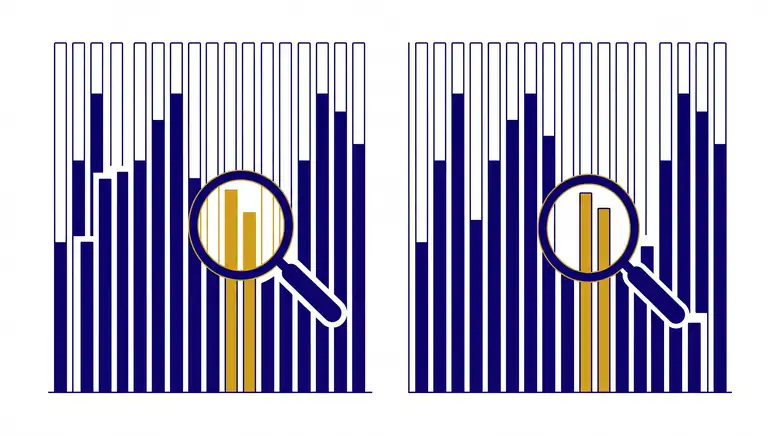
A DNA cold hit can be wrong. A cold hit is a computer match between a DNA profile developed from crime scene evidence and a profile already stored in a database, and the reasons it goes wrong almost never appear in the laboratory report the State hands over. They sit in the material underneath it.
The Brancato Law Firm has done that underneath work. In a sexual battery case built on a database match to an incident roughly eight years earlier, we subpoenaed the laboratory’s bench notes, obtained the raw electronic data from the instrument, and sent it to an independent laboratory. We then retained an expert geneticist, who found the State’s analyst had misread the DNA at one location. Read correctly, the evidence did not match our client, and the prosecutor dismissed the case. The full account is in our DNA evidence defense case study.
Each case is unique. Past results do not guarantee future outcomes.
A complete DNA profile from a clean sample, matched to one person, is powerful evidence. The cold hits that fall apart are the ones where the profile was incomplete, the sample held more than one person’s DNA, or the DNA arrived by some route other than the crime.
What Is a DNA Cold Hit?
A cold hit is what happens when DNA from an unsolved case is searched against a database and the software returns a name. The National Institute of Justice describes it as a connection made between a person and a crime scene in the absence of a current investigative lead. Nobody suspected the person; a computer put their name on the case.
The database is CODIS, the FBI’s Combined DNA Index System, and two kinds of profiles go into it. One kind comes from people. In Florida, section 943.325 requires a DNA sample at booking from people arrested for felony offenses, under a schedule phased in by offense type since 2011, and a sample is taken again on conviction. That is why someone with an old felony arrest for something unrelated can have a profile sitting in the system for years. The other kind comes from evidence, with no name attached. As of June 2026 the national index held more than 20.3 million offender profiles and 6.4 million arrestee profiles, plus roughly 1.5 million developed from crime scenes.
A case can sit for years and then produce a hit for ordinary reasons: old rape kits get tested as backlogs clear, evidence is retested with newer methods, or the person’s profile is added after an unrelated arrest and the next routine search connects the two.
Profiles are compared at locations on the DNA called loci. CODIS has used 20 core loci since January 1, 2017 and 13 for the 18 years before that, so evidence collected years ago may cover fewer locations than a profile developed today. When the search returns a candidate, the laboratory is supposed to collect a fresh sample and run its own comparison before the match is treated as evidence.
How a DNA Cold Hit Can Be Wrong
A confirmed hit says a profile from the evidence is consistent with your profile at the locations compared. It says nothing about how your DNA reached the item, or when. A figure like one in seven hundred trillion describes how rare a profile is among people, not how DNA got onto a door handle. These are the five questions a defense asks of any cold hit.
The crime scene profile may be incomplete
Evidence that has sat in a property room for years is often degraded, and small or damaged samples produce partial profiles covering fewer locations. Fewer locations means more people in the world fit the profile.
Rarity statistics of the kind people remember from television describe a complete profile. A subpoenaed search of roughly 65,000 profiles in Arizona’s offender database found 122 pairs of people whose profiles matched each other at nine of 13 locations. Partial matches at that level are ordinary, which is the point. So the first question is how many locations were compared, and whether the State’s statistic was calculated for that number or for a complete profile.
The sample may hold more than one person’s DNA
A swab from a doorknob, a steering wheel, or under someone’s fingernails usually picks up DNA from several people. Pulling one person’s profile out of that mixture is an interpretation, and interpretations differ.
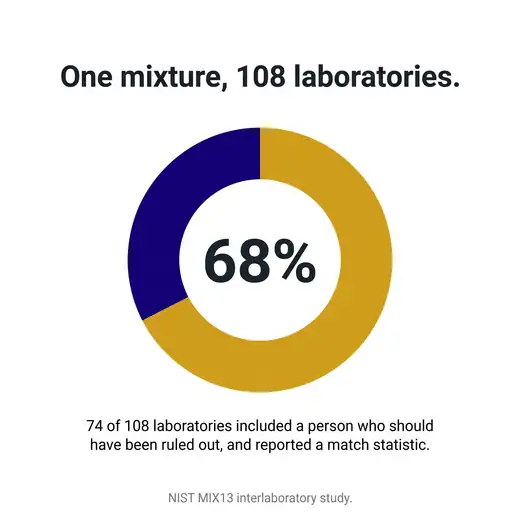
In 2013 the National Institute of Standards and Technology sent identical DNA evidence to 108 forensic laboratories. On the hardest mixture in the study, 74 of them included a person who should have been ruled out and supplied a match statistic to go with it.
Many laboratories now use probabilistic genotyping software for mixtures. It is a real improvement on the older hand calculations, but it has a tested range. A review by the President’s Council of Advisors on Science and Technology found the research supported these programs for samples with three contributors where the person of interest makes up at least 20 percent of the sample, and that beyond that range there had been little validation. If the laboratory concluded four or five people contributed, ask whether the method was ever tested on a sample like that.
Your DNA can end up somewhere you have never been
DNA moves between people and onto objects through ordinary contact, called secondary transfer, and it happens far more easily than most people assume.
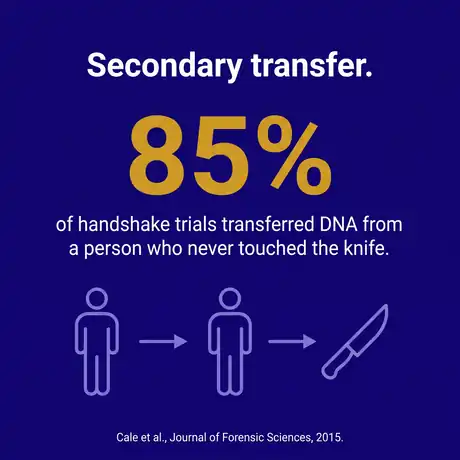
Researchers at the University of Indianapolis had pairs of volunteers shake hands for two minutes. One of each pair then handled a knife, which was swabbed afterward. In 85 percent of the trials, enough DNA from the person who never touched the knife had transferred to produce a profile. In one fifth of the samples, that person came back as the main or only contributor to the weapon.
The same thing has happened in a real case. Lukis Anderson was charged with murder in California after his DNA was found on a homicide victim’s fingernails, and he spent nearly half a year in custody. He had never been to the house. The paramedics who picked him up off a street that night, drunk, responded to the homicide scene about three hours later and carried his DNA there on their uniforms or their equipment. Hospital records eventually showed he was in a hospital bed while the killing took place.
The evidence can be contaminated, mislabeled, or switched
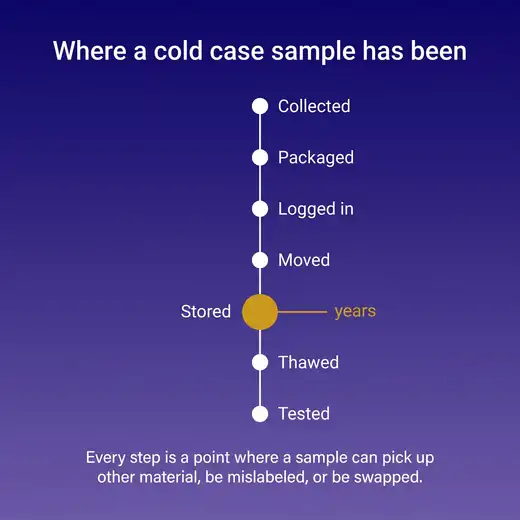
Evidence in a cold case has been handled by many people over many years. It was collected at a scene, packaged, logged into a property room, moved, stored, and tested, sometimes more than once. Each step is a point where one sample can pick up material from another, where a label can go on the wrong container, or where two items can be swapped. The same is true of the fresh sample taken after the hit. Testing has also become far more sensitive than when most cold case evidence was collected, which makes it easier to pick up material unrelated to the crime. The chain of custody paperwork is the record of who touched what, and it is worth reading line by line.
The match depends on how an analyst read the data
The testing instrument does not print a name. It produces an electronic file showing a pattern of peaks, and a human analyst decides which peaks are real DNA and which are artifacts of the process, how many people contributed, and which results belong to whom. Those judgment calls are recorded in the analyst’s bench notes and in the raw data file. They do not appear in the report.
That is where our own cold hit case turned. A profile has to be consistent at every location that gets compared, so a real difference at one location is an exclusion rather than a weaker match. The word doing the work is real: a result can be missing or distorted for technical reasons that have nothing to do with whose DNA it is, which is why establishing that a difference is genuine takes an expert looking at the instrument data.
How to Challenge a Cold Hit
Challenging a cold hit means obtaining the material underneath the report and putting a qualified expert on it. The report states conclusions; the record of how they were reached is kept elsewhere and has to be asked for. A forensic DNA expert generally needs five categories of material:
- The laboratory reports. What was tested, by what methods, and what the analyst concluded at each stage.
- The analyst’s bench notes. The working records made during testing, holding observations and decisions the report leaves out. This is the first thing our firm subpoenas in a DNA case.
- The electronic data files. These carry extensions like .fsa or .hid and cannot be opened without specialized DNA software. Without them, an expert reviews someone else’s summary of the evidence instead of the evidence.
- Any probabilistic genotyping report, with the settings used. The program, the version, and the parameters entered all change the answer the software gives.
- The police reports. Where each item was found and who handled it, which is how an expert can tell whether the DNA result fits the State’s account.
With that material, the defense has options it did not have before. The expert may find an exclusion, as ours did, or that the mixture was too complex to support any reliable conclusion, or that the software was used outside the range it was validated for. That last finding raises an admissibility question. Florida adopted the Daubert standard effective May 23, 2019, written into section 90.702, and a judge must be satisfied that the testimony rests on sufficient facts or data, that the methods are reliable, and that the witness applied them reliably to this case. Testimony that fails does not reach the jury.
Depositions do as much work as the documents. In our case the expert geneticist attended the depositions of the State’s forensic witnesses and helped prepare the questions, and one of the State’s own experts acknowledged that the DNA did not match at the required threshold.
This is slow work, and a case built this way does not resolve in a few court dates. A public defender’s office can and does litigate DNA evidence, so if private representation is not realistic, ask the court for the public defender rather than hiring a private attorney who cannot fund an expert. Our comparison of a public defender and a private attorney in Tampa covers that decision honestly.
Can Florida Prosecute a Case This Old?
Often, yes, and the DNA is the reason. Florida Statute 775.15(16) lets a prosecution begin at any time after the accused is identified through DNA analysis, for offenses including sexual battery under chapter 794, kidnapping, robbery, carjacking, burglary, aggravated battery, several lewd and lascivious offenses, and aggravated child abuse.
That exception comes with a condition that can cut in the defense’s favor. It applies only if a sufficient portion of the evidence tested for DNA has been preserved and is available for testing by the accused. The State cannot use the DNA to reopen an old case and then tell you there is nothing left for your expert to test, so one of the first questions is what was preserved, how much, and in what condition.
Sexual battery charges also have their own timing rules, and in an old case the cutoff date written into each one often decides the question. Each removes the time limit when it applies.
| If this is true of the case | Cutoff written into the rule |
| Identified through DNA, offense on the 775.15(16) list, tested evidence preserved and available to the defense | Not if already time barred by July 1, 2006 |
| First degree felony sexual battery, victim under 18, under 775.15(13)(b) | Not if already time barred by October 1, 2003 |
| Any sexual battery, victim under 16, under 775.15(13)(c) | Not if already time barred by July 1, 2010 |
| First or second degree felony, victim 16 or older, reported within 72 hours, under 775.15(14)(a) | None stated |
| Sexual battery, victim under 18, under 775.15(20) | Offenses committed on or after July 1, 2020 only |
Subsection 20, the newest, reaches only offenses committed on or after July 1, 2020, so it does nothing in a decades-old case. If none applies, the general limitation periods in section 775.15 govern and the charge may be time barred, an argument lost if it is not raised. Our explainer on sexual battery in Florida covers the charge itself.
What to Do Now
If you have been contacted but not arrested, understand what the detective is after. They already have the match. What they need is a statement connecting you to the place, the person, or the time. An innocent explanation offered without a lawyer becomes a recorded admission that you were there, and the difference gets decided months later by people who were not in the room.
Do not agree to another DNA sample without counsel, and say nothing about the case on jail calls, which are all recorded. Get counsel involved early, because preservation letters and independent testing work better before samples are consumed and the people who handled the evidence retire.
If the person arrested is a family member and you are making the calls, there is work only you can do. Write down what you can reconstruct about the year the offense is alleged to have happened: where he lived, who with, where he worked, who he was close to. Then gather what still exists on paper. Leases, pay stubs, phone records, and medical records get harder to obtain every year, and an alibi built from documents holds up in a way a memory will not. Our guide on what to do after an arrest in Tampa covers the first steps.
Talk to a Tampa Firm That Has Challenged DNA Evidence
If you or a family member has been arrested or contacted about an old case because of a DNA database match, we can look at what the State actually has and tell you straight what we see. The Brancato Law Firm handles forensic science defense across Hillsborough, Pinellas, and Pasco Counties, and works with DNA analysts, geneticists, and independent laboratories on serious felony cases. Rocky Brancato has tried 150+ jury trials to verdict and served as Chief Operations Officer of the Hillsborough County Public Defender’s Office, overseeing a staff of over 100 attorneys, and provides direct oversight on case strategy in matters like these. Call (813) 727-7159 for a free and confidential consultation, or reach us through our contact page.
The Brancato Law Firm, P.A.
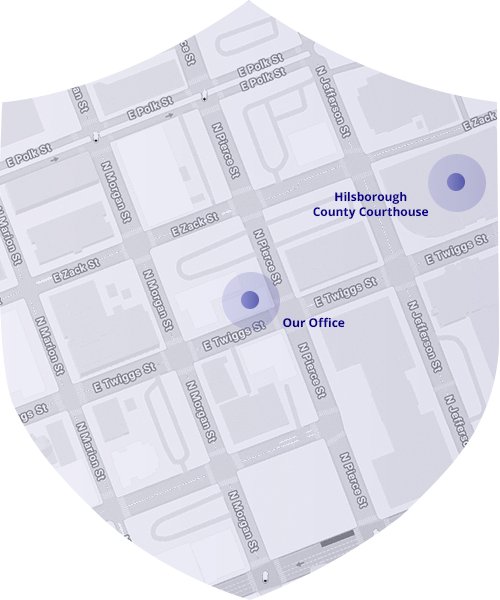
620 E. Twiggs Street, Suite 205, Tampa, FL 33602
(813) 727-7159
Serving Hillsborough, Pinellas, and Pasco Counties
The Brancato Law Firm, P.A. is a Tampa-based criminal defense practice. We are not affiliated with any other Brancato-named law firms.
Visit Us
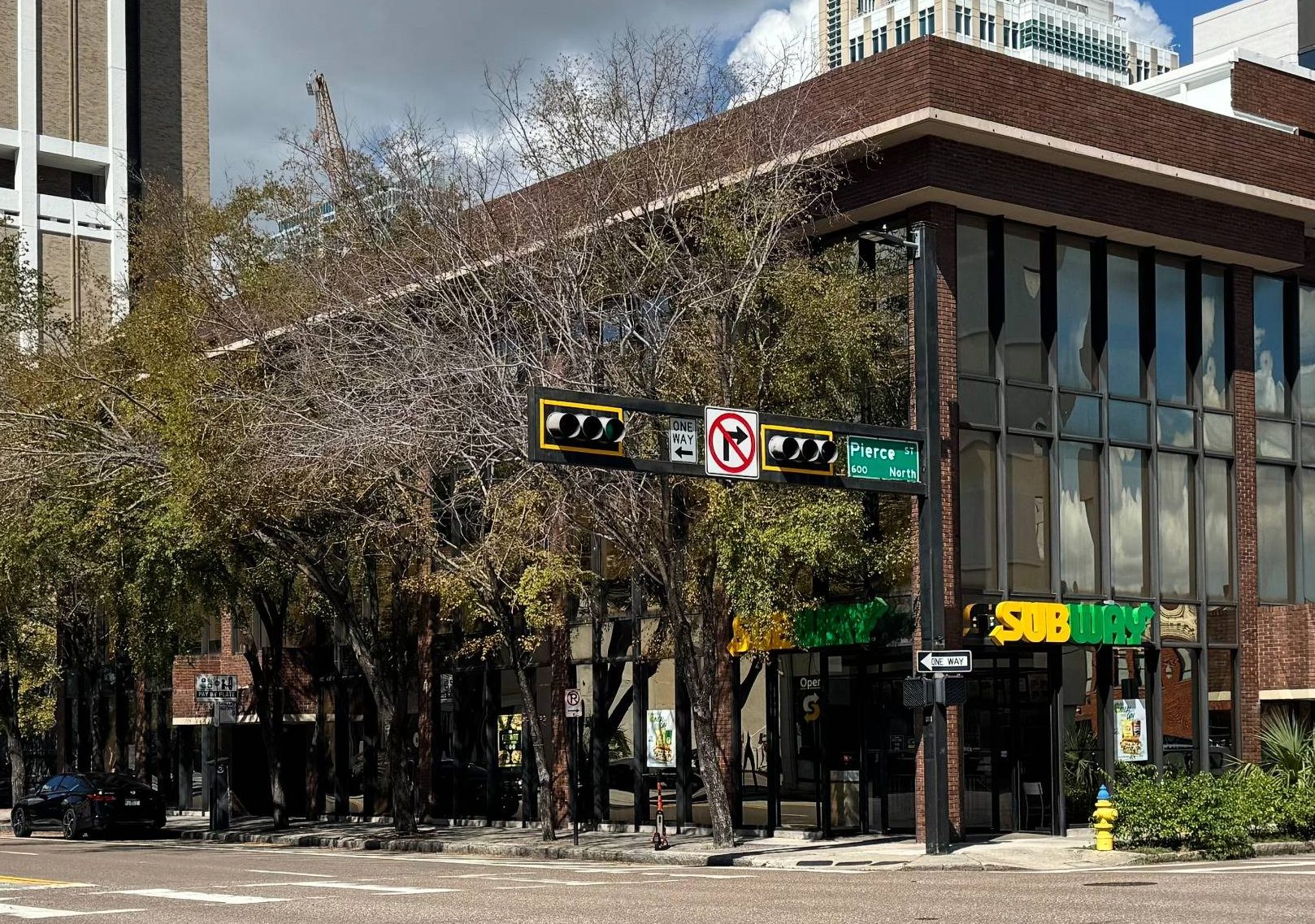
Tampa, FL 33602
Contact Us Now
Free Legal Consultation (813) 727-7159