- Free Consultation 24/7: (813) 727-7159 Tap Here To Call Us




What Is DUI in Florida? Charges, Penalties, and Defense Strategies


Key Takeaway: DUI charges in Florida cover a wide range of offenses under §316.193. A DUI means driving or being in actual physical control of a vehicle while impaired by alcohol or drugs — or with a blood-alcohol level of 0.08 or higher. A first offense is a misdemeanor carrying up to 6 months in jail. A third DUI within 10 years is a felony. DUI manslaughter is a second-degree felony punishable by up to 15 years in prison. However, DUI cases are among the most defensible criminal charges because there are so many points where the State’s evidence can break down.
I’m Tampa criminal defense attorney Rocky Brancato. As a member of the National College for DUI Defense (NCDD) and the DUI Defense Lawyers Association, and as a former police academy instructor who taught officers how to conduct criminal investigations, I bring a unique perspective to every Florida DUI charges case — I know how officers are trained and where their procedures fall short.
How Does Florida Define DUI?
Under §316.193, you can face DUI charges in Florida if you are driving or in “actual physical control” of a vehicle and one of three conditions is met: your normal faculties are impaired by alcohol or drugs, your blood-alcohol level is 0.08 or higher, or your breath-alcohol level is 0.08 or higher.
Florida Statute §316.193: The phrase “actual physical control” is critical. You do not have to be driving to be charged with DUI — sitting in the driver’s seat with the keys accessible can be enough. The State must prove you were either impaired to the extent your normal faculties were affected, or that your BAC was at or above 0.08. At The Brancato Law Firm, P.A., we challenge both the impairment evidence and the chemical test results.
“Normal faculties” under Florida law include your ability to see, hear, walk, talk, judge distances, make judgments, act in emergencies, and drive a vehicle. The State typically relies on field sobriety exercises, the officer’s observations, and chemical test results to prove impairment. Each of these has weaknesses we can exploit.
What Are the Penalties for DUI in Florida?
Florida DUI charges carry penalties that increase sharply with each offense and with certain aggravating factors:
| Offense | Classification | Maximum Penalty |
|---|---|---|
| 1st DUI | Misdemeanor | 6 months jail, $500–$1,000 fine |
| 1st DUI (BAC 0.15+ or minor in vehicle) | Enhanced misdemeanor | 9 months jail, $1,000–$2,000 fine |
| 2nd DUI | Misdemeanor | 9 months jail, $1,000–$2,000 fine, 1-year ignition interlock |
| 3rd DUI within 10 years | 3rd-degree felony | 5 years prison, 2-year ignition interlock |
| 4th+ DUI (any timeframe) | 3rd-degree felony | 5 years prison, $2,000+ fine |
| DUI causing serious bodily injury | 3rd-degree felony | 5 years prison |
| DUI manslaughter | 2nd-degree felony | 15 years prison |
In addition to the criminal penalties outlined above, DUI charges in Florida trigger license suspension, increased insurance rates, and a permanent criminal record. The Brancato Law Firm, P.A. fights to prevent these consequences at every stage.
What Happens If You Refuse the Breathalyzer?
Florida’s implied consent law means that by driving on Florida roads, you have already consented to chemical testing if an officer has lawful cause to believe you are impaired. If you refuse, DHSMV automatically suspends your license — 1 year for a first refusal, 18 months for a second.
However, the consequences of refusal changed dramatically on October 1, 2025. Under Trenton’s Law (HB 687), a first-time refusal to submit to a breath or urine test is now a separate second-degree misdemeanor — carrying up to 60 days in jail and 6 months of probation — charged independently from the DUI itself. A second or subsequent refusal remains a first-degree misdemeanor punishable by up to 1 year in jail and a $1,000 fine. Furthermore, officers must now advise you that refusal can lead to criminal prosecution in addition to the administrative license suspension. Because the refusal charge is filed separately, you can be convicted of refusing the test even if the DUI charge is dismissed.
That said, refusing the breathalyzer does not mean the State wins on Florida DUI charges. In fact, many DUI cases without chemical test results are more defensible because the State must rely entirely on the officer’s observations and field sobriety exercises. At The Brancato Law Firm, P.A., we have won DUI cases where our clients refused testing — and we also defend the separate refusal charge aggressively.
Case Study — Not Guilty, DUI and Resisting Officer: We represented a client charged with DUI (refusal) and resisting arrest without violence. Using scene video, Rocky argued the client was not impaired and contended the officer was overly aggressive. The jury returned a verdict of Not Guilty on both counts. Past results do not guarantee future outcomes.
When Does DUI Become a Felony in Florida?
Warning: A third DUI within 10 years of a prior conviction is a third-degree felony carrying up to 5 years in prison. A fourth or subsequent DUI is always a felony — regardless of how much time has passed between offenses. DUI causing serious bodily injury is a third-degree felony, and DUI manslaughter is a second-degree felony punishable by up to 15 years. If you left the scene of a DUI crash that caused death, the charge becomes a first-degree felony with up to 30 years.
The jump from misdemeanor to felony DUI changes everything — prison instead of jail, a permanent felony record, and the loss of civil rights. If you are facing a felony DUI charge, the stakes could not be higher. At The Brancato Law Firm, P.A., we have the trial experience to fight these charges aggressively.
How We Fight DUI Charges in Tampa
Because I taught criminal procedure at the police academy, I know exactly how officers are trained to conduct DUI investigations — and I know where those procedures break down. Here is how we fight DUI charges in Florida at The Brancato Law Firm, P.A.:
- Challenge the traffic stop. If the officer had no lawful reason to stop you, everything that followed — including the breath test — may be suppressed.
- Challenge field sobriety exercises. These exercises are subjective and unreliable. Medical conditions, uneven surfaces, footwear, and nervousness all affect performance. We demonstrate that poor performance does not equal impairment.
- Challenge the breath or blood test. The operator must properly calibrate and maintain breathalyzer machines. The operator must follow specific procedures. If the operator skipped any step, the court may exclude the result.
- Challenge “actual physical control.” If you were sleeping in a parked car, sitting in the passenger seat, or not actually driving, we argue you were not in actual physical control of the vehicle.
- Use the video. Dash camera and body camera footage often tells a different story than the officer’s report. We review every second of available video.
Can DUI Charges Be Dropped or Reduced in Florida?
Yes — and prosecutors reduce Florida DUI charges more often than most people realize. The most common outcome we pursue is a reduction to reckless driving, which avoids a DUI conviction on your record. Here are the paths we take at The Brancato Law Firm, P.A.:
- Reckless driving reduction. If weaknesses exist in the State’s evidence, we negotiate a reduction to reckless driving — no DUI on your record, no mandatory license suspension, and significantly lower insurance impact.
- Motion to suppress. If the stop, the detention, or the chemical test violated your constitutional rights, we file a motion to suppress. If the evidence is thrown out, the case often collapses.
- DHSMV hearing challenges. DHSMV handles your license suspension separately from the criminal case. We fight the administrative suspension to keep you driving while the criminal case is pending.
Case Study — Marijuana DUI Reduced to Reckless Driving: We represented a client charged with DUI (marijuana) — the blunt was lit at the time of the stop and thick smoke was visible on video. Despite this evidence, Rocky negotiated a reduction to reckless driving, keeping the DUI conviction off our client’s record. Past results do not guarantee future outcomes.
Case Study — DUI Reduced to Reckless Driving: Officers stopped our client with open liquor bottles in the vehicle and admitted to consuming alcohol. However, Rocky demonstrated the client was not unlawfully impaired. Result: Reduced to reckless driving. Past results do not guarantee future outcomes.
What Should You Do After a DUI Arrest?
If you are facing DUI charges in Florida and have been booked at Orient Road Jail or Falkenburg Road Jail, take these steps immediately:
- Request a DHSMV hearing within 10 days. After a DUI arrest, you have only 10 calendar days to request a formal review hearing with DHSMV to fight your license suspension. If you miss this deadline, the suspension takes effect automatically.
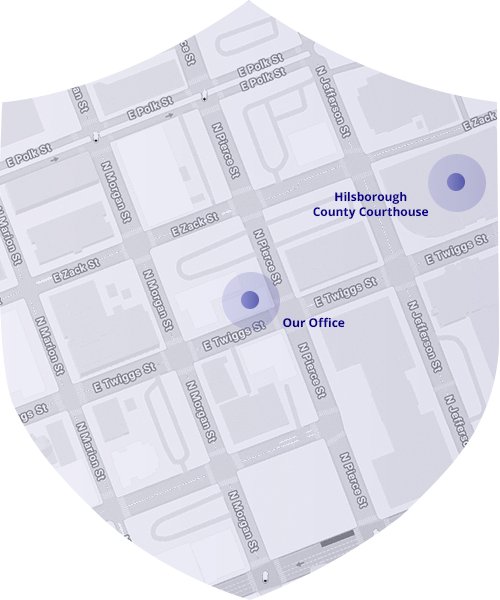
- Call a DUI defense attorney before your first appearance. Your arraignment at the Hillsborough County Courthouse happens quickly. An attorney can argue for favorable bond conditions and begin building the defense.
- Do not discuss the case. Do not post about the arrest on social media, do not discuss it with friends, and do not speak with law enforcement without an attorney present.
- Preserve evidence. Dash camera footage, body camera video, and surveillance recordings can all support the defense — but they do not last forever.
Case Study — DUI License Suspension Overturned, CDL Reinstated: Our client lost both a standard driver’s license and a commercial driver’s license (CDL) after a DUI arrest. Rocky handled the DHSMV hearing personally and filed a petition for writ of certiorari in circuit court. The judge ruled the suspension improper and reinstated both licenses. Past results do not guarantee future outcomes.
Frequently Asked Questions About DUI in Florida
Is a first DUI a felony in Florida?
No — a first DUI is a misdemeanor carrying up to 6 months in jail. However, if the DUI caused serious bodily injury, it becomes a third-degree felony. If it caused a death, it becomes DUI manslaughter — a second-degree felony. The Brancato Law Firm, P.A. defends clients facing DUI charges at every level in Hillsborough, Pinellas, and Pasco Counties.
Can I lose my license for a DUI in Florida?
Yes. A first DUI conviction results in a 180-day to 1-year license suspension. A second conviction within 5 years results in a 5-year suspension. A third conviction results in a 10-year suspension. In addition, refusing the breathalyzer triggers an automatic administrative suspension. Tampa criminal defense attorney Rocky Brancato fights both the criminal charge and the license suspension simultaneously.
What is the BAC limit in Florida?
The legal limit is 0.08 for standard drivers and 0.02 for drivers under 21. A BAC of 0.15 or higher triggers enhanced penalties, including higher fines and longer potential jail time. However, a BAC reading is not always accurate — machine calibration issues, operator errors, and medical conditions can all produce false results.
More Questions About DUI Defense
Can DUI charges be dismissed in Florida?
Yes. If the officer conducted an unlawful traffic stop, improperly administered the breath test, or failed to follow required procedures, the court may suppress the evidence — and without evidence, the case is often dismissed. The Brancato Law Firm, P.A. examines every step of the investigation for constitutional violations.
Should I take the breathalyzer or refuse?
Since October 1, 2025, Trenton’s Law makes this decision even more consequential. A refusal now triggers both an automatic license suspension and a separate criminal charge — a second-degree misdemeanor for a first refusal, a first-degree misdemeanor for a second. However, submitting to the test gives the State direct evidence of your blood-alcohol level. There is no one-size-fits-all answer — the best strategy depends on the specific circumstances. If you have already been arrested, contact The Brancato Law Firm, P.A. immediately to discuss your options.
Hiring a DUI Defense Attorney
Why should I hire The Brancato Law Firm for a DUI charge?
Rocky Brancato is a member of the National College for DUI Defense (NCDD) and the DUI Defense Lawyers Association. As a former police academy instructor who taught officers criminal procedure and courtroom testimony, Rocky understands DUI investigations from the inside. With more than 150 jury trials to verdict, an AV Preeminent rating, and Super Lawyers recognition, The Brancato Law Firm, P.A. brings the experience that DUI cases demand.
How much does a DUI lawyer cost in Tampa?
Fees depend on whether the charge is a first offense or a felony DUI, the complexity of the evidence, and whether the case involves a DHSMV hearing. The Brancato Law Firm, P.A. offers free, confidential consultations. Call (813) 727-7159 to discuss your case.
You Are Reading This for a Reason — Let Us Help
If you are facing DUI charges in Florida, you already know the consequences are serious — license suspension, criminal record, insurance increases, and potential jail time. We have defended hundreds of DUI cases in Hillsborough County, and we know how to challenge the stop, the field sobriety exercises, and the chemical test results.
Every day you wait is a day the prosecution builds its case. The earlier Tampa criminal defense attorney Rocky Brancato gets involved, the more options you have — especially the critical 10-day DHSMV deadline.
Call The Brancato Law Firm, P.A. today at (813) 727-7159 for a free, confidential consultation. We are available 24/7 and serve clients throughout Hillsborough, Pinellas, and Pasco Counties.
For more about how we defend DUI charges, visit our DUI Defense practice page. You can also read our guide on What Is Reckless Driving in Florida? — we resolve many DUI cases through reduction to reckless driving, and understanding both charges is important.
The Brancato Law Firm, P.A. is a Tampa-based criminal defense practice serving clients exclusively in Hillsborough, Pinellas, and Pasco Counties. We are not affiliated with any other Brancato-named law firms.
This page is for informational purposes only and does not constitute legal advice. Each case is unique, and outcomes depend on the individual facts and circumstances involved. Past results do not guarantee future outcomes.
Visit Us

Suite #205
Tampa, FL 33602
Contact Us Now
Free Legal Consultation (813) 727-7159