

From First DUI to Death Penalty



Can Mouth Alcohol Throw Off a Florida Breath Test? (2026)


Mouth alcohol is alcohol sitting in the mouth or throat, from a recent drink, a burp, regurgitation, or acid reflux, that a breath machine can read as if it came from deep in the lungs. Florida’s breath testing rule, Fla. Admin. Code R. 11D-8.007(3), requires the officer or operator to reasonably ensure that the person has not taken anything by mouth or regurgitated for at least 20 minutes before the test. Florida courts do not require nonstop face-to-face watching, but once the defense challenges the observation period, the State must show the full 20 minutes were covered, and breath room video often decides that question.
As founder of The Brancato Law Firm, P.A., a Tampa criminal defense firm, a member of the National College for DUI Defense, and a former police academy instructor, I have watched a lot of breath room video. The 20 minutes before a breath test are where small things happen: a burp, a hiccup, a hand to the mouth, an officer looking at paperwork instead of the person. Our attorneys review that window minute by minute in every breath test case, because a number on an Intoxilyzer printout is only as reliable as the air that went into the machine.
What is mouth alcohol, and why does it matter for a breath test?
Mouth alcohol is alcohol in the mouth, throat, or esophagus that has not come from the lungs. A Florida breath machine is built to measure alcohol in deep lung air, because that is the air that reflects alcohol in the blood. Alcohol left in the mouth from a recent sip, or brought back up by a burp, regurgitation, or reflux, can be pushed out with the breath sample and counted as if it were lung alcohol. That is why every breath test program, including Florida’s, uses a waiting and observation period before the test.
The science behind the 20-minute wait is well studied. In a 1992 study published in the Journal of Forensic Sciences, Harding and colleagues had denture wearers hold brandy in their mouths and then tested them on an Intoxilyzer 5000. The researchers reported that beyond 20 minutes after the subjects spit out the brandy, mouth alcohol “made no significant contribution” to the breath reading, with trace readings in only two subjects. The flip side is the point for a DUI defense: inside that 20-minute window, mouth alcohol can raise the number.
What does Florida’s 20-minute observation rule require?
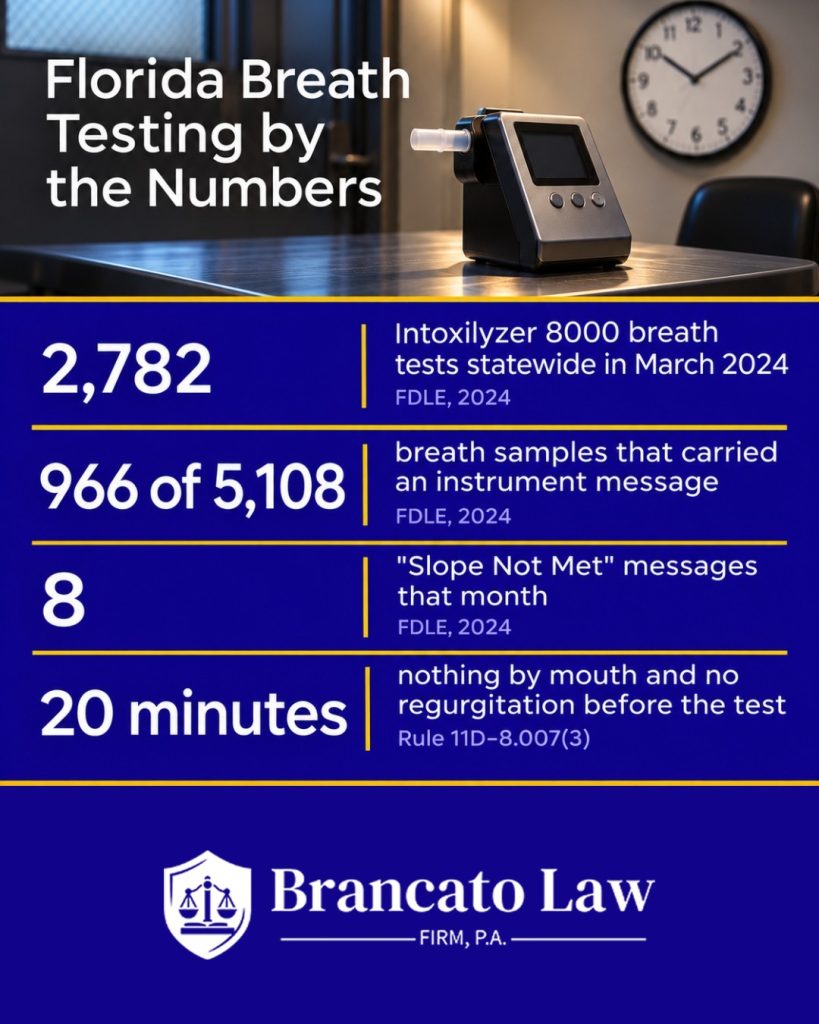
Florida requires a 20-minute deprivation and observation period before every evidentiary breath test. Rule 11D-8.007(3), Florida Administrative Code, says the breath test operator, agency inspector, arresting officer, or person designated by the permit holder “shall reasonably ensure that the subject has not taken anything by mouth or has not regurgitated for at least twenty (20) minutes before administering the test.” The same subsection says it does not require “an additional twenty (20) minute observation period before the administering of a subsequent sample.” The current version of the rule took effect July 1, 2026.
The rule matters because Florida law makes breath results admissible only when the test followed FDLE’s approved methods. Under section 316.1934(3), Florida Statutes, a breath test is valid only if it “must have been performed substantially in accordance with methods approved by the Department of Law Enforcement and by an individual possessing a valid permit.” Section 316.1932(1)(b)2. adds that “insubstantial differences” between the approved method and what actually happened do not make the test invalid. So the fight over the 20 minutes is usually a fight over whether the State substantially complied.
| Question | What the rule or case law says | Source |
|---|---|---|
| How long? | At least 20 minutes before the test with nothing by mouth and no regurgitation | Rule 11D-8.007(3) |
| Who watches? | The operator, agency inspector, arresting officer, or a person the permit holder designates | Rule 11D-8.007(3) |
| Standard | “Reasonably ensure,” judged by substantial compliance | Rule 11D-8.007(3); s. 316.1934(3) |
| Nonstop eye contact? | Not required; the observer may be within a few feet without staring | Kaiser v. State (2d DCA 1992) |
| A new 20 minutes for the second sample? | No, unless something happens that restarts the clock | Rule 11D-8.007(3) |
| How many samples? | At least two within 15 minutes that agree within 0.020 g/210L; a third if they do not | Rule 11D-8.002(12) |
Does the officer have to stare at you for the full 20 minutes?
No. Florida courts have held that the officer does not need continuous face-to-face observation for the full 20 minutes. The leading case is Kaiser v. State, 609 So. 2d 768 (Fla. 2d DCA 1992). Kaiser was tested at a county jail by an operator who stayed within a few feet of him for 20 minutes or more but did not stare at him the whole time. The Second District held that “continuous face to face observation for twenty minutes is not required to achieve substantial compliance,” and that whether the operator could make certain Kaiser did not regurgitate or ingest anything was a question of weight for the jury. Kaiser is a Second District decision, and the Second District hears appeals from Hillsborough County, so it carries real weight in Tampa DUI cases.
The most recent appellate decision applying that rule is Chiaravalle v. State, 373 So. 3d 881 (Fla. 4th DCA 2023). A Palm Beach County driver was arrested at about 12:42 a.m., and his observation period ended at 1:05 a.m. He sat handcuffed in the back of a patrol car with a dash camera recording. The officers testified they stayed within earshot, did not look at him every second, and did not hear him burp, hiccup, or regurgitate. The driver argued he was really watched for only eleven minutes. The trial court believed the officers, and the Fourth District affirmed, holding that any remaining doubt about the observation “would go to the weight of the evidence to be decided by the factfinder, and not to its admissibility.”
Both cases show that a weak observation period may not get a breath result thrown out before trial. A judge who admits the result still has not decided it is accurate. The same video and the same gaps can be shown to a jury, and our attorneys use them that way when suppression is denied. Breath challenges are one part of a larger plan, and our Tampa DUI lawyer page explains how they fit with the rest of a defense.
When does a short observation period throw out the breath test?
A breath result can be thrown out when the State cannot account for the full 20 minutes. In Department of Highway Safety & Motor Vehicles v. Farley, 633 So. 2d 69 (Fla. 5th DCA 1994), a deputy observed the driver for only seventeen minutes, and the State offered no evidence at all about the three minutes before that. A hearing officer suspended Farley’s license for six months anyway. The circuit court overturned the suspension, and the Fifth District agreed that “the state failed to carry its burden” of showing substantial compliance with the rule.
Farley shows how these challenges are won. Once the defense raises the 20-minute rule, the State has to prove substantial compliance. Testimony from someone who was with the person and noticed no burping or drinking can fill a gap, as Farley itself pointed out, but the State has to offer that testimony. When the video, the affidavit, and the officer’s memory do not cover the whole window, the breath result is vulnerable in both the criminal case and the license case.
How does the Intoxilyzer flag mouth alcohol?
The Intoxilyzer 8000 checks the shape of each breath sample. FDLE’s Intoxilyzer 8000 Reference Guide (2006) says a valid sample must have a slope in which the alcohol concentration “consistently rises and then levels off.” If the concentration drops during the sample instead, the machine reports “Slope Not Met,” which the guide describes as a “negative slope,” and the test is aborted. FDLE’s agency inspection sequence in the same guide includes a “Mouth Alcohol Test” step, so the instrument’s ability to catch this pattern is part of the routine inspection.
The machine also relies on the officer for the clock. The 2006 guide says the operator enters the start of the observation period, and if fewer than 20 minutes have passed, “the instrument will count down the remaining time” before the test continues. The Intoxilyzer cannot see a burp at minute 12. It only knows the start time someone typed in, which is why the video matters more than the printout.
Instrument messages are not rare. FDLE’s subject test statistical summary for March 2024 reported 2,782 Intoxilyzer 8000 breath tests statewide that month and 5,108 individual breath samples. Of those samples, 966, or 18.91%, carried an instrument message, and the machines reported “Slope Not Met” 8 times. FDLE’s memo also counted 14 tests with no 0.020 agreement between samples. Most messages are about volume or refusals rather than mouth alcohol, but the numbers show that Florida’s breath machines flag problem samples every month, and that a clean printout depends on a clean test.
The slope check has limits. It reacts to the shape of one sample, and it cannot tell whether the officer actually covered the 20 minutes. A sample that passes the slope check still prints as a number, and the reflux research below shows how a number can look valid and still be off. Florida is also bringing the newer Intoxilyzer 9000 into use, with its own forms and procedures, which our post on the Intoxilyzer 8000 vs. 9000 in Florida explains.
Can acid reflux (GERD) cause a false breath test result?
Acid reflux can raise a breath reading in some cases, but the research says it is not automatic. In a 2015 study in the Journal of Forensic Sciences, Booker and Renfroe dosed 15 subjects, 10 of them diagnosed with gastroesophageal reflux disease (GERD), to blood alcohol levels above 0.150 and compared blood and breath every 20 minutes for 8 hours. After absorption, blood and breath agreed closely. But three subjects showed elevated breath readings up to 0.105 during the absorption phase that the authors attributed to gastric alcohol passing into the esophagus, not to burping or regurgitation. The contamination appeared only when there was a high concentration of alcohol in the stomach, and when it appeared it was “irreproducible in magnitude.”
Not every study agrees that reflux matters. A 1999 study by Kechagias and colleagues in the Journal of Forensic Sciences tested 10 patients with severe GERD; four had reflux during the study, and the authors reported no widely deviant breath readings compared with blood. An honest reading of the science is that reflux is a real but situational risk. It matters most when the person drank shortly before the test, when the stomach still held alcohol, and when the two breath samples or the drinking timeline do not make sense together.
Our attorneys treat reflux that way. A GERD argument needs medical records, a drinking timeline, and usually an expert who can explain the absorption phase to a judge or jury. Where reflux and a short or poorly watched observation period come together, the argument is stronger. Where a blood test is available, the comparison can be decisive, and our post on whether you can get a blood test instead of a breath test in Florida covers that option.
Do dentures, burping, or vomiting affect the 20-minute rule?
Burping and vomiting go straight to the rule, while dentures usually do not. The rule’s own words cover anyone who “has regurgitated” within 20 minutes of the test, so a burp that brings up stomach contents or an episode of vomiting inside the window means the person has not gone 20 minutes without regurgitating. Dentures are different. In Schofield v. State, 867 So. 2d 446 (Fla. 3d DCA 2004), a Monroe County driver with an orthodontic plate gave a first sample that printed “Invalid Sample — Mouth Alcohol.” The deputy had her rinse her mouth and took two more samples, which read .114 and .111. The Third District held that Florida law does not require an officer to ask about dentures or remove them, and that evidence of dentures goes “to the weight accorded the test result, not the admissibility.”
The Harding study supports that view for dentures alone: denture use, with or without adhesive, did not significantly change breath readings as long as the 20-minute deprivation period was observed. The practical point is the same for every one of these events. If something happened in the mouth during the 20 minutes, the clock should have started over, and our attorneys look for proof of whether it did.
| Event | How the rule treats it | What we look for |
|---|---|---|
| Burp or belch | Can be regurgitation under Rule 11D-8.007(3) | The time on video, whether the officer noticed, whether the 20 minutes restarted |
| Vomiting | Regurgitation; the 20 minutes should restart | Jail, patrol car, and breath room video; the affidavit start time |
| Hiccups or coughing | Not named in the rule; can signal reflux | Medical history and whether the samples agree |
| Gum, mints, or a drink of water | “Taken anything by mouth” | Booking property, video of the hands and mouth |
| Dentures or dental work | Not required to be removed (Schofield) | Whether the first sample was flagged and how the officer responded |
| Acid reflux (GERD) | Not named in the rule; a scientific issue | Records, drinking timeline, expert review |
How do our attorneys use breath room video?
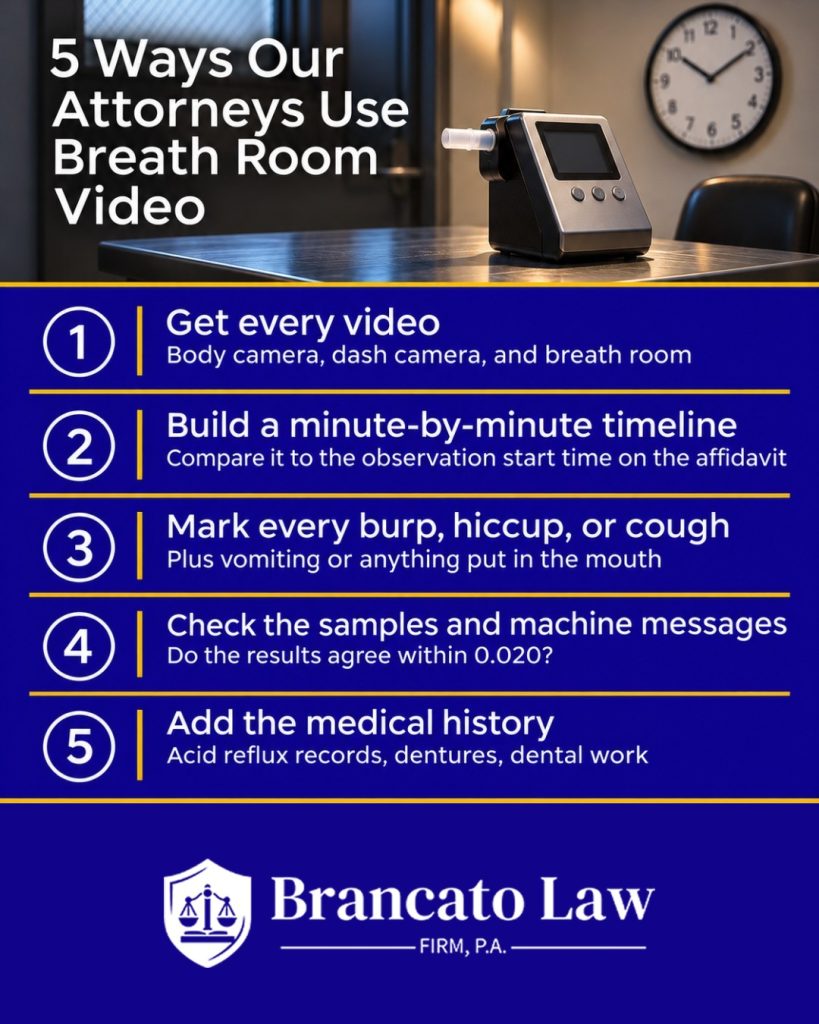
Breath room video is the best evidence of what really happened in the 20 minutes. In our Hillsborough County cases, the observation period often runs while the officer is filling out paperwork, and the video shows where the officer was looking and what the client was doing. We request the video and the breath records at the start of the case, as part of the Florida criminal case process that begins at arrest. Then we work through five steps:
- Get every video. Body camera, dash camera, jail video, and the breath room camera each cover different minutes.
- Build a minute-by-minute timeline. We compare the video clock to the observation start time on the breath test affidavit.
- Mark every burp, hiccup, or cough. We also note any vomiting, any hand to the mouth, and anything put in the mouth.
- Check the samples and machine messages. We look at whether the results agree within 0.020 and whether the instrument flagged a sample.
- Add the medical history. Acid reflux records, dentures, and dental work can explain what the video shows.
The timeline then decides the forum. A clear gap, as in Farley, supports a motion to suppress the breath result or the affidavit. A closer case, as in Chiaravalle, goes to the jury as a reason to doubt the number. The same timeline also helps in the license review, and our post on what happens when an Intoxilyzer is not properly maintained covers the instrument records we request alongside the video.
How fast should you act after a breath test?
Act within days. Under section 322.2615, Florida Statutes, a driver whose license was suspended after a DUI arrest has 10 days from the notice of suspension to request a formal or informal review. That hearing is often the first chance to put the officer’s observation period on the record. Video and records also have to be requested before they can be reviewed, so the earlier our attorneys start, the more of the 20 minutes we can account for. Our guide to what happens after a DUI arrest in Hillsborough County walks through the first weeks of a case.
Frequently asked questions about mouth alcohol and the 20-minute rule
Does burping during the 20-minute observation period invalidate a Florida breath test?
Not automatically, but a burp that brings up stomach contents is regurgitation, and the rule requires 20 minutes without it before the test. The Brancato Law Firm checks the video for the exact minute of any burp and whether the officer restarted the clock, and uses a gap to challenge the result before trial or in front of the jury. Our DUI defense attorneys in Tampa raise this in suppression motions and license hearings.
Can acid reflux cause a false positive on the Intoxilyzer 8000?
It can in some cases, mainly when alcohol is still in the stomach shortly after drinking. At The Brancato Law Firm, our attorneys pair medical records and a drinking timeline with expert review before raising reflux, because the research, including a 2015 Journal of Forensic Sciences study, found the effect only in some subjects and only at high stomach alcohol levels.
Do I have to take out my dentures before a breath test in Florida?
No. Florida law does not require officers to ask about dentures or have them removed, according to Schofield v. State, 867 So. 2d 446 (Fla. 3d DCA 2004). Our team at The Brancato Law Firm still reviews whether a first sample was flagged and how the officer handled it, because dental work can matter when the observation period was short.
What does “Slope Not Met” mean on a Florida breath test printout?
“Slope Not Met” means the alcohol concentration in a breath sample went down instead of rising and leveling off, and the Intoxilyzer 8000 aborted that test, according to FDLE’s 2006 reference guide. When we see that message in a client’s records, The Brancato Law Firm looks closely at what happened in the minutes before the next sample. A failure to give enough valid samples can also be treated as a refusal, which our post on a refused breath test in Tampa explains.
Does the officer have to restart the 20 minutes if I throw up?
Yes. Vomiting is regurgitation, and Rule 11D-8.007(3) requires at least 20 minutes without regurgitation before the test is given. The Brancato Law Firm compares the time of the vomiting on video to the affidavit’s observation start time, because a test given less than 20 minutes later is open to challenge.
How do I get the breath room video in a Hillsborough County DUI case?
Your defense attorney can request it through discovery, along with body camera, dash camera, and jail video. At The Brancato Law Firm, we ask for every recording that covers the observation period early in the case and build the timeline before the first plea offer, and our Hillsborough County criminal defense page describes how we handle cases in that courthouse.
Talk to our DUI attorneys about your breath test
Ask for the breath room video early, before you decide anything about a plea. The Brancato Law Firm, P.A., founded by Tampa Criminal Defense Attorney Rocky Brancato, will request the video and the Intoxilyzer records, build the 20-minute timeline, and file the license review before the 10-day deadline runs. Call (813) 727-7159. You can call us at any hour, and our office is two blocks from the courthouse. Our firm has Spanish-speaking staff, and attorney Jean-Luc Adrien speaks Spanish, Haitian Creole, and French. For more about our defense strategies, visit our DUI defense page.
The Brancato Law Firm, P.A.
620 E. Twiggs Street, Suite 205, Tampa, FL 33602
(813) 727-7159
Serving Hillsborough, Pinellas, and Pasco Counties
The Brancato Law Firm, P.A. is a Tampa-based criminal defense practice. We are not affiliated with any other Brancato-named law firms.
Visit Us

Tampa, FL 33602

Contact Us Now
Free Legal Consultation (813) 727-7159
