

From First DUI to Death Penalty



How to Fight a Transmitting Harmful Material to a Minor Charge in Florida? (2026)


To fight a charge of transmitting harmful material to a minor in Florida, the defense tests three things the State must prove under section 847.0138: that the accused sent the material electronically to a specific person, that the accused knew or believed that person was under 18, and that the material legally qualifies as “harmful to minors” under the three-part test in section 847.001. Each image or message sent can be charged as a separate third-degree felony, punishable by up to 5 years in prison, and a conviction requires sex offender registration. Common defenses include no reasonable belief the recipient was a minor, material that does not meet the legal definition, and proof that someone else sent it.
As founder of The Brancato Law Firm, P.A., a Tampa criminal defense firm, and a veteran of the Major Crimes Unit, where I defended sex crimes and child abuse cases, I have seen how quickly a single photo sent in a chat becomes a felony with lifetime consequences. I am also a former Chief Operations Officer of the Hillsborough County Public Defender’s Office, where I oversaw a staff of over 100 attorneys. Our attorneys defend these charges by reading every message in the chat, checking how the recipient’s age was presented, and testing whether the material meets the statute’s narrow legal definition.
What is transmitting harmful material to a minor in Florida?
Transmitting harmful material to a minor is electronically sending an image, information, or data that is “harmful to minors” to a specific person the sender knows or believes is under 18. Under section 847.0138, Florida Statutes, a person who “knew or believed that he or she was transmitting” such material to “a specific individual known by the defendant to be a minor” commits a third-degree felony. “Known by the defendant to be a minor” means the defendant had actual knowledge or believed the recipient was a minor, so the crime applies when the recipient is an undercover officer posing as a child.
The statute defines “transmit” as sending to a specific individual “via electronic mail.” Courts have read that phrase broadly. In Simmons v. State, 944 So. 2d 317 (Fla. 2006), the Florida Supreme Court interpreted “electronic mail” to include email and instant messages sent to a specific person, and in Duclos-Lasnier v. State, 192 So. 3d 1234 (Fla. 2d DCA 2016), the Second District held that “texting a harmful image to a minor violates section 847.0138.” The statute does not reach websites or posts made for general public viewing, and it does not apply to subscription-based transmissions such as list servers. These charges are part of our internet crimes practice, described on our Tampa internet crimes attorney page.
What makes material “harmful to minors” under Florida law?
Material is “harmful to minors” only if it depicts nudity, sexual conduct, or sexual excitement and meets all three parts of the test in section 847.001. The material must:
- Predominantly appeal to a prurient, shameful, or morbid interest;
- Be patently offensive to prevailing standards in the adult community as a whole about what is suitable for minors; and
- Taken as a whole, be without serious literary, artistic, political, or scientific value for minors.
“Nudity” has a specific definition, covering exposed genitals, pubic area, or buttocks, a female breast below the top of the nipple, or covered male genitals in a discernibly turgid state. The definition matters because many charged images are cropped, partially clothed, or ambiguous. A shirtless photo, a swimsuit photo, or a crude joke without a depiction of nudity or sexual conduct may not qualify at all. The statute also covers “information” and “data,” so sexual descriptions in text can be charged, but the same three-part test applies to the words. Our attorneys review each image and message separately against each part of the definition.
What are the penalties for transmitting harmful material to a minor?
Each count of transmitting harmful material to a minor is a third-degree felony, punishable by up to 5 years in prison and a $5,000 fine under sections 775.082 and 775.083. The more serious consequence is registration: section 847.0138 is one of the offenses listed in section 943.0435, so a conviction makes a person a sexual offender who must register with the Florida Department of Law Enforcement. Prosecutors usually charge one count for each image or message, so a single conversation can produce several felonies.
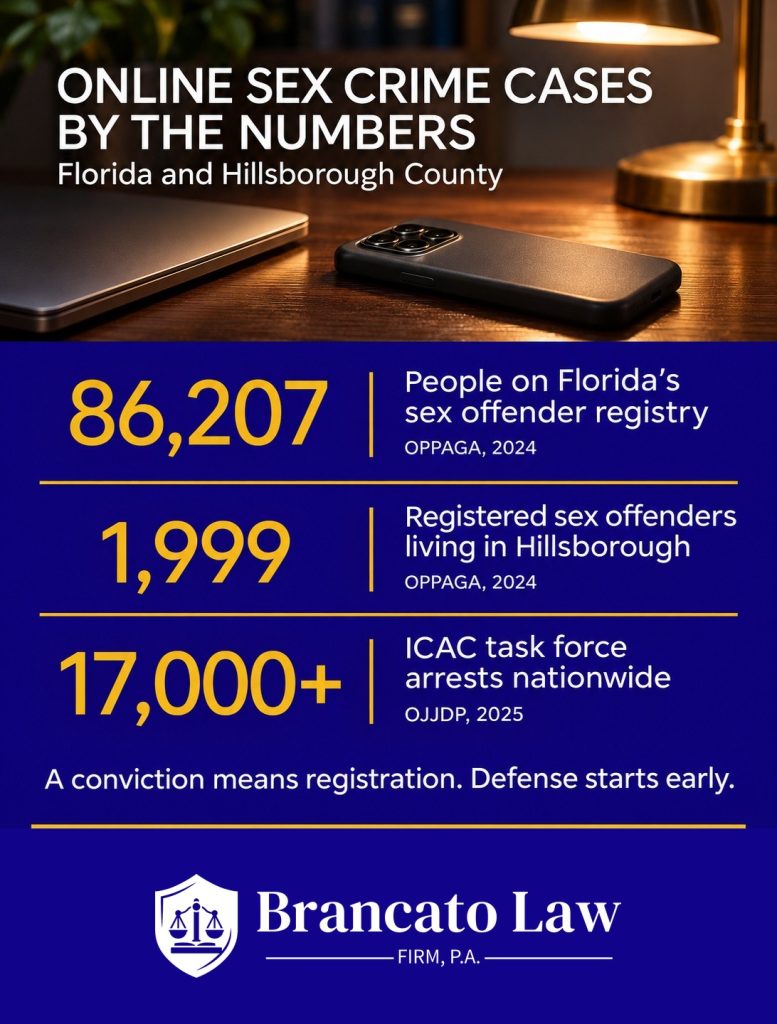
Registration reaches a large number of people. As of October 2024, the Florida Department of Law Enforcement’s registry listed 86,207 sexual offenders and predators, and 1,999 registered sex offenders were living in Hillsborough County communities, according to the Florida Legislature’s Office of Program Policy Analysis and Government Accountability in its 2024 review of sex offender registration.
| Charge | Statute | Level | Registration |
|---|---|---|---|
| Transmitting material harmful to a minor (each count) | 847.0138 | Third-degree felony: up to 5 years | Yes |
| Using a computer to solicit a child | 847.0135(3) | Third-degree felony (higher if the sender misrepresents age) | Yes |
| Traveling to meet a minor after solicitation | 847.0135(4) | Second-degree felony | Yes |
| Sexting by a minor (first violation) | 847.0141 | Noncriminal: 8 hours of community service, a $60 civil penalty, or a cyber-safety program | No |
Teenagers are treated differently. When a minor sends a nude photo to another minor, the case is usually charged under the sexting statute, section 847.0141, which makes a first violation noncriminal. Section 847.0138 is aimed at the sender who knows or believes the recipient is a minor; an adult is never charged under the sexting statute.
Does the minor have to actually receive the image?
No. In King v. State, 59 So. 3d 272 (Fla. 4th DCA 2011), a jury asked the judge, “if it’s sent and not received is it transmission?” The Fourth District affirmed the conviction and held that the statute punishes those who believe they are transmitting harmful material to a minor “regardless of whether the minor receives the transmission.” The practical point is that a failed send, a message the officer never opened, or a photo that did not load can still be charged. The defense focus belongs on what the sender knew and believed, and on whether the sender was actually the person at the keyboard.
How do our attorneys fight a transmitting harmful material charge?
Our attorneys fight these charges by holding the State to each element and by reading the entire conversation, not the excerpts in the arrest report. These are the defenses The Brancato Law Firm uses most often in Hillsborough, Pinellas, and Pasco County courts.
1. No knowledge or belief that the recipient was a minor
The State must prove the accused knew or believed the recipient was under 18. In many stings, the chat begins on an adult dating app or a site that requires users to be 18, and the age claim comes later, buried in a long conversation, or is contradicted by the profile. We build a timeline showing exactly when and how age was raised and what the accused said in response. Our post on whether not knowing someone’s age is a defense in Florida explains how belief about age works in different sex offenses.
2. The material does not meet the legal definition
Every image and message must satisfy the nudity, sexual conduct, or sexual excitement requirement and all three parts of the harmful-to-minors test. We challenge counts based on images that are cropped, clothed, or non-sexual, and counts based on text that is crude but does not describe sexual conduct.
3. Someone else sent it
Phones and accounts are shared, borrowed, and hacked. The State must prove who sent each message. We look at device extraction reports, login records, IP addresses, and where the accused was when each message was sent.
4. Too many counts
Prosecutors often charge one count per image, which inflates the scoresheet. We examine whether multiple counts actually reflect separate transmissions, and whether related solicitation and traveling counts violate double jeopardy under the rules in our post on solicitation of a child using a computer.
5. Unlawful search of a phone or account
A search of a phone or a cloud account generally requires a warrant. When police search a phone at the scene of a sting without one, or exceed the scope of a warrant, the resulting evidence can be suppressed.
6. Entrapment, used carefully
Florida law recognizes entrapment when law enforcement induces a person who was not ready to commit the crime, but it is hard to win in online sting cases. Our post on entrapment in Florida explains the standard. We raise it when the officer, not the accused, introduced the sexual topic, requested the photo, and pressed after refusals, and we pair it with the evidence-based defenses above.
How common are online sting cases in Hillsborough County?
Online stings are a regular part of law enforcement work in Hillsborough County. During an April 21 to 24, 2025 operation, the Hillsborough County Sheriff’s Office reported arresting 15 people after detectives posed as juveniles and as relatives offering a juvenile online; the release states that suspects sent explicit photos of their genitalia to the believed juvenile. Twelve were arrested when they traveled to a meeting location, and three were arrested later on warrants. Nationally, the U.S. Justice Department’s Office of Juvenile Justice and Delinquency Prevention reports that Internet Crimes Against Children task forces conducted nearly 347,000 investigations in 2025, leading to the arrest of more than 17,000 offenders.
Stings have been a major source of these cases for decades. A national study by researchers at the University of New Hampshire’s Crimes against Children Research Center, published in Sexual Abuse: Journal of Research and Treatment in 2005, found that proactive investigations, where investigators pose as minors online, accounted for 25 percent of all arrests for internet sex crimes against minors in the year studied. The same study reported high rates of guilty pleas and found that entrapment, fantasy or role-playing, and factual impossibility defenses were used but not successfully. That is why our attorneys build the defense around the elements and the evidence, not around a sting defense alone.
What happens after an arrest for transmitting harmful material to a minor?
After an arrest in Hillsborough County, the accused goes to first appearance within 24 hours, where the judge sets bond and conditions that usually include no contact with minors and no internet use without approval. In our experience, Hillsborough County does not offer pretrial services supervision as a release option, though some neighboring counties do, so those conditions are argued at that first hearing. Our Hillsborough County criminal defense page covers local procedure, and our guide to the Florida criminal case process walks through each stage after arrest.
Not every case starts with an arrest. Some begin with a search warrant, a detective’s phone call, or a request to “come in and talk.” If you learn you are under investigation, representation before charges are filed lets our attorneys deal with investigators and the State Attorney’s Office before a charging decision. Our post on what to do after messaging a minor online covers those first steps, and our post on what happens after a Tampa sex sting arrest covers sting cases.
What should you do if you are charged or under investigation?
Do not delete anything, do not talk to detectives, and do not contact the person in the chat. Our attorneys give every client these instructions:
- Do not delete accounts, apps, or messages. Deleting can be charged as tampering with evidence and can destroy messages that help the defense.
- Do not give a statement or consent to a phone search without a lawyer present.
- Write down which apps and accounts were used, who else had access to the phone, and how the conversation started.
- Follow every release condition, especially restrictions on internet use and contact with minors.
Frequently asked questions about transmitting harmful material to a minor
Can a transmitting harmful material to a minor charge be dropped in Florida?
Yes, these charges can be dropped or reduced when the evidence does not show belief that the recipient was a minor, when the material does not meet the legal definition, or when the State cannot prove who sent it. The Brancato Law Firm presents those problems to the prosecutor early, including through pre-file advocacy in cases still under investigation.
Is it still a crime if the “minor” was an undercover officer?
Yes, because the statute covers anyone the defendant “believed” was a minor, and the Florida Supreme Court upheld the statute in a case where a deputy posed as a 13-year-old. Our attorneys at The Brancato Law Firm focus on what the accused actually believed, using the full chat and the platform’s age rules.
Will I have to register as a sex offender for sending a photo to a minor?
Yes, a conviction under section 847.0138 is a qualifying offense for sex offender registration under section 943.0435. The Brancato Law Firm weighs registration in every plea discussion, and our post on whether a withheld adjudication avoids sex offender registration explains why the form of a plea matters.
Is sending sexual text messages without pictures a crime in Florida?
It can be, because section 847.0138 covers “information” and “data,” not just images, if the words meet the harmful-to-minors test and the sender believed the recipient was a minor. Lawyers at The Brancato Law Firm challenge text-only counts that do not describe nudity or sexual conduct.
What if I am under 18 and sent a nude photo to another teen?
A minor who sends a nude photo to another minor is usually charged under the sexting statute, where a first violation is noncriminal. The Brancato Law Firm represents students and families in these cases through our internet crimes defense practice, with attention to school discipline and future records.
Does it matter which app was used?
Not for the crime itself, because courts treat email, instant messages, and text messages as covered, but the app matters for the evidence. Our team at The Brancato Law Firm subpoenas platform records, which often show account creation details, login locations, and the age settings on the profile.
For more about our defense strategies, visit our Internet Crimes page.
What our attorneys do first in these cases is preserve the complete chat history and the platform records before an account is deactivated. Call The Brancato Law Firm, P.A., founded by Tampa Criminal Defense Attorney Rocky Brancato, at (813) 727-7159, and do not speak with detectives until you have. You can call us at any hour. Our firm has Spanish-speaking staff, and attorney Jean-Luc Adrien speaks Spanish, Haitian Creole, and French. Our office is two blocks from the courthouse, and we defend internet crimes cases in Hillsborough, Pinellas, and Pasco counties.
The Brancato Law Firm, P.A.
620 E. Twiggs Street, Suite 205, Tampa, FL 33602
(813) 727-7159
Serving Hillsborough, Pinellas, and Pasco Counties
The Brancato Law Firm, P.A. is a Tampa-based criminal defense practice. We are not affiliated with any other Brancato-named law firms.
Visit Us

Tampa, FL 33602

Contact Us Now
Free Legal Consultation (813) 727-7159
