

From First DUI to Death Penalty



How to Fight a Pimping or Deriving Support Charge in Florida? (2026)


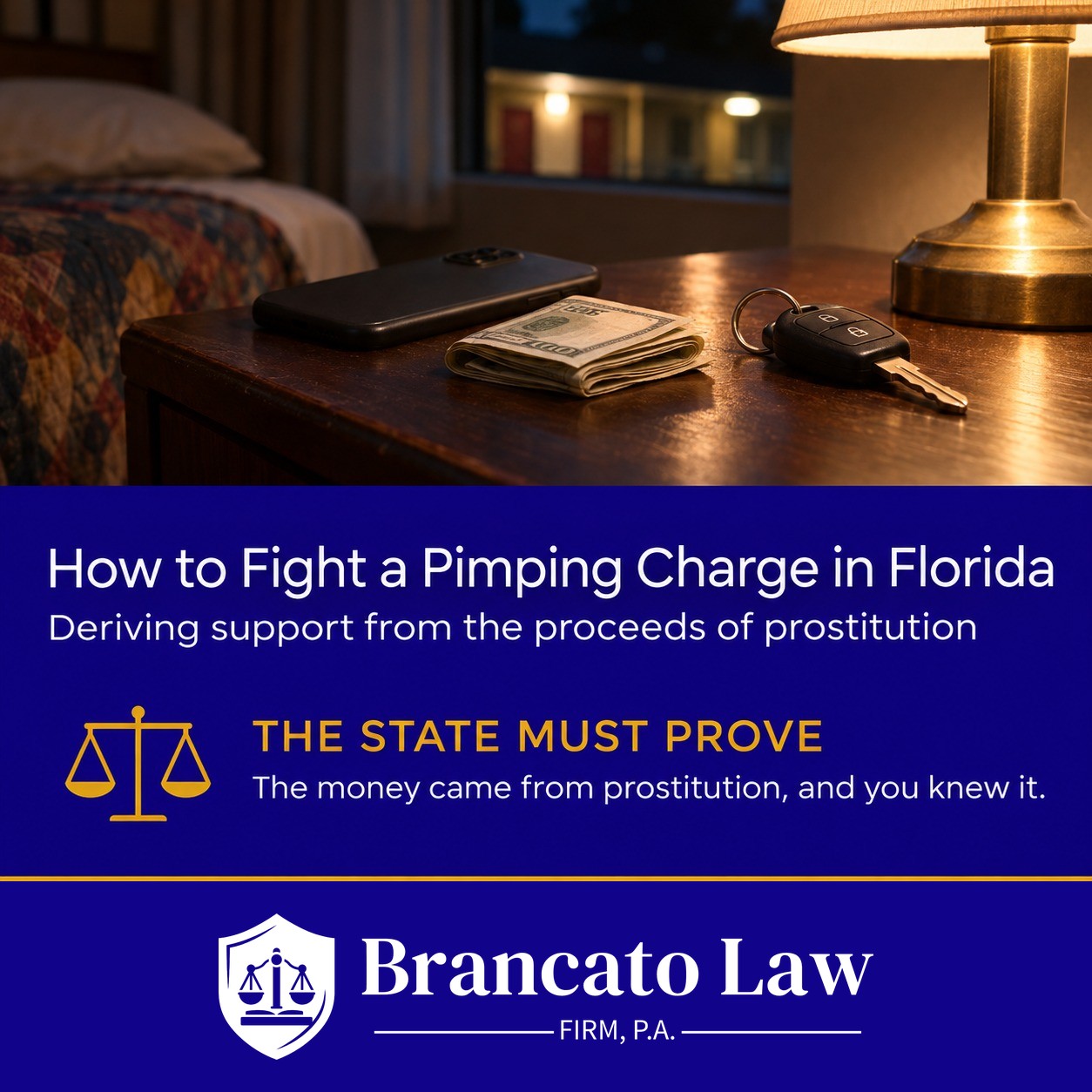
To fight a pimping charge in Florida, the defense attacks the two things the State must prove under section 796.05: that the accused lived on or took support from the earnings of another person’s prostitution, and that the accused knew or reasonably believed that person was engaged in prostitution. Florida calls the offense deriving support from the proceeds of prostitution. A first offense is a second-degree felony punishable by up to 15 years in prison, a second offense is a first-degree felony punishable by up to 30 years, and a third or later offense carries a 10-year mandatory minimum prison term. Many cases turn on whether the money can actually be traced to prostitution, on what a driver, partner, or roommate actually knew, and on whether a detective was allowed to tell the jury what the accused “meant.”
A Florida jury can convict someone of deriving support from prostitution only if the State proves where the money came from and what the accused knew about it, and in many cases the arrest report proves neither. As founder of The Brancato Law Firm, P.A., a Tampa criminal defense firm, I have held prosecutors to that proof for more than 25 years in Hillsborough County courtrooms. I learned how sex crime cases are built in the Major Crimes Unit, where I handled sex crimes cases, and I am a former Chief Operations Officer of the Hillsborough County Public Defender’s Office, where I oversaw a staff of over 100 attorneys. Our attorneys defend pimping and deriving support charges by tracing every dollar the State points to and by challenging the undercover testimony these cases are built on.
What is a pimping charge in Florida?
A pimping charge in Florida is usually filed as deriving support from the proceeds of prostitution under section 796.05, Florida Statutes. The statute makes it a crime for a person who knows or reasonably believes another person is engaged in prostitution “to live or derive support or maintenance in whole or in part” from what is believed to be that person’s prostitution earnings. The word “pimping” does not appear in the statute; it is the everyday name for the conduct the law targets.
Prostitution itself has a narrow legal meaning. Under section 796.07(1)(d), prostitution is “the giving or receiving of the body for sexual activity for hire,” and sexual activity is defined to mean specific sex acts. Escorting, dancing, webcam work, and companionship are not prostitution unless sexual activity is exchanged for money. Our guide to whether prostitution is legal in Florida covers where those lines fall, and that line matters here: if the underlying activity was not prostitution, money earned from it cannot support a section 796.05 charge.
At our firm, deriving support charges are defended as part of our sex crimes practice; our Tampa sex crimes lawyer page covers the prostitution, sting, and trafficking cases our attorneys defend in Hillsborough, Pinellas, and Pasco counties.
What are the penalties for pimping in Florida?
The penalty for deriving support from prostitution in Florida rises with each offense, from a second-degree felony on a first offense to a first-degree felony with a 10-year mandatory minimum on a third. The maximum prison terms come from section 775.082, and fines of up to $10,000 come from section 775.083. The offense levels come from the Criminal Punishment Code ranking chart in section 921.0022.
| Offense | Degree | Maximum prison | Maximum fine | Scoresheet level | Mandatory minimum |
|---|---|---|---|---|---|
| First offense | Second-degree felony | 15 years | $10,000 | Level 5 | None |
| Second offense | First-degree felony | 30 years | $10,000 | Level 7 | None |
| Third or later offense | First-degree felony | 30 years | $10,000 | Level 7 | 10 years in prison |
The scoresheet level matters as much as the maximum. A level 5 offense scored alone by a person with no record adds 28 points, which falls below the 44-point line where Florida’s Criminal Punishment Code requires a prison sentence, so a first offense with no prior record leaves room for probation, a withhold of adjudication (a sentence without a formal conviction), or a negotiated reduction. A level 7 offense scored alone adds 56 points, which produces a lowest permissible sentence of 21 months in state prison unless the defense proves a legal reason for a downward departure. Prior convictions, additional counts, and drug charges filed in the same case all add points.
Deriving support involving an adult is not on the list of offenses that require sex offender registration under section 943.0435. That list does include human trafficking for commercial sexual activity, which is one reason our attorneys fight hard to keep a deriving support case from being charged or pleaded as trafficking.
What does the State have to prove in a Florida deriving support case?
The State has to prove three things beyond a reasonable doubt in a Florida deriving support case. Each one is a separate place to win.
- Another person was engaged in prostitution. The State must show sexual activity for hire as section 796.07 defines it, not just dating, escorting, or adult entertainment.
- The accused knew or reasonably believed it. The statute reaches a person “with reasonable belief or knowing” about the prostitution. Suspicion, rumor, or closeness to the person is not the same as knowledge.
- The accused lived on or took support from the prostitution earnings. The money or support has to come from the prostitution itself, in whole or in part, not from the person’s other income.
The third element is where many cases are weakest. In State v. Morris, 540 So. 2d 226 (Fla. 5th DCA 1989), the State charged a man with living off the earnings of a woman he knew was a prostitute. The trial court dismissed the charge, and the Fifth District Court of Appeal affirmed, because the charge alleged only that he received support from her while knowing she was a prostitute. The court held that the charge must allege the accused lived from or derived support from “the prostitution earnings.” The lesson still applies today: sharing rent, a car, or a household with someone who engages in prostitution is not a crime by itself, and the State has to connect the specific money to prostitution.
The statute also covers what is “believed to be” prostitution earnings. That wording lets the State charge people in undercover operations where no real prostitution took place, but it also puts the accused person’s own understanding at the center of the case, which is exactly what the defense can contest.
Can a driver, boyfriend, or roommate be charged with deriving support?
Yes, a driver, partner, or roommate can be charged with deriving support from prostitution in Florida, but only if the State proves that person knew about the prostitution and took a share of its proceeds. In practice, the people arrested on this charge are often not the stereotyped pimp: they are the person who drove someone to a hotel, the partner who shares a bank account, or the friend who rented the room. Each of those roles has an innocent explanation, and the defense builds the case around it.
A Second District case from Polk County shows how these charges are tried. In McSweeney v. State, 286 So. 3d 369 (Fla. 2d DCA 2019), an undercover vice detective answered an online ad and arranged to meet a woman who said her driver needed $50. When they arrived, the driver walked to the door, asked for half the money up front, and said, “She can go in and do her thing.” The detective paid him nothing, and the driver was convicted of attempted deriving support from the proceeds of prostitution. At trial, the prosecutor asked the detective, based on his training and experience, what the driver meant, and the detective told the jury it meant “she can go in and have sex with me.”
The Second District Court of Appeal reversed and ordered a new trial. The court held that because the driver’s words were not coded language, the detective’s interpretation “usurped the jury’s function” on the one element in dispute: whether the driver knew or reasonably believed the woman was there for prostitution. The court also rejected the State’s harmless error argument. For anyone charged after a sting, McSweeney matters because it limits one of the most common tactics in these trials, letting an experienced detective tell the jury what the accused was thinking.
How is deriving support different from human trafficking or procuring in Florida?
Deriving support punishes living off prostitution earnings, while human trafficking punishes recruiting, transporting, or obtaining a person for exploitation, and procuring punishes arranging or inducing the prostitution itself. Prosecutors often file these charges together after an undercover operation, and the differences decide the exposure.
| Charge | What the State must show | Classification | Sex offender registration |
|---|---|---|---|
| Deriving support, s. 796.05 | Knowing or reasonably believing another person engages in prostitution, and living on or taking support from those earnings | Second-degree felony on a first offense; first-degree felony after that | Not a listed offense |
| Procuring or transporting for prostitution, s. 796.07(2)(d) and (f) | Taking or transporting a person for prostitution with knowledge or reasonable cause to believe the purpose, or soliciting, inducing, or procuring another to commit prostitution | Transporting starts as a second-degree misdemeanor on a first violation; paragraph (2)(f) has its own penalty scale | Not a listed offense |
| Human trafficking using coercion of an adult for commercial sex, s. 787.06(3)(b) | Recruiting, transporting, harboring, or obtaining a person for exploitation using coercion, such as force, threats, debt, or seized identification | First-degree felony | Listed offense |
| Human trafficking for commercial sex involving a minor, s. 787.06(3)(g) | Trafficking for commercial sexual activity involving a child under 18 or an adult believed to be under 18 | Life felony | Listed offense |
The trafficking statute, section 787.06, also reaches anyone who “benefits financially” from a venture that subjected a person to trafficking, which overlaps with deriving support. The key difference for adults is coercion. When the evidence shows a consenting adult and shared money, with no force, threats, debt bondage, or seized documents, our attorneys argue the case belongs under section 796.05 at most, and never under the trafficking statute. Our page on human trafficking defense in Tampa explains how those charges are defended.
How do our attorneys fight a pimping charge in Florida?
Our attorneys fight a pimping charge in Florida by testing each element against the evidence, starting with the money and the accused person’s knowledge. These are the defenses we develop most often.
- Trace the money. We subpoena bank, payment app, and payroll records to show that the funds the State calls prostitution proceeds came from wages, shared bills, gifts, or lawful work. Under State v. Morris, support from a person is not support from prostitution.
- Challenge knowledge. Driving someone, living with someone, or dating someone does not prove knowledge of prostitution. We look at what the client was actually told, what the messages say, and whether the client was present for any agreement.
- Keep the detective in his lane. When a detective tries to interpret plain words for the jury, we object under McSweeney and move in limine (a pretrial request to exclude evidence) to bar the testimony before trial.
- Contest whether the activity was prostitution. Escort, massage, dancing, or online content work is not prostitution without sexual activity for hire. If the State cannot prove the underlying prostitution, the deriving support charge fails with it.
- Suppress unlawfully obtained evidence. Phone searches, hotel room entries, and vehicle searches during stings are reviewed for warrant and consent problems. A successful motion to suppress can remove the messages or cash the State relies on.
- Raise entrapment where the facts support it. If undercover officers induced a person with no predisposition to take money from prostitution, Florida’s entrapment statute, section 777.201, can be a complete defense.
- Separate the client from trafficking allegations. When the alleged worker is an adult who was not coerced, we push to have trafficking counts dropped and the case resolved, if at all, under section 796.05 or a lesser misdemeanor under section 796.07.
The person the State calls the victim is often the most important witness, and that person may say the money was shared voluntarily or was never prostitution money at all. Our team interviews witnesses and, where needed, takes depositions to lock in that testimony before trial.
How often are prostitution offenses prosecuted in Florida?
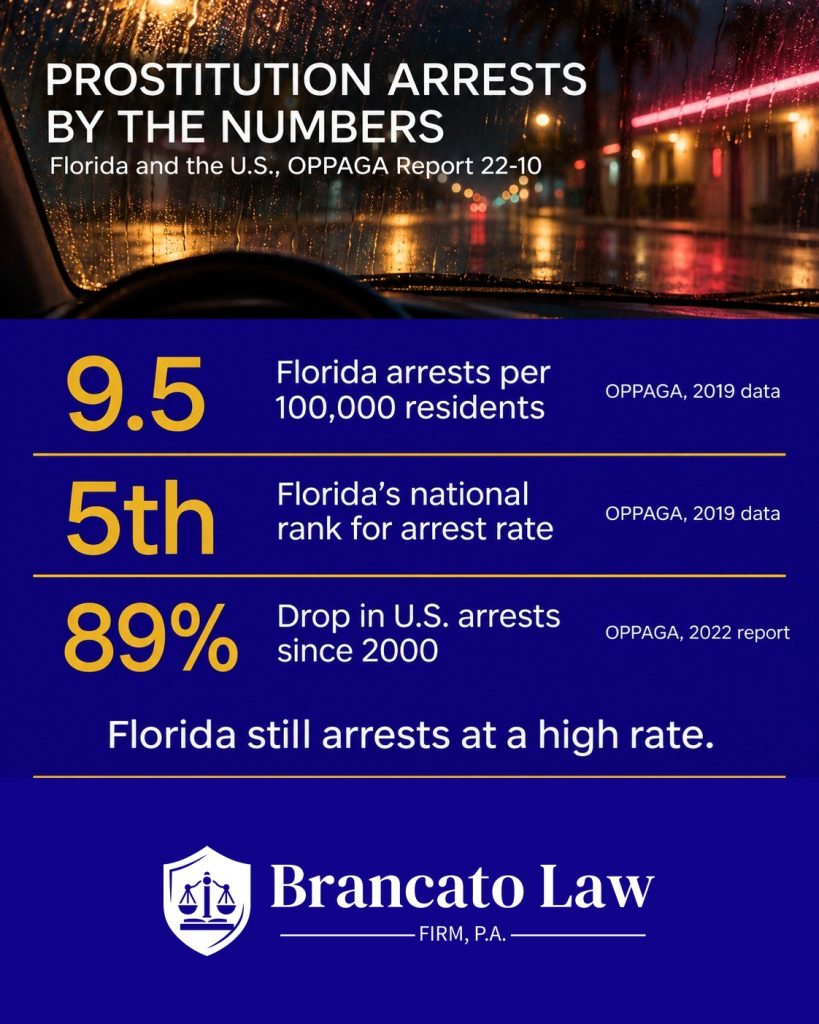
Florida arrests people for prostitution offenses at one of the highest rates in the country. In its December 2022 Report 22-10, Florida’s Office of Program Policy Analysis and Government Accountability (OPPAGA) found that in 2019 Florida’s arrest rate for prostitution offenses was 9.5 arrests per 100,000 residents, which ranked fifth nationally, and that prostitution arrests nationwide had declined 89% since 2000 (OPPAGA Report 22-10, page 1). The same report found that the people who sell sex, rather than buyers or pimps, make up most of those arrested, which is why a deriving support charge often follows an investigation that began with someone else’s arrest.
Research also shows why prosecutors so often pair these charges with drug counts. A 2014 study funded by the National Institute of Justice and conducted by the Urban Institute examined the underground commercial sex economy in eight U.S. cities, including Miami. It found that 25 percent of the pimps interviewed had worked as drug dealers before pimping, and 18 percent continued dealing drugs while they pimped (Urban Institute, Estimating the Size and Structure of the Underground Commercial Sex Economy in Eight Major US Cities, 2014). That overlap cuts both ways: cash found in a car or home may be drug money, wages, or anything else, and the State still has to prove it came from prostitution.
How are deriving support cases handled in Hillsborough County?
In Hillsborough County, deriving support charges usually come out of undercover operations run by the Hillsborough County Sheriff’s Office (HCSO) Human Trafficking Section or the Tampa Police Department. These operations are large and frequent: HCSO’s “Operation Relentless Summer,” which ran from June 8 to August 5, 2026 and included undercover online chat and hotel and motel operations, produced 116 arrests, according to an HCSO news release from August 2026. In our experience, the person who drove, booked the room, or held the money is often arrested in the same operation as the buyers, and the charging decision is made later by the State Attorney’s Office for the 13th Judicial Circuit. Our article on how Tampa escort stings work walks through those operations step by step.
After an arrest, the accused goes to first appearance at the Orient Road Jail, where a judge sets bond and conditions such as no contact with the alleged worker. That no-contact order can cut the accused off from a partner or roommate, so our attorneys address it early. The period between arrest and the filing decision is also when the defense has the most leverage; our representation before charges are filed gives prosecutors the bank records, messages, and witness accounts that support a lesser charge or no charge at all. You can see where this fits in the full sequence of a case on our Florida criminal case process page, and our Hillsborough County criminal defense page covers the local courts.
Can deriving support charges be dropped in Florida?
Yes, deriving support charges can be dropped in Florida when the State cannot prove the money came from prostitution or that the accused knew about it. Prosecutors may file a nolle prosequi (a formal decision to drop the case), decline to file the felony, or reduce it to a misdemeanor under section 796.07 when the defense shows the evidence does not reach section 796.05. Common reasons include financial records that explain the money, a witness who says the support was unrelated to prostitution, suppression of phone or search evidence, and a detective’s report that relies on interpretation rather than facts. The Brancato Law Firm presents that evidence to the State Attorney’s Office as early as possible, because a charging decision is easier to shape than a filed felony.
Frequently asked questions about pimping and deriving support charges in Florida
Can I be charged for accepting rent or gifts from a partner who does sex work?
You can be charged only if the State can prove you knew or reasonably believed your partner was engaged in prostitution and that the rent or gifts came from those earnings. Our attorneys at The Brancato Law Firm use bank and payment records to show where shared money actually came from, which is the point the court found missing in State v. Morris. Our sex crimes defense attorneys handle these cases throughout Hillsborough, Pinellas, and Pasco counties.
Is it a crime to drive someone to a hotel for an escort appointment in Florida?
Driving someone is a crime under section 796.07(2)(d) only if you knew or had reasonable cause to believe the purpose was prostitution, and it becomes deriving support only if you also took a share of the prostitution earnings. The Brancato Law Firm examines the texts, calls, and payment arrangements to show what the driver actually knew and was paid for. The McSweeney decision also limits a detective’s ability to tell a jury what a driver meant.
Is deriving support from prostitution a felony if no money changed hands?
It can still be charged as an attempt, as in McSweeney, where the driver asked an undercover detective for money but was never paid. Our team at The Brancato Law Firm looks closely at attempt charges from stings, because the State’s proof of intent often rests entirely on a few words in a conversation. Under Florida’s attempt statute, section 777.04, an attempt is generally punished one degree lower than the completed offense.
What should I do if police want to talk to me about a prostitution or trafficking investigation?
Do not give a statement until you have spoken with a criminal defense attorney, because statements about money and knowledge are often the State’s main evidence on these charges. The Brancato Law Firm can contact detectives on your behalf and present your side before a filing decision through our pre-file advocacy. Keep your financial records and messages; do not delete them.
Will a deriving support charge be upgraded to human trafficking?
Prosecutors can add a human trafficking charge when they believe there was coercion of an adult or involvement of a minor, and they sometimes file both at once. The Brancato Law Firm challenges trafficking counts that lack evidence of force, threats, debt bondage, seized documents, or a minor, since those charges carry first-degree felony or life felony penalties and sex offender registration. Our guide to sex crime charges in Florida explains how these charges relate.
Can a first-time deriving support charge end without prison?
Yes, a first offense scored alone falls below Florida’s prison threshold, so probation, a withhold of adjudication, or a reduction to a misdemeanor is possible depending on the facts and any prior record. Our attorneys at The Brancato Law Firm build mitigation, including work history and financial records, to support a non-prison outcome when the case cannot be dismissed. A second or third offense is far more serious because it moves to level 7, and a third offense carries a 10-year mandatory minimum.
For more about our defense strategies, visit our Sex Crimes page.
Prostitution cases move quickly from arrest to a filing decision, and the records that explain the money are easiest to gather in the first weeks. Call The Brancato Law Firm, P.A., founded by Tampa Criminal Defense Attorney Rocky Brancato, at (813) 727-7159 for a confidential consultation; you can call us at any hour. Our firm has Spanish-speaking staff, and attorney Jean-Luc Adrien speaks Spanish, Haitian Creole, and French. Our office is two blocks from the courthouse, and we defend prostitution and deriving support charges in Hillsborough, Pinellas, and Pasco counties.
The Brancato Law Firm, P.A.
620 E. Twiggs Street, Suite 205, Tampa, FL 33602
(813) 727-7159
Serving Hillsborough, Pinellas, and Pasco Counties
The Brancato Law Firm, P.A. is a Tampa-based criminal defense practice. We are not affiliated with any other Brancato-named law firms.
Visit Us

Tampa, FL 33602

Contact Us Now
Free Legal Consultation (813) 727-7159
