

From First DUI to Death Penalty



How to Fight a Pawnbroker Fraud Charge in Florida? (2026)


To fight a pawnbroker fraud charge in Florida, the defense attacks knowledge: under section 539.001(8)(b)8., the State must prove you knowingly gave a false statement of ownership or a false ID to a pawnshop and received money for the item. It is a third-degree felony if you received less than $300 and a second-degree felony at $300 or more, so the amount on the pawn ticket matters. Florida courts have reversed convictions where the jury was not told the false statement had to be made knowingly, and where the State overcharged the degree.
Most people charged with pawnbroker fraud never read the form they signed. I’m Rocky Brancato, founder of The Brancato Law Firm, P.A., a Tampa criminal defense firm, and as former Chief Operations Officer of the Hillsborough County Public Defender’s Office, where I oversaw a staff of over 100 attorneys, I saw how often these cases rest on a pawn ticket, a thumbprint, and an assumption about what the seller knew. Our attorneys defend pawnshop cases in Hillsborough, Pinellas, and Pasco Counties, usually alongside the dealing in stolen property charge that comes with them.
What is false verification of ownership to a pawnbroker in Florida?
False verification of ownership is knowingly telling a pawnshop you own an item, or that it is not stolen, when that is false, and receiving money for it. It also covers using a false or altered ID in a pawn transaction. The crime is in the Florida Pawnbroking Act, section 539.001(8)(b)8., Florida Statutes, and courts often call it pawnbroker transaction fraud.
Every pawn or sale in Florida runs through a state-approved transaction form. The seller signs a statement that the item “is not stolen,” has no liens, and that the seller “is the rightful owner of the goods.” The form also records the seller’s ID, address, physical description, and right thumbprint. That signed form is usually the State’s main exhibit. Our attorneys explain the full range of property cases on our Tampa theft and property crimes attorney page.
What does the State have to prove?
The State must prove three things: a false verification of ownership or a false or altered ID, that you gave it knowingly, and that you received money from the pawnbroker for the item.
| Element | What the State must show | What our attorneys test |
|---|---|---|
| False verification or false ID | The ownership statement on the form was untrue, or the ID was false or altered | Did you own the item, or have the owner’s permission to pawn it? |
| Knowingly | You knew the statement was false when you signed | Did you know the item was stolen? Did anyone explain the form? |
| Money received | The pawnbroker paid you for the item | How much? The amount sets the felony degree |
What are the penalties for pawnbroker fraud in Florida?
Pawnbroker fraud is always a felony, and the degree depends on how much money you received, not on what the item was worth.
| Charge | Amount | Degree | Maximum prison |
|---|---|---|---|
| False verification of ownership (s. 539.001(8)(b)8.a.) | Less than $300 received | Third-degree felony | 5 years |
| False verification of ownership (s. 539.001(8)(b)8.b.) | $300 or more received | Second-degree felony | 15 years |
| Dealing in stolen property (s. 812.019(1)) | Any amount | Second-degree felony (Level 5) | 15 years |
A conviction also carries repayment. If the item is returned to its owner and you are convicted of theft, dealing in stolen property, or pawnbroker fraud, section 539.001 requires the court to order you to repay the pawnshop the full amount you received plus pawn service charges, and the statute counts a no contest plea or a withhold of adjudication as a conviction for that purpose. Dealing in stolen property is ranked at Level 5 in section 921.0022, which is why prosecutors so often pair the two charges.
How do our attorneys fight a pawnbroker fraud charge?
Our attorneys fight pawnbroker fraud charges by attacking knowledge, ownership, the amount, and how the charges are stacked. These are the four defenses we review first:
- You did not know the item was stolen. A signature on a form is evidence of knowledge, but it is not the end of the question.
- You owned the item or had permission. Pawning a spouse’s, roommate’s, or relative’s property with permission is not a false verification.
- The degree is wrong. Less than $300 received means a third-degree felony, not a second.
- The charges overlap. Florida law limits convictions for both theft and dealing in stolen property from the same course of conduct.
Knowledge must be proven: what Wiley and Hale show
The word “knowingly” is the heart of the statute. In Wiley v. State, 830 So. 2d 889 (Fla. 1st DCA 2002), a man’s ex-girlfriend found her stolen jewelry in a pawnshop. He said he bought it from someone on the street. The jury instruction on pawnbroker transaction fraud left out the requirement that the false verification be given knowingly, and the First District reversed that conviction as fundamental error because knowledge “was a focus of the appellant’s defense.”
The State does not have to prove you read the form, though. In Hale v. State, 838 So. 2d 1185 (Fla. 5th DCA 2003), the clerk filled out the ticket and never asked the customer to read it, and the ownership warranty was in faint type on the back. The Fifth District still upheld the charge, holding that a signature under a penalty-of-perjury statement is “some evidence” of knowledge or willful blindness, and that lack of proof a defendant read the document “will not insulate” him. The lesson: the defense must show what you actually knew about where the item came from, not just that you skipped the fine print.
The amount controls the degree: what Stanford shows
Prosecutors sometimes charge the higher degree when the numbers do not support it. In Stanford v. State, 833 So. 2d 174 (Fla. 3d DCA 2002), a man pawned a buffer, a paint spray gun, and a small TV at a South Dade pawnshop and received $70 in total, yet was convicted of the second-degree felony. The Third District held the error was fundamental, reduced the conviction to a third-degree felony, and ordered resentencing on the whole case. Our attorneys check the pawn ticket amounts before anything else.
Stacked charges: theft and dealing in stolen property
Under section 812.025, the State may charge theft and dealing in stolen property for the same conduct, but a jury may return a guilty verdict on only one of them. In Wiley, the grand theft conviction had been vacated for that reason. Pawnbroker fraud is a separate offense, so our attorneys look for every way the counts overlap and press the prosecutor to drop the ones that duplicate the same pawn. Our guide to dealing in stolen property charges for pawning something explains that charge in depth.
How do pawnshop cases reach police in Hillsborough County?
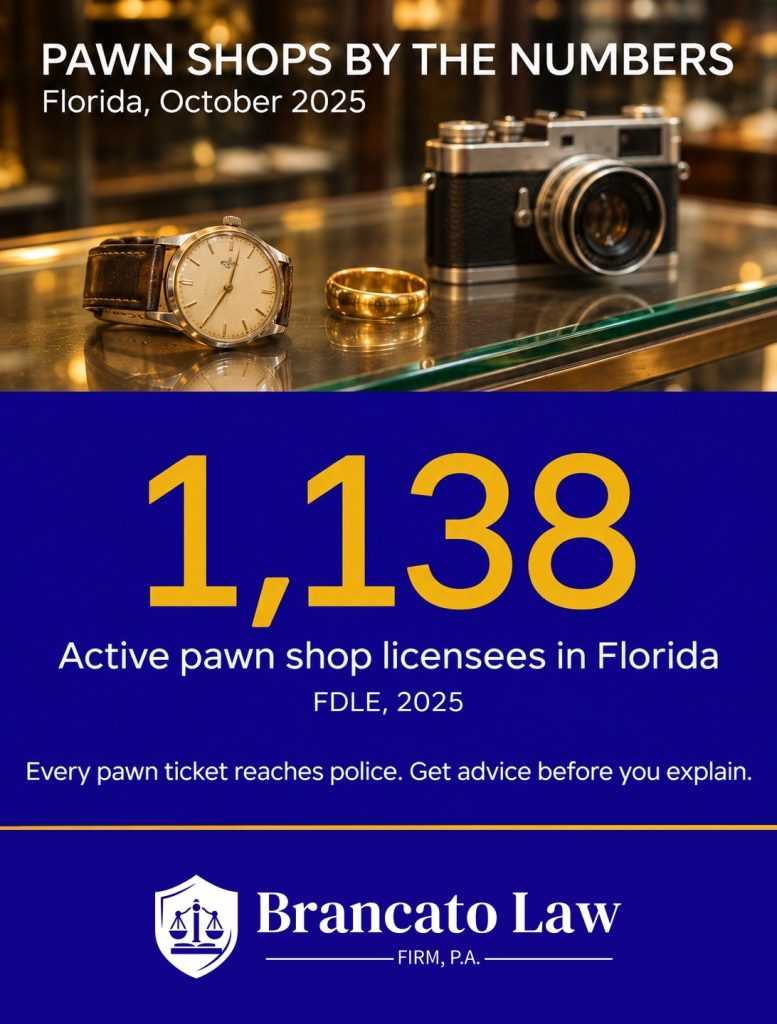
Pawn records go to law enforcement every business day. Under section 539.001(9), pawnbrokers must deliver transaction forms to the local police or sheriff by the end of each business day or, when the agency provides software, electronically, and goods must be held unaltered for 30 days so police can inspect them. A January 2026 Florida Senate staff analysis of a bill that would create a statewide pawn database (SB 1582) reported that, as of October 5, 2025, Florida had 1,138 active pawn shop licensees, citing an FDLE feasibility study.
In our Hillsborough County cases, the typical file starts when a theft victim reports a serial number or a detective matches a pawn ticket to a burglary or theft report. The detective then pulls the ticket, the thumbprint, and the store video, and asks the person who pawned the item to “come explain.” That interview is where most of these cases are won or lost.
What should you do if police contact you about something you pawned?
If a detective calls about something you pawned, do not go in to explain until you have talked with a lawyer. Your explanation of where the item came from is exactly what the State needs to prove knowledge. Our attorneys provide representation before charges are filed and can give the detective or prosecutor the innocent explanation, such as a purchase receipt or the owner’s permission, without exposing you to questions that build a case.
- Find proof of how you got the item: receipts, texts with the seller, or a statement from the owner who let you pawn it.
- Keep your copy of the pawn ticket and note the amount you received.
- Do not try to buy the item back or contact the alleged victim before talking to a lawyer.
- Ask about diversion. Low-value first offenses may qualify for a pretrial program, explained in our guide to the Hillsborough County PTI program.
If you are arrested, the case moves to first appearance within 24 hours, where bond is set. Our guide to the stages of a Florida criminal case explains each step after that.
Frequently asked questions about pawnbroker fraud charges in Florida
Can a pawnbroker fraud charge be dropped in Florida?
Yes. Prosecutors drop or reduce these charges when the evidence shows the person owned the item, had the owner’s permission, or had no reason to know it was stolen. The Brancato Law Firm gathers receipts, messages, and witness statements early, and our Tampa theft defense attorneys often resolve the pawn count as part of the larger case.
Is it a crime to pawn something for a friend in Florida?
It can be, if the item was stolen and you knew or should have known it. The pawn form says you are the rightful owner, so pawning someone else’s property puts your signature on that statement; our attorneys at The Brancato Law Firm focus on what your friend told you and what you had reason to believe.
What if I pawned my own property but used an old ID?
An expired ID is not the same as a “false or altered” one, but a borrowed or doctored ID can support the charge even if the item was yours. The Brancato Law Firm reviews the ID recorded on the ticket and the store video to show what was actually presented, as the State must prove each element under section 539.001.
Will I have to pay the pawnshop back?
Usually, if you are convicted and the item goes back to its owner. Section 539.001 requires repayment of the full amount plus pawn charges, and it treats a no contest plea or withheld adjudication as a conviction for that purpose, so our attorneys at The Brancato Law Firm factor repayment into any negotiation from the start.
Is pawning a stolen item worse than stealing it?
Often, yes. Dealing in stolen property is a second-degree felony regardless of value, while many thefts are misdemeanors or third-degree felonies; our guide to theft charges in Florida compares them. The Brancato Law Firm works to keep a pawn case from becoming a stack of felonies that overstates what happened.
For more about our defense strategies, visit our Theft and Property Crimes page.
The first call from a detective about a pawn ticket is the moment to get advice, before you explain anything. Call The Brancato Law Firm, P.A., founded by Tampa Criminal Defense Attorney Rocky Brancato, at (813) 727-7159, available 24/7 and two blocks from the courthouse. Our firm has Spanish-speaking staff, and attorney Jean-Luc Adrien speaks Spanish, Haitian Creole, and French.
The Brancato Law Firm, P.A.
620 E. Twiggs Street, Suite 205, Tampa, FL 33602
(813) 727-7159
Serving Hillsborough, Pinellas, and Pasco Counties
The Brancato Law Firm, P.A. is a Tampa-based criminal defense practice. We are not affiliated with any other Brancato-named law firms.
Visit Us

Tampa, FL 33602

Contact Us Now
Free Legal Consultation (813) 727-7159
