

From First DUI to Death Penalty



How to Fight Introduction of Contraband in Florida? (2026)


To fight an introduction of contraband charge in Florida, the defense focuses on knowledge: Florida courts require proof that the person knowingly brought the item into the jail or prison, or knowingly possessed it there. Bringing drugs, a weapon, an escape tool, or a cell phone into a county jail is a third-degree felony under section 951.22, punishable by up to 5 years. In a state prison under section 944.47, drugs, alcohol, and weapons are second-degree felonies punishable by up to 15 years. Many contraband charges start at booking, when drugs the arresting officer missed are found at the jail, and the defense can challenge both knowledge and a second conviction for the same drugs.
Some of the most avoidable felonies in Florida are filed at the jail door, when a small bag of marijuana or a pill turns up during booking. I am Rocky Brancato, founder of The Brancato Law Firm, P.A., a Tampa criminal defense firm, and a former Chief Operations Officer of the Hillsborough County Public Defender’s Office, where I oversaw a staff of over 100 attorneys, and I have spent more than 25 years in Hillsborough County courtrooms. Our attorneys defend contraband cases by reconstructing the search at the scene, the transport, and the booking search, because that timeline usually decides whether the State can prove knowledge.
What is introduction of contraband in Florida?
Introduction of contraband is bringing a prohibited item into a jail or prison, or onto its grounds, without authorization from the officer in charge. Florida has two statutes. Section 951.22, Florida Statutes, covers county detention facilities such as the Orient Road and Falkenburg Road jails in Hillsborough County. Section 944.47 covers state correctional institutions run by the Department of Corrections. Both make it a crime to introduce contraband, possess it on the grounds, give it to or receive it from an inmate, or take it out of the facility.
Both statutes define contraband by list. In a county jail, the list includes written or recorded communications, currency, food, clothing, tobacco, cigarettes, cigars, intoxicating beverages, drugs of any kind, firearms and dangerous weapons, tools to help an escape, and cell phones or other portable communication devices introduced inside the secure perimeter. Because most contraband cases involve drugs found on a person, they are part of the work on our Tampa drug crimes attorney page.
What are the penalties for introducing contraband into a Florida jail or prison?
The penalty depends on the item and the facility. In a county jail, drugs, weapons, escape tools, and cell phones are third-degree felonies under section 951.22(2), and the other listed items, such as food, money, tobacco, and letters, are first-degree misdemeanors. In a state prison, section 944.47(2)(a) makes letters, money, food, clothing, and cell phones third-degree felonies, makes a vaping device a first-degree misdemeanor, and makes everything else, including drugs, alcohol, and weapons, a second-degree felony.
| Item | County jail (s. 951.22) | State prison (s. 944.47) |
|---|---|---|
| Drugs, including marijuana and any controlled substance | Third-degree felony, Level 4; up to 5 years | Second-degree felony; up to 15 years |
| Firearm or weapon | Third-degree felony, Level 4; up to 5 years | Second-degree felony, Level 6; up to 15 years |
| Cell phone or portable communication device | Third-degree felony, Level 4; up to 5 years | Third-degree felony, Level 4; up to 5 years |
| Escape tool | Third-degree felony, Level 4; up to 5 years | Not separately listed in s. 944.47(1)(a) |
| Alcohol | First-degree misdemeanor; up to 1 year | Second-degree felony; up to 15 years |
| Letters, money, food, or clothing for an inmate | First-degree misdemeanor; up to 1 year | Third-degree felony, Level 3; up to 5 years |
| Tobacco or cigars | First-degree misdemeanor; up to 1 year | Not listed in s. 944.47(1)(a) |
Severity levels come from the Criminal Punishment Code chart in section 921.0022. A Level 4 offense standing alone scores 22 points, which is below the 44-point threshold that requires a prison sentence, so a first-time offender charged with bringing a small amount of drugs into a county jail usually has room to argue for probation, a withhold of adjudication, or a reduction. Section 944.47(2)(b) adds that a corrections employee who uses the job to commit the offense is ranked one level higher.
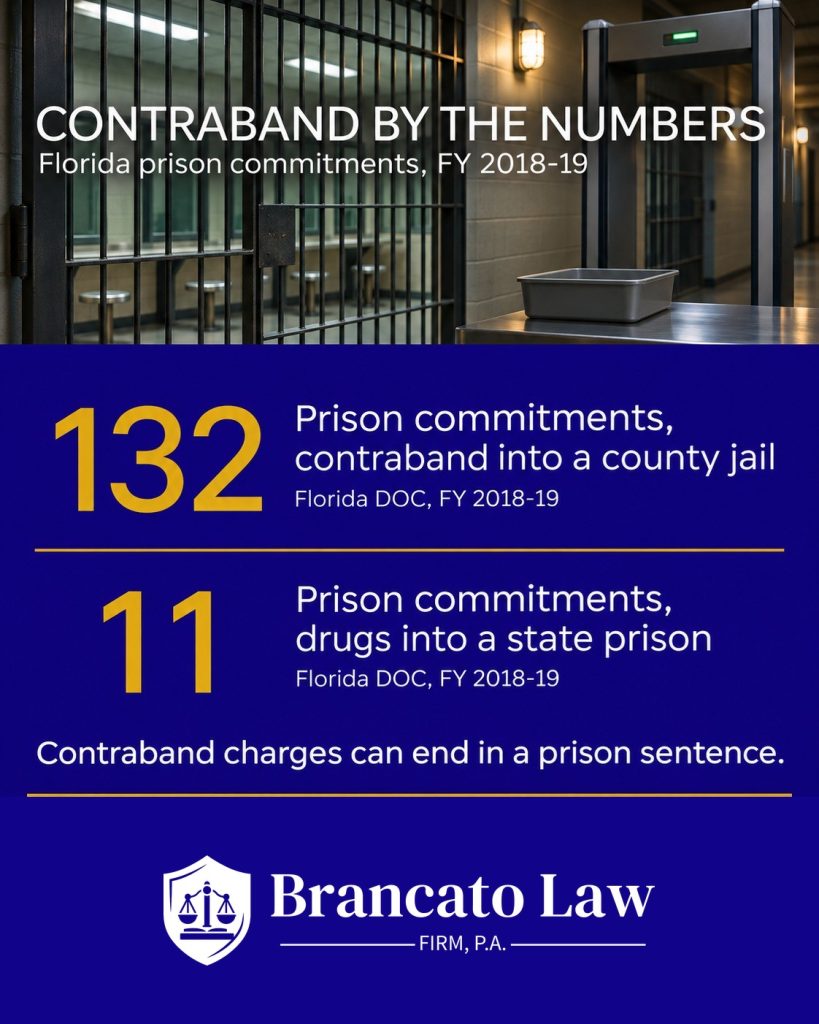
Contraband cases regularly end in prison. In fiscal year 2018-19, the Florida Department of Corrections recorded 132 new prison commitments for introducing contraband into a county detention facility and 11 new commitments for introducing a controlled substance into a state prison, according to the Florida Legislature’s Criminal Justice Impact Conference analysis of CS/SB 1286 (2020). Those figures count only people sentenced to state prison, so cases that ended in county jail time, probation, a diversion program, or a dismissal are not part of them.
What does the State have to prove in a Florida contraband case?
The State has to prove the person knowingly introduced or possessed an item on the contraband list, at a county detention facility or state correctional institution, without authorization through regular channels. Knowledge is the element that matters most. In Brown v. State, 150 So. 3d 281 (Fla. 1st DCA 2014), a man on work release in Escambia County was patted down coming back from his shift and a guard found a bag of marijuana in his pants pocket. He testified he had changed into pants other people could reach and did not know the bag was there.
The First District held that both introducing contraband and possessing it at a county jail “contemplate knowing and willful action,” and that “the state must prove and the jury must find that the defendant acted knowingly.” Because the jury was told it could convict for introduction without finding knowledge, the court reversed and ordered a new trial. The lesson is practical: an item someone else put in your clothing, a borrowed jacket, or a shared car can be a complete defense if the evidence supports it.
Can you be charged with contraband if police find drugs on you at the jail?
Yes. Florida courts have allowed introduction charges against arrestees when drugs the arresting officer missed are found during the jail search. In State v. Bendt, 711 So. 2d 1244 (Fla. 2d DCA 1998), an officer found a marijuana cigarette in a man’s pocket, asked whether he had any more drugs, and warned him he would be charged with introduction of contraband if he did. He said no, and a corrections officer later found a baggie of marijuana in his sock at the jail. The trial court dismissed the introduction count on Fifth Amendment grounds, but the Second District reinstated it, reasoning that he was charged because of the physical evidence found on him, not because of anything he said.
Bendt does not end the defense in a booking case. Knowledge still has to be proved under Brown, and the facts of each arrest matter: how thoroughly the officer searched at the scene, whether the person was asked about contraband and in what words, how long the person was in the patrol car, and whether anyone else had access to the clothing or the car. Our attorneys request the body camera video, the transport video, and the booking search records in every one of these cases. The arrest-to-booking process is covered in our Hillsborough County first appearance guide.
Can you be convicted of both drug possession and contraband for the same drugs?
Not always. In Desire v. State, 829 So. 2d 948 (Fla. 4th DCA 2002), a man was convicted of possession of cocaine and of introduction or possession of contraband at a county detention facility for the same bag. Because neither the jury instruction nor the verdict form separated introduction from possession, the jury may have convicted him of possessing the same cocaine twice, and the Fourth District reversed the possession conviction on double jeopardy grounds. Our attorneys check every contraband information and verdict form for this problem, because it can remove a conviction and points from the scoresheet.
How do our attorneys fight a contraband charge in Florida?
We fight contraband charges by attacking knowledge first, then the location, the item, and the charging theory. These are the defenses Florida law supports.
- No knowledge. The State must prove you knew the item was there. Shared clothing, borrowed bags, and items planted by others are real defenses under Brown.
- Not contraband. The item must be on the statute’s list. A prescription medication carried through regular channels, or a legal document exchanged with your lawyer, is not contraband; section 951.22(1)(a) expressly excludes legal correspondence.
- Authorized through regular channels. Items approved by the sheriff or the officer in charge are not contraband.
- Wrong facility or location. The item must be introduced into, or possessed on the grounds of, a covered facility. For cell phones, the device must be inside the secure perimeter.
- Illegal search. If the original stop or arrest was unlawful, a motion to suppress can remove the evidence and the arrest that brought you to the jail.
- Double jeopardy. Under Desire, two convictions for the same drugs can violate double jeopardy if the charging and verdict documents do not separate the conduct.
Why did Florida make cell phones prison contraband?
Florida added cell phones to the state prison contraband list after a 2008 government report flagged them as a growing problem. The Office of Program Policy Analysis and Government Accountability’s Report 08-20 (April 2008) found that Florida compared favorably with other states in controlling drugs in prisons, but that cell phones were “a growing problem” because inmates could use them to arrange escapes and orchestrate crime, and it suggested the Legislature revise the law so people who provide and use contraband phones could be prosecuted. Today, section 944.47(1)(a)6. makes it a third-degree felony to introduce a cell phone or other portable communication device inside the secure perimeter of a state prison without consent from the officer in charge, and section 951.22(1)(k) does the same for county jails.
The phone statutes contain their own defense. They apply to devices “intentionally and unlawfully introduced inside the secure perimeter,” so a phone left in a car in the visitor parking lot, or a device a visitor did not know was in a bag, raises a factual dispute about intent and location.
How are contraband cases handled in Hillsborough County?
In Hillsborough County, most contraband charges come from the jail search at booking, after an arrest by the Tampa Police Department, the Hillsborough County Sheriff’s Office, or another agency. The contraband count is added to whatever charge led to the arrest and is prosecuted by the State Attorney’s Office in the 13th Judicial Circuit. Visitors and jail employees face the same statute, and employee cases often draw an internal investigation before any charge is filed, which is when our pre-file advocacy does the most good.
Because a contraband count often rides along with a small drug or misdemeanor arrest, it can turn a case that qualified for diversion into a felony. Our attorneys look at whether the underlying charge and the contraband count can be resolved together through one of the Hillsborough County diversion programs, and we raise the knowledge and double jeopardy issues before the State files its information. Our guide to the Florida criminal case process explains each step from arrest to resolution, and our Hillsborough County criminal defense page covers the local courts.
Can contraband charges be dropped in Florida?
Yes. Contraband charges are dropped or reduced when the State cannot prove knowledge, when the item is not on the statutory list, when the underlying stop was unlawful, or when the contraband count duplicates a possession charge for the same item. Our attorneys gather the scene and booking video and the search records early, and present the knowledge problem to the prosecutor before the filing decision. In many booking cases, the realistic goal is to resolve the case on the original charge without the added felony.
Frequently asked questions about contraband charges in Florida
Is bringing a cell phone into a Florida jail a felony?
Yes. Intentionally and unlawfully bringing a cell phone or other portable communication device inside the secure perimeter of a county jail is a third-degree felony under section 951.22(1)(k). The Brancato Law Firm looks closely at the words “intentionally” and “secure perimeter,” because a phone forgotten in a pocket or left in a lobby locker raises a real defense.
Can a jail visitor be charged with introducing contraband?
Yes. The statutes apply to anyone who introduces contraband or gives it to an inmate, not only inmates. Our attorneys at The Brancato Law Firm defend visitors by examining what the visitor knew, what the jail’s posted rules allowed, and whether the item was ever inside the facility.
Is it contraband to bring prescription medication into jail?
It can be, if it is brought in outside regular channels. Section 951.22 lists drugs “of any kind or nature,” including sleeping pills, but jails have medical intake procedures for legitimate prescriptions. The Brancato Law Firm uses the booking medical records to show a prescription was disclosed and handled through the jail’s own process.
Can a corrections officer be charged with introducing contraband?
Yes, and the penalty is higher. Under section 944.47(2)(b), a state prison employee who uses the job to commit the offense is ranked one level higher on the Criminal Punishment Code chart. Our representation before charges are filed helps officers under internal investigation before the case goes to the State Attorney.
Is introducing contraband into a jail the same as drug possession?
No. They are separate statutes, but the same drugs can support both charges only if the conduct is separated properly. The Brancato Law Firm reviews the information and verdict form under Desire v. State to make sure a client is not convicted twice for one bag. Our drug crimes defense page explains the possession charge.
What should I do if I am charged with contraband after an arrest?
Do not discuss the search with jail staff or other inmates, and do not try to explain the item on a recorded jail call. The Brancato Law Firm will request the arrest and booking video right away, because the timeline from the street to the jail is usually the best evidence of what you knew.
For more about our defense strategies, visit our Drug Crimes page.
The video from the arrest, the patrol car, and the booking room is the evidence that decides most contraband cases, and some of it is overwritten on a schedule. Our attorneys will request it immediately and press the knowledge issue before the State files. Call The Brancato Law Firm, P.A., founded by Tampa Criminal Defense Attorney Rocky Brancato, at (813) 727-7159; you can call us at any hour. Our firm has Spanish-speaking staff, and attorney Jean-Luc Adrien speaks Spanish, Haitian Creole, and French. Our office is two blocks from the courthouse, and we defend contraband cases in Hillsborough, Pinellas, and Pasco counties.
The Brancato Law Firm, P.A.
620 E. Twiggs Street, Suite 205, Tampa, FL 33602
(813) 727-7159
Serving Hillsborough, Pinellas, and Pasco Counties
The Brancato Law Firm, P.A. is a Tampa-based criminal defense practice. We are not affiliated with any other Brancato-named law firms.
Visit Us

Tampa, FL 33602

Contact Us Now
Free Legal Consultation (813) 727-7159
