

From First DUI to Death Penalty



How to Fight a Contributing to the Delinquency of a Minor Charge in Florida? (2026)


To fight a contributing to the delinquency of a minor charge in Florida, the defense focuses on what the adult actually knew and did. Under section 827.04, the State must prove an act that caused, tended to cause, encouraged, or contributed to a child becoming delinquent, dependent, or a child in need of services, and Florida courts require proof that a person of common understanding would know the conduct would have that effect. The basic charge is a first-degree misdemeanor punishable by up to one year in jail and a $1,000 fine, while a person 21 or older who impregnates a child under 16 commits a third-degree felony under the same section.
Contributing cases are often charged the night of a party or a family blowup and decided months later on one question: what did the adult really know? I learned how these cases are built in the Major Crimes Unit, where I handled child abuse cases, and I have since tried more than 150 jury trials to verdict as founder of The Brancato Law Firm, P.A., a Tampa criminal defense firm with more than 25 years in Hillsborough County courtrooms. Our attorneys start by separating what the client did from what other adults or the teenager did, because the statute punishes only the defendant’s own knowing conduct.
What Is Contributing to the Delinquency of a Minor in Florida?
Contributing to the delinquency of a minor is the Florida crime of doing something that causes, tends to cause, encourages, or contributes to a child becoming a delinquent child, a dependent child, or a child in need of services, defined in section 827.04, Florida Statutes. The same subsection also covers anyone who “Induces or endeavors to induce, by act, threat, command, or persuasion,” a child to act or live in a way that tends to make the child delinquent, dependent, or in need of services. Our Tampa child abuse attorney team defends these charges because they sit in the same chapter of Florida law as child abuse and neglect.
The statute reaches three different outcomes for the child. “Delinquent” refers to a child who commits a crime, “dependent” generally refers to a child who is abused, abandoned, or neglected under chapter 39, and a “child in need of services” covers problems such as chronic truancy and running away. In State v. Fuchs, 769 So. 2d 1006 (Fla. 2000), an Osceola County mother was charged after police repeatedly found her 11-year-old son home alone overnight with his four- and five-year-old sisters. The Florida Supreme Court rejected her vagueness challenge and held that these words are terms of art defined in chapters 39, 984, and 985, so “section 827.04(1)(a) is not unconstitutionally vague.”
What Are the Penalties for Contributing to the Delinquency of a Minor?
Contributing to the delinquency of a minor is a first-degree misdemeanor, punishable by up to one year in jail and a $1,000 fine under section 775.082 and section 775.083. The impregnation provision in subsection (3) is a third-degree felony, punishable by up to five years in prison and a $5,000 fine.
| Subsection | Conduct | Degree and maximum |
|---|---|---|
| 827.04(1)(a) | Any act that causes, tends to cause, encourages, or contributes to a child becoming delinquent, dependent, or a child in need of services | First-degree misdemeanor: up to 1 year in jail and a $1,000 fine |
| 827.04(1)(b) | Inducing or trying to induce a child, by act, threat, command, or persuasion, to act or live in a way that tends to make the child delinquent, dependent, or in need of services | First-degree misdemeanor: up to 1 year in jail and a $1,000 fine |
| 827.04(3) | A person 21 or older who impregnates a child under 16; consent and “lack of chastity” are not defenses | Third-degree felony: up to 5 years in prison and a $5,000 fine |
Two procedural rules in subsection (2) surprise many clients. The State does not need any juvenile court to have declared the child delinquent, dependent, or in need of services before charging the adult, and a juvenile adjudication of the child does not bar a later prosecution of the adult. The adult’s case stands on its own evidence.
What Must Prosecutors Prove?
Prosecutors must prove that the defendant’s own conduct, done with the required knowledge, tended to cause or encourage the child’s delinquency, dependency, or need for services. The Florida Supreme Court set the knowledge standard in State v. Shamrani, 370 So. 2d 1 (Fla. 1979), holding that the acts must be done “under such circumstances that a person of common understanding would know” they would cause, tend to cause, encourage, or contribute to the child’s delinquency or dependency. That standard is the center of most defenses.
| Scenario | What the State usually claims | Defense question |
|---|---|---|
| Teen party with alcohol or marijuana | The adult supplied, allowed, or encouraged underage drinking or drug use | Who supplied it, and did the defendant know it was happening? |
| Young children left alone | The parent left children unsupervised in a way that tends to make them dependent | How old were the children, how long, and what arrangements existed? |
| Truancy or running away | The adult encouraged the child to skip school or leave home | Did the adult encourage it, or only fail to stop a teenager’s choices? |
| Relationship with a teenager | The adult’s conduct encouraged delinquent behavior | Is the evidence of the adult’s conduct, or of the teen’s own acts? |
How Do Our Attorneys Fight a Contributing to the Delinquency of a Minor Charge?
Our attorneys fight contributing charges by holding the State to proof of the client’s own knowing conduct and by testing whether that conduct had any real tendency to cause the outcome charged. These are the defenses we raise most often.
- No knowledge. In Kito v. State, 888 So. 2d 114 (Fla. 4th DCA 2004), a 16-year-old spent almost every day at a man’s house, drinking alcohol his wife supplied and smoking marijuana her boyfriend brought, while the man was usually at work. The Fourth District reversed his conviction because the State “failed to show Kito had any actual knowledge that the Minor was consuming drugs or alcohol in his home,” and his presence at home a few times did not prove the required culpability.
- Someone else did it. At a party or in a shared home, several adults may be present. Our attorneys identify who bought, poured, or handed over alcohol or drugs, using receipts, texts, social media, and witness interviews, because guilt by presence is not enough.
- No tendency to cause delinquency or dependency. The State has to tie the act to one of the outcomes defined in Florida’s juvenile statutes. Ordinary parenting decisions, a single lapse, or a reasonable supervision plan may not meet that standard, and our attorneys present the full context.
- The person was not a child. The definitions the statute borrows apply to children under 18. Our attorneys confirm the person’s age and the State’s proof of it.
- Charging the wrong offense. Alcohol cases may belong under a more specific law, such as the open house party statute in section 856.015 or the ban on giving alcohol to anyone under 21 in section 562.11, each with its own elements. Our attorneys check whether the State chose the charge that fits the evidence.
- Negotiation and diversion. Many first-time contributing cases can be resolved without a conviction through dismissal, a withhold of adjudication, or a diversion agreement, which matters for anyone who works with children or holds a professional license.
Why Do Prosecutors Treat Supplying Alcohol to Teens So Seriously?
Prosecutors point to research linking adult-supplied alcohol to teen drinking problems. A prospective cohort study by Richard Mattick and colleagues, published in The Lancet Public Health in 2018, followed 1,927 adolescents for six years and found that teens supplied alcohol only by their parents had 2.58 times the odds of later binge drinking compared with teens who had no supply. The authors concluded there is “no evidence” that parental supply protects children from harmful drinking.
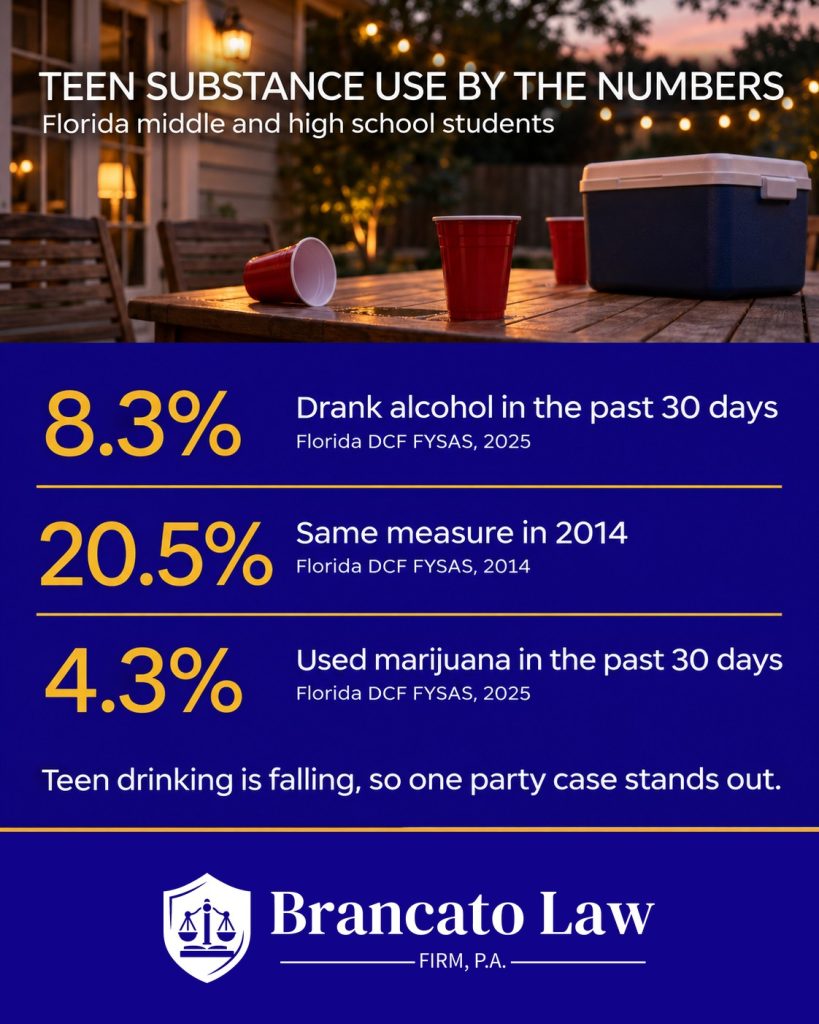
Underage drinking in Florida has fallen sharply, which can make a single party case stand out. Among Florida middle and high school students combined, past-30-day alcohol use fell from 20.5% in 2014 to 8.3% in 2025, and past-30-day marijuana use fell from 12.4% to 4.3%, according to the 2025 Florida Youth Substance Abuse Survey published by the Florida Department of Children and Families. In our experience, those cases often begin with a parent’s complaint or a school resource officer’s report rather than a patrol stop.
How Are Contributing Cases Handled in Hillsborough County?
In Hillsborough County, a misdemeanor contributing charge is prosecuted in county court, while the felony impregnation charge under subsection (3) goes to circuit court in the 13th Judicial Circuit. A person arrested who does not bond out sees a judge at first appearance, held every day of the year by video from the jail, as our guide to Hillsborough first appearance explains.
These cases often run alongside a DCF investigation or a family court matter, especially when the theory is dependency rather than delinquency. Our Hillsborough County criminal defense attorneys coordinate the criminal defense with any DCF case so that statements made in one do not damage the other. Our post on Florida alcohol offenses covers the related underage drinking laws.
What Should You Do If You Are Under Investigation?
You should not give a statement to police or a DCF investigator about the child before speaking with a defense attorney. Explanations like “I knew they were drinking, but I took their keys” can supply the knowledge element the State otherwise lacks. Our attorneys provide representation before charges are filed and can present context to the prosecutor before a charging decision.
Each stage of the Florida criminal case process has deadlines, and party photos, messages, and receipts are easiest to preserve in the first days.
Frequently Asked Questions About Contributing to the Delinquency of a Minor in Florida
Can a contributing to the delinquency of a minor charge be dropped in Florida?
Yes. Prosecutors can drop the charge when the evidence does not show the defendant knew about the conduct, when someone else supplied the alcohol or drugs, or when the client completes a diversion agreement. The Brancato Law Firm presents that evidence early, sometimes through pre-file advocacy before a charge is filed.
Is giving alcohol to a 17-year-old contributing to the delinquency of a minor in Florida?
It can be charged that way, because a child’s underage drinking can be treated as conduct tending toward delinquency, and separate laws also make it a crime to give alcohol to anyone under 21. Our attorneys at The Brancato Law Firm review who supplied the alcohol and what the client knew, as in Kito v. State, where a conviction was reversed for lack of knowledge.
Can a parent be charged with contributing to the delinquency of their own child?
Yes. The statute applies to “Any person,” including parents, and a parent can be charged on a dependency theory for conduct such as leaving young children alone. The Brancato Law Firm works with clients to show the supervision arrangements and context that the police report leaves out.
Does the State have to prove my child was declared delinquent?
No. Section 827.04(2) says no juvenile court adjudication is needed to prosecute the adult, and an adjudication of the child does not prevent a later prosecution. The Brancato Law Firm focuses instead on the State’s proof of the adult’s own acts and knowledge.
Will a contributing conviction affect my job or license?
It can, because the offense sits in the child abuse chapter of Florida law and may appear on background screenings for jobs involving children. Our child abuse defense lawyers in Tampa at The Brancato Law Firm aim for a dismissal or withhold of adjudication that keeps sealing available.
Is contributing to the delinquency of a minor a felony in Florida?
Usually no; the basic offense is a first-degree misdemeanor. The exception is subsection (3), which makes it a third-degree felony for a person 21 or older to impregnate a child under 16, and The Brancato Law Firm defends those felony cases alongside any related sex offense charges.
For more about our defense strategies, visit our Child Abuse page.
Our attorneys can start by reviewing the arrest report and preserving the party photos, messages, and receipts that show who did what. Call The Brancato Law Firm, P.A., founded by Tampa Criminal Defense Attorney Rocky Brancato, at (813) 727-7159; you can call us at any hour, and our office is two blocks from the courthouse. Our firm has Spanish-speaking staff, and attorney Jean-Luc Adrien speaks Spanish, Haitian Creole, and French.
The Brancato Law Firm, P.A.
620 E. Twiggs Street, Suite 205, Tampa, FL 33602
(813) 727-7159
Serving Hillsborough, Pinellas, and Pasco Counties
The Brancato Law Firm, P.A. is a Tampa-based criminal defense practice. We are not affiliated with any other Brancato-named law firms.
Visit Us

Tampa, FL 33602

Contact Us Now
Free Legal Consultation (813) 727-7159
