

From First DUI to Death Penalty



How to Fight a Conspiracy Charge in Florida (2026)


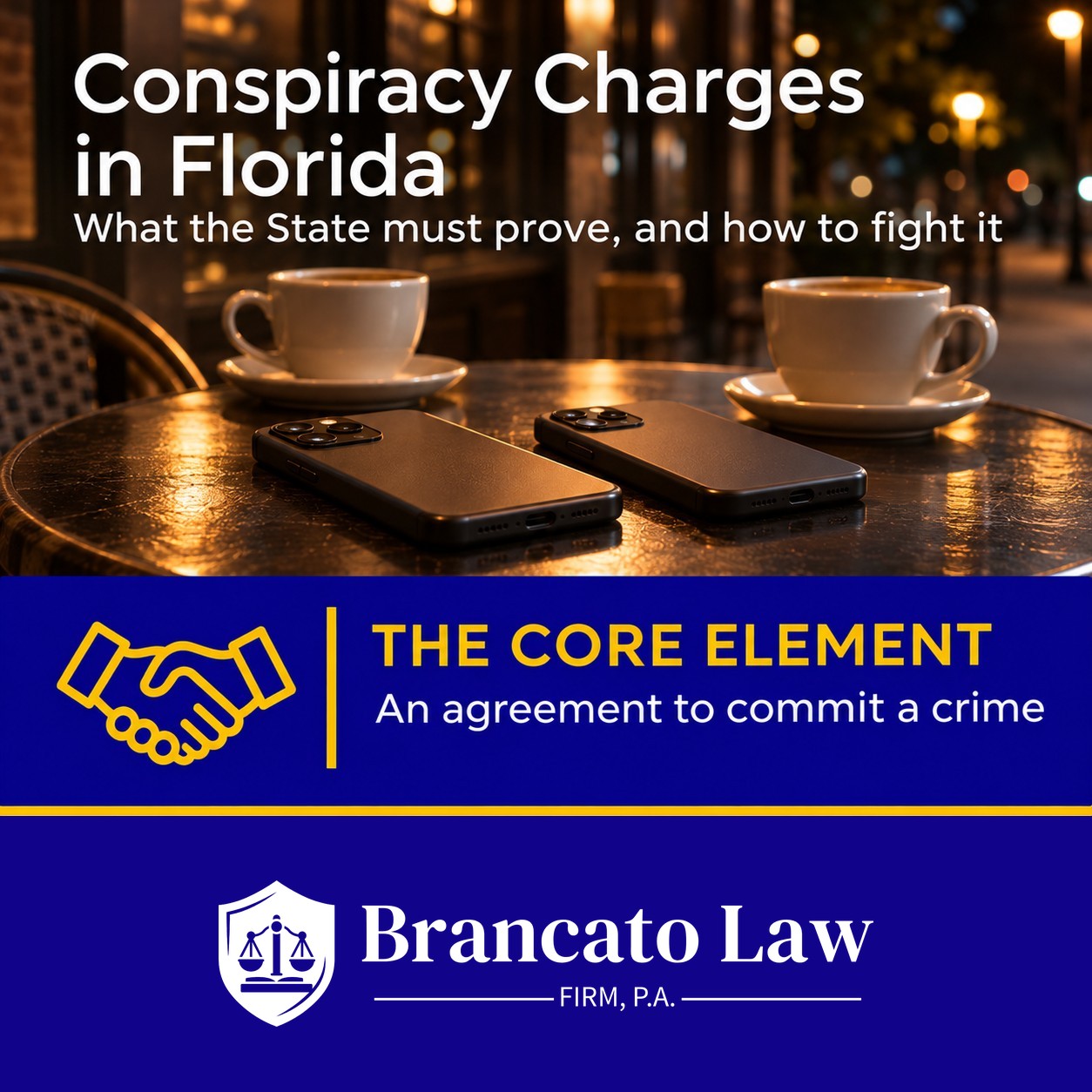
To fight a conspiracy charge in Florida, the defense attacks the agreement. Under section 777.04(3), Florida Statutes, criminal conspiracy is agreeing with one or more other people to commit a crime, and the State must prove both an express or implied agreement and an intent to commit a specific offense. Common defenses are that there was no real agreement, that the only other party was an undercover officer or informant, and that the defendant voluntarily renounced the plan and prevented the crime. Conspiracy is usually punished one level below the planned crime, but conspiracy to traffic drugs is a first-degree felony punished as if the trafficking had been committed.
Prosecutors file conspiracy charges when they can prove a conversation but not a completed crime, or when they want to reach everyone who talked about a plan. As founder of The Brancato Law Firm, P.A., a Tampa criminal defense firm, and a former Chief Operations Officer of the Hillsborough County Public Defender’s Office, where I oversaw a staff of over 100 attorneys, I have watched conspiracy counts get added to drug, robbery, and fraud cases throughout more than 25 years in Hillsborough County courtrooms. Our attorneys defend them by taking apart the recordings, texts, and informant testimony the State uses to claim there was an agreement.
What is criminal conspiracy in Florida?
Criminal conspiracy is an agreement between two or more people to commit a crime. Section 777.04(3), Florida Statutes says a person “who agrees, conspires, combines, or confederates with another person or persons to commit any offense” commits criminal conspiracy. The statute applies to any offense, felony or misdemeanor.
The crime is the agreement itself. The statute’s text describes no requirement that the planned crime be completed, so a person can be convicted of conspiracy to commit a robbery or a drug deal that never took place. When the crime does happen, the State often charges both, and Florida courts allow it. In Turner v. State, 402 So. 3d 1162 (Fla. 3d DCA 2025), the Third District affirmed a getaway driver’s convictions for both armed robbery and conspiracy to commit armed robbery.
Conspiracy charges are common. Professor Neal Kumar Katyal’s article Conspiracy Theory, 112 Yale L.J. 1307 (2003) reports that over one-quarter of all federal criminal prosecutions, and a large number of state cases, involve conspiracy charges.
What must the State prove to convict you of conspiracy?
The State must prove an agreement and an intention to commit a particular crime. The Second District, which hears appeals from Hillsborough, Pinellas, and Pasco Counties, stated the rule this way in Massad v. State, discussed below: “The crime of conspiracy consists of an express or implied agreement between two or more persons to commit a criminal offense.” Showing that people intended to work together is not enough; they must have combined to accomplish an act that is itself a crime.
The agreement does not have to be written or spoken in so many words. Prosecutors usually try to prove an implied agreement from conduct: repeated calls before a deal, a shared car, a lookout’s position, money that changed hands. That is why conspiracy trials are often decided by how the jury reads text messages and recorded calls, and why the defense works to show the other explanations for the same facts.
| What the State shows | Is that a conspiracy? |
|---|---|
| Two people agree to commit a specific crime, by words or by coordinated conduct | Yes, under s. 777.04(3) |
| People talk about a plan that involves nothing illegal | No; the agreement must be to commit a crime |
| You knew a friend planned a crime but never agreed to take part | No; knowledge alone is not agreement |
| Your only partner was an undercover officer or informant who was to do the essential act | No, under King v. State |
| You agreed, then persuaded the others to stop or otherwise prevented the crime | Defense of renunciation, s. 777.04(5) |
Can you be convicted of conspiring with an undercover officer or informant?
Not when the government agent is your only partner and was supposed to carry out the essential part of the crime. In King v. State, 104 So. 2d 730 (Fla. 1957), an agent working for the Miami Crime Commission set up a bookmaking operation with public funds to catch police officers taking bribes, and Miami police officers were charged with conspiring to protect it for payment. The Florida Supreme Court held that when people conspire with someone who is, unknown to them, a government agent acting in the line of duty, and an essential part of the offense is to be performed only by that agent, they may not legally be convicted of conspiracy. The Court reversed and ordered a new trial.
The rule is narrow. When two or more real participants agree with each other, the presence of an informant in the deal does not erase their agreement. In sting cases, our attorneys look first at who actually agreed with whom and what each person was supposed to do, and then at whether the government created the crime, which raises the separate entrapment defense. Many conspiracy cases also depend on a cooperating witness, and our guide to confidential informants in your Tampa criminal case explains how to challenge one.
How did the Second District apply the agreement rule in a Pasco County case?
The Second District reversed a conspiracy conviction in Massad v. State, No. 2D21-0849 (Fla. 2d DCA July 15, 2022), because the State proved a conversation but not an agreement to commit a crime. Dale Massad, a former mayor of Port Richey, was in the Pasco County Jail on other charges when he called the city’s acting mayor about a police officer who had helped investigate him. On the recorded jail call, Massad said, “So anything you can do is good,” and the acting mayor said someone had to answer for it. The State charged Massad with conspiring to obstruct justice falsely under color of law.
The appellate court held the evidence was insufficient. The acting mayor’s only action was requesting the officer’s personnel and arbitration files, which the State stipulated were public records, and he had requested them before the call. There was no evidence of the underlying crime and no evidence of an agreement to use the records to intimidate or retaliate against the officer. The court reversed with instructions to vacate the judgment and sentence.
The lesson reaches well beyond politics. Jail calls, texts, and recorded conversations often sound bad out of context. A conspiracy charge still requires proof that the people agreed to commit a particular crime, and our attorneys hold the State to that proof in a motion for judgment of acquittal and on appeal.
Is conspiracy to traffic drugs punished the same as trafficking?
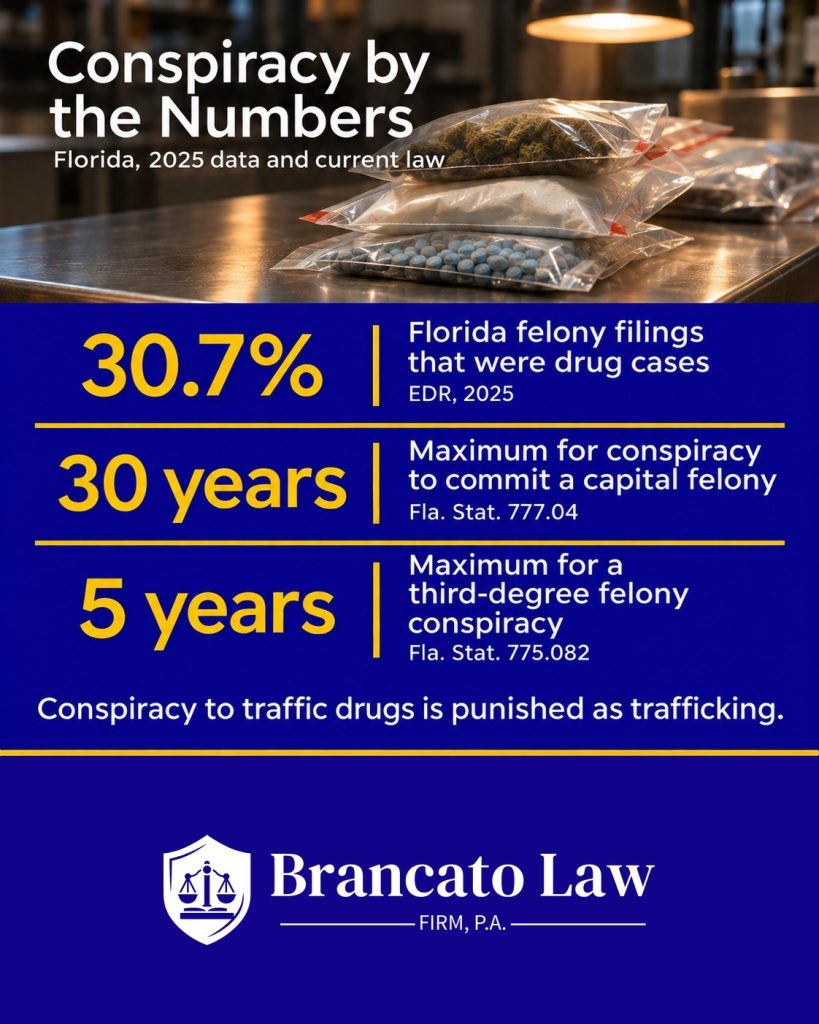
Yes. Under section 893.135(5), Florida Statutes, anyone who agrees, conspires, combines, or confederates with another person to commit a trafficking offense commits a first-degree felony and “is punishable as if he or she had actually committed such prohibited act.” The same subsection allows separate convictions and sentences for the conspiracy and for the trafficking itself.
That means the mandatory minimum prison terms for the drug and weight involved apply to conspiracy as well. Our guides on drug trafficking in Florida and how to defend against a fentanyl trafficking charge set out those minimums. On our Tampa drug crimes attorney page, we explain how our firm handles these cases from the first day of an investigation.
Drug cases make up a large share of what Florida courts handle. Drug filings were 30.7 percent of all felony filings in Florida in 2025, according to the Legislature’s Office of Economic and Demographic Research in its July 2026 Criminal Justice Trends report. Large drug investigations in our area routinely produce multi-defendant cases. In March 2025, the Hillsborough County Sheriff’s Office announced 33 arrests after a six-month investigation with FDLE and the DEA, with most suspects facing trafficking charges and 11 facing racketeering (RICO) charges. In cases like that, the State’s theory of who agreed with whom decides each defendant’s exposure.
What are the penalties for conspiracy in Florida?
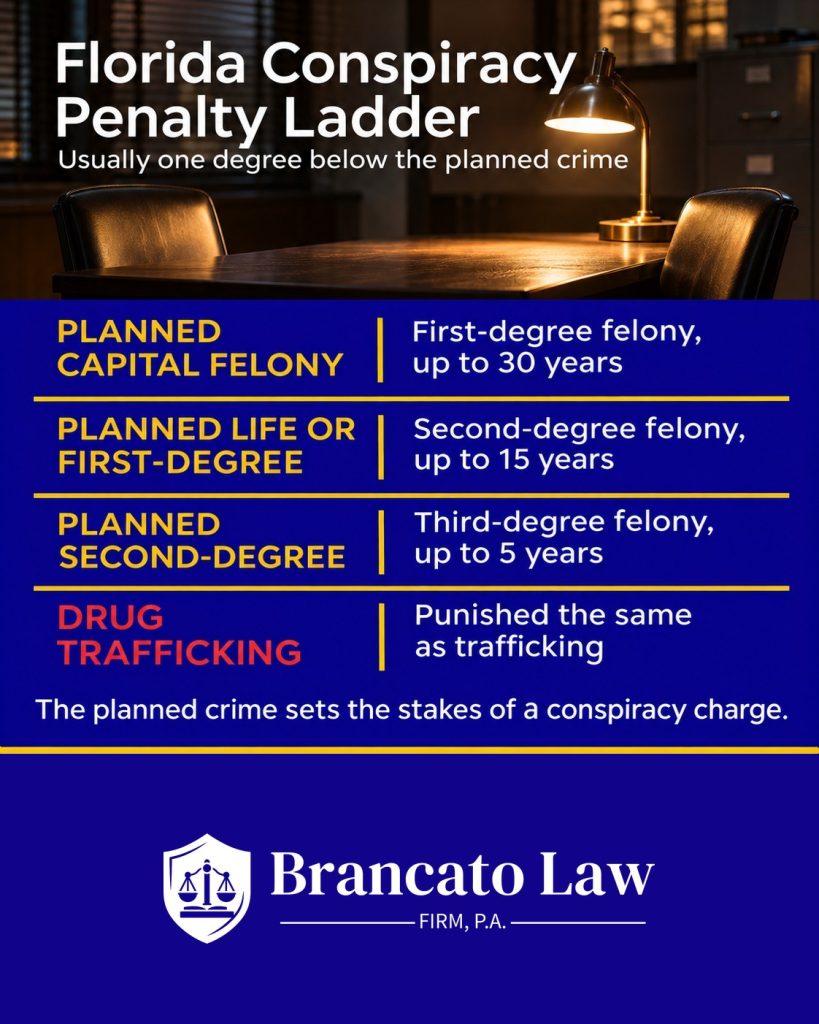
Outside of drug trafficking and a few other listed offenses, conspiracy is generally one degree below the crime the defendants agreed to commit. Section 777.04(4) sets the degree, and section 775.082, Florida Statutes and section 775.083 set the maximums.
| Crime the defendants agreed to commit | Conspiracy charge | Maximum prison or jail | Maximum fine |
|---|---|---|---|
| Capital felony | First-degree felony | 30 years | $10,000 |
| Life or first-degree felony (not drug trafficking) | Second-degree felony | 15 years | $10,000 |
| Drug trafficking under s. 893.135(1) | First-degree felony, punished as trafficking | Same as trafficking, including mandatory minimums | Same as trafficking |
| Second-degree felony, third-degree burglary, or third-degree felony ranked level 3 to 10 | Third-degree felony | 5 years | $5,000 |
| Other third-degree felony | First-degree misdemeanor | 1 year | $1,000 |
| First- or second-degree misdemeanor | Second-degree misdemeanor | 60 days | $500 |
For scoresheet purposes, section 777.04(4) generally ranks a conspiracy one level below the planned offense, except for the offenses the statute lists, including drug trafficking.
Can you withdraw from a conspiracy in Florida?
Yes, but walking away is not enough. Section 777.04(5) makes it a defense if, under circumstances showing a complete and voluntary renunciation of your criminal purpose, you persuaded the others not to commit the crime or otherwise prevented it.
The words “complete and voluntary” matter. Backing out because police showed up, or putting the plan off until a better time, does not fit the statute. Persuading the others to drop the plan, or telling someone in a position to stop it, can. The defense is fact-heavy, and our attorneys build it from the same texts and calls the State relies on.
How do our attorneys fight a conspiracy charge?
Our firm attacks the agreement, the parties, and the proof. The work usually includes:
- Listening to every recording and reading every message in full, because conspiracy cases are often built on excerpts.
- Separating knowledge from agreement. Knowing what a friend planned is not agreeing to it.
- Identifying who the real parties were. If the only other party was a government agent who was to perform the essential act, King bars a conspiracy conviction.
- Testing whether the agreed act was actually a crime, as in Massad.
- Challenging informants and cooperating codefendants on what they were promised for their testimony.
- Raising renunciation under section 777.04(5) when the facts support it.
- Making specific motions for judgment of acquittal so every issue is preserved for appeal.
What should you do if you are under investigation for conspiracy?
Stop discussing the case on the phone, by text, or on jail calls, and talk to a criminal defense attorney before you speak with detectives. Conspiracy investigations usually run for weeks or months before any arrest, using controlled calls, informants, and phone records, so the person under investigation is often the last to know. The investigation stage is the first step in the Florida criminal case process, and it is when the State decides whom to charge and with what.
Our representation before charges are filed is a staple of our practice. Nearly every month, cases never get filed because of our firm’s front-end advocacy, and our attorneys decide case by case what, if anything, to give detectives.
Frequently asked questions about conspiracy charges in Florida
Can you be convicted of conspiracy if the crime never happened?
Yes. Under section 777.04(3), the crime is the agreement itself, so the State can convict on conspiracy even if the planned offense was never carried out. The Brancato Law Firm focuses these defenses on whether there was ever a real agreement to commit a specific crime, the issue that won reversal in Massad v. State.
Can you be charged with both conspiracy and the crime itself in Florida?
Yes. Florida allows separate convictions for conspiracy and the completed offense, and section 893.135(5) says so expressly for drug trafficking. Our attorneys at The Brancato Law Firm look for ways to collapse those counts in negotiations, because two convictions mean two sentences on the scoresheet.
Is conspiracy a felony in Florida?
Usually. Conspiracy to commit a felony is generally a felony one degree lower, conspiracy to traffic drugs is a first-degree felony, and conspiracy to commit a lower-level third-degree felony or a misdemeanor is a misdemeanor. The Brancato Law Firm checks the degree and severity ranking of every conspiracy count at the outset, as explained on our drug crimes defense page.
Can text messages or phone calls prove a conspiracy?
They can be used to try. Prosecutors often argue that messages show an implied agreement, but messages read out of context frequently show only talk, knowledge, or a deal on someone else’s side. Our attorneys at The Brancato Law Firm review every message in full and challenge how the State obtained them, including any search of your phone.
Does a conspiracy need more than two people?
No. Section 777.04(3) requires an agreement with “another person or persons,” so two people are enough. The Brancato Law Firm checks whether the second person was a government agent or informant, because under King v. State that can defeat the charge.
Can conspiracy charges be dropped in Florida?
Yes. Prosecutors drop or reduce conspiracy counts when the recordings do not show a clear agreement, when the main witness is an informant with credibility problems, or when the conspiracy count adds nothing to a stronger substantive charge. The Brancato Law Firm raises those weaknesses with prosecutors early, often through pre-file advocacy.
For more about our defense strategies, visit our Drug Crimes page.
Conspiracy investigations often run for months before an arrest, and what you say during that time can become the State’s proof of an agreement. Our attorneys will start by finding out what the State has and keeping you from adding to it. Call The Brancato Law Firm, P.A., founded by Tampa Criminal Defense Attorney Rocky Brancato, at (813) 727-7159; you can call us at any hour. Our firm has Spanish-speaking staff, and attorney Jean-Luc Adrien speaks Spanish, Haitian Creole, and French.
The Brancato Law Firm, P.A.
620 E. Twiggs Street, Suite 205, Tampa, FL 33602
(813) 727-7159
Serving Hillsborough, Pinellas, and Pasco Counties
The Brancato Law Firm, P.A. is a Tampa-based criminal defense practice. We are not affiliated with any other Brancato-named law firms.
Visit Us

Tampa, FL 33602

Contact Us Now
Free Legal Consultation (813) 727-7159
